
In the realm of energy storage, li ion battery technology has emerged as a cornerstone due to its high energy density, long cycle life, and versatility in applications ranging from portable electronics to electric vehicles. As the demand for higher performance li ion battery systems grows, the search for advanced anode materials beyond conventional graphite has intensified. Among these, silicon-based anodes stand out owing to their exceptionally high theoretical specific capacity, which is approximately ten times that of graphite. However, the commercialization of silicon-based anodes in li ion battery configurations is hindered by significant challenges, primarily the substantial volume expansion during lithiation and delithiation processes. This volume change leads to mechanical degradation, unstable solid electrolyte interphase (SEI) formation, and rapid capacity fading. In this comprehensive review, I will delve into the fundamental principles, ongoing challenges, and recent advancements in silicon-based anodes for li ion battery applications, with a focus on structural design, binder development, and electrolyte additives. I will also incorporate tables and formulas to summarize key findings and provide a forward-looking perspective on the future of this promising technology.
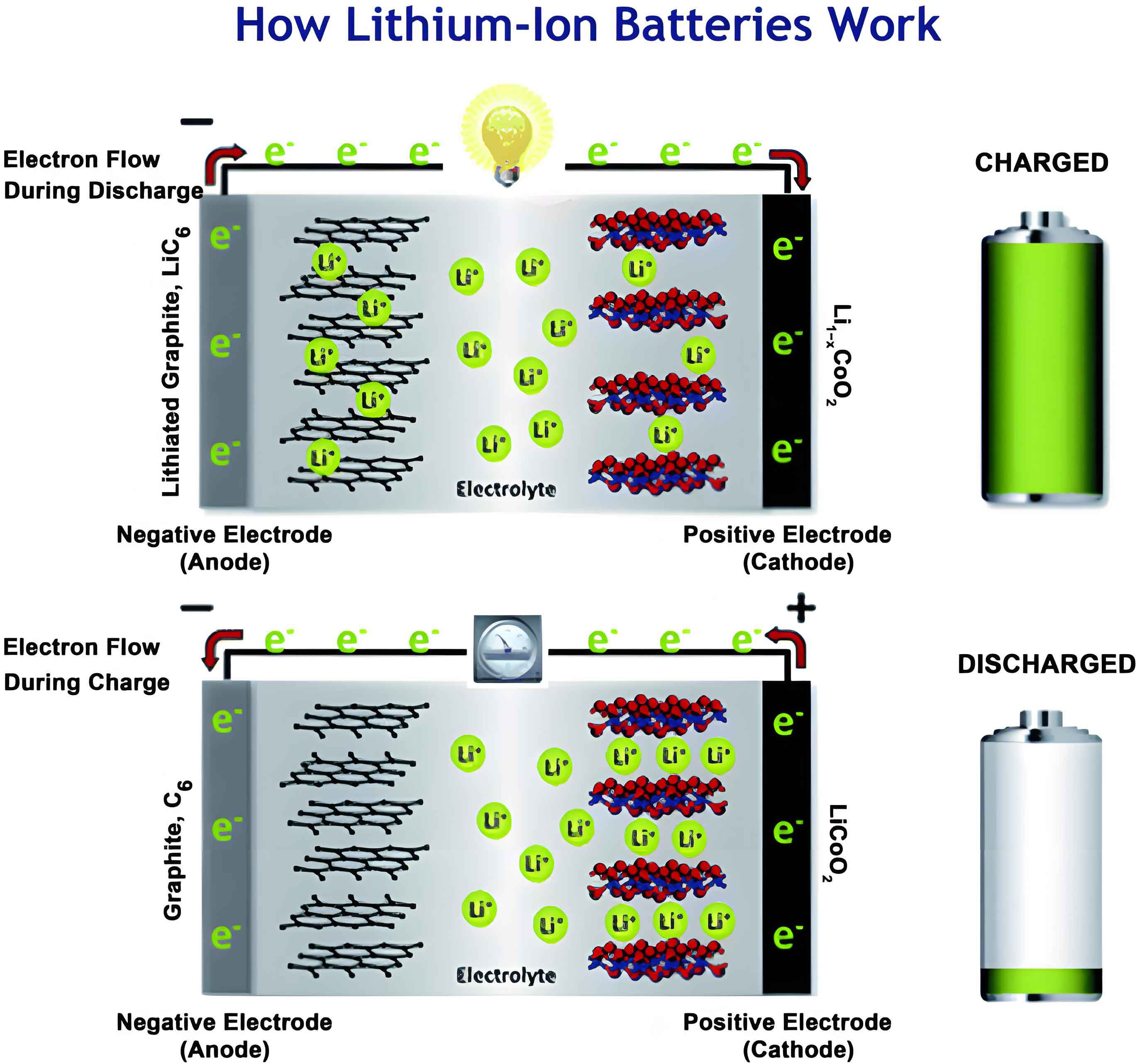
The working principle of silicon-based anodes in a li ion battery revolves around an alloying mechanism with lithium. The electrochemical reaction can be expressed as:
$$Si + xLi^+ + xe^- \rightleftharpoons Li_xSi$$
Under ideal conditions, this process involves multiple phase transformations, but at room temperature, it primarily results in the formation of amorphous LixSi phases. Upon full lithiation to Li4.4Si, silicon undergoes a volume expansion of about 420%, which is linear with lithium concentration. This expansion is a critical issue in li ion battery performance, as it induces stress within the electrode, leading to particle pulverization and loss of electrical contact. Similarly, silicon monoxide (SiO) anodes, another silicon-based variant, exhibit a theoretical capacity of around 2043 mAh/g and undergo a more complex reaction mechanism:
$$SiO + 2Li^+ + 2e^- \rightarrow Si + Li_2O$$
$$4SiO + 4Li^+ + 4e^- \rightarrow 3Si + Li_4SiO_4$$
$$5SiO + 2Li^+ + 2e^- \rightarrow 3Si + Li_2Si_2O_5$$
$$7SiO + 6Li^+ + 6e^- \rightarrow 5Si + Li_6Si_2O_7$$
$$3SiO + 2Li^+ + 2e^- \rightarrow 2Si + Li_2SiO_3$$
$$Si + xLi^+ + xe^- \rightleftharpoons Li_xSi$$
While SiO anodes show reduced volume expansion (~200%) due to the formation of buffering lithium silicates, they suffer from lower initial coulombic efficiency caused by irreversible phases. These fundamental reactions underscore the inherent trade-offs in silicon-based anodes for li ion battery systems.
The challenges associated with silicon-based anodes in li ion battery applications are multifaceted. The volumetric changes during cycling not only cause active material fragmentation but also lead to continuous SEI growth. As the SEI breaks and reforms, it consumes active lithium ions and increases interfacial resistance, thereby diminishing the cycle life of the li ion battery. Additionally, the destruction of the conductive network within the electrode further exacerbates capacity fade. To address these issues, researchers have pursued various strategies, which I will categorize into three main areas: structural design and modification of silicon materials, development of advanced binders, and optimization of electrolyte additives. Each approach aims to enhance the stability and performance of silicon-based anodes in li ion battery configurations.
Structural design and modification of silicon-based materials are pivotal in mitigating volume expansion effects. Nanostructuring has been widely explored to shorten lithium-ion diffusion paths and alleviate mechanical stress. For instance, silicon nanoparticles, nanowires, and porous nano-silicon structures have demonstrated improved cyclic stability. The performance of different nanostructures can be summarized in the following table:
| Nanostructure Type | Preparation Method | Key Advantages | Typical Capacity (mAh/g) | Cycling Performance |
|---|---|---|---|---|
| Nanoparticles | High-energy mechanical milling | Short diffusion distance, high surface area | ~1200 | 100 cycles with <3% decay |
| Nanowires | Vapor-liquid-solid growth | Uniaxial electron transport, stress relaxation | ~2000 | Enhanced stability due to directional expansion |
| Porous Nano-silicon | Magnesiothermic reduction | 3D interconnected pores, high tap density | ~2000 | Good rate capability at high currents |
| Disproportionated SiO | Mechanical milling and heat treatment | Si nanoparticles embedded in SiOx matrix | ~1000 | Buffered volume expansion |
Despite these benefits, nanostructuring often increases production costs and reduces tap density, which may limit the practical energy density of li ion battery cells. Therefore, composite approaches with carbon materials have gained prominence. Carbon coating or embedding silicon in carbon matrices enhances conductivity and provides mechanical support. Common structures include core-shell, yolk-shell, and pomegranate-like designs. The carbon component can be derived from polymers, graphene, or other carbon sources, and its role can be quantified by the following relationship for composite performance:
$$C_{composite} = f_{Si} \cdot C_{Si} + f_{C} \cdot C_{C}$$
where \(C_{composite}\) is the specific capacity of the composite, \(f_{Si}\) and \(f_{C}\) are the mass fractions of silicon and carbon, and \(C_{Si}\) and \(C_{C}\) are their respective theoretical capacities. In practice, the carbon phase often contributes minimally to capacity but significantly to stability. For example, silicon-carbon composites with graphene show capacities up to 1244 mAh/g and volume expansion as low as 67%, compared to 113% for bare SiO. Moreover, metal oxide coatings, such as TiO2 or Al2O3, offer rigid layers that suppress side reactions and volume change. Amorphous TiO2-coated silicon anodes have demonstrated capacity retention of 81% after 3000 cycles at high current densities, highlighting their potential in durable li ion battery systems.
Another critical aspect in advancing silicon-based anodes for li ion battery applications is the development of specialized binders. Traditional binders like polyvinylidene fluoride (PVDF) are insufficient due to weak van der Waals interactions that fail to maintain electrode integrity during volume changes. Instead, binders with strong adhesion, flexibility, and sometimes conductivity are required. A comparison of binder types is presented below:
| Binder Type | Examples | Key Features | Impact on Si Anode Performance |
|---|---|---|---|
| Conventional | CMC, PAA | High carboxyl group density, forms chemical bonds with Si | Improved cycle life, but may require conductive additives |
| Biopolymer | Alginate, chitosan, DNA-based | Eco-friendly, multifunctional groups, good adhesion | Enhanced stability, e.g., alginate-based anodes retain 1700 mAh/g over 100 cycles |
| Conductive Polymer | PANI, PEDOT:PSS composites | Inherent conductivity, reduces need for extra conductive agents | High rate capability, e.g., PANI-based anodes show 90% capacity retention after 5000 cycles |
| Composite | CMC/PEDOT:PSS blends | Combines adhesion and conductivity | Superior rate and cycle performance compared to single binders |
The effectiveness of binders can be described by their ability to maintain electrode cohesion, which influences the overall impedance of the li ion battery. For instance, binders with elastic properties can accommodate volume changes, as modeled by the strain energy dissipation:
$$U = \frac{1}{2} k (\Delta V)^2$$
where \(U\) is the energy absorbed by the binder, \(k\) is the elastic constant, and \(\Delta V\) is the volume change. Higher \(k\) values indicate better stress tolerance, crucial for long-term cycling in li ion battery anodes. Recent innovations include self-healing binders that repair cracks during cycling, further extending the lifespan of silicon-based electrodes in li ion battery configurations.
Electrolyte additives play a vital role in stabilizing the SEI on silicon-based anodes in li ion battery systems. Additives such as fluoroethylene carbonate (FEC) and vinylene carbonate (VC) decompose prior to the base electrolyte, forming a robust and flexible SEI rich in LiF or polymeric species. This SEI layer helps mitigate continuous electrolyte decomposition and lithium ion loss. The reduction reactions of common additives can be represented as:
$$FEC + Li^+ + e^- \rightarrow LiF + \text{polymeric species}$$
$$VC + Li^+ + e^- \rightarrow \text{poly(VC)} + \text{other products}$$
These reactions contribute to a more stable interface, enhancing the coulombic efficiency and cycle life of li ion battery cells. Moreover, synergistic effects from multiple additives, such as VC combined with propylene sulfite (PS), have been shown to improve SEI ionic conductivity and thermal stability. The table below summarizes key electrolyte additives and their functions:
| Additive | Primary Function | Effect on Si Anode | Typical Usage in Li Ion Battery |
|---|---|---|---|
| FEC | SEI formation agent | Promotes LiF-rich SEI, reduces gas generation | 1-10 wt% in carbonate-based electrolytes |
| VC | SEI stabilizer | Forms poly(VC), enhances SEI elasticity | 1-5 wt%, often used with other additives |
| DTD | Film-forming and impedance reducer | Improves low-temperature performance | 0.5-2 wt% |
| PES | Sulfonate-based SEI modifier | Increases SEI ionic conductivity | 1-3 wt% |
| DMMP | Flame retardant | Enhances safety without compromising performance | 5-10 wt% in high-energy li ion battery systems |
The optimization of electrolyte formulations is essential for maximizing the performance of silicon-based anodes in li ion battery applications. Computational screening methods are emerging to identify novel additives that can form adaptive SEI layers capable of withstanding large volume changes. Additionally, pre-lithiation techniques using additives like lithium biphenyl have been explored to compensate for initial lithium loss, thereby improving the first-cycle coulombic efficiency of li ion battery cells with silicon anodes.
Looking ahead, the future of silicon-based anodes in li ion battery technology hinges on integrated approaches that combine material design, binder engineering, and electrolyte optimization. While significant progress has been made in nanostructuring and composite formation, scalability and cost remain barriers. For instance, the production of uniform silicon-carbon composites at industrial scales requires advanced manufacturing techniques. Furthermore, the development of multifunctional binders that eliminate the need for separate conductive additives could boost the energy density of li ion battery cells. In terms of electrolytes, the exploration of localized high-concentration electrolytes or solid-state electrolytes may offer better compatibility with silicon anodes by forming more stable interfaces.
From a system perspective, the integration of silicon-based anodes with high-voltage cathodes, such as nickel-rich NCM or lithium-rich materials, demands careful balancing of capacity and stability. The overall energy density of a li ion battery can be estimated using the formula:
$$E_{cell} = \frac{C_{anode} \cdot C_{cathode}}{C_{anode} + C_{cathode}} \cdot V_{cell}$$
where \(E_{cell}\) is the specific energy, \(C_{anode}\) and \(C_{cathode}\) are the capacities of anode and cathode, and \(V_{cell}\) is the average cell voltage. With silicon anodes offering high \(C_{anode}\), the challenge lies in maintaining cycle life without sacrificing power density. Advanced characterization tools, such as in situ microscopy and spectroscopy, are crucial for understanding degradation mechanisms and guiding material design.
In conclusion, silicon-based anodes represent a transformative opportunity for next-generation li ion battery systems, promising substantial gains in energy density. However, their successful implementation requires overcoming volume expansion-induced failures through synergistic strategies. Structural modifications like nanostructuring and carbon compositing, alongside innovative binders and electrolyte additives, have collectively improved the cyclic stability and efficiency of silicon anodes in li ion battery configurations. As research continues to address cost, scalability, and integration issues, silicon-based anodes are poised to play a pivotal role in meeting the growing energy storage demands, ultimately enabling more powerful and durable li ion battery technologies for diverse applications.