
In the realm of energy storage, lithium-ion batteries have emerged as a pivotal technology due to their high energy density, long cycle life, and environmental friendliness. As a researcher in this field, I have closely followed advancements in anode materials, particularly focusing on silicon-based composites. Silicon, with its exceptional theoretical capacity of approximately 4200 mAh/g, presents a promising alternative to conventional graphite anodes in lithium-ion batteries. However, its practical application is hindered by significant volume expansion during lithiation and delithiation, leading to rapid capacity decay. To mitigate these issues, graphene has been extensively studied as a reinforcing matrix due to its high surface area, excellent electrical conductivity, and mechanical strength. In this article, I will comprehensively review the research progress on silicon-graphene (Si@G) composites for lithium-ion battery anodes, emphasizing various preparation methods, their impact on electrochemical performance, and future prospects. Throughout this discussion, the term “li ion battery” will be frequently highlighted to underscore its relevance in energy storage systems.
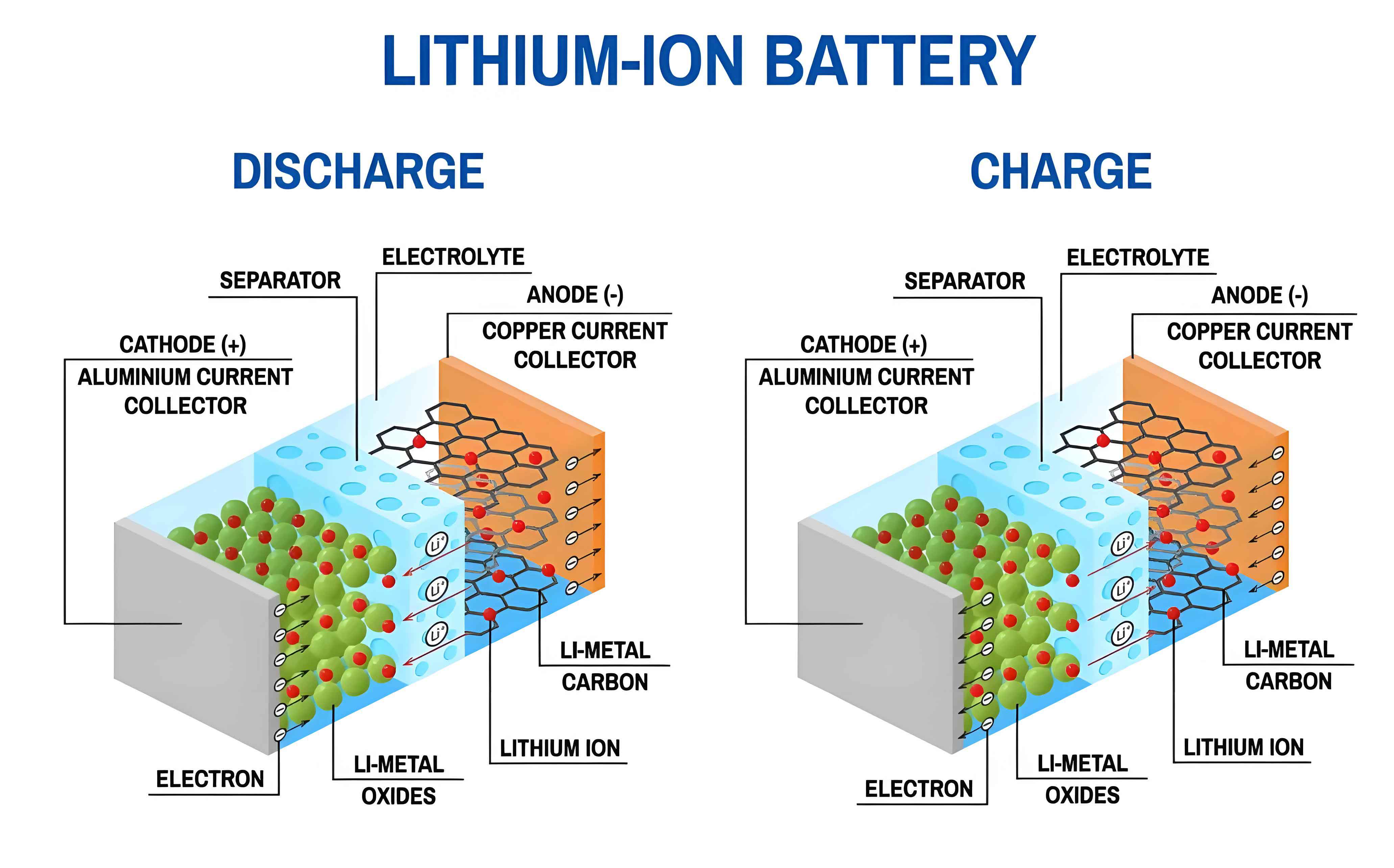
The integration of silicon and graphene into Si@G composites aims to harness the high capacity of silicon while leveraging graphene’s conductive and buffering properties. The performance of these composites in a li ion battery is critically influenced by the preparation method, which governs morphology, interface interactions, and structural stability. I will delve into several key synthesis techniques, including high-energy ball milling, chemical vapor deposition, sol-gel, spray drying, electrostatic self-assembly, hydrothermal, and in-situ methods. Each approach offers distinct advantages and challenges in optimizing Si@G composites for lithium-ion battery applications. To facilitate comparison, I will incorporate tables summarizing parameters and formulas to quantify electrochemical behaviors. For instance, the volume expansion of silicon during cycling can be expressed as: $$ \Delta V = \frac{V_{\text{final}} – V_{\text{initial}}}{V_{\text{initial}}} \times 100\% $$ where $\Delta V$ often exceeds 300% for pure silicon, contributing to capacity fade in a li ion battery. By exploring these aspects, I aim to provide a detailed perspective on how Si@G composites can enhance the performance and durability of lithium-ion batteries.
Preparation Methods for Si@G Composites
The synthesis of Si@G composites is a multifaceted process that directly impacts their electrochemical properties in a li ion battery. I will examine each method in detail, highlighting mechanisms, outcomes, and implications for lithium-ion battery performance.
High-Energy Ball Milling
High-energy ball milling is a mechanical technique that involves grinding silicon and graphene precursors together to achieve uniform mixing and size reduction. This method is favored for its simplicity and scalability in producing Si@G composites for lithium-ion battery anodes. During milling, the mechanical forces not only reduce particle size but also induce surface amorphization in silicon, which can improve electrochemical performance. The process can be described by a kinetic equation: $$ E_{\text{milling}} = k \cdot t \cdot f(d) $$ where $E_{\text{milling}}$ represents the energy input, $k$ is a constant, $t$ is time, and $f(d)$ is a function of particle diameter. This energy input facilitates the embedding of silicon nanoparticles into graphene layers, enhancing conductivity and buffering volume changes in a li ion battery. However, excessive milling can lead to agglomeration and structural defects, which may compromise the integrity of the composite. The table below summarizes key parameters and outcomes of high-energy ball milling for Si@G composites in lithium-ion battery applications.
| Parameter | Typical Range | Impact on Li-ion Battery Performance |
|---|---|---|
| Milling Time | 2-10 hours | Longer time improves homogeneity but may cause over-grinding, reducing capacity retention. |
| Ball-to-Powder Ratio | 10:1 to 20:1 | Higher ratios enhance mixing efficiency but increase contamination risk. |
| Silicon Content | 10-50 wt% | Optimal at 20-30% for balancing capacity and volume expansion in li ion battery. |
| Graphene Type | Reduced graphene oxide or pristine graphene | Affects conductivity and mechanical strength; reduced graphene oxide often yields better adhesion. |
In terms of electrochemical performance, Si@G composites prepared by ball milling typically exhibit initial reversible capacities ranging from 800 to 1500 mAh/g in a li ion battery, with capacity retention influenced by cycling conditions. The volume expansion buffering can be modeled as: $$ \sigma_{\text{buffer}} = \frac{E_{\text{graphene}} \cdot \varepsilon_{\text{si}}}{1 – \nu} $$ where $\sigma_{\text{buffer}}$ is the stress buffered by graphene, $E_{\text{graphene}}$ is Young’s modulus of graphene, $\varepsilon_{\text{si}}$ is the strain from silicon expansion, and $\nu$ is Poisson’s ratio. This highlights the role of graphene in mitigating degradation in lithium-ion batteries.
Chemical Vapor Deposition (CVD)
Chemical vapor deposition involves the thermal decomposition of gaseous precursors to deposit graphene onto silicon substrates, forming Si@G composites with controlled interfaces. This method is renowned for producing high-quality graphene coatings that enhance the electrical conductivity and structural stability of silicon anodes in a li ion battery. The CVD process can be expressed by a reaction equation: $$ \text{CH}_4 (\text{g}) \xrightarrow{\text{high T}} \text{C} (\text{s}) + 2\text{H}_2 (\text{g}) $$ where methane decomposes to form carbon (graphene) on silicon particles. The growth kinetics follow: $$ \frac{dC}{dt} = k \cdot P_{\text{CH}_4} \cdot e^{-E_a / RT} $$ with $dC/dt$ as the deposition rate, $k$ a rate constant, $P_{\text{CH}_4}$ the partial pressure of methane, $E_a$ activation energy, $R$ gas constant, and $T$ temperature. This allows precise tuning of graphene thickness and morphology for optimal lithium-ion battery performance. However, CVD is equipment-intensive and costly, limiting large-scale production. The table below outlines critical CVD parameters for Si@G composites in li ion battery applications.
| Parameter | Typical Value | Effect on Li-ion Battery Anode |
|---|---|---|
| Deposition Temperature | 800-1000°C | Higher temperatures improve graphene crystallinity but may degrade silicon structure. |
| Precursor Gas Flow Rate | 50-200 sccm | Controlled flow ensures uniform coating; excess can lead to carbon debris. |
| Silicon Substrate Morphology | Nanoparticles or thin films | Nanoparticles offer higher surface area, enhancing capacity in li ion battery. |
| Graphene Layer Number | 1-5 layers | Fewer layers provide better flexibility for volume buffering in lithium-ion batteries. |
Electrochemically, CVD-derived Si@G composites often show high specific capacities up to 2200 mAh/g in a li ion battery, with improved cycle life due to the conformal graphene coating. The capacity retention can be quantified as: $$ \text{Retention} = \frac{C_n}{C_1} \times 100\% $$ where $C_n$ is the capacity at cycle $n$ and $C_1$ is the initial capacity. For CVD-based composites, retention rates above 80% after 100 cycles are common, underscoring their potential for durable lithium-ion batteries.
Sol-Gel Method
The sol-gel technique involves the formation of a colloidal suspension (sol) that transitions into a gel network, enabling the uniform dispersion of silicon in graphene aerogels for Si@G composites. This method is advantageous for creating porous three-dimensional structures that facilitate electrolyte penetration and buffer volume changes in a li ion battery. The process can be described by hydrolysis and condensation reactions: $$ \text{Si(OR)}_4 + 4\text{H}_2\text{O} \rightarrow \text{Si(OH)}_4 + 4\text{ROH} $$ $$ \text{Si(OH)}_4 \rightarrow \text{SiO}_2 \cdot n\text{H}_2\text{O} (\text{gel}) $$ where silicon precursors form a gel matrix intertwined with graphene sheets. The porosity ($\phi$) of the resulting composite influences lithium-ion diffusion: $$ \phi = \frac{V_{\text{pores}}}{V_{\text{total}}} $$ with higher porosity enhancing rate capability in lithium-ion batteries. However, sol-gel synthesis often requires long processing times and organic solvents, posing scalability challenges. The table below summarizes key aspects of sol-gel derived Si@G composites for li ion battery anodes.
| Aspect | Details | Implications for Li-ion Battery |
|---|---|---|
| Gelation Time | Several hours to days | Longer times improve homogeneity but delay production for lithium-ion battery materials. |
| Silicon Precursor | Tetraethyl orthosilicate or silicon nanoparticles | Nanoparticles yield better dispersion, boosting capacity in li ion battery. |
| Graphene Concentration | 5-20 mg/mL in sol | Optimal concentration ensures conductive network without blocking pores. |
| Drying Method | Supercritical or freeze-drying | Preserves porous structure, enhancing cycling stability in lithium-ion batteries. |
In terms of performance, sol-gel based Si@G composites typically exhibit reversible capacities around 850 mAh/g in a li ion battery, with excellent cycle stability due to the buffering effect of the graphene aerogel. The volume expansion stress ($\sigma_v$) can be mitigated by the gel matrix: $$ \sigma_v = E_{\text{composite}} \cdot \alpha \cdot \Delta T $$ where $E_{\text{composite}}$ is the composite’s modulus, $\alpha$ is thermal expansion coefficient, and $\Delta T$ is temperature change during cycling. This underscores the method’s utility for robust lithium-ion battery anodes.
Spray Drying
Spray drying is a rapid processing technique where a slurry containing silicon and graphene is atomized and dried to form microspherical Si@G composites. This method is scalable and allows for the creation of hierarchical structures with internal voids that accommodate volume expansion in a li ion battery. The drying kinetics can be modeled as: $$ \frac{dm}{dt} = -k \cdot A \cdot (P_{\text{sat}} – P_{\text{air}}) $$ where $dm/dt$ is the mass loss rate, $k$ is a mass transfer coefficient, $A$ is surface area, $P_{\text{sat}}$ is saturation pressure, and $P_{\text{air}}$ is air pressure. This process yields composites with high tap density and good electrical connectivity for lithium-ion battery applications. However, controlling particle size distribution and preventing agglomeration are critical challenges. The table below highlights spray drying parameters for Si@G composites in li ion battery anodes.
| Parameter | Typical Range | Impact on Li-ion Battery Performance |
|---|---|---|
| Inlet Temperature | 150-250°C | Higher temperatures accelerate drying but may cause cracks, affecting cycle life. |
| Slurry Solid Content | 10-30 wt% | Optimal content ensures spherical morphology and high capacity in li ion battery. |
| Atomization Pressure | 1-3 bar | Higher pressure produces finer particles, enhancing rate capability in lithium-ion batteries. |
| Graphene Type | Oxidized or reduced forms | Reduced graphene improves conductivity, boosting power density for li ion battery. |
Electrochemically, spray-dried Si@G composites often deliver initial discharge capacities up to 1886 mAh/g in a li ion battery, with high initial Coulombic efficiency due to the compact structure. The capacity fade rate ($r_f$) can be expressed as: $$ r_f = \frac{\Delta C}{\Delta t} $$ where $\Delta C$ is capacity loss over time $\Delta t$. For these composites, $r_f$ is typically low, around 0.1% per cycle, highlighting their durability in lithium-ion batteries.
Electrostatic Self-Assembly
Electrostatic self-assembly relies on oppositely charged surfaces to adsorb silicon nanoparticles onto graphene sheets, forming Si@G composites with strong interfacial bonds. This method enhances dispersion and prevents aggregation, which is crucial for stable performance in a li ion battery. The interaction energy ($U$) between charged particles can be described by Derjaguin-Landau-Verwey-Overbeek (DLVO) theory: $$ U = U_{\text{electrostatic}} + U_{\text{van der Waals}} $$ where $U_{\text{electrostatic}} = \frac{q_1 q_2}{4\pi \varepsilon r}$ and $U_{\text{van der Waals}} = -\frac{A}{6r}$ for spherical particles, with $q$ as charge, $\varepsilon$ permittivity, $r$ distance, and $A$ Hamaker constant. This ensures uniform coating and effective buffering of volume changes in lithium-ion batteries. However, surface functionalization of silicon and graphene is required, adding complexity. The table below outlines key factors in electrostatic self-assembly for Si@G composites in li ion battery anodes.
| Factor | Description | Role in Li-ion Battery |
|---|---|---|
| Surface Charge Density | Controlled by pH or functional groups | Higher density improves adhesion, enhancing cycle stability in li ion battery. |
| Silicon Particle Size | Nanoscale (20-100 nm) | Smaller size reduces stress from volume expansion, benefiting lithium-ion battery life. |
| Graphene Sheet Size | Micron to sub-micron scale | Larger sheets provide better coverage, improving conductivity in li ion battery. |
| Assembly Time | Minutes to hours | Longer times ensure complete adsorption, optimizing performance for lithium-ion batteries. |
In terms of electrochemical outcomes, Si@G composites from electrostatic self-assembly often show capacities around 1400 mAh/g in a li ion battery, with excellent rate capability due to the conductive graphene network. The interfacial strength ($\sigma_i$) can be approximated as: $$ \sigma_i = \frac{F_{\text{adhesion}}}{A_{\text{contact}}} $$ where $F_{\text{adhesion}}$ is the adhesive force and $A_{\text{contact}}$ is the contact area. High $\sigma_i$ values correlate with improved capacity retention in lithium-ion batteries.
Hydrothermal Method
The hydrothermal method involves heating a mixture of silicon and graphene oxide in an aqueous solution under pressure to form Si@G composites. This technique promotes the reduction of graphene oxide and its integration with silicon, yielding materials with enhanced electrochemical properties for a li ion battery. The reaction can be summarized as: $$ \text{Si} + \text{GO} + \text{H}_2\text{O} \xrightarrow{\text{high T, P}} \text{Si}@\text{rGO} + \text{byproducts} $$ where GO is graphene oxide and rGO is reduced graphene oxide. The process kinetics depend on temperature ($T$) and pressure ($P$): $$ k = A e^{-E_a / (RT)} \cdot f(P) $$ with $k$ as rate constant and $A$ pre-exponential factor. This method allows for in-situ carbon coating on silicon, further buffering volume changes in lithium-ion batteries. However, controlling the morphology and preventing silicon oxidation are challenges. The table below details hydrothermal parameters for Si@G composites in li ion battery applications.
| Parameter | Typical Condition | Effect on Li-ion Battery Anode |
|---|---|---|
| Temperature | 120-200°C | Higher temperatures enhance reduction but may degrade silicon, impacting capacity in li ion battery. |
| Reaction Time | 6-24 hours | Longer times improve composite formation but increase energy consumption for lithium-ion battery materials. |
| pH of Solution | Neutral to alkaline | Alkaline conditions favor graphene reduction, boosting conductivity in li ion battery. |
| Silicon-to-Graphene Ratio | 1:1 to 1:5 by weight | Optimal ratio balances capacity and mechanical support for lithium-ion batteries. |
Electrochemically, hydrothermal-derived Si@G composites often exhibit reversible capacities up to 1500 mAh/g in a li ion battery, with high capacity retention due to the robust graphene encapsulation. The volume expansion coefficient ($\beta$) can be related to composite structure: $$ \beta = \frac{\Delta V_{\text{composite}}}{\Delta V_{\text{si}}} $$ where lower $\beta$ values indicate better buffering, crucial for long-term cycling in lithium-ion batteries.
In-Situ Synthesis
In-situ synthesis involves the direct growth of graphene or carbon coatings on silicon particles during chemical reactions, creating Si@G composites with intimate interfaces. This method ensures uniform distribution and strong bonding, which enhances electrical conductivity and mechanical stability in a li ion battery. A common approach uses catalytic decomposition: $$ \text{Si} + \text{C}_x\text{H}_y \xrightarrow{\text{catalyst}} \text{Si}@\text{C} + \text{H}_2 $$ where carbon coats silicon and may integrate with graphene. The growth rate can be modeled as: $$ \frac{dL}{dt} = \frac{D \cdot C_{\text{sat}}}{L} $$ with $dL/dt$ as layer thickness increase, $D$ diffusion coefficient, $C_{\text{sat}}$ saturation concentration, and $L$ current thickness. This yields composites with minimal defects, optimizing performance for lithium-ion batteries. However, catalyst selection and removal add steps. The table below summarizes in-situ synthesis aspects for Si@G composites in li ion battery anodes.
| Aspect | Details | Significance for Li-ion Battery |
|---|---|---|
| Catalyst Type | Iron, nickel, or cobalt nanoparticles | Affects graphene quality; iron often yields high conductivity for li ion battery. |
| Reaction Atmosphere | Inert gas (e.g., argon) with carbon source | Prevents oxidation, ensuring pure composites for lithium-ion batteries. |
| Silicon Precursor Form | Nanoparticles or porous silicon | Porous structures accommodate expansion, enhancing cycle life in li ion battery. |
| Carbon Coating Thickness | 5-20 nm | Thinner coatings improve kinetics; thicker ones better buffer volume changes in lithium-ion batteries. |
In terms of performance, in-situ synthesized Si@G composites can achieve capacities around 1120 mAh/g in a li ion battery, with exceptional cycling stability due to the seamless interface. The capacity degradation ($D$) over cycles can be expressed as: $$ D = 1 – e^{-\lambda n} $$ where $\lambda$ is a decay constant and $n$ is cycle number. For these composites, $\lambda$ is low, indicating slow degradation, which is vital for durable lithium-ion batteries.
Comparative Analysis and Electrochemical Performance
To synthesize the discussion, I will compare the various preparation methods for Si@G composites in terms of their impact on lithium-ion battery performance. Key metrics include specific capacity, cycle life, rate capability, and scalability. The overall goal is to optimize these composites for practical applications in li ion battery systems. The table below provides a comprehensive comparison based on literature insights.
| Preparation Method | Typical Capacity (mAh/g) in Li-ion Battery | Cycle Stability (Capacity Retention after 100 cycles) | Rate Capability (Capacity at High Current) | Scalability for Li-ion Battery Production |
|---|---|---|---|---|
| High-Energy Ball Milling | 800-1500 | 70-85% | Moderate (400-800 mAh/g at 2A/g) | High (simple and cost-effective) |
| Chemical Vapor Deposition | 1500-2200 | 80-95% | High (800-1200 mAh/g at 3A/g) | Low (complex and expensive) |
| Sol-Gel | 800-1000 | 85-90% | Moderate (500-700 mAh/g at 1A/g) | Medium (time-consuming but tunable) |
| Spray Drying | 1500-1900 | 75-90% | High (700-900 mAh/g at 2A/g) | High (rapid and scalable) |
| Electrostatic Self-Assembly | 1200-1600 | 80-95% | High (600-800 mAh/g at 5A/g) | Medium (requires surface modification) |
| Hydrothermal | 1400-1700 | 85-98% | Moderate (500-700 mAh/g at 3A/g) | Medium (energy-intensive but versatile) |
| In-Situ Synthesis | 1100-1500 | 90-99% | High (800-1000 mAh/g at 2A/g) | Low to Medium (catalyst-dependent) |
From this comparison, it is evident that each method offers trade-offs between performance and practicality for lithium-ion batteries. For instance, CVD yields high capacities but poor scalability, while ball milling balances cost and performance. The electrochemical behavior can be further analyzed using formulas. The specific capacity ($C_s$) of a Si@G composite in a li ion battery is influenced by silicon content and graphene conductivity: $$ C_s = \frac{w_{\text{si}} \cdot C_{\text{si}} + w_{\text{g}} \cdot C_{\text{g}}}{w_{\text{total}}} $$ where $w$ denotes weight fractions and $C$ capacities, with $C_{\text{si}} \approx 4200$ mAh/g and $C_{\text{g}} \approx 372$ mAh/g for graphite. However, due to volume expansion effects, the effective capacity often deviates: $$ C_{\text{eff}} = C_s \cdot \eta \cdot (1 – \delta) $$ with $\eta$ as Coulombic efficiency and $\delta$ as capacity loss factor from cycling. For a durable li ion battery, minimizing $\delta$ through optimized Si@G composites is crucial.
Moreover, the rate performance of these composites in a lithium-ion battery can be modeled using the Peukert equation: $$ C_{\text{rate}} = C_0 \cdot I^{-k} $$ where $C_{\text{rate}}$ is capacity at current $I$, $C_0$ is capacity at low current, and $k$ is the Peukert constant. For Si@G composites, $k$ values are typically lower than for pure silicon, indicating better high-current performance due to graphene’s conductive network. This highlights the importance of synthesis method in tailoring properties for advanced lithium-ion batteries.
Challenges and Future Perspectives
Despite significant progress, several challenges remain in the development of Si@G composites for lithium-ion battery anodes. As I reflect on the research, key issues include controlling graphene quality (e.g., layer number, defects, oxygen functional groups), optimizing silicon-graphene interfaces, and scaling up production cost-effectively. The volume expansion of silicon continues to be a primary concern, even with graphene buffering, as it can lead to SEI layer instability and electrolyte depletion in a li ion battery. Future efforts should focus on hybrid approaches, such as combining multiple preparation methods or incorporating additional coatings (e.g., carbon nanotubes or polymers) to enhance performance. For example, a composite with Si@C core-shell structures embedded in graphene matrices could further improve cycling stability in lithium-ion batteries.
From a theoretical standpoint, advanced modeling and simulation can aid in designing optimal Si@G architectures. The stress-strain relationship during lithiation can be expressed as: $$ \sigma = E \cdot \epsilon + \sigma_0 $$ where $\sigma$ is stress, $E$ is elastic modulus, $\epsilon$ is strain, and $\sigma_0$ is residual stress. By tuning composite morphology, $\epsilon$ can be reduced, prolonging li ion battery life. Additionally, in-situ characterization techniques, such as electron microscopy or spectroscopy, will provide deeper insights into degradation mechanisms.
Looking ahead, the integration of Si@G composites into commercial lithium-ion batteries requires addressing economic and environmental factors. Sustainable sourcing of silicon and graphene, along with green synthesis methods, will be essential. I anticipate that with continued innovation, Si@G composites will play a pivotal role in next-generation high-energy-density li ion batteries, enabling applications in electric vehicles, grid storage, and portable electronics. The ongoing research in this field underscores the dynamic nature of lithium-ion battery technology and its potential to transform energy storage landscapes.