
As a researcher deeply involved in the field of energy storage, I have observed the rapid expansion of lithium-ion battery technology in grid-scale applications. However, the practical deployment often reveals a significant gap between laboratory performance and real-world service behavior. This article, based on extensive experimental work, aims to elucidate how specific operational conditions—namely, the state-of-charge (SOC) window, charge-discharge rate, and operating temperature—profoundly affect the electrochemical performance and service life of lithium-ion batteries. The insights presented here are intended to guide the optimal design and configuration of li-ion battery energy storage systems (BESS) for enhanced longevity and economic viability.
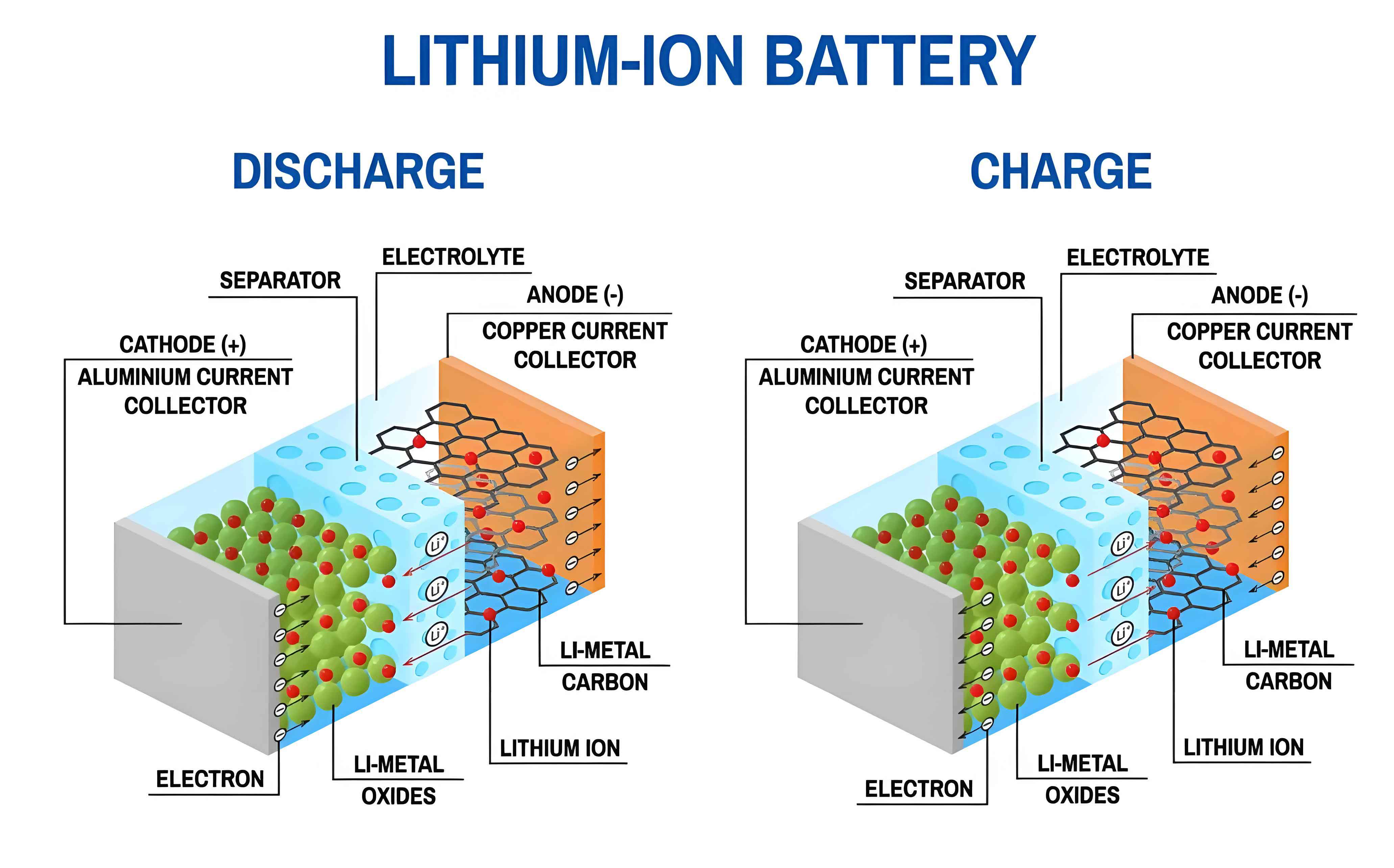
The transition towards renewable energy sources like wind and solar has necessitated the integration of large-scale energy storage to mitigate intermittency and stabilize the grid. Among various technologies, the li-ion battery has emerged as a frontrunner due to its high energy density, declining cost, and flexibility. Yet, the financial success of a li-ion battery storage project hinges not just on initial capital expenditure but more critically on the total energy delivered over its operational lifetime. This lifetime is intrinsically tied to the service conditions imposed by the application, such as frequency regulation which demands high power (high C-rate) cycles. Therefore, a systematic investigation into the degradation mechanisms under different operational regimes is paramount. In this work, we employed commercial 26650-type lithium iron phosphate (LFP) cells with a nominal capacity of 4 Ah as a representative model system for grid storage. We subjected these li-ion battery units to controlled cycling tests, varying key parameters to quantify their impact.
Experimental Methodology and Test Matrix
Our testing protocol was designed to simulate realistic, yet accelerated, storage duty cycles. Prior to testing, all li-ion battery cells were conditioned with three full-capacity cycles at 1 C to establish a baseline capacity. The core testing parameters were as follows:
| Variable Parameter | Test Levels | Constant Parameters | Cycle Termination Criterion |
|---|---|---|---|
| Charge/Discharge Rate (C-rate) | 0.5 C, 1 C, 1.5 C, 2 C | SOC Window: 10%-90% & 5%-95%; Temperature: 25°C | Capacity retention ≤ 80% of initial |
| SOC Operating Window | 5%-95%, 10%-90%, 15%-85%, 20%-80%, 25%-75% | C-rate: 0.5 C & 1 C; Temperature: 25°C | Up to 1000+ cycles or until 80% retention |
| Operating Temperature | 0°C, 15°C, 25°C, 35°C, 50°C | C-rate: 1 C; SOC Window: 10%-90% | Capacity retention ≤ 80% of initial |
For each test condition, the li-ion battery was cycled using constant current-constant voltage (CC-CV) charging and constant current (CC) discharging within the specified SOC limits, controlled by voltage cut-offs. The cycle life was tracked as the number of cycles completed before the discharge capacity faded to 80% of its initial value. This data forms the basis for our analysis on how service conditions dictate the performance envelope of a li-ion battery.
Impact of Charge-Discharge Rate (C-rate) on Li-ion Battery Life
The C-rate, defining the current relative to the battery’s capacity, is a critical stressor. Our tests unequivocally show that the cycle life of a li-ion battery is inversely related to the operational C-rate. Figure 1 (data represented in table below) summarizes the cycle life obtained under different rates for two common SOC windows.
| C-rate | SOC Window: 10%-90% (Cycles) | SOC Window: 5%-95% (Cycles) | Estimated Service Life Multiplier (Relative to 2 C) |
|---|---|---|---|
| 0.5 C | >2000 (92% retention at 2000) | ~2330 | >12x |
| 1 C | >2000 (89% retention at 2000) | ~1780 | >9x |
| 1.5 C | ~1677 | Not Tested | ~8.4x |
| 2 C | ~1880 | ~200 (rapid failure after) | 1x (Baseline) |
The degradation accelerates dramatically at 2 C, especially when utilizing a wider SOC window (5%-95%). In that case, the li-ion battery failed catastrophically after approximately 200 cycles, with capacity plunging below 20% soon after. This underscores a non-linear relationship between stress and degradation. The capacity fade can be modeled empirically using a power-law relationship common for li-ion battery aging:
$$ Q_{loss} = A \cdot (C_{rate})^n \cdot N^m $$
where \( Q_{loss} \) is the fractional capacity loss, \( A \) is a pre-exponential factor, \( C_{rate} \) is the discharge rate, \( N \) is the cycle number, and \( n \) and \( m \) are exponents typically less than 1. Our data suggests \( n \) is significant, indicating a strong sensitivity to rate.
From a system design perspective, this has direct implications. A frequency regulation project configured for 2 C discharge (e.g., 9 MW/4.5 MWh) may save ~30% on initial battery costs compared to a 1 C configuration (9 MW/9 MWh). However, as the cycle life at 1 C can be over three times longer than at 2 C, the levelized cost of energy (LCOE) for the 1 C li-ion battery system is likely lower, enhancing long-term profitability. The trade-off is clear: sacrificing power density for energy density (lower C-rate) extends the useful life of the li-ion battery asset.
Effect of Depth of Discharge (SOC Operating Window)
Another lever for optimizing li-ion battery lifetime is constraining the operational SOC window, effectively reducing the depth of discharge (DOD). Our results demonstrate a consistent trend: shallower cycling extends cycle life. The data for 0.5 C cycling is particularly illustrative, as shown in Table 3.
| SOC Operating Window | Approximate Depth of Discharge (DOD) | Capacity Retention After 1000 Cycles | Relative Life Extension Factor* |
|---|---|---|---|
| 25% – 75% | 50% | 91.8% | ~1.7x |
| 20% – 80% | 60% | 85.3% | ~1.3x |
| 15% – 85% | 70% | 86.8% | ~1.35x |
| 10% – 90% | 80% | 83.8% | ~1.2x |
| 5% – 95% | 90% | 80.6% | 1x (Baseline) |
*Estimated factor to reach 80% retention compared to 5%-95% baseline.
A more generalized model for cycle life as a function of DOD is given by the inverse power law or exponential relationship often cited for li-ion batteries:
$$ N_{f} = K \cdot (DOD)^{-\gamma} $$
where \( N_{f} \) is the cycle life to failure, \( K \) is a constant, and \( \gamma \) is a positive exponent. Our data validates this model; operating between 25%-75% SOC (50% DOD) yielded vastly superior retention compared to 5%-95% SOC (90% DOD). This is because extreme SOCs (high and low) induce greater mechanical strain on electrode materials and promote undesirable side reactions. Therefore, designing a li-ion battery energy storage system with a controlled SOC buffer (e.g., 10%-90% instead of 0%-100%) is a simple yet effective strategy to enhance longevity, even though it reduces the immediately available energy capacity.
The Critical Role of Operating Temperature for Li-ion Battery Consistency
Temperature is perhaps the most pervasive environmental factor affecting li-ion battery performance. Our controlled temperature cycling tests reveal a pronounced “sweet spot” around 25°C. Deviation in either direction hastens degradation, as quantified in Table 4.
| Operating Temperature | Cycles to 80% Capacity Retention | Relative Life vs. 25°C | Primary Degradation Mechanism |
|---|---|---|---|
| 0°C | ~540 | ~14% | Lithium plating, increased polarization |
| 15°C | ~2760 (estimated) | ~73% | Slowed kinetics, moderate side reactions |
| 25°C | ~3760 | 100% | Optimal balanced kinetics |
| 35°C | ~2250 (estimated) | ~60% | Accelerated SEI growth, electrolyte decomposition |
| 50°C | ~1254 | ~33% | Severe electrolyte breakdown, gas generation |
The Arrhenius equation broadly governs the temperature dependence of the chemical degradation processes within a li-ion battery:
$$ k = A \cdot e^{-E_a / (R T)} $$
where \( k \) is the rate constant of a degradation reaction (e.g., solid electrolyte interphase (SEI) growth), \( E_a \) is the activation energy, \( R \) is the gas constant, and \( T \) is the absolute temperature. At low temperatures, the dominant failure mode shifts to lithium plating on the anode due to reduced lithium-ion diffusivity and charge transfer kinetics. The overpotential (\( \eta \)) for lithium deposition becomes negative, favoring plating over intercalation:
$$ \eta = \phi_{anode} – U_{eq} – \frac{RT}{F} \ln \left( \frac{a_{Li^+}}{a_{Li}} \right) $$
where \( \phi_{anode} \) is the anode potential, \( U_{eq} \) is the equilibrium potential, \( F \) is Faraday’s constant, and \( a \) denotes activity. At high temperatures, the rate of parasitic reactions increases exponentially, leading to loss of active lithium and electrolyte, and potentially to thermal runaway.
Perhaps more insidious than the absolute capacity fade is the issue of inconsistency. An unregulated temperature test mimicking seasonal variations (15-30°C) showed significant capacity fluctuations cycle-to-cycle. In a large li-ion battery pack comprising thousands of cells, even single-digit temperature gradients can cause diverging aging paths among cells. This divergence accelerates over time, leading to pack imbalance, reduced usable capacity, and increased risk of overcharge/over-discharge for individual cells. Hence, sophisticated thermal management systems (TMS) are not a luxury but a necessity for large-scale li-ion battery storage to ensure homogeneity and safety.
Mechanistic Analysis of Polarization and Performance Limits
The underlying reason why high C-rates and extreme temperatures are detrimental lies in increased polarization. The total overpotential (\( \eta_{total} \)) during operation of a li-ion battery can be decomposed as:
$$ \eta_{total} = \eta_{ohmic} + \eta_{ct} + \eta_{diff} $$
where \( \eta_{ohmic} \) is the ohmic drop from electronic and ionic resistance, \( \eta_{ct} \) is the charge transfer overpotential at the electrode-electrolyte interface, and \( \eta_{diff} \) is the concentration overpotential due to mass transport limitations. At high C-rates, all three components increase. The effective voltage window for safe operation shrinks because the charge voltage climbs and discharge voltage drops, as seen in the distorted voltage-capacity curves. This can be visualized by the modified Nernst equation and Butler-Volmer kinetics. The usable capacity (\( C_{usable} \)) at a high rate is less than the theoretical capacity because the cut-off voltage is reached prematurely:
$$ C_{usable}(I, T) = C_{theoretical} – \int_{t_0}^{t_{cutoff}} \left| \frac{\partial V(I, T, SOC)}{\partial SOC} \right|^{-1} dSOC $$
This polarization effect is exacerbated at low temperatures (high \( \eta_{ct} \) and \( \eta_{diff} \)) and at high temperatures (increased \( \eta_{ohmic} \) due to possible electrolyte decomposition). Furthermore, the cumulative strain from repeated lattice expansion/contraction during deep cycling, quantified by a stress parameter (\( \sigma \)), contributes to particle cracking and loss of electrical contact:
$$ \sigma \propto \frac{\Delta V_{molar}}{V_{molar}} \cdot E \cdot DOD $$
where \( \Delta V_{molar}/V_{molar} \) is the volume change ratio of the active material, \( E \) is the modulus of elasticity, and \( DOD \) is the depth of discharge. Thus, the optimization of service conditions for a li-ion battery is essentially the minimization of total polarization and mechanical stress over its operational lifetime.
Comprehensive Discussion and System Design Implications
Synthesizing the findings, the performance of a li-ion battery is a multi-variable function of its service conditions. We can propose a generalized lifetime estimation model for a li-ion battery under grid storage duty:
$$ L_{total} = \int_{0}^{t_{EOL}} f(C_{rate}(t), DOD(t), T(t), \overline{SOC}(t)) dt $$
where \( L_{total} \) is the total energy throughput to end-of-life (EOL), and the function \( f \) encapsulates the complex, coupled degradation mechanisms. For practical design, we derive the following guidelines:
- C-rate Selection: Avoid continuous operation above 1 C for longevity-critical applications. For frequency regulation, consider oversizing the energy capacity (lower C-rate design) to reduce per-cycle stress. The trade-off analysis between capital cost and LCOE must favor the latter for sustainable projects.
- SOC Window Management: Implement active SOC control strategies to operate within a moderate window (e.g., 10%-90% or even 20%-80%). This “capacity buffer” not only extends cycle life but also provides headroom for grid services like spinning reserve or arbitrage.
- Thermal Management Imperative: Maintain the li-ion battery pack within a narrow temperature band around 25°C (±5°C) through active cooling/heating. This is crucial not for peak efficiency alone, but for ensuring cell-to-cell consistency, which is the cornerstone of pack safety and durability.
- Condition-Adaptive Operation: Advanced battery management systems (BMS) should dynamically adjust power setpoints and SOC limits based on real-time temperature and state-of-health (SOH) estimates to optimize the lifetime of the li-ion battery system.
To illustrate the economic impact, consider a simplified cost model. The Levelized Cost of Storage (LCOS) for a li-ion battery system can be expressed as:
$$ LCOS = \frac{C_{cap} + \sum_{t=1}^{n} \frac{C_{O\&M,t}}{(1+r)^t}}{\sum_{t=1}^{n} \frac{E_{disch,t} \cdot \eta_{rt}}{(1+r)^t}} $$
where \( C_{cap} \) is capital cost, \( C_{O\&M,t} \) is operation and maintenance cost in year \( t \), \( E_{disch,t} \) is annual discharged energy, \( \eta_{rt} \) is round-trip efficiency, \( r \) is discount rate, and \( n \) is system life in years. Optimizing service conditions directly increases \( n \) and \( E_{disch,t} \), thereby reducing LCOS.
Conclusion
In conclusion, the journey of a li-ion battery from a consumer electronics component to a cornerstone of the modern electricity grid demands a paradigm shift in how we perceive its operation. This investigation underscores that the service conditions are not mere background variables but are primary determinants of electrochemical performance and economic return. The li-ion battery is a sensitive electrochemical system whose longevity is dictated by the trifecta of rate, depth, and temperature of operation. By consciously designing systems to operate under milder conditions—lower C-rates, constrained SOC windows, and stringent thermal control—we can unlock the full potential of li-ion battery technology. This approach will yield storage systems with lower lifetime costs, higher reliability, and greater safety, ultimately accelerating the integration of renewable energy and supporting global decarbonization goals. The future of grid-scale energy storage lies not just in better li-ion battery chemistry, but equally in smarter, more respectful management of the li-ion battery within its optimal service envelope.