
With the rapid development of new energy technologies, lithium-ion batteries have emerged as a pivotal energy storage solution due to their high efficiency and environmental friendliness. Among cathode materials, lithium cobalt oxide (LiCoO2) stands out as one of the earliest commercialized and most successful options, owing to its straightforward synthesis, high specific capacity, stable cycling performance, and good thermal stability. However, challenges persist, particularly at high operating voltages, where irreversible structural transformations and adverse side reactions with electrolytes lead to rapid capacity decay and reduced cycle stability. In this review, we explore various modification strategies aimed at enhancing the structural integrity and electrochemical performance of LiCoO2 in li-ion battery applications. We focus on particle size optimization, bulk doping, and surface modification, summarizing recent progress and future directions to achieve high-energy-density li-ion battery systems.
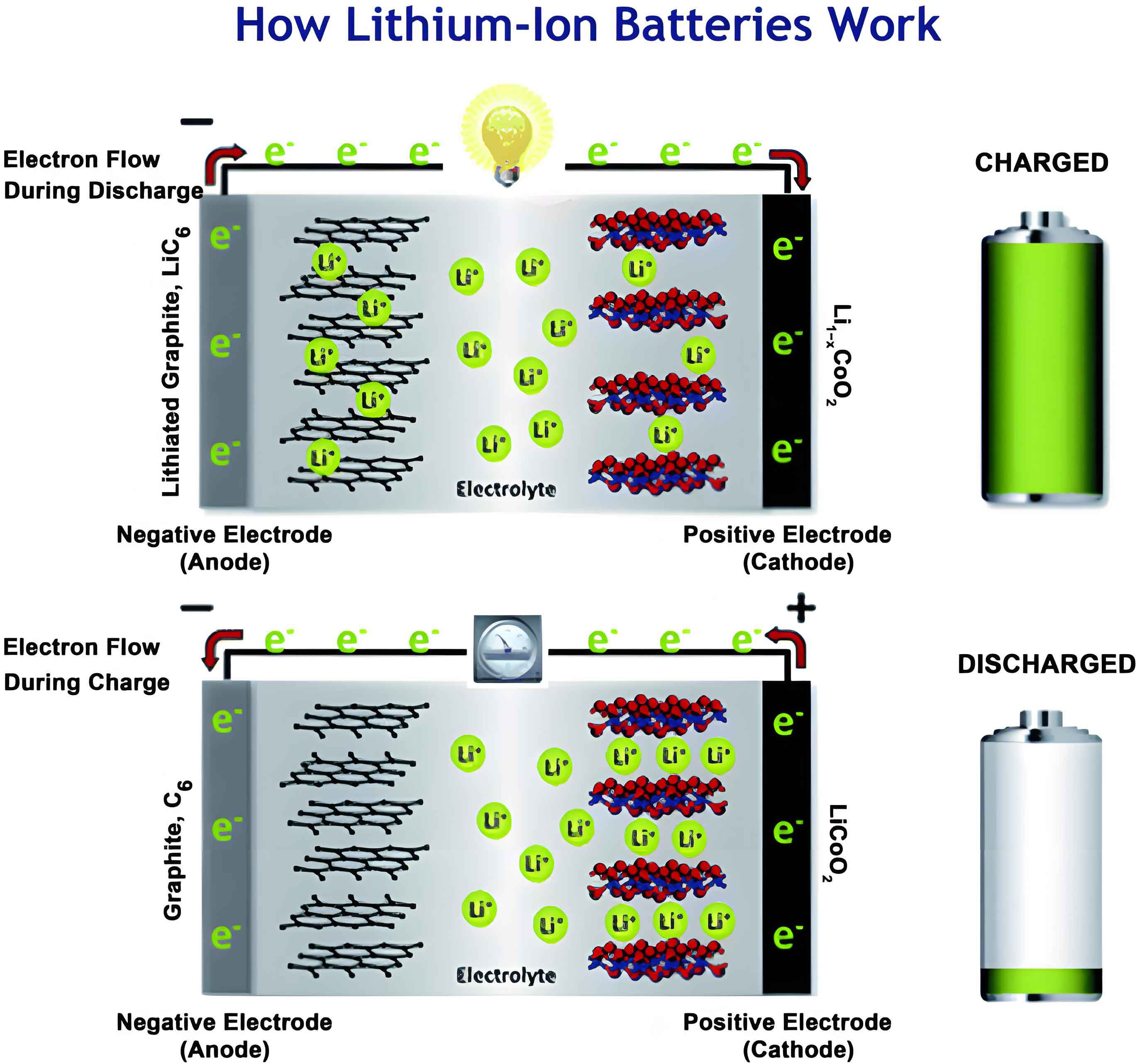
The performance of li-ion battery cathodes heavily relies on material properties, and LiCoO2 serves as a benchmark due to its layered structure. This structure belongs to the hexagonal R$\bar{3}$m space group, with lattice parameters of a = b = 2.816 Å and c = 14.080 Å, resulting in a unit cell volume of 96.32 Å3. The theoretical specific capacity of LiCoO2 is given by:
$$C_{\text{theoretical}} = \frac{nF}{3.6M} = 274 \, \text{mAh·g}^{-1}$$
where \(n\) is the number of electrons transferred (here, \(n = 1\) for Li+ extraction), \(F\) is Faraday’s constant (96485 C·mol−1), and \(M\) is the molar mass (97.87 g·mol−1). However, practical capacity in li-ion battery systems is limited to 135–140 mAh·g−1 within a voltage window of 2.75–4.2 V, highlighting the need for modifications to unlock higher capacities at elevated voltages.
During charge and discharge in a li-ion battery, Li+ deintercalation from LiCoO2 induces phase transitions that compromise stability. As Li1-xCoO2 forms, the structure evolves from hexagonal (O3-I) to monoclinic and back to hexagonal phases, described by the following sequential transformations:
$$\text{O3-I} \rightarrow \text{O3-II} \rightarrow \text{Monoclinic} \rightarrow \text{Hexagonal (CoO}_2\text{)}$$
For \(0 < x < 0.07\), the O3-I phase is stable; at \(0.07 < x < 0.25\), a coexistence of O3-I and O3-II occurs with reduced interlayer spacing; and beyond \(x > 0.5\), irreversible phase changes lead to structural collapse. This is exacerbated at high voltages (>4.2 V), where increased Li+ extraction boosts energy density but accelerates degradation. The energy density of a li-ion battery is expressed as:
$$E = C \times V$$
where \(E\) is energy density, \(C\) is capacity, and \(V\) is voltage. Thus, pushing LiCoO2 to higher voltages is desirable, but it intensifies issues like Co dissolution, oxygen release, and electrolyte decomposition, all of which hinder li-ion battery longevity.
To address these challenges, we categorize modification approaches into three main areas: particle size and morphology control, bulk doping, and surface coating. Each strategy aims to stabilize the layered structure, suppress side reactions, and enhance Li+ diffusion in li-ion battery cathodes.
Particle Size Optimization and Morphology Control
Reducing particle size in LiCoO2 improves electrochemical performance by shortening Li+ diffusion paths and increasing surface area for electrolyte contact. This is crucial for high-rate li-ion battery applications. Synthesis methods such as sol-gel, hydrothermal, and solid-state reactions yield nanoscale particles with enhanced properties. For instance, a sol-gel-derived LiCoO2 with particles ranging from 0.32 to 0.47 µm demonstrates higher Li+ diffusion coefficients, calculated using the equation:
$$D_{\text{Li}^+} = \frac{R^2}{2t}$$
where \(D_{\text{Li}^+}\) is the diffusion coefficient, \(R\) is particle radius, and \(t\) is diffusion time. Smaller particles reduce internal stress during cycling, mitigating capacity fade in li-ion battery systems. Table 1 summarizes key synthesis techniques and their impact on LiCoO2 morphology for li-ion battery use.
| Synthesis Method | Particle Size Range | Morphology | Effect on Li-Ion Battery Performance |
|---|---|---|---|
| Sol-Gel | 0.32–0.47 µm | Hexagonal layered | Enhanced Li+ diffusion, stable cycling |
| Hydrothermal | 50–200 nm | Nanoplates | Improved rate capability |
| Solid-State with Templates | Submicron | Porous structures | Higher conductivity, reduced impedance |
Bulk Doping Strategies
Bulk doping involves substituting elements into LiCoO2 lattice sites to stabilize the structure at high voltages. This approach modifies electronic and ionic conductivity, suppresses phase transitions, and reduces Co dissolution in li-ion battery cathodes. Doping can be single-element or multi-element, each offering unique benefits.
Single-Element Doping
Common dopants include Al, Ti, Mg, and Ca, which replace Co or Li sites. For example, Al doping strengthens the lattice due to higher Al–O bond energy (512 kJ·mol−1) compared to Co–O (368 kJ·mol−1), as per the enthalpy of formation:
$$\Delta H_f^{\text{Al-O}} > \Delta H_f^{\text{Co-O}}$$
This enhances structural stability in li-ion battery cycling. Ti doping, even at low concentrations (<0.15%), inhibits oxygen activity and phase changes, enabling capacities up to 205 mAh·g−1 at 4.5 V. The effect of dopants on lattice parameters can be modeled by Vegard’s law:
$$a_{\text{doped}} = a_0 + kx$$
where \(a_0\) is the original lattice constant, \(k\) is a proportionality factor, and \(x\) is dopant concentration. Optimizing \(x\) is critical; excessive doping can form insulating layers, impairing li-ion battery performance.
Multi-Element Doping
Multi-element doping synergistically improves multiple aspects of LiCoO2 for li-ion battery applications. For instance, Al–Zr co-doping stabilizes the layered structure and boosts Li+ transport, while Ca–P dual-doping acts as a “pillar” to prevent layer collapse. Gradient doping, such as Al–F–Mg, creates a robust subsurface layer that suppresses oxygen release. The synergistic effect can be quantified by the stability factor \(S\), defined as:
$$S = \sum_i \alpha_i \Delta E_i$$
where \(\alpha_i\) is the weight of dopant \(i\) and \(\Delta E_i\) is its contribution to binding energy. Table 2 summarizes multi-element doping systems and their outcomes in li-ion battery testing.
| Doping Elements | Doping Sites | Key Effects in Li-Ion Battery | Capacity Retention at 4.6 V |
|---|---|---|---|
| Al, Zr | Co, Li sites | Stabilizes structure, enhances Li+ diffusion | ~80% after 500 cycles |
| Ca, P | Li, O sites | Prevents layer sliding, improves rate performance | ~70% after 500 cycles |
| B, F | Gradient doping | Forms stable CEI, inhibits oxygen loss | 93.2% after 800 cycles |
| Si/Al, Na, F | Multiple sites | Suppresses side reactions, anchors structure | High cyclic stability |
| In, Mg, Al | Co, Li sites | Inhibits oxygen evolution, stabilizes CEI | 75.1% after 500 cycles |
| Zn, Y, Tb | Uniform doping | Maintains phase reversibility, reduces impedance | 98% after 100 cycles |
The effectiveness of doping in li-ion battery cathodes depends on ionic radii and electronegativity matching. For a dopant D replacing Co, the condition for minimal lattice distortion is:
$$\frac{|r_D – r_{\text{Co}}|}{r_{\text{Co}}} < 0.15$$
where \(r\) denotes ionic radius. This ensures structural integrity during Li+ intercalation/deintercalation in li-ion battery operation.
Surface Modification Techniques
Surface coating creates a protective barrier between LiCoO2 and electrolytes, mitigating parasitic reactions in li-ion battery systems. Common coatings include metal oxides (e.g., Al2O3, TiO2), fluorides (e.g., MgF2, AlF3), and conductive materials (e.g., carbon nanotubes). Methods like atomic layer deposition and wet-chemical coating enable uniform layers that enhance stability.
For example, a Li1.5Al0.5Ti1.5(PO4)3 (LATP) coating forms a spinel-like surface layer after annealing at 700°C, providing high ionic conductivity and blocking electrolyte decomposition. The coating thickness \(d\) optimizes performance; too thin a layer may be ineffective, while too thick increases impedance. The optimal \(d\) for li-ion battery cathodes is given by:
$$d_{\text{opt}} = \sqrt{\frac{D_{\text{Li}^+} \tau}{2}}$$
where \(\tau\) is the characteristic time for Li+ diffusion. Surface conversion approaches, such as in situ formation of Li2CoP2O7, yield coatings that improve capacity to 203.8 mAh·g−1 at 4.6 V. Additionally, binders like dextran sulfate lithium (DSL) create artificial interfaces that strengthen Co–O bonds, achieving near-100% Coulombic efficiency in li-ion battery cycling.
Table 3 compares various surface modification methods for LiCoO2 in li-ion battery applications, highlighting their impact on electrochemical properties.
| Coating Material | Coating Method | Thickness | Benefits for Li-Ion Battery | Cycle Life Improvement |
|---|---|---|---|---|
| Al2O3 | Atomic Layer Deposition | 2–5 nm | Reduces HF attack, stabilizes interface | ~50% longer cycle life |
| Li3InCl6 | Vacuum Drying | Nanoscale | Lowers impedance, enhances Li+ transport | High stability at 4.6 V |
| Y2O3 | Sol-Gel Coating | 0.5 wt% | Improves thermal stability, reduces Co dissolution | 82.8% capacity retention after 100 cycles |
| LiAlSiO4 | Sol-Gel Coating | Surface layer | Forms solid solution, prevents phase transition | 96.3% capacity retention after 50 cycles |
Conclusion and Future Perspectives
In summary, modifying LiCoO2 through particle size control, bulk doping, and surface coating significantly enhances its performance in li-ion battery systems. These strategies address structural instability and interfacial reactions at high voltages, enabling higher energy densities and longer cycle lives. The li-ion battery industry continues to benefit from such advancements, as LiCoO2 remains a cornerstone cathode material for portable electronics and emerging applications.
Future research should focus on optimizing dopant combinations and coating architectures using computational models, such as density functional theory (DFT), to predict stability. For instance, the formation energy \(E_f\) of doped LiCoO2 can be calculated as:
$$E_f = E_{\text{doped}} – E_{\text{pristine}} – \sum \mu_i n_i$$
where \(E_{\text{doped}}\) and \(E_{\text{pristine}}\) are total energies, \(\mu_i\) is chemical potential of element \(i\), and \(n_i\) is number of atoms. This guides the design of stable materials. Additionally, integrating solid-state electrolytes with modified LiCoO2 could further improve safety and energy density in next-generation li-ion battery technologies.
We emphasize that continuous innovation in modification techniques will drive the evolution of li-ion battery cathodes, supporting the global transition to sustainable energy. The li-ion battery field, with LiCoO2 as a key component, holds promise for achieving higher voltages and capacities, ultimately enabling more efficient energy storage solutions.