
As the world grapples with environmental challenges such as global warming and ozone depletion, the transition to electric vehicles (EVs) has become imperative. Central to this shift is the li ion battery, prized for its high energy density, efficiency, and longevity. However, the performance and safety of li ion batteries are highly sensitive to operating temperature, with an optimal range of 20–40°C. During high-rate discharge, significant heat generation can push temperatures beyond safe limits, necessitating effective thermal management. Traditional methods like forced air cooling often fall short under strenuous conditions, prompting exploration of advanced techniques like immersion cooling. In this study, I investigate an immersion cooling system using SF33 as the dielectric coolant, comparing its efficacy against forced air cooling for li ion battery applications. Through experimental analysis and visualization, I aim to demonstrate the superior thermal regulation offered by immersion cooling, ensuring battery stability and longevity.
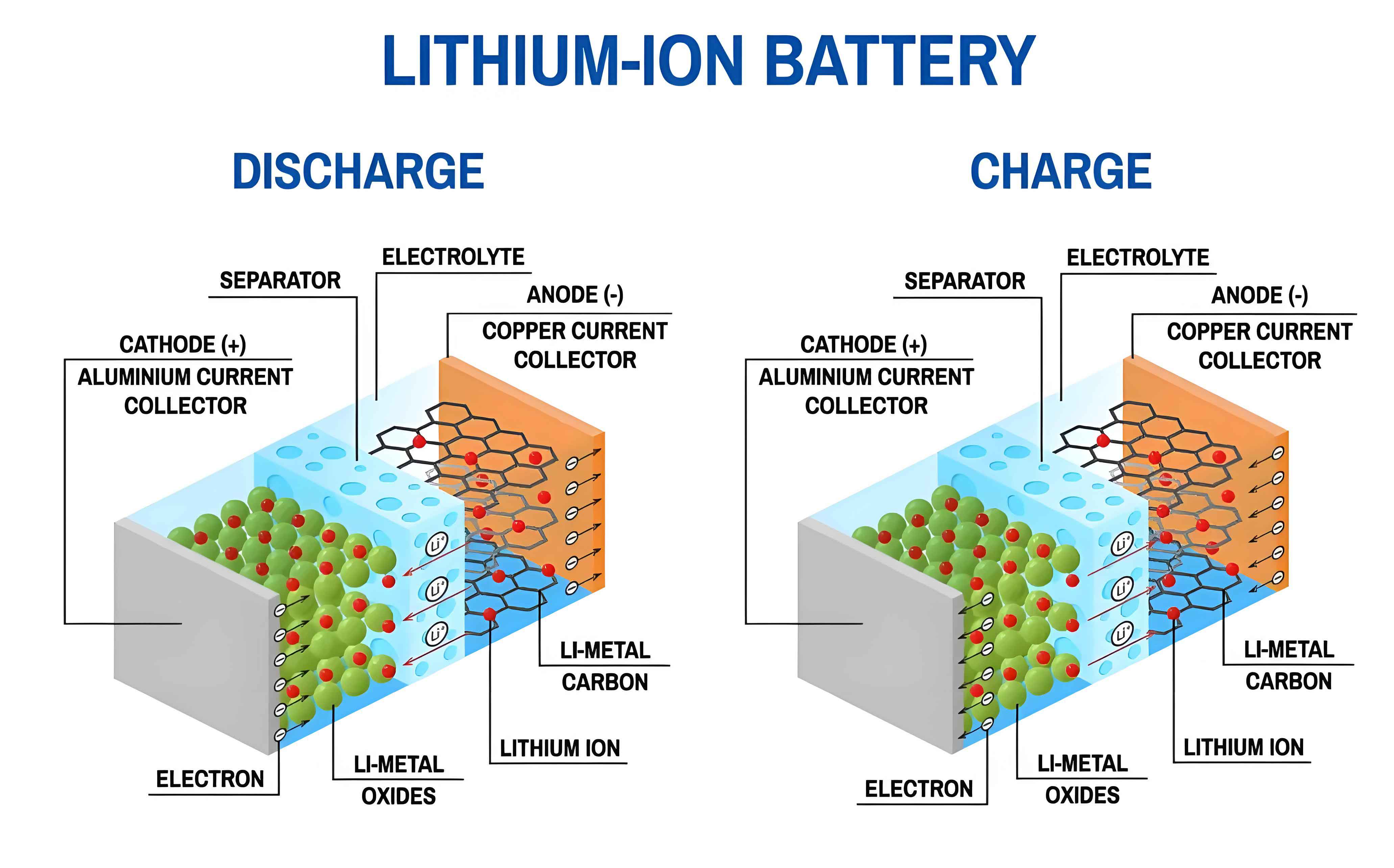
The li ion battery, particularly the 18650 cylindrical type, is ubiquitous in EV power systems due to its compact design and reliable performance. However, its thermal behavior under high discharge rates poses a critical challenge. Heat generation in a li ion battery can be modeled using the energy balance equation:
$$ Q = I^2 R + I \left( \frac{\partial U}{\partial T} \right) $$
where \( Q \) is the heat generation rate, \( I \) is the discharge current, \( R \) is the internal resistance, and \( \frac{\partial U}{\partial T} \) represents the entropy change. At high currents, the \( I^2R \) term dominates, leading to rapid temperature rise. Without adequate cooling, this can accelerate degradation, reduce cycle life, and even trigger thermal runaway. Thus, developing a robust battery thermal management system (BTMS) is essential. Immersion cooling, where the li ion battery is directly submerged in a dielectric fluid, offers a promising solution by minimizing thermal resistance and leveraging phase change for enhanced heat transfer.
In this work, I designed and built two experimental setups: one for immersion cooling and another for forced air cooling. The immersion system features a sealed glass container filled with SF33 coolant, while the air cooling setup uses a fan to maintain a 2 m/s wind speed. A programmable DC power supply controls charge-discharge cycles, and thermocouples connected to a data acquisition system monitor temperature at key points on the li ion battery surface. The SF33 coolant, with a boiling point of 33°C, low global warming potential, and zero ozone depletion, is ideal for this application. Its properties facilitate efficient heat absorption and phase change, crucial for managing li ion battery thermal loads. For consistency, all tests used 18650 li ion batteries with a nominal capacity of 2 Ah, charged to 4.2 V using a standard protocol before discharge experiments.
Experimental Setup and Methodology
The core of this study involves comparative experiments between immersion cooling and forced air cooling for li ion batteries. Table 1 summarizes the key parameters of the li ion battery and SF33 coolant used.
| Parameter | Value |
|---|---|
| Battery Type | 18650 Cylindrical |
| Nominal Voltage | 3.7 V |
| Capacity | 2 Ah |
| Mass | 45 g |
| SF33 Boiling Point | 33°C |
| SF33 Liquid Density | 1.358 g/cm³ |
| SF33 Latent Heat | 164 kJ/kg |
| SF33 Specific Heat | 1170 J/(kg·K) |
The experimental procedure began with characterizing natural convection heat dissipation for the li ion battery at 3 C and 5 C discharge rates, establishing baseline thermal behavior. Subsequently, forced air cooling (2 m/s wind speed) and immersion cooling tests were conducted under identical discharge conditions. Temperature data were recorded at three points on the li ion battery surface—top, middle, and bottom—to assess uniformity. Dynamic discharge profiles, simulating real-world EV driving patterns, were also implemented to evaluate transient thermal response. For immersion cooling, visualization of boiling phenomena was achieved using a high-speed camera, capturing bubble dynamics and heat transfer enhancement. Finally, a battery pack configuration with multiple li ion batteries was tested under immersion cooling to examine scalability and temperature homogeneity.
Results and Analysis
Natural Convection Baseline
Under natural convection, the li ion battery exhibited significant temperature rise during high-rate discharge. At 3 C, the maximum temperature reached 48.72°C, with a temperature increase (\(\Delta T\)) of 18.72°C from an ambient 30°C. For 5 C discharge, \(\Delta T\) surged to 34.59°C, peaking at 64.59°C. This underscores the inadequacy of passive cooling for li ion batteries under strenuous conditions. The temperature uniformity, however, remained within 1°C across measurement points, validating the use of the mid-point for subsequent analyses. The heat flux \(q”\) from the li ion battery surface can be estimated using Newton’s law of cooling:
$$ q” = h (T_s – T_\infty) $$
where \( h \) is the convective heat transfer coefficient, \( T_s \) is the li ion battery surface temperature, and \( T_\infty \) is the ambient temperature. For natural convection, \( h \) is typically low (5–25 W/m²·K), leading to high \( T_s \) as observed.
Comparison of Cooling Methods
Forced air cooling improved thermal management but still struggled at high rates. At 3 C discharge, the li ion battery temperature peaked at 37.95°C, while immersion cooling limited it to 35.27°C—a 2.36°C advantage. At 5 C, immersion cooling maintained the li ion battery at 35.49°C, whereas forced air cooling allowed a rise to 41.72°C, a 6.45°C difference. This demonstrates the superior heat removal capability of immersion cooling for li ion batteries. The enhanced performance stems from the higher heat transfer coefficient in immersion systems, which can be expressed for boiling as:
$$ h_{imm} = \frac{q”}{T_s – T_{sat}} $$
where \( T_{sat} \) is the saturation temperature of SF33 (33°C). During phase change, \( h_{imm} \) increases dramatically due to latent heat absorption, keeping \( T_s \) close to \( T_{sat} \). Table 2 summarizes the temperature data for both cooling methods.
| Discharge Rate | Cooling Method | Max Temperature (°C) | Temperature Rise (°C) |
|---|---|---|---|
| 3 C | Forced Air Cooling | 37.95 | 7.95 |
| Immersion Cooling | 35.27 | 5.27 | |
| 5 C | Forced Air Cooling | 41.72 | 11.72 |
| Immersion Cooling | 35.49 | 5.49 |
The data clearly indicates that immersion cooling effectively caps the li ion battery temperature near the coolant’s boiling point, irrespective of discharge rate. This is crucial for preventing thermal runaway in li ion batteries, as excessive heat can degrade electrolytes and electrodes.
Dynamic Discharge Performance
Real-world EV operation involves fluctuating power demands, making dynamic discharge profiles vital for assessment. Under a 5 C dynamic cycle (230 s discharge followed by 230 s rest, repeated three times), immersion cooling kept the li ion battery temperature between 34°C and 36°C, with fluctuations under 1°C. In contrast, forced air cooling resulted in temperature swings up to 4°C, reaching 38.44°C. The stability of immersion cooling arises from the constant boiling temperature of SF33, which acts as a thermal buffer. The heat removal rate \( \dot{Q} \) during boiling can be modeled as:
$$ \dot{Q} = \dot{m} h_{fg} + A_s h_{conv} (T_s – T_{sat}) $$
where \( \dot{m} \) is the vapor mass flow rate, \( h_{fg} \) is the latent heat, \( A_s \) is the li ion battery surface area, and \( h_{conv} \) is the convective coefficient. The phase change component dominates, enabling rapid heat dissipation even during transient loads. This ensures that li ion batteries remain within safe limits during aggressive driving scenarios.
Visualization of Boiling Phenomena
High-speed imaging revealed intricate bubble dynamics during immersion cooling of the li ion battery. Initially, small vapor bubbles nucleated at surface imperfections, such as electrode connections and seams. As discharge progressed, bubble frequency, size, and growth rate increased, enhancing turbulent mixing and heat transfer. The bubble growth process can be described by the Rayleigh equation:
$$ R(t) = \sqrt{\frac{2}{3} \frac{\Delta T \rho_l h_{fg}}{\rho_v T_{sat}} t} $$
where \( R(t) \) is bubble radius over time \( t \), \( \rho_l \) and \( \rho_v \) are liquid and vapor densities, and \( \Delta T = T_s – T_{sat} \). Bubbles departing from the li ion battery surface disrupt the thermal boundary layer, reducing contact resistance and augmenting convection. This visualization confirms that boiling is a key mechanism in immersion cooling, efficiently extracting heat from li ion batteries through latent energy absorption.
Battery Pack Immersion Cooling
Scaling to a pack configuration, multiple li ion batteries were fully submerged in SF33 within a sealed system incorporating a pump and condenser. At discharge rates of 1 C, 2 C, and 3 C, the pack temperature stabilized around 36°C, with inter-cell temperature differences below 2°C. The uniformity is attributed to the omnidirectional cooling and fluid circulation, which homogenize temperatures. The overall heat balance for the li ion battery pack can be expressed as:
$$ \sum_{i=1}^{n} Q_i = \dot{m}_c C_p (T_{out} – T_{in}) + \dot{m}_v h_{fg} $$
where \( Q_i \) is heat from each li ion battery, \( \dot{m}_c \) is coolant mass flow rate, \( C_p \) is specific heat, and \( \dot{m}_v \) is vapor mass flow rate. The system’s ability to maintain temperature consistency underscores its viability for EV battery packs, where thermal uniformity is as critical as peak temperature control.
Discussion and Implications
The findings highlight immersion cooling as a transformative approach for li ion battery thermal management. Compared to forced air cooling, it offers lower peak temperatures, reduced fluctuations, and better uniformity—all essential for extending li ion battery life and safety. The use of SF33, with its low environmental impact, aligns with sustainability goals. However, practical implementation requires addressing cost, fluid maintenance, and system integration challenges. Future work could optimize coolant properties, explore hybrid cooling systems, or investigate immersion cooling for fast-charging li ion batteries. Theoretical models, such as those incorporating multiphase flow dynamics, can further refine design guidelines.
Conclusion
This experimental study demonstrates the efficacy of immersion cooling using SF33 for li ion batteries. Under high discharge rates, immersion cooling outperformed forced air cooling by maintaining temperatures within 34–36°C, with advantages of 2.36°C at 3 C and 6.45°C at 5 C. Dynamic discharge tests revealed superior temperature stability, while visualization elucidated boiling-enhanced heat transfer. Battery pack experiments confirmed scalability and temperature homogeneity. These results advocate for immersion cooling as a robust solution for EV thermal management, ensuring li ion batteries operate safely and efficiently. As EV adoption grows, such advanced cooling strategies will be pivotal in unlocking the full potential of li ion battery technology.
In summary, the li ion battery stands as a cornerstone of modern electrification, and its thermal management cannot be overlooked. Through immersion cooling, we can harness phase change physics to achieve precise temperature control, paving the way for more reliable and durable energy storage systems. Continued innovation in this area will undoubtedly contribute to a greener, more sustainable transportation future.