
The proliferation of lithium-ion (Li-ion) batteries as the dominant energy storage solution for portable electronics and electric vehicles presents a dual challenge of resource sustainability and environmental management. As educators in physical chemistry, we possess a unique toolkit of fundamental principles that can directly illuminate the scientific pathways toward a circular economy for these essential devices. The conventional recycling paradigm, often reliant on pyrometallurgy or aggressive hydrometallurgy using mineral acids, stands in stark contrast to the principles of green chemistry. This pedagogical exploration advocates for the integration of the burgeoning field of green solvent-based recycling of spent Li-ion batteries into the core curriculum of physical chemistry. By framing advanced separation science within the established frameworks of thermodynamics, kinetics, electrochemistry, and interfacial phenomena, we can equip the next generation of scientists and engineers with the conceptual understanding necessary to innovate in sustainable technology.
1. Foundational Context: The Li-ion Battery and the Imperative for Green Recycling
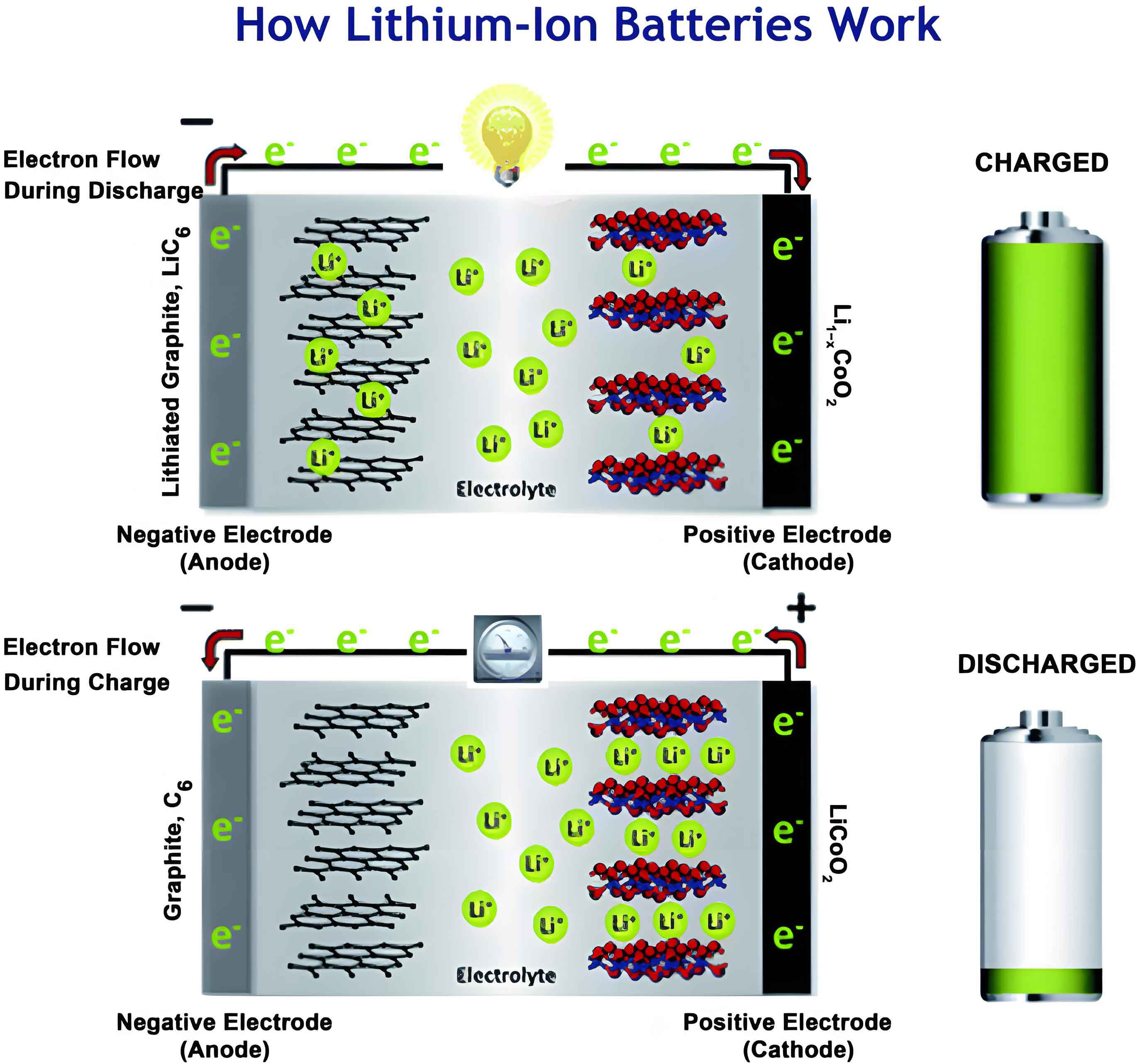
A typical Li-ion battery is a complex multicomponent system. Its value and environmental impact are concentrated in the cathode, which contains critical metals like lithium, cobalt, nickel, and manganese. The anode is typically graphite, the electrolyte is a lithium salt (e.g., LiPF6) in organic carbonate solvents, and the separator is a polymeric membrane. At end-of-life, this assembly becomes a source of valuable materials and potential pollutants. Green recycling aims to recover these materials, especially from the cathode, using environmentally benign processes. Emerging solvents like ionic liquids (ILs) and deep eutectic solvents (DESs) offer a promising alternative due to their low volatility, tunable properties, and often biocompatible components. Teaching the physical chemistry behind these processes transforms abstract principles into tangible solutions for a real-world problem centered on the li ion battery.
2. Thermodynamic Laws: Assessing the Feasibility of Recovery
The first question in any recovery process is its thermodynamic feasibility. The First Law, governing energy conservation, allows us to analyze the energetics of the leaching process. When a cathode material like LiCoO2 is dissolved in a green solvent, the internal energy change of the system ($\Delta U$) is related to the heat exchanged ($q$) and the work done ($w$). For a simple leaching reaction at constant pressure, the enthalpy change ($\Delta H$) is the primary thermal signature, measurable via calorimetry:
$$ \Delta U = q + w \quad \text{and at constant pressure:} \quad \Delta H = q_p $$
More critically, the Second Law and its derived functions determine the spontaneity and equilibrium state of the recovery reaction. For a process at constant temperature and pressure, the Gibbs free energy change ($\Delta G$) is the key criterion:
$$ \Delta G = \Delta H – T\Delta S $$
A negative $\Delta G$ indicates a spontaneous dissolution process. This framework allows students to evaluate why certain DESs, composed of choline chloride and urea, successfully leach metals while others do not. It forces consideration of both the enthalpy (e.g., breaking of crystal lattice, formation of complexes) and entropy (increased disorder upon dissolution) contributions specific to the li ion battery cathode-solvent interaction. The following table summarizes the application of thermodynamic principles:
| Thermodynamic Principle | Application in Li-ion Battery Recycling | Key Question for Students |
|---|---|---|
| First Law ($\Delta U = q + w$) | Calculating the heat effect of the leaching reaction; considering electrical work in electro-assisted leaching. | Is the leaching process exothermic or endothermic? How does energy flow? |
| Gibbs Free Energy ($\Delta G = \Delta H – T\Delta S$) | Predicting spontaneity of metal dissolution. Explaining the effect of temperature and solvent composition. | Why does a certain DES work at 180°C but not at 25°C? How can we modify $\Delta H$ or $\Delta S$ to favor leaching? |
| Chemical Potential ($\mu_i$) | Driving force for component transfer from solid cathode to the liquid solvent phase. | When does the chemical potential of Co2+ in LiCoO2 equal its potential in the solution (equilibrium)? |
3. Multi-Component Thermodynamics and Phase Equilibrium: The Solvent’s Design
Green solvents like DESs are themselves exquisite examples of multi-component non-ideal systems. A DES is formed from a hydrogen bond acceptor (HBA, e.g., choline chloride) and a hydrogen bond donor (HBD, e.g., urea, ethylene glycol). Their phase diagram is a classic binary eutectic system. Teaching this section using the DES as a case study grounds abstract concepts like composition, temperature, and phase fields in a modern, relevant context.
The drastic melting point depression compared to the individual components is explained by the significant negative deviation from ideality, related to the entropy of mixing and strong intermolecular interactions. Students learn to interpret phase diagrams to identify the eutectic composition and temperature, which is crucial for formulating a liquid solvent at low processing temperatures—a clear green chemistry advantage. Furthermore, after metals are leached, the solution becomes a true multi-component mixture. Concepts like chemical potential, $\mu_i = \mu_i^\ominus + RT \ln a_i$, and activity ($a_i$) become essential for understanding the efficiency of extraction and the design of subsequent separation steps (e.g., selective precipitation). The non-ideality of these concentrated ionic solutions can be explored using models like the extended Debye-Hückel law.
| DES Component (Example) | Role | Typical Molar Ratio (HBA:HBD) | Eutectic Point (~) |
|---|---|---|---|
| Choline Chloride (ChCl) | Hydrogen Bond Acceptor (Salt) | 1:2 | 12°C |
| Urea | Hydrogen Bond Donor | ||
| Choline Chloride (ChCl) | Hydrogen Bond Acceptor (Salt) | 1:2 | -66°C |
| Ethylene Glycol (EG) | Hydrogen Bond Donor |
Table: Examples of Deep Eutectic Solvents relevant to li ion battery recycling, demonstrating the concept of phase equilibrium and eutectic formation.
4. Chemical Equilibrium and Kinetics: The “How Fast” and “How Far” of Leaching
The dissolution of cathode active materials in green solvents is a chemical reaction. We can represent it generically for a layered oxide (e.g., LiMO2):
$$ \text{LiMO}_2(s) + \text{Solvent}(l) \rightleftharpoons \text{Li}^+(solv) + \text{M}^{n+}(solv) + \text{Products} $$
The extent of this reaction is governed by the equilibrium constant, $K$, related to the standard Gibbs free energy change: $\Delta_r G^\ominus = -RT \ln K$. Factors affecting $K$, such as temperature (via the van’t Hoff equation) and solvent composition, directly impact the ultimate recovery yield. This provides a perfect platform to discuss Le Chatelier’s principle: how can we shift the equilibrium to favor more dissolution? Increasing temperature or adding a complexing agent that binds strongly to Mn+ are practical strategies explored in li ion battery recycling research.
However, a thermodynamically favorable process ($-\Delta G$) can be useless if it is infinitely slow. This is where chemical kinetics enters. The rate of metal leaching often follows a shrinking core model or other heterogeneous rate laws. Students can apply integrated rate laws to experimental recovery vs. time data to determine the apparent order and rate constant ($k$). The temperature dependence of $k$ is then analyzed using the Arrhenius equation:
$$ k = A e^{-E_a/(RT)} $$
where $E_a$ is the activation energy. Determining $E_a$ for leaching in different DESs helps identify the most efficient solvent and mechanism (e.g., diffusion-controlled vs. chemically controlled). This bridges fundamental kinetics to process optimization for recycling the li ion battery.
5. Electrolyte Solutions and Electrochemistry: From Powering to Recycling
Electrochemistry is the heart of the li ion battery operation and also a powerful tool for its recycling. Teaching this chapter with a dual perspective—function and recovery—is highly effective.
5.1. Electrolyte Solution Properties: The ionic conductivity ($\kappa$) and molar conductivity ($\Lambda_m$) of the battery’s original electrolyte and the recycling solvent are key parameters. For a green solvent, high ionic conductivity is often desirable for electro-assisted leaching or direct electrodeposition. Students can use Kohlrausch’s law of independent migration of ions to understand conductivity behavior:
$$ \Lambda_m^\infty = \lambda_+^\infty + \lambda_-^\infty $$
Measuring the conductivity of a DES as a function of water content (used to lower viscosity) is an excellent experiment that links multi-component thermodynamics (non-ideality) with transport properties.
5.2. Reversible Cell EMF and Applied Electrochemistry: The Nernst equation describes the voltage of a working li ion battery:
$$ E = E^\ominus – \frac{RT}{nF} \ln Q $$
Its degradation can be conceptually linked to changes in reactant/product activities. More directly, electrochemistry enables selective recovery. After leaching, the solution contains multiple metal ions (e.g., Li+, Co2+, Ni2+). Their different standard reduction potentials ($E^\ominus$) allow for separation by electrolysis. The potential required to reduce a metal ion at an electrode is given by:
$$ E_{\text{dep}} = E^\ominus + \frac{RT}{nF} \ln(a_{\text{M}^{n+}}) + \eta $$
where $\eta$ is the overpotential. Students can perform calculations to determine the theoretical cell voltage needed to plate cobalt before lithium, grounding the concept of electrolysis and overpotential in the tangible goal of separating li ion battery components.
| Electrochemical Concept | Role in Battery Function | Role in Battery Recycling |
|---|---|---|
| Conductivity ($\kappa$, $\Lambda_m$) | Determines internal resistance and power capability. | Determines efficiency of electro-assisted leaching or electrodeposition in green solvents. |
| Nernst Equation | Describes cell voltage under load (state of charge). | Predicts equilibrium potentials for metal ion reduction during electrowinning. |
| Overpotential ($\eta$) | Causes voltage loss and heat generation during charge/discharge. | Determines the actual voltage needed for metal deposition; crucial for designing efficient electrolytic recovery. |
| Standard Potential ($E^\ominus$) | Defines the inherent voltage of a cell couple (e.g., Li+/Li vs. Co3+/Co2+). | Provides the basis for selectively recovering metals from a leachate (e.g., $E^\ominus$(Co2+/Co) $\ll$ $E^\ominus$(Li+/Li)). |
6. Colloid and Interface Science: The Critical First Step – Wetting and Dispersion
The recycling process begins at the interface between the solid cathode particle and the liquid green solvent. The efficiency of leaching is profoundly influenced by interfacial phenomena. The work of adhesion ($W_a$) between the solvent and the solid cathode material determines the wetting behavior:
$$ W_a = \gamma_{SV} + \gamma_{LV} – \gamma_{SL} $$
where $\gamma_{SV}$, $\gamma_{LV}$, and $\gamma_{SL}$ are the solid-vapor, liquid-vapor, and solid-liquid interfacial tensions, respectively. For spontaneous immersion (a prerequisite for good leaching), the work of immersion must be positive, which depends on these interfacial energies. A DES with a low surface tension ($\gamma_{LV}$) and a favorable interaction with the metal oxide surface (low $\gamma_{SL}$) will wet and penetrate the cathode powder more effectively. This directly relates the practical challenge of recycling the li ion battery to fundamental concepts of spreading coefficients and contact angles. Furthermore, cathode materials are often micron or nano-sized particles, making colloidal stability in the leachate an important consideration to prevent re-agglomeration and ensure complete reaction.
7. Conclusion: A Synergistic Pedagogical Framework
Integrating the green recycling of spent Li-ion batteries into the physical chemistry curriculum is not merely an add-on topic; it is a powerful, unifying framework that demonstrates the profound relevance of foundational theory to contemporary global challenges. Each major chapter of the course finds direct application:
- Thermodynamics answers whether a green solvent can dissolve a cathode.
- Phase Equilibrium guides the design of the solvent itself.
- Kinetics reveals how to make the dissolution fast and efficient.
- Electrochemistry provides tools for selective metal recovery and connects to the battery’s original function.
- Interfacial Science optimizes the crucial solid-liquid contact.
This approach moves beyond abstract problems, engaging students with a real, complex system—the li ion battery. It fosters systems thinking, where properties like viscosity, conductivity, redox activity, and surface tension are seen as interconnected and tunable through molecular design of green solvents. By framing physical chemistry as the essential language for innovating sustainable technology, we inspire students to become the scientists who will close the loop on the Li-ion battery life cycle, transforming waste into resource through the intelligent application of core scientific principles.
Through this integrated pedagogy, students do not just learn physical chemistry; they learn to use it as a tool for stewardship, viewing every spent li ion battery not as trash, but as a reservoir of value waiting to be unlocked by the precise application of thermodynamic, kinetic, and electrochemical insight.