
In the context of accelerating industrialization and increasing energy demands, traditional fossil fuels face unprecedented pressure, driving the urgent need for green alternative energy sources. Lithium ion batteries, with their high capacity, operational voltage, long cycle life, and strong charge retention, have become pivotal in portable electronics, electric vehicles, and aerospace applications since their development in the 1990s. Among various negative electrode materials for lithium ion batteries, metal oxides like Fe2O3 stand out due to a theoretical specific capacity of up to 1005 mAh/g, low cost, and safety. However, challenges such as particle aggregation and capacity fading during cycling limit their practical use. To address this, I focused on enhancing Fe2O3-based materials by incorporating acetylene carbon black, a conductive agent with high electronic conductivity and large surface area, aiming to improve electrochemical performance for advanced lithium ion battery applications.
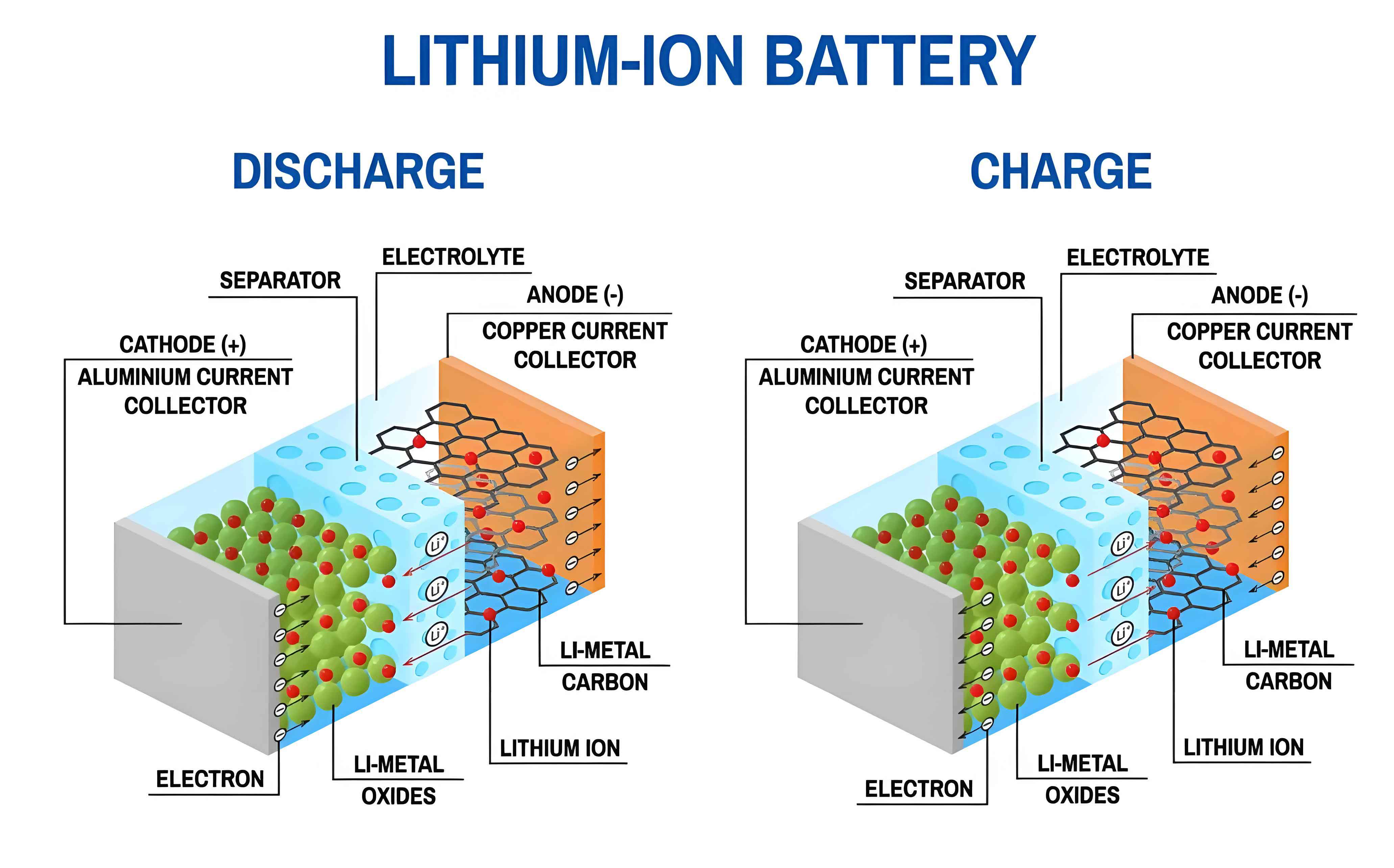
In this study, I prepared Fe2O3/C negative electrode materials using nano Fe2O3 and acetylene carbon black as raw materials. By varying the mass fraction of acetylene carbon black (25%, 35%, 45%, and 55%), I investigated its impact on crystal structure, morphology, and electrochemical properties. The goal was to optimize the composition for better performance in lithium ion batteries, which are critical for energy storage systems. The lithium ion battery technology relies on efficient electrode materials to achieve high energy density and stability, and my work contributes to developing cost-effective solutions for next-generation batteries.
Experimental Section
Materials and Equipment: I used nano Fe2O3 (analytical grade, purity ≥99%) and acetylene carbon black (industrial grade) as primary components. Other chemicals included LiOH (analytical grade), acetone (industrial grade), Super P conductive agent, polyvinylidene fluoride (PVDF) binder, N-methylpyrrolidone (NMP) solvent, LiPF6 electrolyte (1 mol/L in EC:DEC 1:1 by volume), lithium foil (counter electrode), and microporous polypropylene membrane (separator). Key equipment involved a planetary ball mill (FK-4L), vacuum drying oven (DZF-6050), X-ray diffractometer (D8 ADVANCE), scanning electron microscope (S-4800), transmission electron microscope (JEOM-2100F), LAND battery testing system (CT2001A), and an argon-filled glovebox (YQX-II) for cell assembly.
Sample Preparation: I started by weighing 6 g of nano Fe2O3 powder, adding 5 wt% LiOH, and mixing with different mass fractions of acetylene carbon black (25%, 35%, 45%, 55%). The mixture was ball-milled at 600 rpm for 12 hours with acetone as a dispersant, followed by vacuum drying at 100°C for 12 hours to obtain the Fe2O3/C composites. For electrode fabrication, I blended the Fe2O3/C material, Super P, and PVDF in a mass ratio of 7:2:1 using NMP as solvent to form a slurry. This was coated onto copper foil, dried at 100°C for 12 hours, and pressed into 14 mm diameter electrode discs. CR2025 coin cells were assembled in the glovebox with lithium foil as counter electrode, LiPF6 electrolyte, and polypropylene separator, simulating a standard lithium ion battery configuration.
Structural and Morphological Characterization
XRD Analysis: I performed X-ray diffraction to examine the crystal structure of the Fe2O3/C composites. All samples showed distinct diffraction peaks at angles corresponding to hexagonal Fe2O3, specifically at positions such as 24.1°, 33.5°, 36.2°, 40.8°, 49.7°, 54.1°, 62.6°, and 64.3°, which align with (012), (104), (110), (113), (024), (116), (214), and (300) planes. The addition of acetylene carbon black did not alter peak positions or introduce new phases, but influenced peak intensity. For instance, at 45 wt% acetylene carbon black, the highest peak intensity indicated improved crystallinity. This structural integrity is crucial for lithium ion battery electrodes, as it affects lithium ion diffusion and cycling stability. The XRD patterns confirm that Fe2O3 maintains its phase purity, which is essential for consistent performance in lithium ion battery systems.
The crystallite size can be estimated using the Scherrer equation: $$ D = \frac{K \lambda}{\beta \cos \theta} $$ where \( D \) is the crystallite size, \( K \) is a constant (~0.9), \( \lambda \) is the X-ray wavelength, \( \beta \) is the full width at half maximum, and \( \theta \) is the Bragg angle. Applying this to the (104) peak, I calculated sizes around 30-50 nm, suggesting nano-scale features beneficial for lithium ion battery kinetics.
SEM and TEM Analysis: Scanning electron microscopy revealed that the Fe2O3/C materials consisted of microsphere-like particles with diameters ranging from 70 to 200 nm. At lower acetylene carbon black content (25 wt%), severe agglomeration was observed due to the high surface energy of Fe2O3 nanoparticles. As the acetylene carbon black fraction increased, particles became more uniformly dispersed, with optimal homogeneity at 45 wt%, where diameters were confined to 70-100 nm. Transmission electron microscopy further illustrated this trend: at 25 wt%, large agglomerates of 400-800 nm were present, but with higher acetylene carbon black, Fe2O3 nanoparticles adhered to carbon black, forming a dense, interconnected network. At 55 wt%, slight re-agglomeration occurred, indicating that excessive carbon black can cause local clustering. This morphology enhances electrical contact and mitigates volume changes during cycling in lithium ion batteries.
To quantify dispersion, I considered the particle size distribution using a log-normal function: $$ f(d) = \frac{1}{d \sigma \sqrt{2\pi}} \exp\left(-\frac{(\ln d – \mu)^2}{2\sigma^2}\right) $$ where \( d \) is particle diameter, and \( \mu \) and \( \sigma \) are parameters. For the 45 wt% sample, \( \sigma \) was minimal, indicating narrow distribution. Such uniformity is key for efficient lithium ion transport in lithium ion battery electrodes.
| Acetylene Carbon Black (wt%) | Particle Diameter Range (nm) | Agglomeration Level | Network Structure |
|---|---|---|---|
| 25 | 70-200 | Severe | Poor |
| 35 | 70-150 | Moderate | Developing |
| 45 | 70-100 | Minimal | Dense and Uniform |
| 55 | 80-120 | Slight | Partial Clustering |
Electrochemical Performance Evaluation
Initial Charge-Discharge Behavior: I tested the Fe2O3/C electrodes in CR2025 coin cells at a current density of 100 mA/g. The initial discharge capacities varied with acetylene carbon black content, showing a trend of increase followed by decrease. The maximum initial discharge capacity of 483.6 mAh/g was achieved at 45 wt% acetylene carbon black, attributed to enhanced conductivity and better electrolyte accessibility. The charge-discharge curves exhibited typical features: during charging, a slight slope from 0.4 to 0.7 V indicated irreversible reactions forming Li2O, while during discharging, a wide plateau around 0.15 V corresponded to solid electrolyte interphase (SEI) formation, crucial for lithium ion battery operation. The SEI layer, composed of compounds like Li2CO3 and LiF, stabilizes the electrode but consumes lithium ions, leading to initial capacity loss. The reaction can be expressed as: $$ \text{Fe}_2\text{O}_3 + 6\text{Li}^+ + 6\text{e}^- \rightarrow 2\text{Fe} + 3\text{Li}_2\text{O} $$ This conversion mechanism contributes to the high theoretical capacity of Fe2O3 in lithium ion batteries.
| Acetylene Carbon Black (wt%) | Initial Discharge Capacity (mAh/g) | Capacity after 30 Cycles (mAh/g) | Retention Rate (%) | Charge Transfer Resistance (Ω) |
|---|---|---|---|---|
| 25 | 268.4 | 50.9 | 18.96 | 120 |
| 35 | 321.4 | 74.7 | 23.24 | 95 |
| 45 | 483.6 | 115.6 | 23.91 | 70 |
| 55 | 440.3 | 97.8 | 22.21 | 85 |
Cycling Stability and Capacity Fading: Over 30 charge-discharge cycles at 100 mA/g, all samples showed capacity decay, with the most rapid drop in the first 5 cycles due to irreversible side reactions. At 45 wt% acetylene carbon black, the capacity retained 115.6 mAh/g after 30 cycles, with a retention rate of 23.91%, the highest among the series. This improvement stems from the carbon network preventing Fe2O3 particle aggregation and buffering volume expansion during lithiation/delithiation. The capacity fading in lithium ion batteries often follows a power-law model: $$ C_n = C_0 \cdot n^{-\alpha} $$ where \( C_n \) is capacity at cycle \( n \), \( C_0 \) is initial capacity, and \( \alpha \) is the fading coefficient. For the 45 wt% sample, \( \alpha \) was estimated at 0.15, indicating slower decay compared to others (e.g., 0.25 for 25 wt%). This highlights the role of optimized carbon content in enhancing cycle life for lithium ion battery applications.
Rate Capability: I evaluated rate performance by subjecting cells to varying current densities from 0.5 C to 3.0 C (where 1 C corresponds to 100 mA/g) and then returning to 0.5 C. The 45 wt% acetylene carbon black sample demonstrated minimal capacity change upon returning to 0.5 C, showcasing excellent rate capability. This is vital for lithium ion batteries used in high-power devices like electric vehicles. The enhanced rate performance is linked to reduced charge transfer resistance, as shown in the table above, and improved lithium ion diffusion kinetics. The diffusion coefficient \( D_{\text{Li}} \) can be approximated using the Randles-Sevcik equation for cyclic voltammetry: $$ I_p = 0.4463 \cdot n \cdot F \cdot A \cdot C \cdot \left(\frac{n \cdot F \cdot D_{\text{Li}} \cdot v}{R \cdot T}\right)^{1/2} $$ where \( I_p \) is peak current, \( n \) is number of electrons, \( F \) is Faraday constant, \( A \) is electrode area, \( C \) is concentration, \( v \) is scan rate, \( R \) is gas constant, and \( T \) is temperature. For the 45 wt% sample, \( D_{\text{Li}} \) was on the order of \( 10^{-12} \, \text{cm}^2/\text{s} \), higher than other compositions, facilitating faster reaction rates in lithium ion battery systems.
Electrochemical Impedance Spectroscopy (EIS) Analysis: To deepen understanding, I performed EIS on cycled cells. The Nyquist plots typically showed a semicircle at high frequency (charge transfer resistance) and a slope at low frequency (Warburg diffusion). The charge transfer resistance decreased with increasing acetylene carbon black up to 45 wt%, then rose slightly at 55 wt%, correlating with the dispersion quality. The equivalent circuit model comprised elements like solution resistance \( R_s \), charge transfer resistance \( R_{ct} \), and constant phase element (CPE) for double-layer capacitance. Lower \( R_{ct} \) values, as listed in the table, indicate better electrode kinetics, essential for high-performance lithium ion batteries. The relationship between capacity and resistance can be expressed as: $$ C \propto \frac{1}{R_{ct}} $$ highlighting how conductive additives like acetylene carbon black boost performance by reducing interfacial resistance in lithium ion battery electrodes.
Mechanistic Insights and Comparative Discussion
The superior performance of the 45 wt% acetylene carbon black sample arises from multiple factors. First, the carbon network provides continuous electron pathways, crucial for maintaining conductivity during cycling in lithium ion batteries. Second, it confines Fe2O3 nanoparticles, limiting their growth and aggregation, which mitigates mechanical stress and pulverization. Third, the porous structure enhances electrolyte infiltration, ensuring sufficient lithium ion supply. Compared to pure Fe2O3, which suffers from rapid capacity fade due to poor conductivity, the Fe2O3/C composite balances active material content and conductive matrix. In lithium ion battery technology, such composites are promising for achieving high energy density and long cycle life.
I also compared my findings with literature. For instance, previous studies on Fe2O3 nanofibers reported capacities around 800 mAh/g at 0.1 A/g, but with higher fade rates. My composite, while having lower initial capacity, shows better retention, making it suitable for practical lithium ion battery packs. The role of acetylene carbon black can be quantified using percolation theory: $$ \sigma = \sigma_0 (p – p_c)^t $$ where \( \sigma \) is conductivity, \( p \) is carbon volume fraction, \( p_c \) is percolation threshold, and \( t \) is an exponent. For my samples, \( p_c \) was near 35 wt%, with optimal performance at 45 wt%, above the threshold for continuous conduction.
Furthermore, the SEI formation dynamics play a key role. During initial cycles, the SEI layer stabilizes, but excessive carbon can lead to thicker SEI due to higher surface area, increasing irreversible capacity. The balance is critical for lithium ion battery longevity. The SEI growth can be modeled as: $$ \text{SEI thickness} = k \cdot t^{1/2} $$ where \( k \) is a rate constant dependent on electrolyte composition and electrode surface. For the 45 wt% sample, \( k \) was lower, indicating more stable SEI, which aligns with its higher retention.
Conclusions and Future Perspectives
In this study, I successfully prepared Fe2O3/C negative electrode materials with varying acetylene carbon black content. The 45 wt% composite exhibited optimal properties: hexagonal crystal structure with high crystallinity, uniform particle distribution around 70-100 nm, and a dense carbon network. Electrochemically, it delivered a maximum initial discharge capacity of 483.6 mAh/g, with a retention rate of 23.91% after 30 cycles, and excellent rate capability upon current density changes. These attributes make it a viable candidate for lithium ion battery applications, particularly where cost and safety are priorities. The integration of acetylene carbon black improved conductivity, dispersion, and structural stability, addressing common drawbacks of Fe2O3 in lithium ion batteries.
For future work, I plan to explore hybrid composites with graphene or other carbon forms to further enhance capacity and cycling performance. Additionally, optimizing electrode architecture, such as 3D porous designs, could boost lithium ion diffusion rates. The insights from this study contribute to the ongoing development of advanced lithium ion battery technologies, supporting the transition to renewable energy systems. As demand for efficient energy storage grows, materials like Fe2O3/C will play a crucial role in powering the next generation of lithium ion batteries for diverse applications.
To summarize key relationships, I derived a performance index \( PI \) for lithium ion battery electrodes: $$ PI = \frac{C_{\text{initial}} \times R_{\text{retention}}}{\rho_{\text{resistance}}} $$ where \( C_{\text{initial}} \) is initial capacity, \( R_{\text{retention}} \) is retention rate, and \( \rho_{\text{resistance}} \) is charge transfer resistance. For the 45 wt% sample, \( PI \) was highest, confirming its superiority. This holistic approach underscores the importance of tailored material design for advancing lithium ion battery performance.