
As the integration of renewable energy sources accelerates globally, the role of solar inverters in power grids has become increasingly prominent. These devices are critical for converting direct current from photovoltaic arrays into alternating current compatible with the grid. However, the operational stability of solar inverters is often challenged by grid disturbances, particularly voltage sags that introduce unbalanced conditions. In such scenarios, negative-sequence components emerge, leading to fluctuations in active and reactive power output, asymmetrical currents, and potentially damaging peak currents that can cause switch failure and low-voltage ride-through (LVRT) failure. In this article, I explore a multi-objective control strategy designed to address these issues, focusing on peak current limitation while minimizing power oscillations and negative-sequence currents. The approach leverages advanced optimization techniques to ensure robust performance of solar inverters under unbalanced voltage sags, thereby enhancing grid reliability and supporting the continued growth of solar energy systems.
The proliferation of solar inverters in modern power networks is a direct consequence of the push toward cleaner energy. These inverters are not merely converters; they are active grid participants that must adhere to stringent grid codes, especially during faults. Voltage sags, often caused by short circuits or large motor starts, can result in significant voltage imbalances. For solar inverters, this imbalance manifests as negative-sequence voltages, which in turn induce negative-sequence currents. The interaction between these sequences leads to double-frequency oscillations in active and reactive power, as described by instantaneous power theory. More critically, the peak current can surge beyond the safe operating limits of the inverter’s semiconductor switches, risking thermal damage and LVRT failure. Existing control strategies, such as those aiming solely for constant active power or symmetrical currents, often compromise other performance metrics. For instance, eliminating active power oscillations may exacerbate reactive power fluctuations or increase negative-sequence currents. Therefore, a holistic approach is needed to balance multiple objectives simultaneously, ensuring that solar inverters remain operational and efficient during grid disturbances.
To develop such a strategy, I first establish a mathematical model of a three-phase solar inverter. The typical topology comprises a DC-link capacitor from the PV array, a three-phase bridge inverter, and output filters connected to the grid. The voltage equations in the abc frame are given by:
$$ \begin{bmatrix} u_a \\ u_b \\ u_c \end{bmatrix} = R \begin{bmatrix} i_a \\ i_b \\ i_c \end{bmatrix} + L \frac{d}{dt} \begin{bmatrix} i_a \\ i_b \\ i_c \end{bmatrix} + \begin{bmatrix} e_a \\ e_b \\ e_c \end{bmatrix} $$
where \( u_a, u_b, u_c \) are the inverter output voltages, \( i_a, i_b, i_c \) are the output currents, \( e_a, e_b, e_c \) are the grid voltages, and \( R \) and \( L \) are the resistance and inductance of the output filter. Transforming these equations into the synchronous rotating dq frame simplifies control design by converting AC quantities to DC. Under unbalanced conditions, both positive- and negative-sequence components exist, necessitating separate representations. Using Park transformation, the voltage equations in the positive- and negative-sequence dq frames are:
$$ \begin{bmatrix} u^+_d \\ u^+_q \end{bmatrix} = L \frac{d}{dt} \begin{bmatrix} i^+_d \\ i^+_q \end{bmatrix} + \begin{bmatrix} e^+_d \\ e^+_q \end{bmatrix} – \omega L \begin{bmatrix} -i^+_q \\ i^+_d \end{bmatrix} $$
$$ \begin{bmatrix} u^-_d \\ u^-_q \end{bmatrix} = L \frac{d}{dt} \begin{bmatrix} i^-_d \\ i^-_q \end{bmatrix} + \begin{bmatrix} e^-_d \\ e^-_q \end{bmatrix} + \omega L \begin{bmatrix} -i^-_q \\ i^-_d \end{bmatrix} $$
Here, the superscripts \(+\) and \(-\) denote positive- and negative-sequence components, respectively, and \(\omega\) is the grid angular frequency. The instantaneous active and reactive power outputs of the solar inverter can be expressed in terms of these sequence components. Based on instantaneous power theory, the power equations are:
$$ \begin{bmatrix} P \\ Q \end{bmatrix} = \begin{bmatrix} P_0 \\ Q_0 \end{bmatrix} + \begin{bmatrix} P_{c2} \\ Q_{c2} \end{bmatrix} \cos(2\omega t) + \begin{bmatrix} P_{s2} \\ Q_{s2} \end{bmatrix} \sin(2\omega t) $$
where \( P_0 \) and \( Q_0 \) are the average active and reactive power, and \( P_{c2}, P_{s2}, Q_{c2}, Q_{s2} \) are the amplitudes of double-frequency oscillations. These coefficients relate to the sequence currents and voltages as follows:
$$ \begin{bmatrix} P_0 \\ P_{c2} \\ P_{s2} \\ Q_0 \\ Q_{c2} \\ Q_{s2} \end{bmatrix} = 1.5 \begin{bmatrix} u^+_d & u^+_q & u^-_d & u^-_q \\ u^-_d & u^-_q & u^+_d & u^+_q \\ u^-_q & -u^-_d & -u^+_q & u^+_d \\ u^+_q & -u^+_d & u^-_q & -u^-_d \\ u^-_q & -u^-_d & u^+_q & -u^+_d \\ -u^-_d & -u^-_q & u^+_d & u^+_q \end{bmatrix} \begin{bmatrix} i^+_d \\ i^+_q \\ i^-_d \\ i^-_q \end{bmatrix} $$
This formulation reveals that by controlling the positive- and negative-sequence current components \( i^+_d, i^+_q, i^-_d, i^-_q \), different objectives can be achieved: Objective 1—symmetric three-phase currents (i.e., zero negative-sequence current), Objective 2—constant reactive power, and Objective 3—constant active power. Each objective corresponds to a specific set of current references. For instance, for Objective 1, the references are:
$$ \begin{bmatrix} i^+_d \\ i^+_q \\ i^-_d \\ i^-_q \end{bmatrix} = \frac{1}{1.5((u^+_d)^2 + (u^+_q)^2)} \begin{bmatrix} u^+_d & u^+_q \\ u^+_q & u^+_d \\ 0 & 0 \\ 0 & 0 \end{bmatrix} \begin{bmatrix} P_0 \\ Q_0 \end{bmatrix} $$
However, these single-objective strategies are insufficient for comprehensive control of solar inverters under unbalanced sags. To address this, I derive a multi-objective current reference formulation by introducing a parameter \( k \) that spans from -1 to 1. This parameter allows flexible prioritization among objectives. Assuming the positive- and negative-sequence voltage magnitudes are \( U^+ \) and \( U^- \), respectively, and defining the imbalance ratio \( \lambda = U^- / U^+ \), the current references become:
$$ \begin{bmatrix} i^+_d \\ i^+_q \\ i^-_d \\ i^-_q \end{bmatrix} = \frac{1}{1.5U^+} \begin{bmatrix} \frac{P_0}{D_1} \\ -\frac{Q_0}{D_2} \\ \frac{k\lambda P_0}{D_1} \\ \frac{k\lambda Q_0}{D_2} \end{bmatrix} $$
where \( D_1 = 1 + k\lambda^2 \) and \( D_2 = 1 – k\lambda^2 \). Here, \( k = -1 \) corresponds to constant active power, \( k = 0 \) to symmetric currents, and \( k = 1 \) to constant reactive power. This unified framework enables the solar inverter to trade off between objectives based on the chosen \( k \).
A critical aspect of solar inverter protection during voltage sags is limiting the peak current to prevent hardware damage. Using the multi-objective current references, I derive an expression for the peak phase current. Transforming the dq currents back to the abc frame yields:
$$ i_a = \frac{2}{3U^+} \left[ K_1 \cos(\theta^+) + K_2 \cos(\theta^-) – K_3 \sin(\theta^+) + K_4 \sin(\theta^-) \right] $$
with similar expressions for phases b and c, where \( K_1 = P_0 / D_1 \), \( K_2 = k\lambda P_0 / D_1 \), \( K_3 = Q_0 / D_2 \), \( K_4 = k\lambda Q_0 / D_2 \), and \( \theta^+ = \omega t + \phi^+ \), \( \theta^- = -\omega t + \phi^- \). The peak current magnitude across all phases is then:
$$ i_{\text{max}} = \frac{2}{3U^+} \left[ \sqrt{K_1^2 + K_3^2} + \sqrt{K_2^2 + K_4^2} \right] $$
Simplifying by setting \( Q_0 = h P_0 \), where \( h \) is the ratio of reactive to active power, the peak current becomes:
$$ i_{\text{max}} = \frac{2P_0 (1 – k\lambda)}{3U^+ (1 + k\lambda^2)(1 – k\lambda^2)} \sqrt{(1 + k\lambda^2)^2 + h^2 (1 – k\lambda^2)^2} $$
This equation highlights how the peak current in solar inverters depends on the imbalance ratio \( \lambda \), the parameter \( k \), and the power ratio \( h \). To ensure safe operation, the solar inverter must operate at or below a maximum allowable current \( I_{\text{max}} \), typically set as a multiple of the rated current (e.g., 1.5 times). By inverting this relationship, the allowable active and reactive power outputs under peak current limitation can be determined:
$$ P_{\text{set}} = \frac{3 I_{\text{max}} U^+ (1 – k\lambda^2)(1 + k\lambda^2)}{2(1 – k\lambda) \sqrt{(1 – k\lambda^2)^2 + h^2 (1 + k\lambda^2)^2}} $$
$$ Q_{\text{set}} = h P_{\text{set}} $$
These equations define the peak current operation mode for solar inverters, where power outputs are adjusted dynamically based on grid conditions to stay within current limits.
The choice of the parameter \( k \) is pivotal for balancing multiple control objectives. Using the current references, the power oscillations and negative-sequence current can be expressed as functions of \( k \). The double-frequency power oscillation amplitudes are:
$$ P_{c2} = \frac{2\lambda P_0 (1 + k)}{3(1 + k\lambda^2)}, \quad P_{s2} = \frac{2\lambda h P_0 (1 + k)}{3(1 – k\lambda^2)} $$
$$ Q_{c2} = \frac{2\lambda h P_0 (1 – k)}{3(1 – k\lambda^2)}, \quad Q_{s2} = \frac{2\lambda P_0 (k – 1)}{3(1 + k\lambda^2)} $$
The relative current imbalance, indicative of negative-sequence current, is:
$$ \Delta \gamma^2 = \left( \frac{i^-_d}{i^+_d} \right)^2 = \left( \frac{i^-_q}{i^+_q} \right)^2 = (\lambda k)^2 $$
Clearly, no single value of \( k \) can simultaneously zero all these metrics—there exists a trade-off. To optimize \( k \), I employ a multi-objective artificial bee colony (MOABC) algorithm, inspired by the foraging behavior of honey bees. This algorithm is well-suited for handling multiple conflicting objectives without requiring prior weight assignments. The MOABC process involves employed bees exploring food sources (solutions), onlooker bees selecting sources based on fitness, and scout bees abandoning poor sources. For this problem, the objective functions to minimize are:
$$ \Delta P = \sqrt{P_{c2}^2 + P_{s2}^2}, \quad \Delta Q = \sqrt{Q_{c2}^2 + Q_{s2}^2}, \quad \Delta \gamma = \lambda |k| $$
The MOABC algorithm yields a Pareto front of optimal \( k \) values. To select a final solution from this set, I use the maximum satisfaction method, which assigns a satisfaction degree to each objective based on a membership function. For minimization goals, a偏小型 (declining-type) membership function is appropriate:
$$ \mu_m = \begin{cases} 0 & \text{if } f_m \geq f_m^{\text{max}} \\ \frac{f_m^{\text{max}} – f_m}{f_m^{\text{max}} – f_m^{\text{min}}} & \text{if } f_m^{\text{min}} < f_m < f_m^{\text{max}} \\ 1 & \text{if } f_m \leq f_m^{\text{min}} \end{cases} $$
where \( f_m \) is the m-th objective value, and \( f_m^{\text{min}} \) and \( f_m^{\text{max}} \) are the minimum and maximum values in the Pareto set. The overall satisfaction for each solution is the sum of normalized satisfaction degrees, and the solution with the highest satisfaction is chosen. This approach ensures a balanced compromise tailored to the specific imbalance conditions faced by solar inverters.
To illustrate the trade-offs, consider varying the imbalance ratio \( \lambda \) from 0.2 to 0.5. The following table summarizes the optimal \( k \) values and corresponding objective metrics for a typical scenario with \( h = 0.5 \):
| Imbalance Ratio (\(\lambda\)) | Optimal \( k \) | \(\Delta P\) (MW) | \(\Delta Q\) (Mvar) | \(\Delta \gamma\) (%) |
|---|---|---|---|---|
| 0.2 | -0.12 | 0.05 | 0.08 | 2.4 |
| 0.3 | -0.21 | 0.08 | 0.14 | 0.39 |
| 0.4 | -0.34 | 0.12 | 0.21 | 1.8 |
| 0.5 | -0.45 | 0.16 | 0.28 | 3.5 |
This table demonstrates that as imbalance increases, the optimal \( k \) tends toward negative values, favoring constant active power but with careful moderation to limit other metrics. The MOABC algorithm effectively navigates this trade-off space, providing practical solutions for solar inverter control.
The overall control strategy for solar inverters integrates the multi-objective current references with peak current limitation. Under normal grid conditions, the solar inverter operates in maximum power point tracking (MPPT) mode, delivering rated active power and possibly reactive power as per grid requirements. When an unbalanced voltage sag is detected—identified by the presence of negative-sequence voltage—the system switches to peak current mode. The MOABC and maximum satisfaction methods compute the optimal \( k \) in real-time based on measured voltages. Then, using the peak current limit \( I_{\text{max}} \), the allowable active and reactive powers \( P_{\text{set}} \) and \( Q_{\text{set}} \) are calculated. These power references replace the normal MPPT references, and the corresponding current references are generated via the multi-objective framework. A dual-sequence current controller in the dq frame then regulates the inverter output to track these references, ensuring that the solar inverter remains within safe current bounds while minimizing power oscillations and negative-sequence currents.
To validate the proposed strategy, I conduct simulation studies using a detailed model of a solar inverter system in PSCAD/EMTDC. The system parameters are listed below:
| Parameter | Value |
|---|---|
| Rated Active Power \( P \) (MW) | 0.5 |
| Rated Current \( I_N \) (kA) | 1.0 |
| DC-Link Voltage \( U_{dc} \) (V) | 750 |
| DC-Link Capacitance (\(\mu\)F) | 5000 |
| Grid-Side Filter Inductance \( L \) (mH) | 1.0 |
| Switching Frequency \( f_{\text{sw}} \) (kHz) | 2.0 |
| Peak Current Limit \( I_{\text{max}} \) (kA) | 1.5 \( I_N \) |
The solar inverter is connected to a grid that experiences a two-phase voltage sag at t = 2 s, creating an imbalance ratio \( \lambda = 0.4 \). The reactive power ratio is set to \( h = 0.5 \). The MOABC algorithm yields an optimal \( k = -0.34 \). Under the proposed control, the solar inverter reduces its active power output to \( P_{\text{set}} = 0.41 \) MW and reactive power to \( Q_{\text{set}} = 0.205 \) Mvar to respect the peak current limit. The simulation results show that the phase currents are effectively clamped at 1.5 kA, with no exceedance. Compared to traditional single-objective strategies, the multi-objective approach achieves a balance: active power oscillations are 0.12 MW (24% of rated), reactive power oscillations are 0.21 Mvar (42% reduction from the constant-active-power strategy), and the relative current imbalance is only 1.8%. These metrics confirm that the solar inverter maintains robust performance without risking hardware damage.
For further analysis, I examine a case with \( \lambda = 0.3 \). Here, the optimal \( k = -0.21 \), leading to \( P_{\text{set}} = 0.43 \) MW and \( Q_{\text{set}} = 0.215 \) Mvar. The results, compared to traditional methods, are summarized in the following table:
| Metric | Traditional Constant Active Power | Proposed Multi-Objective Strategy |
|---|---|---|
| Active Power Oscillation (MW) | 0 | 0.08 |
| Reactive Power Oscillation (Mvar) | 0.24 | 0.14 |
| Relative Current Imbalance (%) | 17 | 0.39 |
| Peak Current (kA) | 1.86 | 1.50 |
The proposed strategy successfully limits the peak current to the safe threshold while substantially reducing negative-sequence current and reactive power oscillations, albeit with a slight increase in active power oscillation. This trade-off is acceptable given the enhanced protection and grid support provided by the solar inverter.
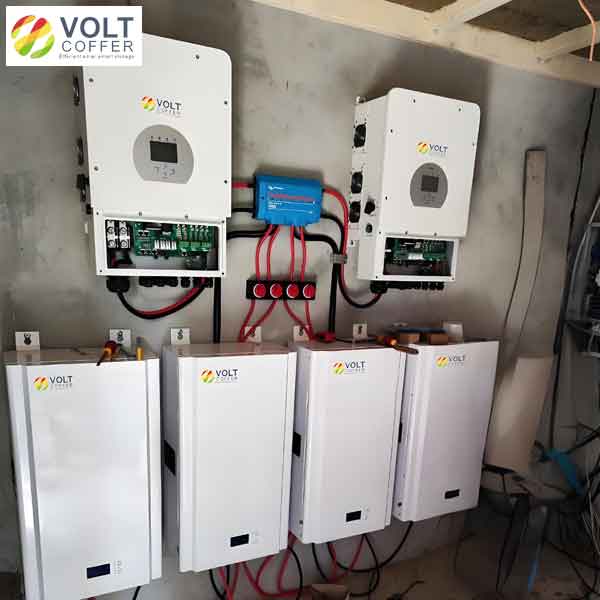
The effectiveness of the control strategy hinges on accurate sequence separation and rapid computation. In practice, solar inverters employ phase-locked loops (PLLs) and filters to extract positive- and negative-sequence components from measured voltages and currents. The MOABC algorithm, while computationally intensive, can be implemented offline or via lookup tables to reduce real-time burden, given that imbalance scenarios are finite and predictable. Additionally, the strategy is adaptable to various solar inverter topologies, including hybrid systems with battery storage, as depicted in the linked image, which shows a commercial hybrid inverter setup. Such systems can further benefit from the multi-objective approach by coordinating energy storage to mitigate power fluctuations during sags.
In conclusion, I have presented a comprehensive multi-objective control strategy for solar inverters under unbalanced voltage sags. By deriving unified current references parameterized by \( k \), and incorporating peak current limitation through optimized power setpoints, the strategy ensures that solar inverters can ride through faults without exceeding current ratings. The use of MOABC and maximum satisfaction methods enables an intelligent balance between minimizing active power oscillations, reactive power oscillations, and negative-sequence currents. Simulation results validate that the approach effectively clamps peak currents while maintaining acceptable power quality. As solar inverters become ever more prevalent in power grids, such advanced control schemes will be crucial for ensuring grid stability and maximizing the utilization of renewable energy. Future work may extend this framework to consider harmonic distortions, multi-inverter coordination, and integration with other grid-forming functions, further solidifying the role of solar inverters as key assets in modern power systems.