
As a researcher in the field of renewable energy systems, I have always been fascinated by the potential of solar power generation. Solar photovoltaic (PV) systems are at the forefront of green energy technologies, and at the heart of these systems lie solar inverters, which convert DC power from PV panels into AC power for grid integration or local consumption. The performance of solar inverters is critical for system efficiency, reliability, and power quality. In this article, I will delve into the design and control of three-phase solar inverters, with a focus on addressing the challenge of unbalanced loads. Traditional three-leg inverters perform well under balanced conditions but struggle to maintain symmetrical output voltages when loads are asymmetric. Through my work, I explore a three-phase four-leg inverter topology combined with advanced modulation techniques, such as three-dimensional space vector pulse width modulation (3D-SVPWM), to ensure robust operation in unbalanced scenarios. This discussion will include mathematical modeling, control strategies, simulation results, and practical insights, all aimed at enhancing the capabilities of solar inverters in modern power systems.
The importance of solar inverters cannot be overstated in the context of global energy transition. They enable the integration of distributed solar resources into the grid, supporting decarbonization goals. However, as load diversity increases in residential, commercial, and industrial settings, three-phase systems often face unbalanced loads due to single-phase appliances, fault conditions, or uneven distribution. This imbalance can lead to voltage asymmetries, increased harmonics, and reduced power quality, ultimately affecting equipment performance and grid stability. Therefore, developing solar inverters that can mitigate these issues is essential. My approach involves a four-leg inverter structure, which adds a neutral leg to provide independent control over the neutral point voltage, allowing for symmetrical output even under unbalanced conditions. This topology, coupled with sophisticated control algorithms, represents a significant advancement in solar inverter technology.
To understand the core problem, let’s consider the mathematical foundation of three-phase inverters. In a traditional three-leg inverter, the output voltages are derived from switching states of three bridge legs. Under balanced loads, the system can be analyzed using dq-axis transformations, simplifying control design. However, under unbalanced loads, the dq-axis components contain alternating terms that distort the output. The differential equations for a three-phase four-leg inverter can be derived as follows. Let the phase voltages be represented as controlled voltage sources, and define the system parameters: L as the filter inductance, C as the filter capacitance, U_DC as the DC bus voltage, and load currents as I_Lu, I_Lv, I_Lw. The equations in the uvw frame are:
$$ L \frac{d}{dt} \begin{bmatrix} I_u \\ I_v \\ I_w \end{bmatrix} = L_n \frac{d}{dt} \begin{bmatrix} I_n \\ I_n \\ I_n \end{bmatrix} + \frac{U_{DC}}{2} \begin{bmatrix} d_{uf} \\ d_{vf} \\ d_{wf} \end{bmatrix} – \begin{bmatrix} U_{un} \\ U_{vn} \\ U_{wn} \end{bmatrix} $$
$$ \frac{d}{dt} \begin{bmatrix} U_{un} \\ U_{vn} \\ U_{wn} \end{bmatrix} = \frac{1}{C} \left( \begin{bmatrix} I_u \\ I_v \\ I_w \end{bmatrix} – \begin{bmatrix} I_{Lu} \\ I_{Lv} \\ I_{Lw} \end{bmatrix} \right) $$
Here, d_uf, d_vf, d_wf are the duty cycles for each phase, and I_n is the neutral current. By applying Clarke and Park transformations, we convert these to the αβγ and dq0 frames for easier control. The transformation matrix T for Park transformation is:
$$ T = \frac{2}{3} \begin{bmatrix} \sin(\omega t) & \sin(\omega t – \frac{2\pi}{3}) & \sin(\omega t + \frac{2\pi}{3}) \\ \cos(\omega t) & \cos(\omega t – \frac{2\pi}{3}) & \cos(\omega t + \frac{2\pi}{3}) \\ \frac{1}{2} & \frac{1}{2} & \frac{1}{2} \end{bmatrix} $$
After transformation, the differential equations in the dq0 frame become:
$$ \frac{d}{dt} \begin{bmatrix} I_d \\ I_q \\ I_0 \end{bmatrix} = \frac{U_{DC}}{2} G \begin{bmatrix} d_d \\ d_q \\ d_0 \end{bmatrix} – G \begin{bmatrix} U_d \\ U_q \\ U_0 \end{bmatrix} + \omega \begin{bmatrix} I_q \\ -I_d \\ 0 \end{bmatrix} $$
$$ \frac{d}{dt} \begin{bmatrix} U_d \\ U_q \\ U_0 \end{bmatrix} = \omega \begin{bmatrix} U_q \\ -U_d \\ 0 \end{bmatrix} + \frac{1}{C} \left( \begin{bmatrix} I_d \\ I_q \\ I_0 \end{bmatrix} – \begin{bmatrix} I_{Ld} \\ I_{Lq} \\ I_{L0} \end{bmatrix} \right) $$
where G is a diagonal matrix incorporating inductances: G = diag(1/L, 1/L, 1/(L + 3L_n)). This formulation highlights how unbalanced load currents introduce AC components in the dq axes, leading to voltage asymmetries. To address this, I employ a closed-loop control strategy with proportional-integral (PI) regulators and a resonant controller tuned to suppress 100 Hz oscillations. The voltage controller is designed as:
$$ G_U(s) = K_p + \frac{K_I}{s} + \frac{K_I s}{s^2 + 4\omega_0^2} $$
with ω_0 = 2π × 50 rad/s. This enhances the system’s ability to reject disturbances from unbalanced loads, ensuring that the output voltages remain symmetrical. Such control innovations are vital for modern solar inverters, which must operate reliably in diverse grid conditions.
The topology of the three-phase four-leg inverter is a key enabler for this performance. As shown in the provided material, it consists of four bridge legs connected to a DC source, with the fourth leg providing a path for neutral current. This allows independent control of each phase voltage, effectively decoupling the phases under unbalanced loads. Compared to traditional three-leg inverters, this design adds minimal complexity but offers significant benefits. For instance, in solar inverters integrated into microgrids or off-grid systems, where load imbalances are common, the four-leg topology can maintain voltage quality without additional transformers or compensators. The switching states for this inverter involve 16 possible combinations, each mapping to a space vector in a three-dimensional αβγ coordinate system. This forms the basis for 3D-SVPWM, a modulation technique that optimizes switching patterns to reduce harmonics and losses.
Let me elaborate on the 3D-SVPWM method, which is central to controlling these solar inverters. In three-dimensional space, the voltage vectors are represented as points in αβγ coordinates. The 16 switching states include 14 active vectors and 2 zero vectors. The space is divided into 24 tetrahedrons, each comprising three adjacent active vectors and the zero vectors. To synthesize a reference voltage vector U_ref, the controller selects the tetrahedron containing U_ref and calculates the dwell times for each active vector using the volt-second balance principle. Mathematically, if U_1, U_2, U_3 are the active vectors in the selected tetrahedron, and t_1, t_2, t_3 are their respective durations over a switching period T_s, we have:
$$ U_{ref} T_s = U_1 t_1 + U_2 t_2 + U_3 t_3 $$
$$ t_1 + t_2 + t_3 + t_0 = T_s $$
where t_0 is the zero vector duration. The dwell times can be computed by solving:
$$ \begin{bmatrix} t_1 \\ t_2 \\ t_3 \end{bmatrix} = \begin{bmatrix} u_{1\alpha} & u_{2\alpha} & u_{3\alpha} \\ u_{1\beta} & u_{2\beta} & u_{3\beta} \\ u_{1\gamma} & u_{2\gamma} & u_{3\gamma} \end{bmatrix}^{-1} \begin{bmatrix} u_{\alpha} \\ u_{\beta} \\ u_{\gamma} \end{bmatrix} T_s $$
Here, u_α, u_β, u_γ are the components of U_ref, and u_iα, u_iβ, u_iγ are the components of U_i. If overmodulation occurs (i.e., t_1 + t_2 + t_3 > T_s), the times are scaled to fit within T_s. This calculation is efficient and suitable for digital implementation in solar inverter controllers. Additionally, the sequence of switching vectors is chosen to minimize switching frequency and total harmonic distortion (THD). Common sequences include symmetric switching or zero-vector rotation patterns, with symmetric switching typically preferred for lower THD under balanced loads. For solar inverters, optimizing these sequences can enhance efficiency and reduce cooling requirements, which is crucial for long-term reliability in solar applications.
To validate the design and control of these solar inverters, I conducted simulations using MATLAB/Simulink. The simulation model included the four-leg inverter with an LC filter, and loads were varied to represent balanced and unbalanced conditions. Under balanced loads (e.g., all phases with 10 Ω resistors), the output voltages and currents were symmetrical, with negligible neutral current. The THD of the output voltage was around 2.3%, indicating high power quality. Under unbalanced loads (e.g., phases with 10 Ω, 30 Ω, and 45 Ω resistors), the output currents became asymmetric, but the voltages remained nearly symmetrical, thanks to the fourth leg compensating for the imbalance. The THD increased to 4.8%, still within acceptable limits for many solar inverter applications. The space vector trajectories visualized in αβγ coordinates further illustrated this: under balanced conditions, the trajectory lay in the αβ plane with no γ-component, forming a circle; under unbalanced conditions, the trajectory extended into the γ-axis, forming an ellipse in the αβ projection. These results confirm that the three-phase four-leg solar inverter can effectively handle load imbalances, a common scenario in real-world solar deployments.
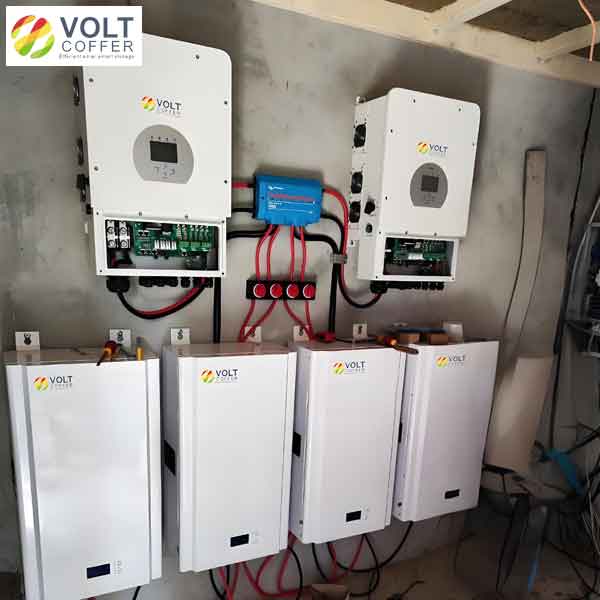
In practice, solar inverters must also interface with energy storage systems to provide backup power and grid support. For example, hybrid solar inverters combine PV conversion with battery management, enabling off-grid operation or peak shaving. The following image illustrates a modern hybrid solar inverter setup, showcasing how such systems integrate into residential or commercial settings. This aligns with the trend toward smarter, more resilient solar energy solutions.
The control algorithms for solar inverters can be further enhanced with adaptive techniques. For instance, machine learning can be used to predict load patterns and optimize switching in real-time. Additionally, grid-forming capabilities are becoming important for solar inverters in microgrids, where they must regulate voltage and frequency without relying on the main grid. My research suggests that the four-leg topology, combined with 3D-SVPWM, provides a solid foundation for these advanced features. To summarize key parameters and performance metrics, I have compiled the following table based on simulation data:
| Condition | Load Resistance (Ω) | Voltage THD (%) | Current Imbalance | Neutral Current |
|---|---|---|---|---|
| Balanced | 10, 10, 10 | 2.3 | None | Negligible |
| Unbalanced | 10, 30, 45 | 4.8 | High | Significant |
This table underscores the effectiveness of the proposed solar inverter design. The slight increase in THD under unbalanced loads is a trade-off for maintaining voltage symmetry, which is often more critical for connected equipment. Future work could focus on reducing THD through improved filtering or multi-level inverter topologies. Moreover, the scalability of these solar inverters for larger systems, such as utility-scale solar farms, warrants investigation. In such contexts, modular designs with distributed control could leverage the four-leg approach for individual string inverters, enhancing overall system robustness.
Another aspect to consider is the impact of environmental factors on solar inverters. Temperature variations, shading, and aging of PV panels can cause power fluctuations, which the inverter must manage seamlessly. The control strategy discussed here, with its robust response to imbalances, can also accommodate these variations by adjusting modulation indices dynamically. For example, if one phase of a solar array experiences shading, the inverter can redistribute power using the fourth leg to prevent voltage drops. This capability is essential for maximizing energy yield in solar installations, especially in uneven terrains or urban environments.
From an economic perspective, the adoption of advanced solar inverters may involve higher initial costs due to added components like the fourth leg and sophisticated controllers. However, the long-term benefits—such as reduced maintenance, improved grid compatibility, and extended equipment lifespan—can justify the investment. As solar technology continues to evolve, cost reductions in power electronics will make these features more accessible. Policymakers and industry stakeholders should promote standards that encourage the use of such inverters to enhance grid stability and renewable integration.
In conclusion, the design and control of three-phase solar inverters for unbalanced loads represent a significant step forward in renewable energy technology. Through my exploration of the four-leg inverter topology and 3D-SVPWM, I have demonstrated that these solar inverters can maintain symmetrical output voltages under challenging load conditions. The mathematical models, simulation results, and control strategies outlined here provide a comprehensive framework for developers and engineers. As solar power becomes increasingly prevalent, innovations in solar inverters will play a pivotal role in ensuring reliable, efficient, and high-quality power delivery. I encourage further research into integrating these inverters with smart grid functionalities, energy storage, and artificial intelligence to unlock their full potential in the sustainable energy landscape.
To reiterate, solar inverters are not just conversion devices; they are intelligent systems that enable the seamless integration of solar energy into our power networks. By addressing imbalances and enhancing control, we can build more resilient solar infrastructures that support global energy goals. I hope this discussion inspires continued innovation in the field, paving the way for next-generation solar inverters that are both robust and adaptable.