
In recent years, the solar power industry has experienced rapid growth, with photovoltaic (PV) systems becoming a significant part of the power grid. As of the end of 2019, the cumulative installed capacity of PV power generation reached 204 million kilowatts, accounting for 10.15% of the total installed capacity in China. This makes solar inverters a critical component in ensuring grid stability and security. However, the integration of solar inverters into weak grids—characterized by high line impedance and transformer leakage inductance—poses unique challenges, particularly during grid faults like voltage sags. Low-voltage ride-through (LVRT) capability is mandated by grid codes, requiring solar inverters to remain connected and provide reactive current support proportional to the voltage dip depth. Yet, these standards often lack explicit requirements for active current during LVRT, leading to potential issues such as frequency fluctuations in weak grids with high PV penetration. This paper addresses these challenges by analyzing control strategies for solar inverters in weak grids, focusing on phase-locked loop (PLL) techniques for unbalanced grids, resonance suppression, and a coordinated active and reactive current control method during LVRT. I will present a comprehensive study, including mathematical modeling, hardware-in-the-loop validation, and practical insights to enhance the performance of solar inverters in such environments.
The proliferation of solar inverters in weak grids necessitates advanced control strategies to mitigate issues like grid imbalance and resonance. Weak grids, common in regions with extensive transmission lines or limited grid infrastructure, exhibit high impedance that can destabilize solar inverters during faults. In this section, I explore key strategies for solar inverters, including PLL methods for unbalanced voltages and resonance damping techniques. These approaches are essential for maintaining grid stability and ensuring reliable operation of solar inverters.
Phase-Locked Loop Techniques for Unbalanced Grids
Accurate grid synchronization is crucial for solar inverters, especially under unbalanced voltage conditions. Common PLL methods include the Synchronous Reference Frame PLL (SRF-PLL), Dual Second-Order Generalized Integrator PLL (DSOGI-PLL), and Decoupled Double Synchronous Reference Frame PLL (DDSRF-PLL). The SRF-PLL is effective in ideal grid conditions but fails to handle voltage imbalances. The DSOGI-PLL, while robust, requires complex computations that burden digital signal processors. In contrast, the DDSRF-PLL is designed for unbalanced grids by decoupling positive- and negative-sequence components, allowing solar inverters to accurately extract grid voltage parameters even during faults.
Under unbalanced grid voltages, the grid voltage can be expressed as the sum of positive-sequence, negative-sequence, and zero-sequence components. For three-wire systems, the zero-sequence component is negligible. Thus, the voltage in the stationary αβ-frame is given by:
$$V_{\alpha\beta} = V_{\alpha\beta}^+ + V_{\alpha\beta}^-$$
where the positive-sequence component rotates at angular frequency ω, and the negative-sequence component rotates at -ω. Through Clarke and Park transformations, the voltage in the rotating dq-frame for the positive and negative sequences can be derived. For the positive-sequence dq-frame:
$$
\begin{bmatrix} V_d^+ \\ V_q^+ \end{bmatrix} =
\begin{bmatrix} \cos(\omega t + \phi^+ – \theta’) & \cos(-\omega t + \phi^- – \theta’) \\ \sin(\omega t + \phi^+ – \theta’) & \sin(-\omega t + \phi^- – \theta’) \end{bmatrix}
\begin{bmatrix} V^{+} \\ V^{-} \end{bmatrix}
$$
Similarly, for the negative-sequence dq-frame:
$$
\begin{bmatrix} V_d^- \\ V_q^- \end{bmatrix} =
\begin{bmatrix} \cos(\omega t + \phi^+ + \theta’) & \cos(-\omega t + \phi^- + \theta’) \\ \sin(\omega t + \phi^+ + \theta’) & \sin(-\omega t + \phi^- + \theta’) \end{bmatrix}
\begin{bmatrix} V^{+} \\ V^{-} \end{bmatrix}
$$
When the PLL is locked, the positive-sequence voltage aligns with the d-axis, leading to coupling terms at twice the grid frequency. The DDSRF-PLL employs cross-decoupling to isolate the DC components, enabling precise phase detection. The control framework involves separate rotating frames for positive and negative sequences, with decoupling networks to eliminate harmonic interactions. This method ensures that solar inverters can maintain synchronization during asymmetric faults, which is vital for stable operation in weak grids.
Resonance Suppression Strategies for Solar Inverters
Resonance in weak grids can exacerbate instability, particularly when solar inverters interact with grid impedance. Resonance suppression strategies are categorized into passive and active damping. Passive damping uses physical resistors but incurs power losses. Active damping, preferred for solar inverters, includes virtual resistor methods and resonance peak suppression. Virtual resistor methods emulate a resistor in the control loop to damp resonances without actual power dissipation.
In solar inverters with LCL filters, resonance can occur due to interactions between the filter capacitance and grid inductance. The virtual resistor approach introduces a damping current proportional to the capacitor voltage derivative, added to the current reference. The equivalent structure involves a virtual resistor in series with the capacitor branch, as shown in the control diagram. The damping current is computed as:
$$ i_d = -K_d \cdot \frac{dV_c}{dt} $$
where \( K_d \) is the virtual resistance gain, and \( V_c \) is the capacitor voltage. This method enhances stability by increasing damping at resonance frequencies. Compared to resonance peak suppression, which requires prior knowledge of grid impedance, virtual resistor methods are more adaptable to varying grid conditions, making them suitable for solar inverters in weak grids.
Table 1 summarizes common resonance suppression techniques for solar inverters:
| Method | Principle | Advantages | Disadvantages | Suitability for Solar Inverters |
|---|---|---|---|---|
| Passive Damping | Physical resistors in filter | Simple implementation | Power losses, reduced efficiency | Low, due to efficiency concerns |
| Virtual Resistor | Emulated resistor in control loop | No power loss, adaptable | Requires careful tuning | High, for weak grid applications |
| Resonance Peak Suppression | Modify transfer function at resonance | Targeted damping | Sensitive to grid changes | Moderate, for fixed impedance grids |
Control Strategies for LVRT in Solar Inverters
During LVRT, solar inverters must provide reactive current support as per grid codes, but active current management is often overlooked. In weak grids, active power deficits during faults can cause frequency deviations, necessitating coordinated control. I analyze traditional methods and propose an enhanced strategy for solar inverters.
Traditional Control Strategy
Conventionally, solar inverters during LVRT use a single current loop control, setting the active current reference to zero to prioritize reactive current and protect power devices like IGBTs from overcurrent. The reactive current reference is calculated based on voltage dip depth:
$$ i_{q,ref} = K \cdot (0.9 – V_{dip}) \cdot I_n $$
where \( K \) is a gain (typically 1.5 to 2), \( V_{dip} \) is the per-unit voltage during the dip, and \( I_n \) is the rated current. This approach ensures compliance with standards but ignores active power support, which can be critical in weak grids. The control framework involves measuring grid voltage, computing reactive current, and using PI controllers for current regulation. However, this may lead to frequency instability in grids with high solar inverter penetration.
Coordinated Active and Reactive Current Control
To address this, I propose a coordinated control strategy that adjusts active current during LVRT based on available capacity. Solar inverters typically have a 1.1 per-unit overcurrent capability. Thus, the active current reference \( i_{d,ref} \) should satisfy:
$$ i_{d,ref} \leq \sqrt{(1.1 I_n)^2 – i_{q,ref}^2} $$
The active current reference is derived from the pre-fault value \( i_{d,ref}^* \), locked during the dip. The control logic follows these steps:
- Use DDSRF-PLL to obtain grid voltage positive-sequence components \( V_d^+ \) and phase angle θ.
- If \( V_d^+ < 0.9 \) per unit, enter LVRT mode: lock \( i_{d,ref}^* \) and θ; if voltage is too low for PLL, generate θ from pre-fault frequency.
- Compute reactive current reference \( i_{q,ref} \) from dip depth.
- Set \( i_{d,ref} \) as the minimum of \( i_{d,ref}^* \) and \( \sqrt{(1.1 I_n)^2 – i_{q,ref}^2} \).
- Use PI controllers for current loops with these references.
This strategy ensures that solar inverters provide both reactive and active support during LVRT, enhancing grid stability. The mathematical model for solar inverters in the decoupled double synchronous reference frame is:
$$
\begin{aligned}
\frac{di_d^+}{dt} &= \frac{1}{L} (V_d^+ – e_d^+ + \omega L i_q^+) \\
\frac{di_q^+}{dt} &= \frac{1}{L} (V_q^+ – e_q^+ – \omega L i_d^+) \\
\frac{di_d^-}{dt} &= \frac{1}{L} (V_d^- – e_d^- – \omega L i_q^-) \\
\frac{di_q^-}{dt} &= \frac{1}{L} (V_q^- – e_q^- + \omega L i_d^-)
\end{aligned}
$$
where \( V_d^+, V_q^+, V_d^-, V_q^- \) are grid voltage components, \( e_d^+, e_q^+, e_d^-, e_q^- \) are inverter voltage outputs, and L is the filter inductance. By controlling positive- and negative-sequence currents separately, solar inverters can manage unbalanced conditions effectively. The overall control framework integrates DDSRF-PLL, virtual resistor damping, and coordinated current control, as depicted in the block diagram.
Table 2 compares traditional and proposed control strategies for solar inverters:
| Aspect | Traditional Control | Coordinated Control |
|---|---|---|
| Active Current During LVRT | Set to zero | Adjusted based on capacity |
| Reactive Current Support | As per standards | As per standards, with optimization |
| Grid Stability in Weak Grids | May cause frequency issues | Enhanced frequency and voltage support |
| Complexity | Low | Moderate, due to additional logic |
| Suitability for High PV Penetration | Low | High |
Mathematical Modeling and Analysis
The dynamics of solar inverters in weak grids can be analyzed using state-space models. Consider an LCL-filtered solar inverter connected to a grid with impedance \( Z_g = R_g + j\omega L_g \). The system equations in the dq-frame are:
$$
\begin{aligned}
L_f \frac{d\mathbf{i}_f}{dt} &= \mathbf{v}_{inv} – \mathbf{v}_c – R_f \mathbf{i}_f – j\omega L_f \mathbf{i}_f \\
C_f \frac{d\mathbf{v}_c}{dt} &= \mathbf{i}_f – \mathbf{i}_g – j\omega C_f \mathbf{v}_c \\
L_g \frac{d\mathbf{i}_g}{dt} &= \mathbf{v}_c – \mathbf{v}_g – R_g \mathbf{i}_g – j\omega L_g \mathbf{i}_g
\end{aligned}
$$
where \( \mathbf{i}_f \) is the inverter-side current, \( \mathbf{v}_c \) is the capacitor voltage, \( \mathbf{i}_g \) is the grid current, \( \mathbf{v}_{inv} \) is the inverter output voltage, and \( \mathbf{v}_g \) is the grid voltage. For unbalanced conditions, these are split into positive- and negative-sequence components. The virtual resistor method modifies the capacitor voltage equation by adding a damping term:
$$ \mathbf{v}_c’ = \mathbf{v}_c – R_{virt} \frac{d\mathbf{v}_c}{dt} $$
where \( R_{virt} \) is the virtual resistance. This introduces additional damping into the system, stabilizing solar inverters against resonance. The coordinated control strategy can be formulated as an optimization problem to maximize active power delivery during LVRT subject to current limits:
$$ \text{Maximize } P = \frac{3}{2} (v_d^+ i_d^+ + v_q^+ i_q^+) \quad \text{subject to } \sqrt{(i_d^+)^2 + (i_q^+)^2} \leq 1.1 I_n $$
This ensures that solar inverters operate within safe limits while supporting the grid.
Hardware-in-the-Loop Validation
To validate the proposed strategies, I developed a hardware control platform based on a TMS320F28335 DSP and CPLD, integrated with an RT-LAB hardware-in-the-loop (HIL) simulation system. The solar inverter parameters are listed in Table 3:
| Parameter | Value |
|---|---|
| Rated Power | 500 kW |
| Grid Voltage | 315 V line-to-line |
| MPPT Voltage | 600 V |
| DC-Link Capacitance | 10,080 µF |
| Filter Inductance | 0.5 mH |
| Filter Capacitance | 220 µF (delta-connected) |
| Switching Frequency | 3 kHz |
The HIL model simulates a weak grid with adjustable impedance and fault scenarios. A voltage dip to 0.6 per unit was applied for 1.41 seconds, with initial conditions of 350 kW active power and zero reactive power. The results show that the coordinated control strategy maintains stable grid current with reduced harmonics and provides active power support during the dip. The instantaneous waveforms include three-phase voltages, currents, DC voltage, and DC current, demonstrating improved performance compared to traditional methods.
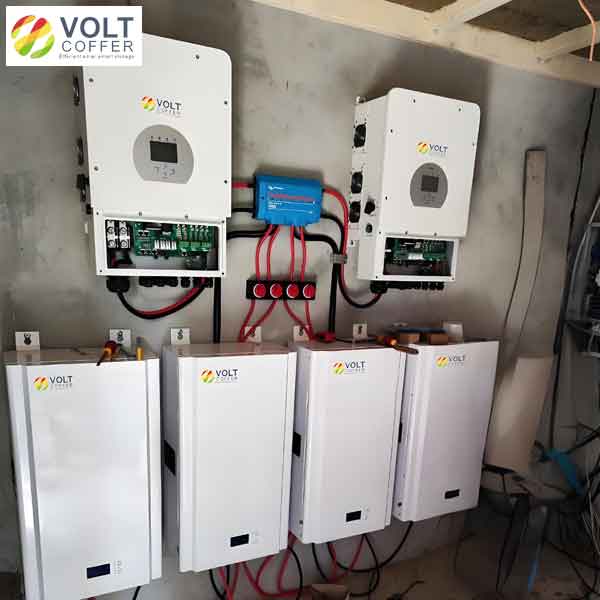
This image illustrates a modern hybrid solar inverter system, akin to the platforms used in validation. The HIL tests confirm that the integration of DDSRF-PLL, virtual resistor damping, and coordinated current control enhances the LVRT capability of solar inverters in weak grids. The system frequency deviations were within acceptable limits, avoiding issues like under-frequency load shedding.
Discussion and Implications
The proposed strategies have significant implications for solar inverter deployment in weak grids. By addressing voltage imbalance, resonance, and active power support during faults, solar inverters can improve grid resilience. The DDSRF-PLL ensures accurate synchronization even under severe unbalance, which is common in weak grids due to asymmetric faults. The virtual resistor method provides robust damping without efficiency penalties, making it ideal for solar inverters where energy loss is a concern. The coordinated control strategy balances active and reactive power, mitigating frequency swings in grids with high solar inverter penetration.
Furthermore, these methods are scalable to larger solar inverter systems and can be integrated with energy storage for enhanced flexibility. Future work could explore adaptive tuning of virtual resistance based on real-time grid impedance estimation, or machine learning techniques for predictive control during LVRT. The role of solar inverters in grid-forming applications also warrants investigation, as weak grids increasingly rely on inverter-based resources.
Conclusion
In this paper, I have explored advanced control strategies for solar inverters in weak grids, focusing on LVRT enhancement. The DDSRF-PLL enables precise phase detection under unbalanced voltages, while virtual resistor methods suppress resonances without power loss. The coordinated active and reactive current control strategy ensures that solar inverters provide both voltage and frequency support during faults, addressing gaps in existing standards. Hardware-in-the-loop validation confirms the effectiveness of these approaches, demonstrating stable operation under simulated weak grid conditions. As solar inverters become more prevalent in power systems, such strategies will be crucial for maintaining grid stability and enabling higher renewable energy integration. Future advancements in solar inverter technology should continue to prioritize adaptability to weak grid environments, ensuring reliable and efficient power delivery.