
As global energy demands continue to rise, the transition from fossil fuels to renewable sources has become imperative. Among these, solar photovoltaic (PV) power generation stands out as a key solution due to its sustainability and scalability. In any PV system, the solar inverter plays a critical role by converting direct current (DC) from solar panels into alternating current (AC) for grid integration or local consumption. The performance, efficiency, and reliability of a solar inverter directly impact the overall system’s viability. In this article, I will provide an in-depth review of solar inverter technologies, focusing on their classification by power rating, typical topological structures, advantages, limitations, and emerging trends. I will emphasize the term “solar inverter” throughout to underscore its centrality in modern energy systems.
Solar inverters can be categorized in various ways, such as by isolation (isolated vs. non-isolated), power conversion stages (single-stage, two-stage, or multi-stage), or output phase (single-phase or three-phase). However, for practical applications, classification based on power rating is most common: central inverters, string inverters, and micro-inverters. Each type serves distinct market segments and operational scales, from utility-scale plants to residential rooftops. Understanding these categories helps in selecting the appropriate solar inverter for specific needs.
Classification of Solar Inverters by Power Rating
The power rating of a solar inverter dictates its application scope. Below is a summary table comparing the three main types:
| Type | Power Range | Primary Applications | Key Features |
|---|---|---|---|
| Central Inverter | 100 kW to 1000 kW | Large-scale grid-connected PV plants | High integration, single MPPT, LCL filter |
| String Inverter | 3 kW to 50 kW | Medium to large distributed PV systems | Multiple MPPTs, modular design, no transformer |
| Micro-inverter | 200 W to 500 W | Small distributed systems, residential use | Per-panel MPPT, high-frequency isolation, plug-and-play |
This classification highlights how each solar inverter type addresses different system requirements, influencing factors like efficiency, cost, and maintenance.
Topological Structures of Solar Inverters
The topology of a solar inverter defines its circuit configuration, which impacts performance metrics such as conversion efficiency, harmonic distortion, and reliability. I will examine typical topologies for each category.
Central Inverters
Central inverters are employed in large PV farms where numerous solar panels are connected in series and parallel to form arrays. The typical topology involves a three-phase two-level inverter structure. It consists of a DC-link capacitor, a three-phase inverter bridge (using IGBTs or MOSFETs), and an LCL filter. The DC-link capacitor stabilizes the voltage from the PV array, while the inverter bridge converts DC to AC through pulse-width modulation (PWM). The LCL filter attenuates high-frequency harmonics, ensuring grid-compliant output. The mathematical representation of the output voltage for a two-level inverter can be expressed as:
$$V_{out} = \frac{V_{dc}}{2} \cdot m_a \cdot \sin(\omega t)$$
where \(V_{dc}\) is the DC-link voltage, \(m_a\) is the modulation index, and \(\omega\) is the angular frequency. The efficiency of a central solar inverter often exceeds 98%, but it relies on a single maximum power point tracking (MPPT) circuit for the entire array, which can lead to power losses under mismatched conditions.
String Inverters
String inverters are designed for distributed generation, where multiple strings of solar panels are connected in parallel to the DC input. A common topology is a two-stage design: a DC-DC boost converter followed by a DC-AC inverter. The boost converter steps up the voltage and performs MPPT for each string, while the inverter generates AC output. Alternatively, single-stage topologies omit the DC-DC stage for simplicity. The power balance equation in a string solar inverter can be described as:
$$P_{in} = P_{pv} – P_{loss,dc}$$
$$P_{out} = P_{in} \cdot \eta_{inv}$$
where \(P_{pv}\) is the PV power, \(P_{loss,dc}\) is DC-side loss, and \(\eta_{inv}\) is the inverter efficiency. String inverters often incorporate LCL filters for harmonic suppression. To illustrate a typical configuration, consider the following diagram inserted here:
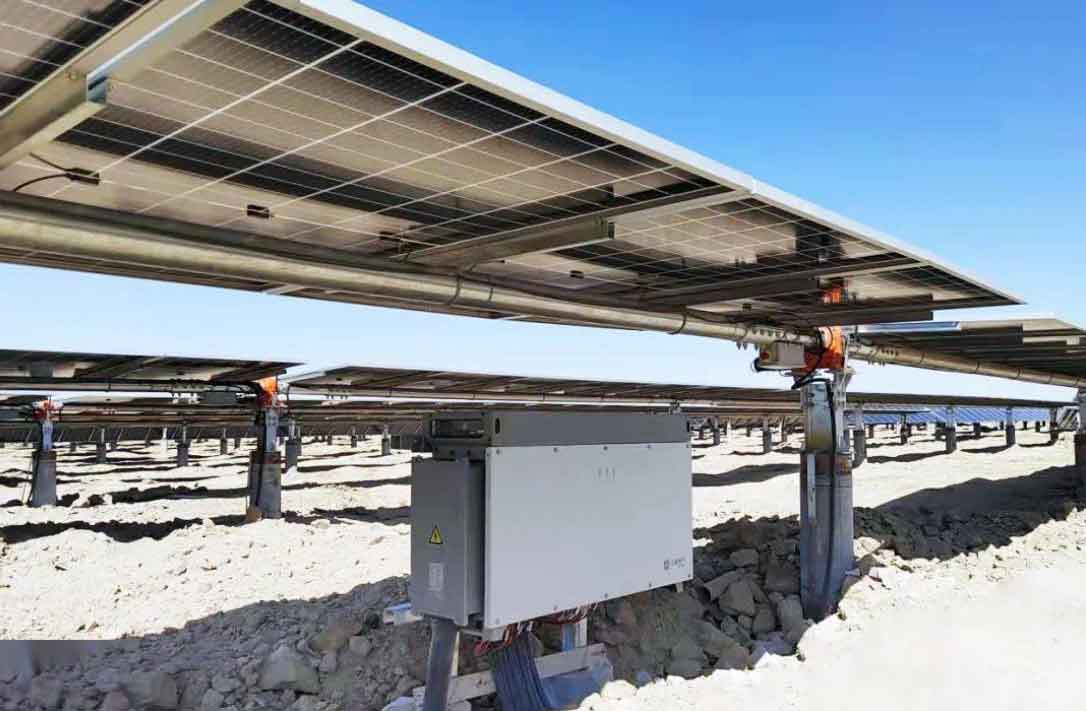
This image shows a string-connected grid inverter, highlighting the integration of multiple PV strings. The flexibility of string solar inverters allows for better adaptation to shading and module variations.
Micro-inverters
Micro-inverters are attached to individual solar panels, enabling independent power conversion. Topologies can be single-stage or two-stage. A popular single-stage topology is the flyback converter combined with a line-frequency unfolding bridge. For instance, an interleaved flyback micro-inverter uses two flyback converters in parallel to reduce current ripple. The output power of a micro solar inverter is given by:
$$P_{micro} = V_{panel} \cdot I_{panel} \cdot \eta_{micro}$$
where \(\eta_{micro}\) is the micro-inverter efficiency, typically around 96%. Two-stage designs include a DC-DC boost converter and a DC-AC inverter, often using high-frequency transformers for isolation. A key challenge is power decoupling to handle the inherent double-line frequency ripple. The ripple power can be modeled as:
$$P_{ripple} = \frac{P_{dc}}{2} \cdot (1 – \cos(2\omega t))$$
where \(P_{dc}\) is the DC power. This necessitates decoupling capacitors or active circuits, impacting the solar inverter’s size and cost.
Advantages and Limitations of Solar Inverter Types
Each solar inverter type offers distinct benefits and faces specific drawbacks. The following table summarizes these aspects in detail:
| Solar Inverter Type | Advantages | Limitations |
|---|---|---|
| Central Inverter |
|
|
| String Inverter |
|
|
| Micro-inverter |
|
|
This comparison underscores the trade-offs involved in selecting a solar inverter. For instance, while central inverters are cost-effective for utility scales, they lack flexibility. String solar inverters balance performance and modularity, whereas micro-inverters excel in reliability but at a higher expense.
Future Trends in Solar Inverter Technology
The evolution of solar inverters is driven by demands for higher efficiency, lower cost, and improved grid support. I will outline key trends for each type.
Central Inverters: Towards Multi-level Topologies
As PV plants scale to higher capacities and voltage levels, central solar inverters face challenges in power handling and harmonic distortion. Multi-level inverters, such as neutral-point clamped (NPC) or cascaded H-bridge (CHB) topologies, are gaining attention. These reduce voltage stress on switches and improve output waveform quality. The output voltage for a three-level NPC inverter can be expressed as:
$$V_{out} = V_{dc} \cdot \sum_{n=1}^{\infty} \frac{4}{n\pi} \cdot m_a \cdot \cos(n\omega t)$$
where \(n\) is the harmonic order. However, multi-level designs require complex control strategies for capacitor voltage balancing. Future research aims to simplify these controls and integrate wide-bandgap devices (e.g., SiC or GaN) to boost switching frequencies and efficiency. The trend is to enhance the central solar inverter’s adaptability to smart grid requirements, such as reactive power support and fault ride-through.
String Inverters: Addressing Leakage Currents and Harmonics
String solar inverters, often transformerless, are prone to common-mode leakage currents, which pose safety risks. Advanced topologies like HERIC (Highly Efficient and Reliable Inverter Concept) or H5 can mitigate this by modifying switching patterns. The leakage current \(I_{leak}\) can be modeled as:
$$I_{leak} = C_{pv} \cdot \frac{dV_{cm}}{dt}$$
where \(C_{pv}\) is the PV panel capacitance and \(V_{cm}\) is the common-mode voltage. Moreover, to improve power quality, harmonic compensation techniques are being integrated. For example, repetitive control or resonant controllers can suppress low-order harmonics. The goal is to develop string solar inverters with higher reliability and grid-forming capabilities for microgrid applications.
Micro-inverters: Enhancing Power Decoupling and Efficiency
For micro-inverters, the primary focus is on replacing electrolytic capacitors with active power decoupling circuits to extend lifespan. Techniques like bidirectional converters or switched-capacitor networks are explored. The decoupling capacitance required can be calculated as:
$$C_{dec} = \frac{P_{dc}}{4 \cdot \pi \cdot f_{line} \cdot \Delta V}$$
where \(f_{line}\) is the grid frequency and \(\Delta V\) is the allowable voltage ripple. Additionally, soft-switching technologies (e.g., zero-voltage switching) are being adopted to reduce switching losses. The efficiency of a micro solar inverter can be optimized by topology innovations, such as resonant flyback or dual-active bridge designs. The trend is towards higher integration, possibly incorporating energy storage interfaces, making the solar inverter a multifunctional unit.
Conclusion
Solar inverters are pivotal components in photovoltaic systems, and their technology continues to evolve rapidly. From central to string to micro-inverters, each type offers unique benefits tailored to specific applications. Central solar inverters dominate large-scale plants but require advancements in multi-level topologies. String solar inverters are ideal for distributed generation, yet challenges like leakage currents and harmonics need addressing. Micro-inverters provide maximal energy harvest per panel but must overcome efficiency and cost hurdles. Future developments will likely focus on improving power density, grid interoperability, and reliability across all solar inverter categories. As renewable energy penetration grows, the role of the solar inverter will expand beyond mere conversion to include grid stabilization and smart energy management. Continued research and innovation in solar inverter technologies are essential for a sustainable energy future.
To summarize key parameters, here is a table of typical performance metrics for solar inverters:
| Metric | Central Solar Inverter | String Solar Inverter | Micro Solar Inverter |
|---|---|---|---|
| Efficiency Range | 98% – 99% | 96% – 98% | 94% – 96% |
| Cost per Watt ($/W) | 0.10 – 0.20 | 0.15 – 0.30 | 0.30 – 0.50 |
| Lifetime (years) | 10 – 15 | 10 – 12 | 8 – 10 |
| MPPT Channels | 1 | 2 – 6 | Per panel |
| Grid Support Features | High (voltage/frequency regulation) | Medium (reactive power control) | Low (basic grid-tie) |
This review underscores the importance of selecting the right solar inverter based on system requirements. As technology progresses, we can expect solar inverters to become more intelligent, efficient, and integral to the energy ecosystem. The journey towards optimized solar inverter designs is ongoing, driven by both academic research and industrial innovation.