
As a professional deeply involved in the renewable energy sector, I have witnessed the rapid evolution of technologies that are pivotal for achieving a sustainable, zero-carbon future. In this article, I will delve into three key zero-carbon technologies: solar thermal utilization integrated with building architecture, high-efficiency photovoltaic inverters, and direct-drive permanent magnet wind power generation. These technologies not only enhance energy efficiency but also significantly reduce carbon emissions. I will provide detailed insights from a first-person perspective, incorporating tables and formulas to summarize critical aspects. Throughout the discussion, I will emphasize the role of solar inverters, as they are central to modern photovoltaic systems.
The urgency to combat climate change has driven innovation across various domains, particularly in building and power generation sectors. Integrating renewable energy sources into everyday infrastructure is no longer an option but a necessity. Let me begin by exploring solar thermal utilization in buildings, a technology that seamlessly combines functionality with aesthetics.
Solar thermal utilization integrated with building architecture addresses the challenges posed by urban density and high-rise constructions. Traditionally, solar water heaters were mounted on rooftops, but as cities grow vertically, this approach becomes limited. The integrated system involves installing collectors on building facades, which not only saves space but also maintains architectural integrity. The system comprises collectors, auxiliary heating, circulation water systems, and support components. Under normal日照 conditions, it converts solar energy into thermal energy, transferring heat via a circulating medium to provide domestic hot water. Key innovations include balcony-framework integration and synchronized construction techniques, ensuring that solar systems are designed, built, and managed alongside the building itself. This avoids post-installation damages and enhances safety.
To quantify the benefits, consider the following technical indicators. The annual electricity savings per system are approximately 1214 kWh, and the main equipment lifespan exceeds 15 years. These metrics underscore the long-term viability of this technology. The efficiency of such systems can be expressed through thermal performance formulas. For instance, the useful energy gain from solar collectors can be modeled using the Hottel-Whillier equation: $$Q_u = A_c [S – U_L (T_i – T_a)]$$ where \(Q_u\) is the useful energy, \(A_c\) is the collector area, \(S\) is the solar radiation absorbed, \(U_L\) is the overall heat loss coefficient, \(T_i\) is the inlet fluid temperature, and \(T_a\) is the ambient temperature. This formula helps optimize design parameters for maximum energy harvest.
Table 1 summarizes the key performance indicators for solar thermal building integration:
| Parameter | Value | Unit |
|---|---|---|
| Annual Electricity Savings per System | 1214 | kWh |
| Equipment Lifespan | >15 | years |
| CO2 Emission Reduction per System | ~2.5 | t/year |
| Typical Investment Recovery Period | 7 | years |
The推广前景 of this technology is promising, especially with the increasing proportion of mid-to-high-rise buildings in urban areas. It is estimated that widespread adoption could lead to annual CO2 reductions of millions of tons, contributing significantly to carbon neutrality goals.
Moving on to the second technology, high-efficiency photovoltaic inverters, or solar inverters, are indispensable in solar power systems. As an engineer specializing in power electronics, I have worked extensively on improving inverter performance. A solar inverter converts direct current (DC) from photovoltaic panels into alternating current (AC) for grid integration, and its efficiency directly impacts overall system output. The core principle involves advanced control strategies that maximize power extraction and ensure high-quality AC output. Key technologies include novel inverter control methods that combine grid-tie functionality, reactive power compensation, and harmonic filtering, along with maximum power point tracking (MPPT) techniques to optimize energy harvest.
The efficiency of a solar inverter is a critical metric, often exceeding 98% in modern designs. This can be represented by the formula: $$\eta = \frac{P_{out}}{P_{in}} \times 100\%$$ where \(\eta\) is the conversion efficiency, \(P_{out}\) is the AC output power, and \(P_{in}\) is the DC input power. For instance, if a solar inverter processes 10 kW of DC power and delivers 9.8 kW of AC power, its efficiency is 98%. Additionally, MPPT accuracy, which ensures the solar panels operate at their optimal voltage and current, can be modeled as: $$MPPT_{\text{accuracy}} = \frac{P_{\text{actual}}}{P_{\text{max}}} \times 100\%$$ where \(P_{\text{actual}}\) is the actual power output and \(P_{\text{max}}\) is the theoretical maximum power. High-precision MPPT, reaching 99.9%, minimizes energy losses.
To illustrate the advancements in solar inverter technology, consider the following table comparing traditional and high-efficiency solar inverters:
| Feature | Traditional Solar Inverter | High-Efficiency Solar Inverter |
|---|---|---|
| Conversion Efficiency | 90-95% | >98% |
| Total Harmonic Distortion | 3-5% | <2% |
| MPPT Accuracy | 95-98% | 99.9% |
| Grid Support Functions | Limited | Advanced (reactive power, harmonics) |
Solar inverters are evolving rapidly, with innovations like string inverters enhancing scalability and reliability. In many installations, solar inverters are configured in string topologies to manage power from multiple panels efficiently. For visual reference, here is an image depicting a string-connected grid inverter setup:
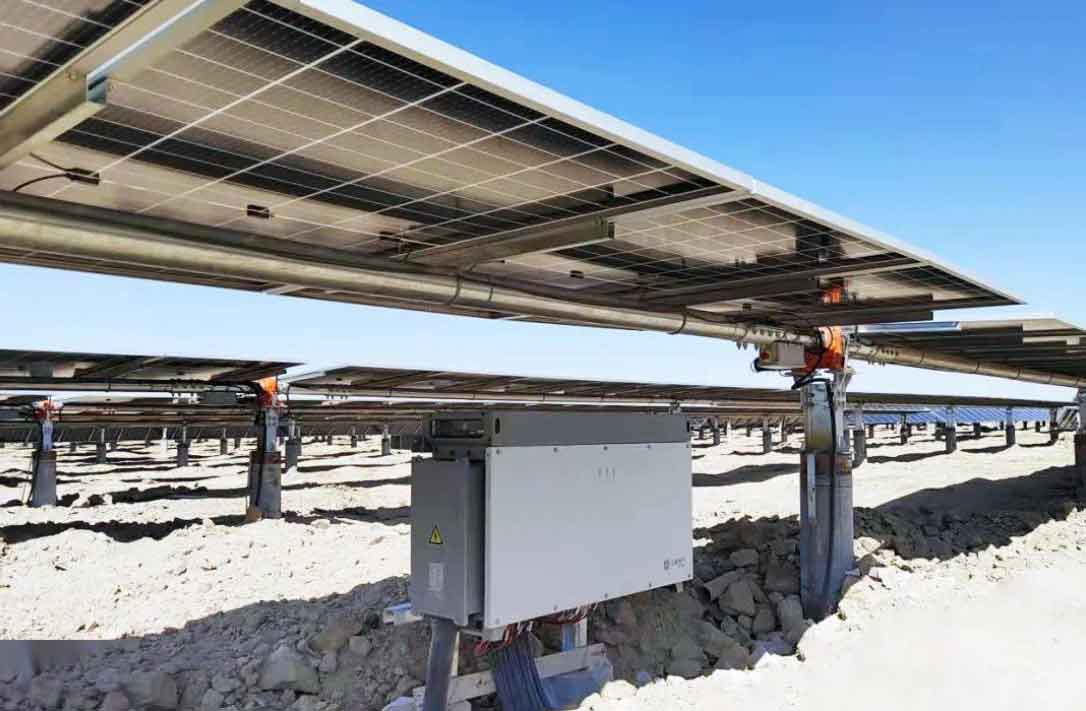
This configuration allows for better monitoring and maintenance, which is crucial for large-scale solar farms. The solar inverter market is expanding, driven by the global push for renewable energy. With photovoltaic capacity growing annually, the demand for efficient solar inverters will continue to rise. In my experience, optimizing solar inverter designs involves balancing cost, performance, and durability. For example, using silicon carbide (SiC) semiconductors can reduce switching losses, further boosting efficiency. The power output of a solar inverter can be expressed as: $$P_{out} = V_{rms} \times I_{rms} \times \text{功率因数}$$ where \(V_{rms}\) and \(I_{rms}\) are the root-mean-square voltage and current, respectively. Ensuring a high power factor, close to unity, minimizes reactive power and grid strain.
The economic and environmental benefits of high-efficiency solar inverters are substantial. Case studies show that upgrading to advanced solar inverters can reduce CO2 emissions by hundreds of tons per year per megawatt, with cost savings from improved energy yield. The推广前景 is bright, with projections indicating that adoption rates could reach 15% in the coming years, potentially abating millions of tons of CO2 annually. Solar inverters are not just components; they are enablers of smart grids, facilitating bidirectional power flow and grid stability. As we deploy more solar capacity, the role of solar inverters in integrating renewables will become even more critical.
Now, let’s turn to the third technology: direct-drive permanent magnet wind power generation. From my involvement in wind energy projects, I can attest to the advantages of this approach over traditional geared systems. Direct-drive technology eliminates the need for a gearbox, coupling the turbine rotor directly to a low-speed permanent magnet generator. This reduces mechanical losses, enhances reliability, and lowers maintenance costs. The principle integrates direct drive, permanent magnets, and full-power converters to adapt quickly to wind speed variations and grid demands. Key technologies include load control, large permanent magnet motor design, pitch system control, and specialized signal acquisition.
The efficiency gain from direct-drive systems can be quantified. Compared to geared doubly-fed induction generators, direct-drive permanent magnet wind turbines exhibit higher传动效率. The power output of a wind turbine is given by: $$P = \frac{1}{2} \rho A v^3 C_p$$ where \(\rho\) is air density, \(A\) is the rotor swept area, \(v\) is wind speed, and \(C_p\) is the power coefficient. Direct-drive systems often achieve a \(C_p\) closer to the Betz limit of 0.593 due to reduced mechanical losses. Additionally, the absence of a gearbox improves overall system efficiency by 2% or more, as shown in Table 2.
| Aspect | Geared Doubly-Fed System | Direct-Drive Permanent Magnet System |
|---|---|---|
| Average Transmission Efficiency | 92-94% | 96-98% |
| Annual Availability | 97-98% | >99% |
| Power Factor Range | Limited | -0.9 to 0.9 |
| Maintenance Requirements | High (gearbox issues) | Low |
The technology also supports advanced grid features like zero-voltage ride-through, ensuring stability during faults. From a design perspective, the permanent magnet generator’s output voltage can be modeled as: $$E = k \Phi \omega$$ where \(E\) is the induced electromotive force, \(k\) is a constant, \(\Phi\) is the magnetic flux, and \(\omega\) is the angular velocity. This linear relationship simplifies control and enhances response times. In practice, direct-drive turbines have been deployed in various capacities, from 1.5 MW to 3.0 MW, with potential for larger offshore applications. The减排潜力 is significant, as wind power continues to expand globally.
Integrating these technologies into a cohesive energy strategy requires understanding their synergies. For instance, solar inverters play a role in hybrid systems that combine solar and wind power. In such setups, solar inverters manage the photovoltaic output, while power converters handle wind generation, ensuring smooth grid integration. The overall system efficiency can be optimized using control algorithms that prioritize sources based on availability and demand. A simplified hybrid power formula is: $$P_{\text{total}} = P_{\text{solar}} \times \eta_{\text{inv}} + P_{\text{wind}} \times \eta_{\text{conv}}$$ where \(P_{\text{solar}}\) and \(P_{\text{wind}}\) are the power inputs from solar and wind, respectively, and \(\eta_{\text{inv}}\) and \(\eta_{\text{conv}}\) are the efficiencies of the solar inverter and wind converter. Advanced solar inverters with grid-support functions can also stabilize fluctuations from wind turbines, enhancing overall reliability.
Looking ahead, the推广前景 for these zero-carbon technologies is immense. In the building sector, integration of solar thermal systems could cover a substantial portion of hot water demand in high-rises, reducing reliance on fossil fuels. For solar power, the continuous improvement of solar inverters will drive down levelized costs of electricity, making photovoltaics more competitive. In wind energy, direct-drive permanent magnet technology is set to dominate, especially in harsh environments like offshore farms. Policy support and technological advancements will accelerate adoption, contributing to global carbon reduction targets.
In conclusion, as a practitioner in renewable energy, I believe that innovations like building-integrated solar thermal, high-efficiency solar inverters, and direct-drive wind turbines are cornerstone technologies for a sustainable future. By leveraging detailed engineering principles, such as those encapsulated in formulas and tables, we can optimize their performance and scale their deployment. The journey towards zero carbon is challenging, but with continued focus on efficiency and integration, we can achieve significant environmental and economic benefits. Solar inverters, in particular, will remain a focal point due to their critical role in energy conversion and grid management. Let’s embrace these technologies and work towards a cleaner, greener planet.