
In my years of experience working with photovoltaic (PV) systems in rural areas, I have witnessed the rapid adoption of solar energy as a sustainable power source. The heart of any PV system is the solar inverter, a device that converts direct current (DC) from solar panels into alternating current (AC) for grid integration or local use. This article delves into the intricacies of solar inverter maintenance, common failures, and the feasibility of deploying such systems in rural environments. I will share insights from my firsthand observations, emphasizing safety protocols, troubleshooting techniques, and practical considerations. To enhance clarity, I will incorporate tables and mathematical formulas that summarize key concepts, ensuring a comprehensive guide for professionals and enthusiasts alike. Throughout this discussion, the term “solar inverter” will be frequently highlighted to underscore its critical role in renewable energy systems.
The solar inverter is not merely a conversion unit; it is an intelligent device equipped with monitoring, protection, and grid-management capabilities. From my perspective, understanding its functionality is paramount for effective operation. A typical solar inverter performs tasks such as maximum power point tracking (MPPT), which optimizes energy harvest by adjusting the electrical operating point of the modules. This can be expressed mathematically: $$P_{max} = V_{mp} \times I_{mp}$$ where \(P_{max}\) is the maximum power output, \(V_{mp}\) is the voltage at maximum power, and \(I_{mp}\) is the current at maximum power. Additionally, the solar inverter ensures grid synchronization by matching frequency and phase, often governed by equations like $$f_{sync} = \frac{1}{2\pi\sqrt{LC}}$$ for inverter output control. These features make the solar inverter indispensable, but they also introduce complexities that can lead to failures if not properly managed.
In rural settings, the installation of solar inverters often involves challenging environments, such as rooftops with corrugated metal sheets. I recall numerous instances where safety hazards arose due to improper practices. For example, when cleaning or inspecting solar panels on sloped roofs, workers must avoid tossing debris and instead lower it in bags using ropes. Slips and falls are common risks, so anti-slip measures are essential. Moreover, the presence of overhead power lines necessitates maintaining safe distances to prevent electric shocks. From my experience, a solar inverter system on such roofs requires regular checks for loose fasteners, corrosion, and panel damage, all of which can compromise performance. The integration of a solar inverter with other components, like combiner boxes and transformers, adds layers of complexity that demand vigilant oversight.
One of the most critical aspects I have encountered is the prevention of electrical hazards. A solar inverter typically includes components like DC isolators, AC breakers, and grounding systems. Before any maintenance, I always ensure that the solar inverter is disconnected from both DC and AC sources, with lockout-tagout procedures applied. Testing for residual voltage with a multimeter is a routine step, as stray currents can persist even after shutdown. In cases where multiple solar inverters are paralleled, grounding integrity becomes crucial; I measure ground resistance to confirm it is below 4 Ω, using formulas like $$R_{ground} = \frac{V_{test}}{I_{test}}$$ where \(V_{test}\) is the applied voltage and \(I_{test}\) is the measured current. This attention to detail mitigates risks such as insulation failures or leakage currents, which are common in humid rural areas.
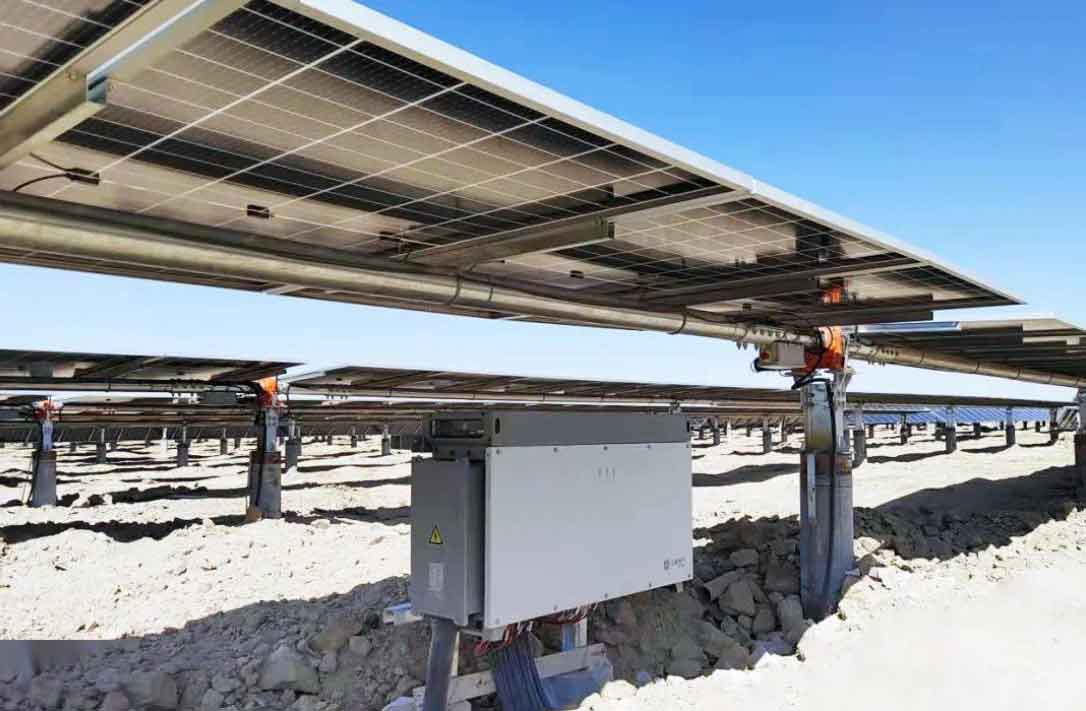
The image above illustrates a typical string-connected grid-tied solar inverter setup, which I often deploy in rural projects. This configuration shows how multiple PV modules are series-connected to form strings, feeding into the solar inverter for conversion. In my work, I emphasize proper wiring to avoid voltage imbalances that can trigger faults. For instance, if one module in a string fails, it affects the entire array’s output, leading to issues like reduced efficiency or shutdowns. The solar inverter here plays a pivotal role in monitoring string voltages and currents, often alerting operators to anomalies through built-in diagnostics. From a design standpoint, I calculate the optimal number of modules per string using $$N_{series} = \frac{V_{inverter,max}}{V_{module,max}}$$ where \(V_{inverter,max}\) is the maximum input voltage of the solar inverter and \(V_{module,max}\) is the peak voltage of a single module. This ensures the solar inverter operates within its safe voltage range, preventing overvoltage trips.
Common failures of solar inverters are a frequent topic in my field discussions. Based on my observations, I have categorized these issues and developed systematic approaches for resolution. The following table summarizes key fault types, their causes, and recommended actions, with a focus on the solar inverter as the central component.
| Fault Type | Possible Causes | Exclusion Methods |
|---|---|---|
| No AC Output | DC switch open, insufficient PV voltage, poor connections, module failure, solar inverter internal fault | Measure DC input voltage with a multimeter; check switches, terminals, and module integrity; inspect solar inverter diagnostics |
| High DC Voltage | Excessive series-connected modules exceeding solar inverter limits | Recalculate string configuration: $$N_{series} \leq \frac{0.8 \times V_{inverter,max}}{V_{module,peak}}$$ to avoid upper voltage bounds |
| Overheating | Incorrect installation obstructing airflow, fan malfunction in solar inverter | Ensure vertical mounting with clearance; clean fans; verify ambient temperature stays below solar inverter rating |
| Grid Voltage Out-of-Range | Utility voltage surpassing solar inverter tolerance | Adjust solar inverter settings to widen acceptable range; confirm grid monitoring is active |
| Parallel Operation Failure | Poor grounding or unequal potentials among multiple solar inverters | Test ground resistance: $$R_{g} < 4 \Omega$$; interconnect all solar inverter ground leads securely |
| Low Insulation Resistance | Water ingress, cable damage, or module degradation causing leakage to ground | Disconnect strings and measure insulation: $$R_{insulation} > 50 M\Omega$$; replace faulty components |
From my perspective, each fault requires a methodical diagnosis. For example, when a solar inverter shows no output, I first verify the DC side by checking each string’s voltage. If the solar inverter indicates a high DC voltage, I reassess the PV array design, ensuring that temperature coefficients are accounted for using $$V_{oc}(T) = V_{oc}(STC) \times [1 + \beta (T – T_{STC})]$$ where \(V_{oc}\) is open-circuit voltage, \(\beta\) is the temperature coefficient, and \(T\) is the actual temperature. This prevents seasonal variations from tripping the solar inverter. Overheating incidents often stem from inadequate ventilation; I recommend installing solar inverters in shaded, well-ventilated areas, and periodically cleaning dust from heat sinks. In rural locales, dust accumulation is accelerated, so I schedule cleanings every quarter to maintain solar inverter efficiency.
Safety during maintenance is non-negotiable in my practice. When working on rooftops with solar inverters, I adhere to strict protocols, such as using personal protective equipment (PPE) and securing tools to prevent drops. For electrical safety, I always de-energize the solar inverter and verify isolation with a voltage tester. The solar inverter’s internal capacitors can retain charge, so I wait for the recommended discharge time before opening enclosures. In adverse weather, like storms or extreme heat, I postpone outdoor work on solar inverters, as moisture or high temperatures can exacerbate risks. From experience, I have learned that a solar inverter’s fault codes are invaluable; they guide troubleshooting while minimizing guesswork. For instance, a “GFCI fault” on a solar inverter might indicate ground leakage, prompting insulation tests as per $$I_{leakage} = \frac{V}{R_{insulation}}$$ where \(V\) is system voltage and \(R_{insulation}\) is the measured resistance.
The feasibility of PV systems in rural areas is a subject I have extensively explored. In my view, rural regions offer unique advantages for solar inverter deployments, such as abundant space and clear ownership of rooftops. However, challenges like grid instability and environmental factors must be addressed. Below, I present a table analyzing key feasibility aspects, integrating formulas to quantify benefits and constraints.
| Aspect | Advantages in Rural Settings | Considerations and Formulas |
|---|---|---|
| Site Availability | Large roof areas, unused land; ideal for solar inverter arrays | Calculate required area: $$A_{array} = \frac{P_{system}}{\eta \times G}$$ where \(P_{system}\) is power output, \(\eta\) is efficiency, \(G\) is solar irradiance |
| Economic Viability | Long-term savings; payback periods often under 10 years | Compute return: $$ROI = \frac{(E_{annual} \times r_{tariff}) – C_{maintenance}}{C_{initial}}$$ with \(E_{annual}\) as yearly energy, \(r_{tariff}\) as electricity rate |
| Technical Suitability | Solar inverters can handle off-grid or hybrid setups | Size solar inverter: $$P_{inverter} = P_{array} \times f_{safety}$$ where \(f_{safety}\) is a derating factor for rural conditions |
| Environmental Impact | Reduced carbon footprint; minimal noise from solar inverters | Estimate CO₂ savings: $$CO₂_{saved} = E_{annual} \times EF_{grid}$$ with \(EF_{grid}\) as grid emission factor |
| Maintenance Requirements | Solar inverters are low-maintenance but need periodic checks | Schedule inspections based on operating hours: $$T_{check} = \frac{H_{annual}}{1000}$$ where \(H_{annual}\) is annual sunlight hours |
In my projects, I often calculate the energy yield from a solar inverter system using $$E_{daily} = P_{rated} \times \text{PSH} \times \eta_{system}$$ where \(P_{rated}\) is the solar inverter’s rated power, PSH is peak sun hours, and \(\eta_{system}\) is overall efficiency. For rural homes, a 5 kW solar inverter system can generate approximately 20 kWh per day, sufficient for basic needs. The solar inverter’s ability to operate in wide temperature ranges is crucial; I select models with ratings like -25°C to 60°C to withstand rural climatic extremes. Moreover, the solar inverter’s grid-support functions, such as voltage regulation, help stabilize weak rural grids, expressed as $$V_{out} = V_{ref} + k \times (P_{set} – P_{actual})$$ where \(V_{out}\) is output voltage, \(V_{ref}\) is reference, and \(k\) is a gain factor.
Another critical point from my experience is the importance of proper installation for solar inverters. In rural areas, I ensure that mounting structures are robust enough to support PV panels and the solar inverter itself. The weight load can be computed with $$W_{total} = N_{panels} \times W_{panel} + W_{inverter}$$ and compared against roof capacity. For corrosion-prone environments, I use galvanized fixtures and apply protective coatings. The solar inverter’s placement also affects performance; I avoid direct sunlight on the unit to prevent overheating, instead opting for north-facing walls in the Southern Hemisphere or south-facing in the Northern Hemisphere. Connectivity is another aspect: the solar inverter must be linked to monitoring systems via RS485 or Wi-Fi, enabling remote diagnostics—a boon in remote rural locations where on-site visits are costly.
When it comes to fault resolution, I have developed a step-by-step methodology for solar inverters. For instance, if a solar inverter frequently trips due to insulation faults, I isolate each string and measure resistance with a megohmmeter. The formula $$R_{insulation} = \frac{V_{test}}{I_{leakage}}$$ helps pinpoint issues. Similarly, for grid voltage problems, I use a power quality analyzer to record variations, ensuring the solar inverter’s settings align with local standards. In cases of solar inverter overheating, I log temperature data over time, applying thermal models like $$T_{junction} = T_{ambient} + R_{th} \times P_{loss}$$ where \(R_{th}\) is thermal resistance and \(P_{loss}\) is power dissipation. This proactive approach minimizes downtime and extends the solar inverter’s lifespan, which in my observations can exceed 15 years with proper care.
The integration of solar inverters into rural microgrids is an area I find particularly promising. A solar inverter can function as a grid-forming unit in off-grid systems, using battery storage to provide uninterrupted power. The control dynamics can be described by differential equations, such as $$\frac{dV_{dc}}{dt} = \frac{I_{pv} – I_{inv}}{C_{dc}}$$ where \(V_{dc}\) is DC link voltage, \(I_{pv}\) is PV current, \(I_{inv}\) is solar inverter current, and \(C_{dc}\) is capacitance. In hybrid setups, the solar inverter manages multiple sources, optimizing energy flow based on load demand. From my deployments, I have seen that a well-configured solar inverter reduces diesel generator usage, cutting fuel costs and emissions. The solar inverter’s MPPT algorithm is key here, often implemented using perturb-and-observe methods modeled as $$D_{new} = D_{old} + \Delta D \times \text{sign}(\Delta P)$$ where \(D\) is duty cycle and \(\Delta P\) is power change.
Looking at long-term sustainability, I emphasize the role of solar inverters in enabling rural electrification. In remote villages, a centralized solar inverter system can power communal facilities, with distribution networks designed using Ohm’s law: $$V_{drop} = I \times R_{line}$$ to minimize losses. The solar inverter’s efficiency, typically above 95%, ensures maximal energy utilization. I also consider lifecycle costs, calculating the levelized cost of energy (LCOE) for a solar inverter system as $$LCOE = \frac{C_{capex} + \sum C_{opex}}{E_{lifetime}}$$ where \(C_{capex}\) is capital expenditure, \(C_{opex}\) is operational cost, and \(E_{lifetime}\) is total energy produced. This metric helps rural communities assess affordability, often showing that solar inverters offer lower LCOE than diesel alternatives over time.
In conclusion, my firsthand experiences underscore the vital importance of solar inverters in rural PV systems. From troubleshooting common faults to ensuring safe installations, the solar inverter remains the cornerstone of reliable solar energy generation. By applying systematic approaches, using formulas for design and diagnosis, and adhering to safety standards, we can harness the full potential of solar inverters in diverse rural settings. The feasibility analysis reveals that with proper planning, solar inverter-based systems are not only viable but also economically and environmentally beneficial. As technology advances, I anticipate solar inverters will become even more integral to rural development, driving energy independence and sustainability. Through continued education and practical innovation, we can overcome challenges and maximize the performance of every solar inverter deployed in the field.