
As the global energy crisis and environmental degradation intensify, the adoption of renewable energy sources has become imperative. Among these, solar power stands out as a pivotal solution, with photovoltaic (PV) technology at its core. In recent years, the solar power industry has experienced rapid growth, and photovoltaic power generation has emerged as a hotbed of technological innovation. The heart of any PV system is the solar inverter, a device that converts direct current (DC) from solar panels into alternating current (AC) for grid integration or local consumption. The performance and reliability of solar inverters are critical to the overall efficiency and stability of PV systems. However, despite significant advancements in PV manufacturing, the core technologies for solar inverters, especially testing methodologies, remain dominated by Western countries. In this article, I will delve into the current state of solar power development, highlight the limitations of existing testing platforms for solar inverters, propose an outdoor testing solution, and outline the goals for building such a platform. Throughout, I will emphasize the importance of solar inverters and incorporate tables and formulas to summarize key points.
The global shift toward sustainable energy has propelled solar power to the forefront of technological research. Solar inverters play a crucial role in this landscape, as they ensure that the energy harvested from sunlight is efficiently converted and fed into the grid. In many countries, including China, policies such as the Renewable Energy Law have spurred investment in solar technologies. However, the reliance on imported technologies for solar inverters has hindered local innovation. For instance, while China accounts for a significant portion of global PV production, the expertise in solar inverter testing and validation lags behind. This gap underscores the need for robust testing platforms that can evaluate solar inverters under real-world conditions. Outdoor testing, in particular, offers a more accurate assessment compared to laboratory settings, as it accounts for variables like solar irradiance, temperature, humidity, and grid fluctuations. By focusing on solar inverters, we can address the technical bottlenecks that constrain the growth of the PV industry.
To understand the context, let’s examine the development of the solar power industry in China. The following table summarizes key milestones and data points related to PV installation and production.
| Year | Solar Cell Production (MW) | PV Installation (MW) | Policy Initiatives |
|---|---|---|---|
| 2000 | 3 | N/A | Initial research phase |
| 2007 | 1088 | N/A | Growth post-Renewable Energy Law |
| 2010 | 8000 | 500 | Support for strategic industries |
| 2013 | N/A | 15000 | Boost from “12th Five-Year Plan” |
| 2020 Target | N/A | 60000 | International Energy Agency goals |
This table illustrates the rapid expansion of PV manufacturing, yet the disparity between production and installation highlights domestic market challenges. Solar inverters are essential components in bridging this gap, as their efficiency directly impacts the viability of PV projects. Despite progress, the industry faces several limitations: scale without strength due to industrialization delays, technological weaknesses from reliance on imports, and insufficient domestic demand driven by high costs. These issues are compounded by the lack of advanced testing platforms for solar inverters, which are often evaluated in controlled indoor environments that fail to replicate field conditions.
The current testing platforms for solar inverters predominantly rely on indoor laboratories. These setups use simulated PV arrays to generate DC power, which is then fed into the solar inverter for conversion testing. While this approach allows for standardized assessments, it neglects the dynamic nature of outdoor environments. For example, solar irradiance can fluctuate rapidly due to cloud cover, affecting the input to solar inverters. Similarly, temperature variations can impact the thermal performance of solar inverters. The indoor testing methodology is based on static parameters, such as the European efficiency formula, which calculates a weighted average of efficiency at different power levels. The European efficiency is given by:
$$ \eta_{Euro} = 0.03 \eta_{5\%} + 0.06 \eta_{10\%} + 0.13 \eta_{20\%} + 0.10 \eta_{30\%} + 0.48 \eta_{50\%} + 0.20 \eta_{100\%} $$
where \(\eta_{x\%}\) represents the efficiency at \(x\%\) of the rated output power. This formula is useful for benchmarking, but it does not account for real-time variations. Moreover, indoor tests often overlook aspects like grid interaction and long-term reliability. Consequently, solar inverters that pass laboratory certifications may fail in actual deployments, leading to system downtime and reduced energy yield. This gap necessitates the development of outdoor testing platforms for solar inverters, which can provide comprehensive evaluations under realistic conditions.
To address these shortcomings, I propose an outdoor testing platform for solar inverters. This platform should be integrated with an existing PV power plant to leverage real-world infrastructure. The system comprises three main components: the PV power generation system (including solar arrays, combiner boxes, transformers, and the grid), testing equipment (such as weather stations, power analyzers, and power quality analyzers), and a comprehensive performance analysis system for solar inverters. The analysis system, developed using tools like LabVIEW and QT, will collect data from various sensors, process it, and generate performance scores based on predefined criteria. This setup enables continuous monitoring of solar inverters in response to environmental changes.
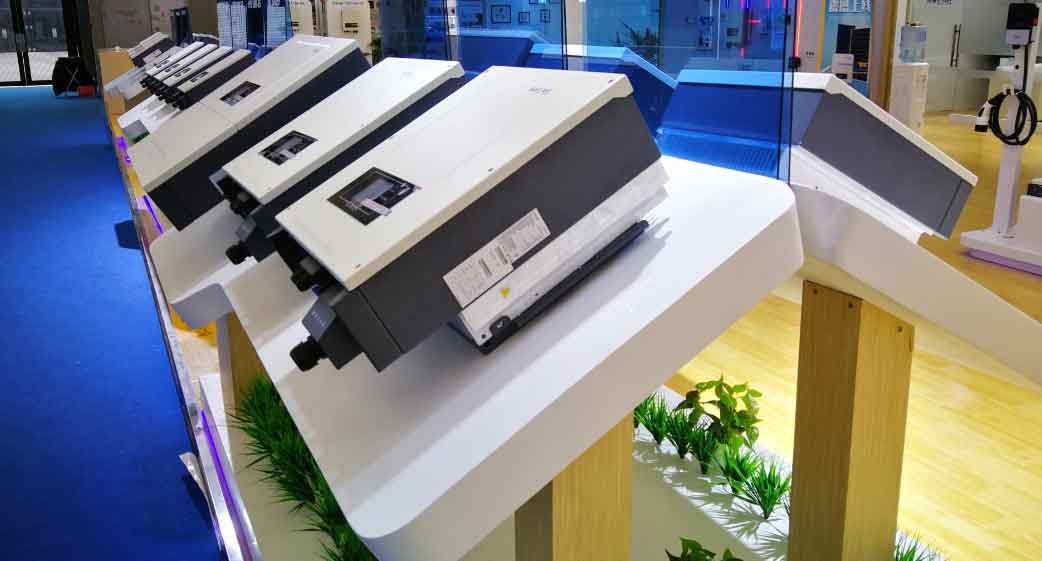
The image above illustrates a typical energy storage inverter, which shares similarities with solar inverters in terms of functionality. Outdoor testing platforms for solar inverters can benefit from such technologies, as they highlight the integration of power conversion and grid management. In the proposed platform, the testing scheme focuses on several key performance metrics for solar inverters. Below, I outline the testing procedures with emphasis on formulas and data analysis.
First, the tracking performance of solar inverters relative to solar irradiance is critical. Solar inverters must respond promptly to changes in irradiance to maximize power output. The test involves comparing data from weather stations and power analyzers. Let \(G(t)\) represent the solar irradiance at time \(t\), and \(P(t)\) denote the output power of the solar inverter. The response time \(\tau\) can be derived from the cross-correlation function:
$$ R(\tau) = \int G(t) P(t+\tau) dt $$
A smaller \(\tau\) indicates better tracking capability. The analysis system will compute this metric and rate the solar inverter accordingly.
Second, conversion efficiency testing extends beyond the European efficiency. Outdoor conditions introduce losses due to temperature and partial shading. The actual efficiency \(\eta_{actual}\) can be expressed as:
$$ \eta_{actual} = \frac{P_{AC}}{P_{DC}} \times 100\% $$
where \(P_{AC}\) is the AC output power and \(P_{DC}\) is the DC input power from the PV array. Continuous monitoring allows for the calculation of daily or monthly average efficiency, providing insights into long-term performance. The following table compares indoor and outdoor efficiency metrics for a hypothetical solar inverter.
| Test Condition | European Efficiency (%) | Average Outdoor Efficiency (%) | Notes |
|---|---|---|---|
| Indoor Laboratory | 98.5 | N/A | Static load conditions |
| Outdoor Platform | N/A | 96.2 | Variable irradiance and temperature |
This table shows that outdoor testing yields lower efficiency due to real-world factors, emphasizing the need for such platforms in evaluating solar inverters.
Third, output voltage stability is vital for grid compatibility. Solar inverters must maintain voltage within specified limits despite input fluctuations. The voltage regulation \(VR\) is defined as:
$$ VR = \frac{V_{no-load} – V_{full-load}}{V_{rated}} \times 100\% $$
where \(V_{no-load}\) and \(V_{full-load}\) are the output voltages at no load and full load, respectively, and \(V_{rated}\) is the rated voltage. Outdoor testing captures variations caused by changing environmental conditions, which indoor tests may miss.
Fourth, harmonic distortion analysis ensures that solar inverters do not degrade grid quality. According to standards, the total harmonic distortion (THD) of current should not exceed 5% at rated power. The THD is calculated as:
$$ THD = \frac{\sqrt{\sum_{h=2}^{50} I_h^2}}{I_1} \times 100\% $$
where \(I_h\) is the harmonic current of order \(h\), and \(I_1\) is the fundamental current. Power quality analyzers will record harmonic data, and the analysis system will assess compliance.
In addition to these tests, the outdoor platform should evaluate other parameters like power factor, soft-start capability, and communication functions. For instance, the power factor \(PF\) is given by:
$$ PF = \frac{P}{S} $$
where \(P\) is the real power and \(S\) is the apparent power. Maintaining a high power factor is essential for efficient grid integration of solar inverters.
The construction of an outdoor testing platform for solar inverters aims to achieve multiple objectives. Technologically, it will fill a void in the domestic research landscape by providing real-world data on solar inverter performance. This data can drive improvements in solar inverter design, such as enhancing maximum power point tracking (MPPT) algorithms. The MPPT efficiency \(\eta_{MPPT}\) can be defined as:
$$ \eta_{MPPT} = \frac{\int P_{actual} dt}{\int P_{max} dt} \times 100\% $$
where \(P_{actual}\) is the actual power output and \(P_{max}\) is the maximum possible power from the PV array. Outdoor testing allows for the optimization of such algorithms under varying conditions.
Economically, the platform can be commercialized to offer testing services to solar inverter manufacturers. This would create a new revenue stream while standardizing quality across the industry. The demand for reliable solar inverters is growing globally, and outdoor testing can serve as a unique selling point. For example, a fee structure based on test duration or complexity could be implemented, as summarized below.
| Service Type | Duration | Estimated Cost (USD) | Key Metrics Tested |
|---|---|---|---|
| Basic Efficiency Test | 1 week | 5,000 | Conversion efficiency, voltage stability |
| Comprehensive Performance Test | 1 month | 20,000 | All metrics including harmonics and grid interaction |
| Long-term Reliability Test | 1 year | 100,000 | Degradation analysis, failure rates |
This table outlines potential service offerings, highlighting how outdoor testing platforms for solar inverters can become economically viable.
Socially, the platform aligns with sustainable development goals by promoting cleaner energy. Improved solar inverters lead to higher PV system efficiencies, reducing the carbon footprint. Moreover, by fostering local expertise, the platform can reduce dependence on foreign technology and create high-skilled jobs. Public awareness campaigns about solar inverters and their testing can further accelerate adoption.
In conclusion, the development of an outdoor testing platform for solar inverters is a critical step toward advancing the solar power industry. Solar inverters are the linchpins of PV systems, and their performance under real-world conditions must be rigorously assessed. The proposed platform integrates PV infrastructure, advanced sensors, and data analysis tools to provide comprehensive evaluations. Through formulas like the European efficiency and metrics such as THD, we can quantify the performance of solar inverters. Tables summarizing data and costs help contextualize the benefits. As the demand for renewable energy grows, investing in such platforms will ensure that solar inverters meet the challenges of dynamic environments. Ultimately, this research underscores the importance of innovation in solar inverter technologies to achieve a sustainable energy future. I encourage continued exploration in this field, with a focus on collaborative efforts between academia, industry, and policymakers to overcome technical barriers and harness the full potential of solar power.