
In my experience with photovoltaic (PV) power plant projects, especially in high-altitude regions, I have observed that environmental conditions pose significant challenges to electrical equipment, particularly solar inverters. High-altitude areas are characterized by lower atmospheric pressure, reduced air density, lower average temperatures, high diurnal temperature variations, and intense ultraviolet radiation. These factors collectively affect the performance, reliability, and lifespan of solar inverters, which are critical components in PV systems for converting direct current (DC) from solar panels into alternating current (AC). In this article, I will delve into the technical aspects of how high altitude impacts solar inverters, focusing on capacity derating, thermal management, and design considerations, supported by tables and formulas to summarize key data and relationships.
The fundamental issue stems from the decrease in air density with increasing altitude. As altitude rises, the atmospheric pressure drops, leading to a reduction in the number of air molecules per unit volume. This affects both the electrical insulation and thermal dissipation properties of equipment. For solar inverters, which generate substantial heat during operation due to components like IGBT power modules and reactors, efficient heat dissipation is crucial. In high-altitude environments, the lower air density reduces the convective cooling capacity of air, making it harder for solar inverters to shed heat. Conversely, the lower ambient temperatures at higher altitudes can partially compensate for this by providing a cooler environment. However, the large diurnal temperature swings—often up to 30 K—combined with the internal temperature rise of solar inverters (typically 30–80 K) can result in total temperature differentials exceeding 110°C, accelerating component aging, cracking, and performance degradation.
To quantify these effects, I have compiled data from standards and practical measurements. The following table summarizes the relative atmospheric pressure, relative air density, and absolute humidity at various altitudes, which are essential for understanding the environmental context.
| Altitude (m) | Relative Atmospheric Pressure | Relative Air Density | Absolute Humidity (g/m³) |
|---|---|---|---|
| 0 | 1.000 | 1.000 | 11.00 |
| 1000 | 0.881 | 0.903 | 7.64 |
| 2000 | 0.774 | 0.813 | 5.30 |
| 2500 | 0.724 | 0.770 | 4.42 |
| 3000 | 0.677 | 0.730 | 2.68 |
| 4000 | 0.591 | 0.653 | 2.54 |
| 5000 | 0.514 | 0.583 | 1.77 |
These parameters directly influence the electrical and thermal behavior of solar inverters. For instance, the reduced air density increases the mean free path of electrons, raising their kinetic energy and making dielectric breakdown more likely. This necessitates enhanced insulation design for solar inverters operating at high altitudes. Moreover, the lower air density impairs heat transfer, as convective cooling is less effective. This is critical because solar inverters rely on air cooling for dissipating heat from power semiconductors. The thermal performance can be modeled using heat transfer equations. For example, the convective heat transfer coefficient \( h \) in air cooling is proportional to air density \( \rho \) and other factors. A simplified relationship can be expressed as:
$$ h \propto \rho^n $$
where \( n \) depends on flow conditions (typically between 0.5 and 1 for forced convection). At high altitudes, \( \rho \) decreases, reducing \( h \) and thereby increasing the temperature rise of solar inverters. The temperature rise \( \Delta T \) of an inverter component can be estimated using:
$$ \Delta T = \frac{P_{\text{loss}}}{h A} $$
where \( P_{\text{loss}} \) is the power loss in watts, \( h \) is the heat transfer coefficient in W/(m²·K), and \( A \) is the surface area in m². As \( h \) drops with altitude, \( \Delta T \) increases for the same \( P_{\text{loss}} \), potentially pushing solar inverters beyond safe operating limits.
Ambient temperature also plays a key role. High-altitude regions exhibit lower average temperatures, which can offset some of the thermal challenges. The table below, derived from standards like GB/T20645-2006, shows the average ambient temperatures at different altitudes.
| Altitude (m) | Average Ambient Temperature (°C) |
|---|---|
| 0 | 20 |
| 1000 | 20 |
| 2000 | 15 |
| 3000 | 10 |
| 4000 | 5 |
| 5000 | 0 |
This temperature gradient means that at 5000 m, the ambient temperature is about 20°C lower than at sea level, which aids in cooling solar inverters. However, the diurnal variation can be extreme, with temperatures swinging from -30°C to 0°C or lower in some cases, stressing the thermal cycling endurance of solar inverters. For solar inverters, the operating temperature range is a critical specification. Typically, string solar inverters are rated for -25°C to +60°C, while central solar inverters may handle -35°C to +60°C. In high-altitude projects, I have seen minimum temperatures as low as -33°C, which exceeds the lower limit of some string solar inverters. Therefore, it is essential to select solar inverters with appropriate temperature ratings or require manufacturers to implement measures like cold-start capabilities or heater elements for reliable operation in such conditions.
The core of the issue lies in capacity derating of solar inverters at high altitudes. According to standards such as GB/T20645-2006 and GB 50797-2012, solar inverters used above 2000 m should be of high-altitude type (G) or derated. The derating compensates for reduced heat dissipation to prevent overheating and ensure longevity. The standard specifies that for high-heat electrical appliances like solar inverters, the temperature rise limit should be adjusted upward by 2 K per 100 m of altitude increase. This can be formulated as:
$$ \Delta T_{\text{max, alt}} = \Delta T_{\text{max, sea level}} + \left( \frac{H}{100} \right) \times 2 \, \text{K} $$
where \( \Delta T_{\text{max, alt}} \) is the maximum allowable temperature rise at altitude \( H \) in meters, and \( \Delta T_{\text{max, sea level}} \) is the sea-level temperature rise limit (often around 50°C for solar inverters). This adjustment reflects the increased difficulty of cooling. To maintain the inverter’s internal temperature within this new limit, the output power must be reduced, as higher power leads to higher losses and greater heat generation. The relationship between output capacity and temperature can be represented by a derating curve. For example, a typical solar inverter might have a temperature-capacity curve where it delivers full power up to 50°C, beyond which capacity drops linearly. At high altitudes, this curve shifts leftward due to the revised temperature rise limit. Mathematically, if the capacity reduction factor \( k \) is a function of temperature \( T \) and altitude \( H \), we can express it as:
$$ k(H, T) = f(T – \Delta T_{\text{offset}}(H)) $$
where \( \Delta T_{\text{offset}}(H) = (H/100) \times 2 \) K for \( H \geq 2000 \) m. In practice, I often use lookup tables or graphs provided by manufacturers. For instance, at 3000 m, if the temperature rise limit is increased by 20 K, the solar inverter might need to derate by 10-15% depending on design.
Beyond the standard approach, several factors influence the derating of solar inverters. First, the installation type matters. String solar inverters are usually mounted outdoors, directly exposed to environmental fluctuations, so their performance is more sensitive to ambient temperature and wind speed. Central solar inverters, housed in enclosures, are somewhat shielded, but their internal heat buildup can be significant. Second, manufacturer-specific designs lead to variability. Different brands of solar inverters use distinct IGBT modules,散热 layouts, conductor current densities, and PWM algorithms, affecting efficiency and thermal margins. For example, a solar inverter with advanced liquid cooling or oversized heat sinks may require less derating. Third, local environmental conditions like wind speed can enhance convective cooling. The effective cooling can be modeled with an empirical formula:
$$ h_{\text{effective}} = h_{\text{still air}} + C \cdot v^m $$
where \( v \) is wind speed in m/s, and \( C \) and \( m \) are constants. In windy high-altitude sites, this can mitigate derating for solar inverters. Fourth, technological advancements are reducing the impact. Modern solar inverters incorporate wide-bandgap semiconductors (e.g., SiC or GaN) that operate at higher efficiencies with lower losses, thereby generating less heat. Additionally, improved thermal interface materials and intelligent cooling controls allow solar inverters to maintain performance with minimal derating.
To illustrate the derating process, consider a hypothetical solar inverter with a sea-level rated capacity of 100 kW and a temperature-capacity curve defined by:
$$ P_{\text{out}}(T) = P_{\text{rated}} \times \left(1 – \alpha (T – T_{\text{ref}})\right) \quad \text{for} \quad T > T_{\text{ref}} $$
where \( P_{\text{out}} \) is the output power in kW, \( T \) is the ambient temperature in °C, \( T_{\text{ref}} \) is the reference temperature (e.g., 50°C), and \( \alpha \) is a derating coefficient (e.g., 0.02 per °C). At 3000 m, the adjusted reference temperature becomes \( T_{\text{ref, alt}} = T_{\text{ref}} – \Delta T_{\text{offset}} \), with \( \Delta T_{\text{offset}} = 20 \) K. Thus, the derating starts at a lower ambient temperature. If the ambient is 10°C, the inverter might still output full power, but at 30°C, it could derate significantly. I have compiled a table showing estimated derating factors for solar inverters at different altitudes and temperatures, based on generic models.
| Altitude (m) | Ambient Temperature (°C) | Derating Factor for Solar Inverters | Effective Output (% of Rated) |
|---|---|---|---|
| 0 | 20 | 1.00 | 100% |
| 2000 | 15 | 0.95 | 95% |
| 3000 | 10 | 0.90 | 90% |
| 4000 | 5 | 0.82 | 82% |
| 5000 | 0 | 0.75 | 75% |
| 3000 | 30 | 0.70 | 70% |
These values are illustrative; actual derating depends on the specific solar inverter design. In projects, I always collaborate with manufacturers to obtain precise curves for their solar inverters. This is crucial because incorrect derating can lead to underutilization or overheating failures. For instance, in a 50 MW PV plant at 4000 m, if solar inverters are not properly derated, the entire system might yield only 40 MW, impacting economics.
Another aspect is the electrical insulation strength. The dielectric withstand voltage of air gaps in solar inverters decreases with altitude due to lower pressure. The breakdown voltage \( V_b \) in air can be approximated by Paschen’s law:
$$ V_b = \frac{B p d}{\ln(A p d) – \ln\left(\ln\left(1 + \frac{1}{\gamma}\right)\right)} $$
where \( p \) is pressure, \( d \) is gap distance, and \( A \), \( B \), and \( \gamma \) are constants. As \( p \) drops at high altitudes, \( V_b \) decreases, requiring larger creepage distances or enhanced insulation in solar inverters. This is often addressed by using high-altitude certified components, which are tested for such conditions.
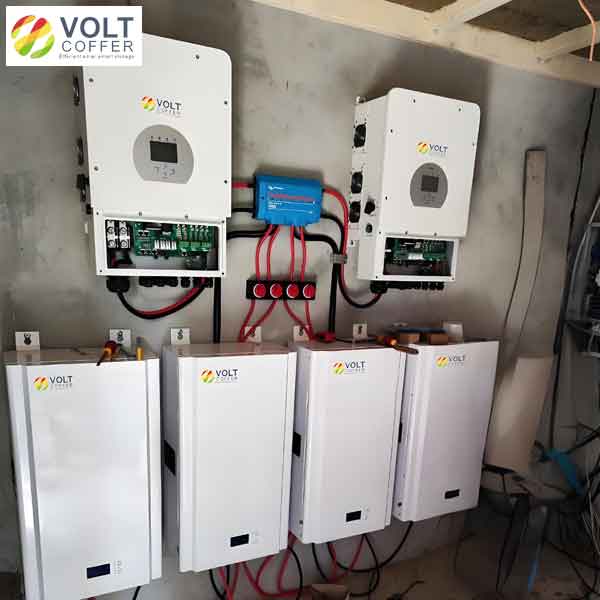
In this context, the image above showcases a modern hybrid solar inverter designed for robust performance, possibly in harsh environments. While not specific to high altitude, it highlights the compact and散热-optimized designs that manufacturers are adopting to enhance the resilience of solar inverters.
Moving to engineering design, I emphasize the importance of site-specific analysis. For high-altitude PV projects, the selection and configuration of solar inverters must account for local microclimates. Wind patterns, for example, can be leveraged for natural cooling. A simple model for convective heat loss with wind is:
$$ Q = h A (T_{\text{surface}} – T_{\text{ambient}}) $$
where \( Q \) is heat flow in watts. By estimating \( h \) from wind speed data, we can predict the operating temperature of solar inverters. In some cases,主动 cooling systems like fans or liquid loops are integrated into solar inverters to maintain capacity. Moreover, the layout of solar inverters in the plant affects mutual heating; adequate spacing ensures better air circulation.
Technological trends are reducing the need for derating. Recent solar inverters feature higher efficiency ratings, often exceeding 99%, which minimizes losses. For instance, if a solar inverter has an efficiency of \( \eta \), the power loss is \( P_{\text{loss}} = P_{\text{in}} (1 – \eta) \). With \( \eta = 0.99 \), losses are halved compared to a 98% efficient solar inverter, directly reducing thermal stress. Furthermore, the use of maximum power point tracking (MPPT) algorithms optimized for low-temperature operation helps solar inverters extract more energy in cold high-altitude conditions, offsetting derating effects. The MPPT efficiency can be modeled as:
$$ \eta_{\text{MPPT}} = \frac{P_{\text{actual}}}{P_{\text{max, available}}} $$
where \( P_{\text{max, available}} \) depends on solar irradiance and cell temperature. In cold climates, PV cells operate more efficiently, increasing \( P_{\text{max, available}} \), which solar inverters can harness if they remain operational.
In conclusion, high-altitude conditions necessitate careful consideration of solar inverters in PV systems. Through derating, enhanced design, and collaboration with manufacturers, the challenges can be mitigated. The key is to balance thermal management, electrical insulation, and environmental adaptability. As solar inverter technology advances, with improvements in semiconductor materials and cooling techniques, the impact of altitude is diminishing, allowing solar inverters to perform reliably with minimal capacity reduction. This progress is vital for expanding PV deployment to remote high-altitude regions, contributing to global renewable energy goals.
To summarize the derating methodology, I propose a comprehensive formula that incorporates multiple factors for solar inverters:
$$ P_{\text{derated}} = P_{\text{rated}} \times k_{\text{alt}} \times k_{\text{temp}} \times k_{\text{wind}} \times k_{\text{design}} $$
where \( k_{\text{alt}} \) is the altitude derating factor (from standards), \( k_{\text{temp}} \) is the temperature derating factor (from curves), \( k_{\text{wind}} \) is a wind correction factor (empirical), and \( k_{\text{design}} \) is a manufacturer-specific factor. This multiplicative approach captures the interplay of environmental and design variables. For practical use, I recommend creating detailed tables for each project, as shown below for a generic solar inverter at varying altitudes and winds.
| Altitude (m) | Wind Speed (m/s) | Derating Factor \( k_{\text{alt}} \) | Derating Factor \( k_{\text{wind}} \) | Overall Derating |
|---|---|---|---|---|
| 2000 | 0 | 0.95 | 1.00 | 0.95 |
| 2000 | 5 | 0.95 | 1.05 | 0.998 |
| 4000 | 0 | 0.82 | 1.00 | 0.82 |
| 4000 | 10 | 0.82 | 1.10 | 0.902 |
Ultimately, the goal is to ensure that solar inverters deliver optimal performance while maintaining safety and longevity in high-altitude environments. By integrating these technical insights into project planning, engineers can design resilient PV systems that harness the abundant solar resources in mountainous regions, leveraging advanced solar inverters as enablers of sustainable energy.