
The widespread adoption of lithium-ion batteries (LIBs) across electric vehicles (EVs), consumer electronics, and grid-scale energy storage represents a cornerstone of modern technological advancement. Their high energy density, long cycle life, and declining cost have fueled a revolution. However, this success brings forth a significant and growing challenge: managing the end-of-life stream of spent lithium-ion batteries. It is projected that a massive wave of retired batteries will arrive around 2025, with the annual volume of spent LIBs potentially reaching millions of tons by 2030. This impending surge creates a dual imperative. On one hand, spent LIBs contain hazardous materials like fluorinated electrolytes and heavy metals, posing severe environmental and safety risks if not handled properly. On the other hand, they are a rich source of valuable and critical metals, including lithium, cobalt, nickel, and manganese. Efficient recycling is therefore not merely a waste management issue but a strategic necessity to secure supply chains, reduce environmental impact, and foster a sustainable circular economy for battery materials. This article explores the structural composition of lithium-ion batteries and delves into the various technological pathways for their resource recovery, analyzing their principles, advancements, and future directions.
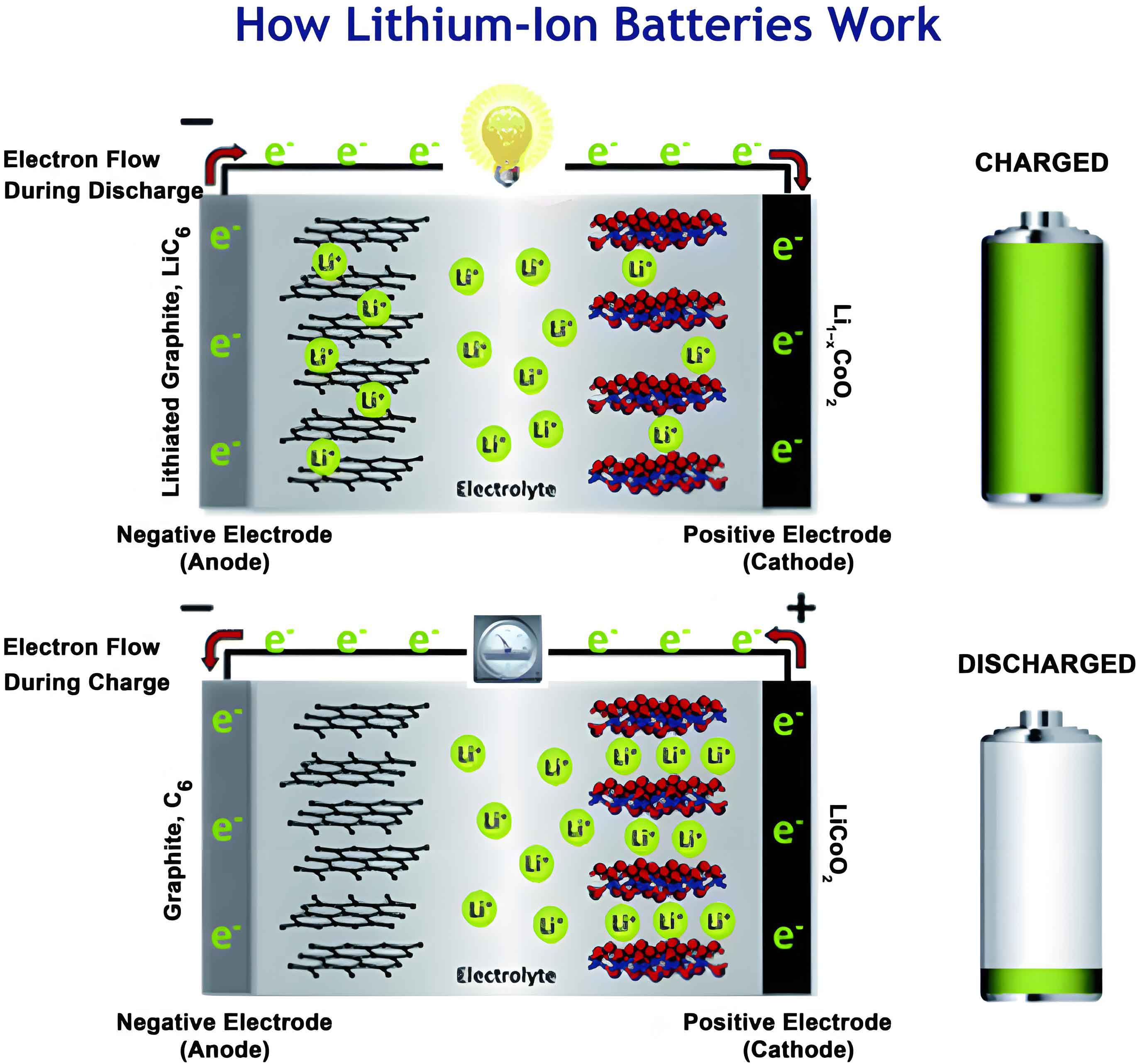
Structural Composition of Lithium-ion Batteries
To effectively recycle a lithium-ion battery, understanding its complex structure is paramount. A typical lithium-ion battery is a multi-component system where each part plays a critical role in its function and, consequently, in its recycling potential. The primary components include the cathode, anode, electrolyte, separator, and casing. The economic and strategic driver for recycling is predominantly the cathode, which houses the valuable metals. The composition and materials of a standard lithium-ion battery are summarized in the table below.
| Component | Mass Fraction (%) | Common Materials |
|---|---|---|
| Cathode | 15–41 | Aluminum foil coated with LiCoO2 (LCO), LiMn2O4 (LMO), LiFePO4 (LFP), LiNixCoyMnzO2 (NCM), LiNiO2 (LNO) |
| Anode | 2–26 | Copper foil coated with graphite, silicon, or lithium titanate (LTO) |
| Electrolyte | 2–11 | Li-salts (LiPF6, LiBF4) in organic carbonates (EC, PC, DMC, DEC) |
| Separator | 2–14 | Microporous polyolefin film (PE, PP) |
| Casing | 12–24 | Stainless steel, aluminum, or aluminum-plastic composite laminate |
The cathode is the most valuable component, constituting a significant portion of the battery’s cost (up to ~40%) and containing the critical metals targeted for recovery. Anode materials, primarily graphite-coated copper foil, offer value through copper recovery and potential graphite regeneration. Electrolyte recovery focuses on extracting lithium salts and organic solvents, while the separator and casing are often recovered as plastic or metal scrap. It is important to note that different cathode chemistries dictate recycling strategies. High-value cobalt- and nickel-rich batteries (e.g., LCO, NCM) have strong economic drivers for metal reclamation. In contrast, lithium iron phosphate (LFP) batteries, while dominant in certain markets, present a greater challenge and lower immediate economic incentive due to their lower content of expensive metals, shifting focus towards lithium recovery and direct material regeneration.
Cascade Utilization: Extending the First Life
Before a lithium-ion battery reaches the stage of material dismantling and chemical recovery, its remaining capacity can be harnessed in less demanding secondary applications. This process is known as cascade or second-life utilization. When an electric vehicle battery pack’s capacity degrades below a certain threshold (typically 70-80% of its original capacity), it may no longer meet the stringent requirements for automotive propulsion but still holds substantial value for stationary energy storage. The fundamental principle involves the disassembly, testing, sorting, and reconfiguration of retired battery modules or cells into new systems tailored for applications such as:
- Grid Energy Storage and Frequency Regulation: Providing backup power and stabilizing the electrical grid.
- Telecommunications Backup Power: Replacing lead-acid batteries in cell towers.
- Renewable Energy Integration: Storing energy from solar panels or wind turbines.
- Low-Speed Electric Vehicles and Forklifts: Powering applications with lower energy and power density requirements.
Cascade utilization maximizes the economic and resource efficiency of a lithium-ion battery, delaying the need for recycling. However, it faces significant technical hurdles. The main challenge is managing the heterogeneity of retired batteries, which differ in chemistry, size, age, and state-of-health. This requires sophisticated battery management systems (BMS), advanced diagnostics, and robust engineering for safe and reliable repurposing. Among battery types, LFP batteries are often considered more suitable for second-life applications due to their superior safety, longer cycle life, and more stable degradation curve compared to some high-nickel chemistries.
Recycling Technologies: From Dismantling to Material Recovery
When a lithium-ion battery is no longer viable for any electrical use, it enters the recycling stream for material recovery. The recycling process is typically a multi-stage operation, beginning with crucial pre-treatment steps, followed by core recovery processes categorized as physical, chemical (pyrometallurgy and hydrometallurgy), and biological methods. The overarching goal is to liberate and purify the valuable elements contained within the spent lithium-ion battery.
Pre-treatment: The Essential First Step
Pre-treatment is designed to prepare the spent lithium-ion battery for efficient and safe downstream processing. It involves several key operations:
- Discharge: Residual energy in spent batteries poses a serious safety risk of short-circuit, fire, or explosion during handling. Discharge can be achieved through physical (e.g., resistive load) or chemical (e.g., salt solution) methods, each with trade-offs between safety, speed, and potential contamination.
- Dismantling and Separation: This step aims to physically separate battery components. Manual disassembly is precise but labor-intensive and hazardous. Automated mechanical processes, involving shredding, crushing, and sieving, followed by separation techniques like magnetic separation (for steel), eddy current separation (for aluminum and copper), and density-based sorting, are preferred for large-scale operations.
- Thermal or Chemical Treatment: To detach the electrode active materials from their metal foils (Al for cathode, Cu for anode), the polyvinylidene fluoride (PVDF) binder must be decomposed or dissolved. Thermal treatment (calcination) burns off organics but consumes energy and may cause lithium loss. Solvent dissolution (using organic solvents like NMP) or alkaline leaching are alternative, less energy-intensive methods.
The efficiency of the entire recycling chain for a spent lithium-ion battery hinges on the effectiveness of these pre-treatment steps.
Physical Recycling: Mechanical Processing and Direct Recovery
Physical recycling refers to processes that recover battery components or materials primarily through mechanical and physical separation methods without involving deep chemical changes. After pre-treatment crushing, a series of operations—such as sieving, magnetic separation, gravity separation, and electrostatic separation—are employed to produce concentrated streams of black mass (a mixture of cathode and anode active materials), copper, aluminum, and plastics. Advanced physical methods aim to go further by regenerating electrode materials. For instance, separated cathode powder can undergo “healing” through short thermal treatment or chemical relithiation to restore its electrochemical properties. A prominent advantage of physical routes is their environmental friendliness, as they avoid the use of large quantities of chemicals and generate less liquid waste. However, achieving high-purity separated materials suitable for direct reuse in new batteries often requires complementary chemical steps, making physical methods frequently an integral part of a hybrid recycling flow sheet for spent lithium-ion batteries.
Chemical Recycling: Pyrometallurgy and Hydrometallurgy
Chemical recycling is the dominant industrial approach for recovering metals from spent lithium-ion batteries. It is divided into two main branches: pyrometallurgy (high-temperature) and hydrometallurgy (solution-based).
Pyrometallurgy: High-Temperature Smelting
Pyrometallurgy involves treating spent battery materials in a high-temperature furnace (e.g., a shaft furnace or rotary kiln) at temperatures typically above 1000°C. Organic components (electrolyte, separator, binder, graphite) serve as a reducing agent and fuel. The valuable metals (Co, Ni, Cu) are reduced to form a molten alloy, while lithium, aluminum, and silicon report to the slag phase. The alloy is further refined, and lithium can sometimes be recovered from the slag by subsequent leaching. The primary reactions can be simplified as reduction by carbon (from graphite and plastics):
$$ \text{LiCoO}_2 + \text{C} \xrightarrow{\text{High T}} \text{Co} + \text{Li}_2\text{O} + \text{CO/CO}_2 $$
The lithium oxide (Li2O) reports to the slag: $$ \text{Li}_2\text{O} + \text{SiO}_2 (\text{from slag former}) \rightarrow \text{Li-silicate slag} $$
Advantages: This process is robust, can handle mixed and untreated battery feed, and has high throughput.
Disadvantages: It is highly energy-intensive, loses lithium to slag (recovery is complex), emits fumes requiring sophisticated gas cleaning, and produces less pure metals compared to hydrometallurgy.
A modern evolution is salt-assisted roasting, a lower-temperature (300-600°C) thermal pre-treatment. Here, spent cathode material is mixed with salts (e.g., (NH4)2SO4, NH4Cl, Na2S2O8). The salt decomposes or reacts, facilitating the conversion of metals into water-soluble sulfates or chlorides, which are then easily leached in water. For example, using ammonium sulfate:
$$ 2\text{LiCoO}_2 + 3(\text{NH}_4)_2\text{SO}_4 \xrightarrow{\Delta} 2\text{Li}_2\text{SO}_4 + 2\text{CoSO}_4 + 6\text{NH}_3 \uparrow + 3\text{H}_2\text{O} \uparrow + \text{O}_2 \uparrow $$
This method significantly lowers energy consumption and improves lithium recovery from the spent lithium-ion battery.
Hydrometallurgy: Leaching and Separation
Hydrometallurgy is the most researched and widely adopted method for targeted metal recovery. It involves leaching the valuable metals from the spent cathode material (black mass) into an aqueous solution, followed by a series of separation and purification steps to recover individual metal compounds.
- Leaching: The core step where metals are dissolved. It typically requires an acid (H+) to protonate oxides and a reducing agent to reduce high-valent metals (Co3+, Mn4+) to more soluble lower states (Co2+, Mn2+).
- Inorganic Acid Leaching: Sulfuric acid (H2SO4) is most common, with hydrogen peroxide (H2O2) as a reductant. The general reaction for NCM is:
$$ 2\text{LiNi}_{x}\text{Co}_{y}\text{Mn}_{z}\text{O}_{2} + 3\text{H}_2\text{SO}_4 + \text{H}_2\text{O}_2 \rightarrow 2\text{xNiSO}_4 + 2\text{yCoSO}_4 + 2\text{zMnSO}_4 + \text{Li}_2\text{SO}_4 + 4\text{H}_2\text{O} + \text{O}_2 $$ - Organic Acid Leaching: Environmentally friendlier alternatives like citric acid, ascorbic acid, formic acid, or acetic acid are used. They act as both acid and reductant (e.g., ascorbic acid, C6H8O6). For instance:
$$ \text{LiCoO}_2 + 1.5\text{C}_6\text{H}_8\text{O}_6 + 1.5\text{H}_2\text{SO}_4 \rightarrow \text{Li}_2\text{SO}_4 + \text{CoSO}_4 + 1.5\text{C}_6\text{H}_6\text{O}_6 + 4\text{H}_2\text{O} $$ - Other Innovatives: Research explores “acid-free” leaching using solutions of Fe2+/Fe3+ salts, where Fe2+ acts as the reductant, or using solid sodium bisulfate (NaHSO4).
- Inorganic Acid Leaching: Sulfuric acid (H2SO4) is most common, with hydrogen peroxide (H2O2) as a reductant. The general reaction for NCM is:
- Separation & Purification: The leachate containing Li+, Ni2+, Co2+, Mn2+ is subjected to:
- Solvent Extraction (SX): The most precise method. Selective organic extractants are used in multiple stages to separate Co, Ni, and Mn from each other and from lithium. For example, phosphinic acid derivatives (e.g., Cyanex 272) selectively extract Co over Ni and Mn.
- Chemical Precipitation: Adding precipitants like sodium hydroxide (NaOH) or oxalic acid (H2C2O4) to selectively precipitate metals as hydroxides or oxalates. A common step is precipitating Al and Fe impurities first, then using NaOH to precipitate Ni/Co/Mn hydroxides together as a precursor, leaving Li in solution.
- Lithium Recovery: The final step often involves concentrating the Li-rich solution and precipitating lithium as low-solubility carbonate (Li2CO3) by adding sodium carbonate (Na2CO3):
$$ 2\text{Li}^+ + \text{CO}_3^{2-} \rightarrow \text{Li}_2\text{CO}_3 \downarrow $$
Advantages: High recovery rates (>95%) and high purity of products, lower energy consumption than pyrometallurgy, and suitability for specific battery chemistries.
Disadvantages: Generates large volumes of process wastewater, requires complex multi-step operations, and needs efficient pre-treatment to avoid reagent consumption by impurities.
Hybrid Pyro-Hydro Processes
To leverage the strengths of both methods, hybrid processes are employed industrially. A typical flow involves a mild pyrolysis step to remove organics and detach materials, followed by hydrometallurgical leaching of the resulting calcine. This combination often improves leaching efficiency, reduces acid consumption, and simplifies the purification of the pregnant leach solution from the spent lithium-ion battery feedstock.
Biological Recycling (Bioleaching): An Emerging Green Technology
Bioleaching employs microorganisms or their metabolites to extract metals from solid waste. For spent lithium-ion batteries, chemolithotrophic acidophilic bacteria (e.g., Acidithiobacillus ferrooxidans) or heterotrophic fungi (e.g., Aspergillus niger) are used. The mechanisms involve:
- Direct Mechanism: Bacteria attach to the solid and enzymatically oxidize metal sulfides (if present) or reduced metal species.
- Indirect Mechanism: Bacteria oxidize Fe2+ to Fe3+ and/or sulfur to sulfuric acid, producing a chemical lixiviant in situ:
$$ 2\text{Fe}^{2+} + 0.5\text{O}_2 + 2\text{H}^+ \xrightarrow{\text{Bacteria}} 2\text{Fe}^{3+} + \text{H}_2\text{O} $$
$$ \text{S}^0 + 1.5\text{O}_2 + \text{H}_2\text{O} \xrightarrow{\text{Bacteria}} \text{H}_2\text{SO}_4 $$
The generated Fe3+ and H2SO4 then chemically oxidize and dissolve the cathode material:
$$ \text{LiCoO}_2 + 2\text{Fe}^{3+} \rightarrow \text{Li}^+ + \text{Co}^{2+} + 2\text{Fe}^{2+} + 2\text{O}_2 $$
Fungi work by excreting organic acids (citric, oxalic, gluconic) which chelate and dissolve metals. Bioleaching operates at ambient temperature and pressure, has very low energy and chemical input, and is inherently environmentally benign. The main challenges are slow kinetics (days to weeks), sensitivity to environmental conditions (pH, temperature, toxicity), and the difficulty in subsequent separation of metals from the complex bio-leachate. While not yet commercially dominant for lithium-ion battery recycling, it represents a promising avenue for sustainable metal recovery.
Comparison of Major Recycling Pathways
The choice of recycling technology depends on factors like battery chemistry, scale, economic considerations, and environmental regulations. The table below provides a comparative summary.
| Recycling Type | Key Methods | Typical Metal Recovery Efficiency | Advantages | Disadvantages |
|---|---|---|---|---|
| Pyrometallurgy | Smelting, Salt Roasting | Co, Ni, Cu: >95%; Li: Variable (0-80%) | Robust, handles mixed feed, high throughput | High energy use, Li loss to slag, gas emissions |
| Hydrometallurgy | Acid/Reductant Leaching, SX, Precipitation | Li, Co, Ni, Mn: >95% (each) | High purity products, selective recovery, lower energy | Chemical waste, complex process, sensitive to feed |
| Physical | Crushing, Separation, Direct Repair | Material recovery: 70-90% | Low chemical use, low pollution, direct material output | Lower purity, often requires complementary steps |
| Biological | Bioleaching with bacteria/fungi | Li, Co, Ni: 50-99% (kinetics dependent) | Very low energy, environmentally friendly, low cost | Very slow, sensitive conditions, immature at scale |
Conclusion and Future Perspectives
The exponential growth in the use of lithium-ion batteries across all sectors makes the development of efficient, economical, and environmentally sound recycling technologies not just an option but an urgent global imperative. The recycling of spent lithium-ion batteries addresses critical issues: mitigating environmental hazards from improper disposal, alleviating pressure on finite natural resources, and enhancing supply chain security for strategic battery materials like lithium, cobalt, and nickel.
Looking ahead, several key trends and challenges will shape the future of lithium-ion battery recycling:
- Integration of Processes: Future recycling plants will likely employ hybrid or integrated flowsheets that combine the best features of different methods. For example, a “mechanical pre-treatment + mild thermal treatment + hydrometallurgy” route can optimize recovery rates, product purity, and economic viability for a mixed stream of spent lithium-ion batteries.
- Focus on Direct Recycling/Re-synthesis: Beyond extracting metals, there is growing interest in directly regenerating cathode materials. Processes involving relithiation and short-range order restoration aim to return the active material directly to the battery manufacturing line, closing the loop with lower energy and material loss.
- Design for Recycling: The ultimate solution involves designing future lithium-ion batteries with recycling in mind. Standardization of cell formats, use of water-soluble binders, marking of chemistries, and designs that facilitate disassembly will drastically lower recycling costs and complexity.
- Policy and Ecosystem Development: Robust regulatory frameworks enforcing extended producer responsibility (EPR), establishing clear collection networks, and creating standards for recycled materials are essential to build a sustainable circular economy. Tracking batteries throughout their lifecycle with digital passports will be crucial.
- Economic Viability for All Chemistries: While recycling high-value NCM batteries is already economically driven, innovating low-cost processes for LFP battery recycling to recover lithium and iron phosphate is critical, given their large market share.
The vision for a sustainable battery ecosystem is the creation of a full lifecycle value chain: “Battery Use -> Collection -> Cascade Utilization -> Material Recycling -> Raw Material Refining -> Precursor/Cathode Re-synthesis -> New Battery Manufacturing.” Achieving this closed-loop system for the lithium-ion battery industry is a monumental but necessary task to ensure that the electrification of our transportation and energy sectors is truly sustainable for generations to come.