
The demand for power sources capable of delivering instantaneous, high-current, millisecond-level pulse discharges is rapidly growing across various advanced technological fields, including specialized equipment, rail transportation, and pulsed power systems. These applications often operate under harsh environmental conditions, requiring energy sources that possess not only high energy density for sustained operation but also the critical ability to provide bursts of ultra-high power. Lithium-ion batteries, with their inherently high power density and energy density, stand as a prime candidate to meet these dual challenges. While extensive research exists on the continuous discharge and moderate pulse performance of lithium-ion batteries, there is a significant gap in publicly available literature concerning their behavior under extreme pulse discharge currents exceeding 1000 A. This study systematically investigates the ultra-high-rate pulse discharge capabilities of a specifically designed lithium-ion battery across a range of low temperatures, providing foundational data and theoretical insights for practical applications in high-power pulse scenarios.
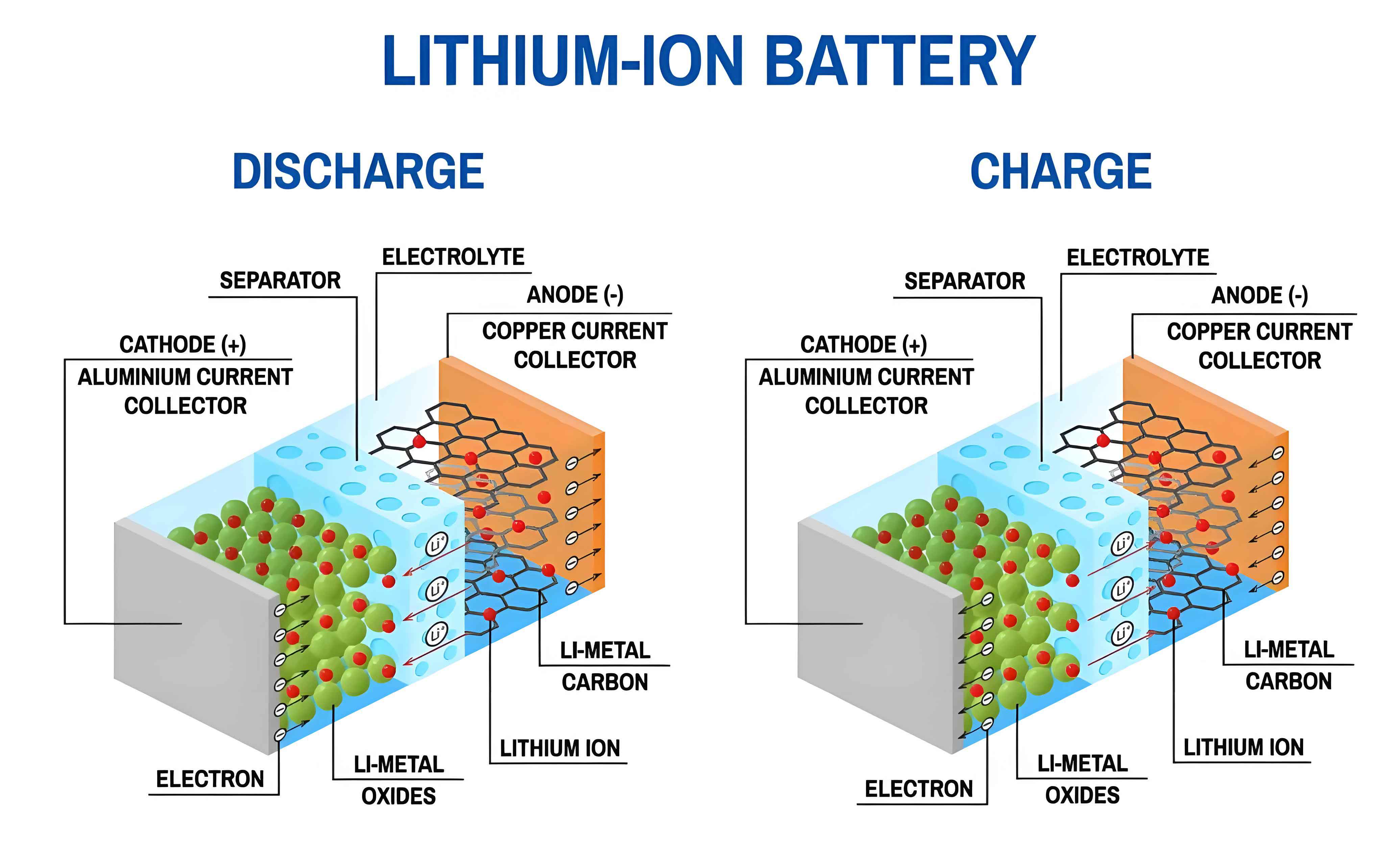
The core of this investigation lies in understanding how the **lithium-ion battery** responds when subjected to current surges of 1500 A to 2000 A, with pulse widths as short as 20 milliseconds, under varying thermal conditions. The ability of a **lithium-ion battery** to deliver such power is governed by the intricate interplay of ionic conductivity within the electrolyte, charge transfer kinetics at the electrode interfaces, and the mass transport of lithium ions within the active materials. At ultra-high currents, these processes can become severely polarized, leading to rapid voltage depression and potential cell damage. Furthermore, temperature is a master variable; it dramatically influences the viscosity of the electrolyte and the diffusion coefficients of lithium ions, thereby setting a fundamental limit on the achievable pulse current at sub-zero conditions. This work aims to map these limits and characterize the associated voltage and power dynamics for a practical **lithium-ion battery** cell.
Experimental Methodology: Cell Design and Testing Protocol
To ensure relevance to industrial practice, the **lithium-ion battery** cells used in this study were manufactured on a full-scale production line. The cell design was optimized for high-rate capability, focusing on electrode architecture and electrolyte formulation.
Electrode Fabrication and Cell Assembly
The negative electrode was formulated using hard carbon as the primary active material, chosen for its good rate capability and structural stability. Conductive additives, including acetylene black and carbon nanotubes (CNT), were incorporated to create a robust percolating network for electron transport. The slurry, with a binder of polyvinylidene fluoride (PVDF) in N-methyl-2-pyrrolidone (NMP), was coated onto a thin copper foil current collector. A meticulous drying process ensured the removal of solvent.
The positive electrode utilized lithium cobalt oxide (LCO), known for its high volumetric energy density and good power characteristics. A similar conductive additive system with CNT was employed. The slurry was coated onto an aluminum foil current collector. Both electrodes were dried under vacuum to eliminate residual moisture, which is critical for the longevity of any **lithium-ion battery**.
The final cell was constructed using a stacking method, assembling 25 positive and 26 negative electrode sheets separated by a polypropylene membrane. The key to the high-power performance was the custom-formulated electrolyte. It consisted of a base of 1 M LiPF6 and was enhanced with additives including lithium bis(trifluoromethanesulfonyl)imide (LiTFSI) and dimethyl carbonate (DMC). These additives are known to improve ionic conductivity, lower interfacial resistance, and enhance low-temperature performance, which is vital for the pulse performance of the **lithium-ion battery**. The assembled pouch cells had a nominal capacity of approximately 1 Ah.
Characterization and Pulse Testing Procedure
Five randomly selected cells from five different production batches were first characterized for their basic properties at room temperature. The direct current internal resistance (DCIR) was measured. The capacity and energy were determined via a standard constant-current discharge protocol. The mass was precisely weighed to calculate specific energy.
The pulse discharge behavior was evaluated using a specialized high-current pulse test system. The protocol was designed to probe the limits of the **lithium-ion battery**:
- 30°C Testing: Cells were stabilized at 30°C and subjected to single 20-ms pulses at currents of 1500 A, 1800 A, and 2000 A.
- 0°C Testing: Cells were conditioned at 0°C and subjected to three consecutive 20-ms pulses (with a 500-ms interval) at 1800 A and 2000 A.
- -20°C Testing: Cells were conditioned at -20°C and subjected to three consecutive 20-ms pulses (with a 500-ms interval) at 1500 A and 1800 A.
Voltage response was recorded with high fidelity during these pulses. The instantaneous power (P) was calculated as the product of current (I) and voltage (V(t)):
$$P_{pulse}(t) = V(t) \cdot I_{pulse}$$
The specific power was then derived by normalizing the power to the cell mass.
Results and Analysis
Basic Electrochemical Characteristics
The consistency and baseline performance of the manufactured **lithium-ion battery** cells are summarized in Table 1. The data confirms good batch-to-batch reproducibility, which is essential for reliable performance in application.
| Cell ID | Internal Resistance (mΩ) | Capacity (mAh) | Energy (mWh) | Mass (g) | Specific Energy (Wh/kg) |
|---|---|---|---|---|---|
| 1 | 1.22 | 983.2 | 3385.9 | 34.8 | 97.30 |
| 2 | 1.22 | 985.5 | 3389.4 | 34.1 | 99.39 |
| 3 | 1.21 | 993.8 | 3395.6 | 34.9 | 97.29 |
| 4 | 1.20 | 989.4 | 3390.7 | 34.5 | 98.28 |
| 5 | 1.27 | 986.1 | 3391.1 | 34.6 | 98.00 |
The specific energy, averaging around 98 Wh/kg, is significantly higher than that of typical electric double-layer capacitors (supercapacitors), which usually range from 10 to 30 Wh/kg. This highlights the advantage of the **lithium-ion battery** in applications requiring a blend of energy and power.
Pulse Discharge Behavior at Elevated Temperature (30°C)
At 30°C, the **lithium-ion battery** demonstrated robust performance. The voltage during the 20-ms pulse decayed in a smooth, monotonic fashion for all current levels tested, up to and including 2000 A. This indicates that the internal polarization resistances, while present, did not cause unstable behavior. The total voltage drop (ΔV) during the pulse is primarily due to ohmic losses and increasing concentration polarization, which can be conceptually described by a simplified equation considering the instantaneous total resistance Rtotal(t):
$$V(t) = V_{OCV} – I_{pulse} \cdot R_{total}(t, T)$$
where VOCV is the open-circuit voltage prior to the pulse.
As the pulse current increased from 1500 A to 2000 A, the rate of voltage decline became steeper, a direct consequence of the higher I·R drop. However, the specific power output increased substantially with current because the linear increase in current outweighed the sub-linear decrease in voltage. The **lithium-ion battery** achieved its highest pulse current capability of 2000 A at this temperature, with a corresponding peak specific power exceeding 101 kW/kg. This confirms that at moderate temperatures, the engineered **lithium-ion battery** possesses excellent high-rate discharge capability with stable voltage response.
Pulse Discharge Behavior at Low Temperatures (0°C and -20°C)
Lowering the ambient temperature introduces significant kinetic and transport limitations within the **lithium-ion battery**. The results clearly delineate a reduced limit for sustainable ultra-high-rate pulse discharge.
At 0°C: The **lithium-ion battery** could reliably handle a 1800 A pulse. Interestingly, during the sequence of three pulses, the terminal voltage at the end of each successive 20-ms pulse was slightly higher than the previous one, leading to an increase in specific power per pulse. This is attributed to internal Joule heating. The heat generated during the high-current pulse raises the local cell temperature, reducing electrolyte viscosity and accelerating ion transport kinetics. This thermal feedback effect partially mitigates the initial low-temperature penalty. The behavior can be qualitatively linked to the Arrhenius-type dependence of ionic conductivity (κ) and diffusion coefficients (D):
$$\kappa, D \propto \exp\left(-\frac{E_a}{RT}\right)$$
where Ea is the activation energy, R is the gas constant, and T is the absolute temperature. A small increase in T during pulsing significantly improves κ and D.
However, at the 2000 A pulse level and 0°C, the voltage profile exhibited severe fluctuations and instability. This indicates that the demand for ionic current exceeded the supply capability of the cold electrolyte, leading to severe concentration polarization at the electrode/electrolyte interface. The depletion of Li+ ions in the interfacial region creates a large, unstable overpotential.
At -20°C: The limits contracted further. A stable, smooth voltage response was observed for 1500 A pulses, again with a slight performance improvement from the first to the third pulse due to self-heating. At 1800 A and -20°C, the voltage response became unstable and fluctuated markedly, similar to the 2000 A case at 0°C. This defines the operational boundary for this specific **lithium-ion battery** design under these extreme conditions.
The interplay between temperature (T), maximum sustainable pulse current (Imax), and peak specific power (Pmax) is synthesized in Table 2.
| Ambient Temperature (°C) | Maximum Stable Pulse Current (A) | Approximate Peak Specific Power (kW/kg) | Voltage Behavior |
|---|---|---|---|
| 30 | 2000 | >101 | Smooth, stable decay |
| 0 | 1800 | >106 | Smooth decay with thermal improvement |
| 0 | 2000 | Fluctuating | Unstable, fluctuating |
| -20 | 1500 | >108 | Smooth decay with thermal improvement |
| -20 | 1800 | Fluctuating | Unstable, fluctuating |
A notable observation is that the calculated specific power at the point of stability is very high across all temperatures, ranging from 101 to 108 kW/kg. The slight increase in specific power at lower temperatures for the stable current level (e.g., 108 kW/kg at -20°C/1500A vs. 101 kW/kg at 30°C/2000A) is likely because the voltage under load starts from a higher initial open-circuit voltage at a lower state-of-discharge (as the test starts from a rested, full state), and the mass normalization factor plays a role. The core finding remains the reduction in absolute current capability with temperature.
Discussion: Mechanisms and Implications
Rate-Limiting Factors in Ultra-High Pulse Discharge
The performance cliff observed when exceeding the temperature-dependent current limit is a direct manifestation of the fundamental processes inside a **lithium-ion battery**. During an ultra-high-rate pulse, the following sequence of resistances dominates the voltage response:
- Ohmic Resistance (RΩ): This includes electronic resistance of components and ionic resistance of the bulk electrolyte. It causes an immediate voltage drop upon current application: ΔVΩ = I · RΩ.
- Charge Transfer Resistance (Rct): The kinetic barrier to Li+ ion reduction/oxidation at the electrode surfaces. It is highly temperature-sensitive.
- Mass Transport Limitation (Diffusion, Rdiff): As current flows, Li+ concentration gradients develop within the electrolyte (in pores) and solid active materials. The resulting overpotential grows with time (t) approximately as: ΔVdiff ∝ I · √t. This is often the primary cause of failure during sustained high-current pulses.
At low temperatures, Rct and the electrolyte resistance component of RΩ increase dramatically. More critically, the solid-state diffusion coefficient of Li+ (Ds) inside active material particles plummets. When the applied current demands lithium extraction/insertion faster than Ds can support, a severe concentration polarization builds up at the particle surface, leading to a rapid and unstable voltage drop—the observed fluctuation. This phenomenon can be modeled using Fick’s second law within a spherical particle approximation:
$$\frac{\partial c_s(r,t)}{\partial t} = D_s \left( \frac{\partial^2 c_s}{\partial r^2} + \frac{2}{r} \frac{\partial c_s}{\partial r} \right)$$
with boundary conditions linked to the ultra-high pulse current. The inability to solve this diffusion profile fast enough under cold conditions leads to the current limit.
Design Principles for Pulse-Optimized Lithium-ion Batteries
This study points toward key design strategies for a **lithium-ion battery** intended for ultra-high pulse discharge:
- Electrode Engineering: Use of active materials with high intrinsic diffusivity (e.g., hard carbon, LTO) or nanostructuring to shorten solid-state diffusion paths. Thin electrodes are crucial to minimize ionic travel distance within the pore electrolyte.
- Conductive Network: A robust, three-dimensional conductive network using materials like CNT ensures low electronic resistance even at very high current densities.
- Electrolyte Formulation: As demonstrated here, tailored electrolytes with low viscosity, high ionic conductivity across a wide temperature range, and beneficial additives (like LiTFSI for improved Li+ transport) are non-negotiable.
- Thermal Management: The observed self-heating effect is a double-edged sword. While it can aid performance in a burst, uncontrolled heating is dangerous. Systems must be designed to manage the heat generated during repetitive pulsed operation of the **lithium-ion battery**.
Comparative Context and Application Outlook
The achieved specific power of 96-108 kW/kg places this **lithium-ion battery** in a unique category, bridging the gap between conventional high-energy lithium-ion batteries and supercapacitors. While supercapacitors can deliver even higher power densities (often 10-100 kW/kg) and cycle life for pulse duty, their energy density is an order of magnitude lower. The **lithium-ion battery** studied here offers a compelling compromise: substantial energy storage (~98 Wh/kg) coupled with the ability to discharge a significant fraction of that energy at power levels exceeding 100 kW/kg for very short durations.
This makes it suitable for applications requiring a “power burst” from a primary energy source, such as:
- Electromagnetic launchers or pulsed power systems for specialized equipment.
- Torque assist or regenerative braking power buffers in advanced rail transport.
- Starting systems for large engines in cold climates.
- High-power industrial tools.
A critical consideration for system design is the depth of discharge (DOD) per pulse and the repetition rate. The energy delivered in a single 20-ms, 2000 A pulse from a ~1 Ah **lithium-ion battery** is relatively small. The practical utility emerges when such pulses are delivered repeatedly or in tailored patterns, making understanding the thermal and state-of-charge (SOC) management paramount.
Conclusion
This investigation provides a detailed examination of the ultra-high-rate pulse discharge behavior of a commercially-styled **lithium-ion battery**. The key finding is that the maximum sustainable pulse current for a **lithium-ion battery** is strongly temperature-dependent, decreasing from 2000 A at 30°C to 1500 A at -20°C for the specific cell design tested. Within these limits, the **lithium-ion battery** delivers exceptionally high specific power (96-108 kW/kg) with a stable voltage response, indicating well-managed internal polarization. Exceeding these current limits at a given temperature results in unstable voltage fluctuations due to severe concentration polarization, primarily from hindered solid-state diffusion and electrolyte transport.
The study underscores that through deliberate material selection (e.g., hard carbon anodes, conductive CNT networks) and advanced electrolyte engineering, the **lithium-ion battery** platform can be tailored to meet extreme pulse power demands while retaining meaningful energy density. Future work should focus on modeling the coupled electrochemical-thermal dynamics during such pulses, investigating long-term cycle life under pulsed conditions, and exploring the integration of these high-power **lithium-ion battery** cells with supercapacitors in hybrid systems to optimize both energy and power density for the most demanding applications.