
The widespread adoption and continued technological evolution of the lithium-ion battery represent a cornerstone of modern energy storage. Its high energy density, long cycle life, and decreasing cost have enabled revolutions in portable electronics, electric transportation, and grid-scale energy storage. However, this remarkable success is perpetually shadowed by persistent safety concerns, primarily associated with the risk of thermal runaway—an uncontrollable self-heating event that can lead to fire or explosion. At the heart of this safety challenge lies the electrolyte, the essential yet vulnerable “blood” of the lithium-ion battery. Conventional electrolytes, composed of lithium salts dissolved in volatile, flammable organic carbonate solvents, present a significant fire hazard. Under abusive conditions such as overcharging, internal short circuit, or external heating, the electrolyte becomes a primary fuel source and a key participant in exothermic decomposition reactions that drive thermal runaway. This article, from the perspective of ongoing research in the field, provides a comprehensive analysis of strategies to enhance the intrinsic safety of electrolytes for lithium-ion battery systems. The discussion is structured around three critical pillars: improving thermal stability, imparting flame retardancy, and enhancing overcharge resistance, with a focus on developments in recent years and future directions.
The Inherent Fire Hazard of Conventional Electrolytes
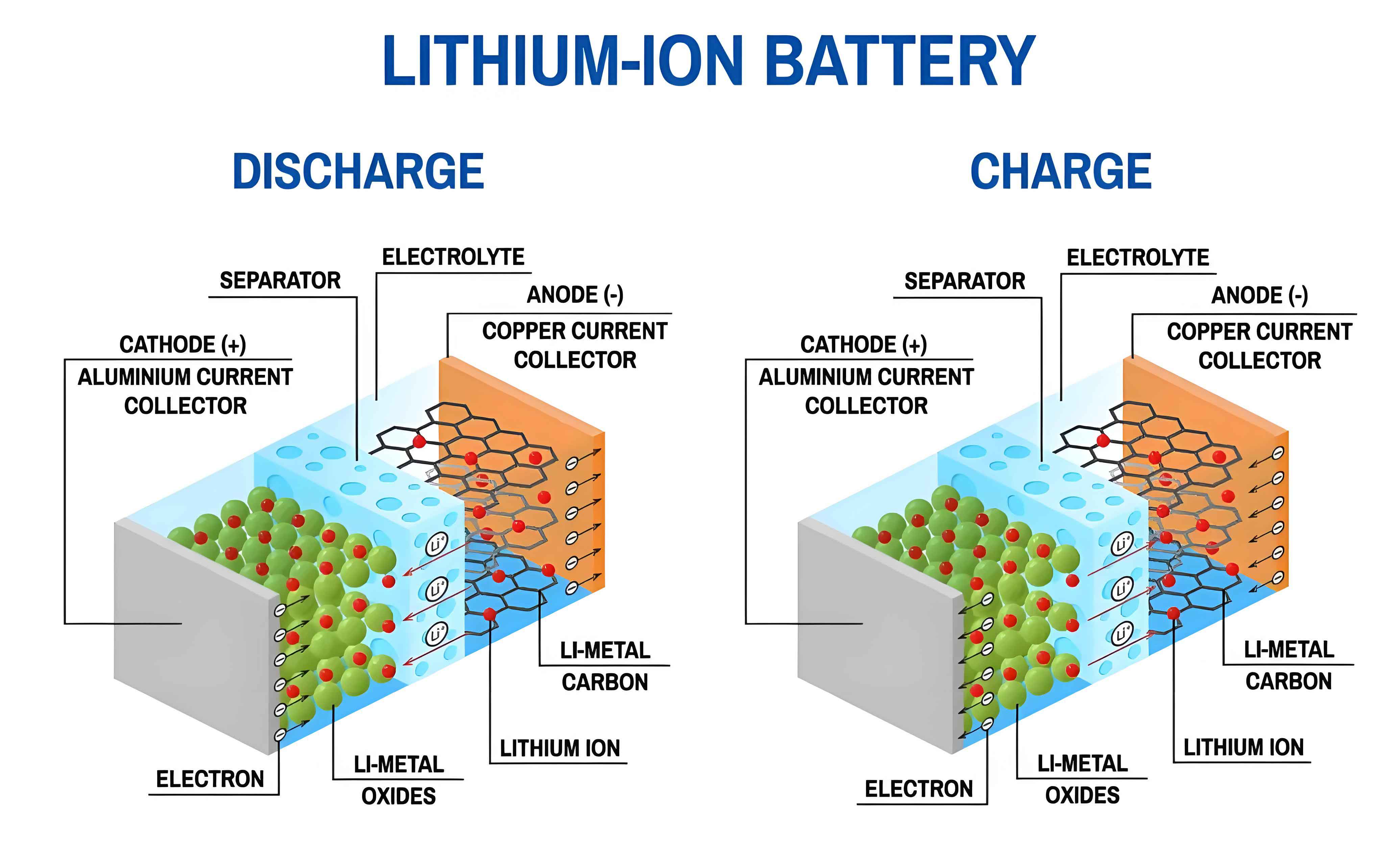
The fundamental role of the electrolyte in a lithium-ion battery is to facilitate the transport of lithium ions between the cathode and anode during charge and discharge cycles. A typical commercial electrolyte consists of a lithium hexafluorophosphate (LiPF6) salt dissolved in a mixture of cyclic and linear organic carbonates, such as ethylene carbonate (EC) and dimethyl carbonate (DMC). While this formulation offers excellent ionic conductivity and stable solid-electrolyte interphase (SEI) formation, its chemical properties are the root cause of its fire hazard. The organic solvents possess low flash points and high volatility, making them readily ignitable. The thermal instability is quantified by parameters such as the onset decomposition temperature (Tonset) and the total heat release (Qtotal) during combustion.
The pathway to thermal runaway in a lithium-ion battery is a complex cascade of reactions, many involving the electrolyte. The process can be conceptually described by an energy balance equation:
$$ \rho C_p \frac{\partial T}{\partial t} = \nabla \cdot (k \nabla T) + \dot{Q}_{gen} – \dot{Q}_{loss} $$
where \( \rho \) is density, \( C_p \) is heat capacity, \( T \) is temperature, \( k \) is thermal conductivity, \( \dot{Q}_{gen} \) is the rate of heat generation from internal reactions, and \( \dot{Q}_{loss} \) is the rate of heat loss to the surroundings. Thermal runaway occurs when \( \dot{Q}_{gen} \) dramatically exceeds \( \dot{Q}_{loss} \). The electrolyte contributes significantly to \( \dot{Q}_{gen} \) through multiple exothermic pathways:
- Decomposition of the LiPF6 salt: LiPF6 thermally decomposes to LiF and PF5, a strong Lewis acid.
$$ \text{LiPF}_6 \xrightarrow{\Delta} \text{LiF} + \text{PF}_5 $$ - Reaction of PF5 with solvent: PF5 catalyzes the decomposition of carbonate solvents, producing various gaseous and heat-releasing products.
$$ \text{PF}_5 + \text{R-O-CO-OR’} \rightarrow \text{POF}_3 + \text{ROH} + \text{R’F} + \text{other products} + \text{Heat} $$ - Reaction of solvents with charged electrodes: At elevated temperatures, the organic solvents can react exothermically with the lithiated anode and the delithiated, highly oxidized cathode.
The combustion of the electrolyte itself releases intense heat. The heat release rate (HRR) during a pool fire of a standard EC/DMC/EMC electrolyte can be modeled and is found to scale with the pool diameter, reaching peak temperatures exceeding 800°C. This intense heat can propagate to neighboring cells in a module, leading to catastrophic failure. Therefore, mitigating the inherent hazards of the electrolyte is paramount for developing a safer lithium-ion battery.
Strategies for Enhancing Thermal Stability
Improving the thermal stability of the electrolyte involves designing components that resist decomposition at higher temperatures. This directly raises the threshold for the onset of thermal runaway in a lithium-ion battery.
1. High Flash Point and Thermally Stable Solvents
Replacing or supplementing traditional low-boiling, low-flash point linear carbonates (e.g., DMC, EMC) with solvents possessing higher thermal stability is a direct approach. The flash point (Tflash) is a key metric, often correlated with molecular structure. For linear carbonates, extending alkyl chains or introducing ether oxygen atoms can significantly increase Tflash. A quantitative relationship can be explored using group contribution methods, where properties like boiling point (Tb) and flash point are estimated from molecular structure. For instance, replacing -O-CH3 with -O-CH2-CH2-O-CH3 in a carbonate leads to a substantial boost in Tflash. Table 1 summarizes the properties of conventional versus advanced high-stability solvents.
| Solvent Type | Example | Chemical Formula | Boiling Point (°C) | Flash Point (°C) | Key Advantage/Disadvantage |
|---|---|---|---|---|---|
| Conventional Linear Carbonate | Dimethyl Carbonate (DMC) | C3H6O3 | 91 | 18 | Low viscosity, good conductivity; Highly flammable |
| Conventional Linear Carbonate | Ethyl Methyl Carbonate (EMC) | C4H8O3 | 110 | 25 | Good low-temp performance; Flammable |
| Advanced Ether-Carbonate | Bis(2-methoxyethyl) carbonate (BMEC) | C8H16O5 | >200 | 121 | High flash point, good solvation; Higher viscosity |
| Advanced Ester Solvent | Glyceryl Tributyrate (GTB) | C15H26O6 | 287 | 174 | Very high flash/boiling point; Limited salt solubility |
| Fluorinated Solvent | Di-2,2,2-trifluoroethyl Carbonate (TFEC) | C5H4F6O3 | ~125 | Non-flammable | Inherently flame-retardant; Expensive, may reduce conductivity |
The trade-off often involves balancing thermal stability with ionic conductivity (\( \sigma \)), which is governed by the Nernst-Einstein relation for dilute solutions and more complex models for concentrated ones:
$$ \sigma = \sum_i n_i q_i \mu_i $$
where \( n_i \) is the charge carrier density, \( q_i \) is the charge, and \( \mu_i \) is the mobility. High-Tflash solvents often have higher viscosity, which can reduce ion mobility \( \mu_i \), thus requiring careful formulation.
2. Thermally Stable Lithium Salts and Additives
LiPF6 is notoriously thermally unstable, decomposing around 80-100°C. Alternatives like lithium bis(trifluoromethanesulfonyl)imide (LiTFSI) and lithium bis(fluorosulfonyl)imide (LiFSI) offer superior thermal stability, with decomposition temperatures above 200°C. However, their use is often limited by aluminum current collector corrosion at high voltages. Strategies include using dual-salt systems, where a small amount of LiPF6 (or LiODFB) passivates the Al, while the majority LiTFSI/LiFSI provides thermal stability. The overall stability can be approximated by a weighted sum of component stabilities, though synergistic or antagonistic effects are common.
Furthermore, additives that scavenge harmful decomposition products like HF and PF5 can indirectly boost thermal stability. For example, an additive (A) that reacts stoichiometrically with HF:
$$ \text{A} + \text{HF} \rightarrow \text{A-F} + \text{H}^+ \text{(trapped)} $$
By removing HF, which catalyzes further decomposition and corrodes electrodes, the overall thermal degradation pathway of the electrolyte in the lithium-ion battery is slowed.
Strategies for Imparting Flame Retardancy
Making the electrolyte non-flammable or self-extinguishing is the most direct way to eliminate its role as a fuel source in a lithium-ion battery fire. This is primarily achieved through the use of flame-retardant (FR) additives or co-solvents.
1. Phosphorus-Based Flame Retardants
Organophosphorus compounds are highly effective FRs. They primarily act in the gas phase through a radical scavenging mechanism. During combustion, they decompose to produce PO· radicals, which scavenge high-energy H· and OH· radicals critical to the flame propagation chain reaction.
$$ \text{PO·} + \text{H·} \rightarrow \text{HPO} $$
$$ \text{HPO} + \text{H·} \rightarrow \text{H}_2 + \text{PO·} \quad \text{(PO· is regenerated)} $$
This “flame poisoning” effect dramatically reduces the heat release rate. Common phosphorus FRs include phosphates (e.g., trimethyl phosphate, TMP), phosphonates (e.g., dimethyl methylphosphonate, DMMP), and cyclic phosphates. Their efficiency is often measured by the self-extinguishing time (SET) in standard tests like the UL 94 vertical burning test. A key challenge is their adverse effect on the stability of the anode SEI and their tendency to co-intercalate into graphite, necessitating careful dosage and formulation with film-forming additives like vinylene carbonate (VC) or fluoroethylene carbonate (FEC). The effective concentration (\( C_{FR} \)) needed for non-flammability often follows a threshold model, below which performance is severely compromised.
2. Fluorine-Based Flame Retardants
Fluorinated compounds, especially hydrofluoroethers (HFEs) like 1,1,2,2-Tetrafluoroethyl-2,2,3,3-tetrafluoropropyl ether (TTE), act as diluents that lower the overall fuel content and volatility of the electrolyte. Their flame-inhibiting action is primarily physical (heat absorption, dilution of fuel vapors) rather than chemical. A significant advancement is their use in “localized high-concentration electrolytes” (LHCEs). Here, a high concentration of LiFSI in a main solvent (e.g., DMC) is diluted by a non-coordinating, non-flammable HFE like TTE. The resulting electrolyte maintains a locally high Li+ solvation structure beneficial for stability, while the bulk properties (viscosity, flammability) are controlled by the HFE diluent. The flame retardancy can be related to the limiting oxygen index (LOI), which tends to increase with the fluorine content in the formulation.
3. Composite and Synergistic Flame Retardants
The most promising approach combines different FR elements (e.g., P, F, N) to achieve synergy, allowing lower total additive loading and mitigating individual drawbacks. For instance, fluorinated phosphate esters (e.g., tris(2,2,2-trifluoroethyl) phosphate, TFP) combine the gas-phase radical scavenging of P with the volatility-lowering effect of F. Phosphazene derivatives (e.g., ethoxy(pentafluoro)cyclotriphosphazene, PFPN) incorporate P, N, and F, offering multiple modes of action. The synergistic effect (\( S \)) can be quantified by comparing the measured FR efficiency of a blend to the theoretical sum of its components’ efficiencies. Table 2 compares key FR additives.
| Flame Retardant Type | Example Compound | Primary Mechanism | Typical Effective Conc. (wt%) | Key Advantages | Key Challenges |
|---|---|---|---|---|---|
| Phosphate | Trimethyl Phosphate (TMP) | Gas-phase radical scavenging (PO·) | 10-30% | Highly effective, low cost | Poor graphite compatibility, reduces conductivity |
| Phosphonate | Dimethyl Methylphosphonate (DMMP) | Gas-phase radical scavenging | 5-15% | High phosphorus content, efficient | SEI instability, volatility |
| Fluorinated Phosphate | Tris(2,2,2-trifluoroethyl) phosphate (TFP) | Combined P and F action | 10-25% | Better SEI stability than non-fluorinated, lower volatility | Higher cost, potential HF generation |
| Cyclic Fluorinated Phosphate | 2-(2,2,2-Trifluoroethoxy)-1,3,2-dioxaphospholane 2-oxide (TFEP) | Combined P and F; can form protective cathode films | As co-solvent | Excellent high-voltage stability, very effective | Synthetic complexity, cost |
| Phosphazene | Ethoxy(pentafluoro)cyclotriphosphazene (PFPN) | Synergistic P, N, F action | 2-10% | High efficiency at low loading, improves Li+ kinetics | Very high cost, synthesis |
| Hydrofluoroether (Diluent) | TTE | Physical dilution, reduces vapor pressure | 30-70% (in LHCE) | Non-flammable, improves low-temp performance | Inert, requires high salt concentration for solvation |
The design goal is to find an FR formulation that minimizes the impact on the core electrochemical function of the lithium-ion battery, obeying a multi-objective optimization problem: Maximize SET/LOI while minimizing increases in cell impedance (\( \Delta Z \)) and capacity fade rate (\( dC/dN \)).
Strategies for Enhancing Overcharge Resistance
Overcharge is a critical abuse condition that forces excess lithium into the anode and excessively oxidizes the cathode, leading to massive heat generation, gas evolution, and ultimately thermal runaway in the lithium-ion battery. Electrolyte-focused strategies aim to introduce a “chemical shunt” that safely dissipates the overcharge current.
Redox Shuttle Additives
This is the most established method. A redox shuttle (RS) is a molecule dissolved in the electrolyte that can be reversibly oxidized at the cathode when the cell voltage exceeds its oxidation potential (\( E_{ox}^{RS} \)). The oxidized species diffuses to the anode, where it is reduced back, completing a charge transfer cycle that consumes the overcharge current as heat, thereby clamping the cell voltage near \( E_{ox}^{RS} \). The ideal redox shuttle must satisfy several criteria, mathematically expressed as boundary conditions:
- \( E_{ox}^{RS} \) must be between the normal charging cutoff voltage (\( V_{charge} \)) and the electrolyte oxidation decomposition voltage (\( V_{decomp}^{elec} \)):
$$ V_{charge} < E_{ox}^{RS} < V_{decomp}^{elec} $$ - High diffusion coefficient (\( D_{RS} \)) and solubility (\( C_{RS}^{0} \)) to support a high maximum shuttle current (\( I_{shuttle}^{max} \)), approximated by:
$$ I_{shuttle}^{max} \approx n F A C_{RS}^{0} \sqrt{\frac{D_{RS}}{t}} $$
where \( n \) is electrons transferred, \( F \) is Faraday’s constant, \( A \) is electrode area, and \( t \) is diffusion time. - Extreme kinetic stability and reversibility, requiring a near-unity electrochemical rate constant (\( k^0 \)) and negligible decomposition per cycle.
Developing shuttles for high-voltage cathodes (e.g., NMC811, NCA) is particularly challenging, as \( E_{ox}^{RS} \) must be >4.3 V vs. Li/Li+. Recent progress involves designing molecules with extended conjugation and electron-donating/withdrawing groups to finely tune the HOMO level and thus \( E_{ox}^{RS} \). Ferrocene derivatives, while highly reversible, operate at ~3.0-3.5V. For high voltage, phenothiazine and phenoxazine derivatives, as well as cyclopropenium salts, have shown promise. Table 3 lists representative redox shuttles.
| Redox Shuttle Class | Example Molecule | Oxidation Potential (Eox vs. Li/Li+) | Key Strengths | Key Limitations |
|---|---|---|---|---|
| Ferrocene-based | Ferrocene / Substituted Ferrocenes | ~3.0 – 3.5 V | Excellent reversibility, fast kinetics | Potential too low for high-voltage cells, may migrate |
| Dimethoxybenzene-based | 2,5-Di-tert-butyl-1,4-dimethoxybenzene (DDB) | ~3.9 V | Good potential for 4V-class cathodes | Limited solubility in carbonates, long-term stability issues |
| Phenothiazine-based | N-Ethylphenothiazine (EPT) | ~3.83 V | Good solubility and stability | Potential still marginal for >4.2V cathodes |
| Cyclopropenium-based | Tris(dialkylamino)cyclopropenium (TAC) salts | ~4.0 – 4.6 V | Very high tunable potential, good solubility as salts | Synthetic complexity, cost, possible reactivity with electrodes |
Shuttle-Activated Safety Mechanisms
An advanced concept involves coupling the redox shuttle action with a secondary safety mechanism. For instance, an “oxidation-induced polymerization” additive has a redox potential slightly below the shuttle’s. Upon mild overcharge, it oxidizes and polymerizes on the cathode surface, forming a resistive layer that internally limits current. If overcharge persists and voltage rises further, the primary redox shuttle activates to clamp the voltage. This two-stage defense can be modeled as a voltage-current relationship with two distinct regulation plateaus.
Integrated Design and Future Outlook
The ultimate goal is to integrate thermal stability, flame retardancy, and overcharge resistance into a single, high-performance electrolyte system for the next-generation lithium-ion battery. This is a formidable materials science challenge, as improving one property can degrade another. For example, a highly fluorinated, non-flammable solvent may have poor wettability for the separator, increasing interfacial resistance. A highly effective phosphorus FR may destabilize the anode SEI. Future research directions must focus on:
- Multi-Functional Molecules: Designing single molecules that serve as solvent, flame retardant, and SEI/CEI former. For example, solvents with built-in phosphonate or sulfonate groups that decompose to form protective, ion-conducting layers on both electrodes while releasing flame-retardant species.
- Machine Learning-Accelerated Discovery: Using computational screening and AI models to predict the properties (flash point, oxidation potential, HOMO/LUMO levels, viscosity) of vast virtual libraries of molecules, accelerating the discovery of optimal electrolyte components.
- Concentrated and Solvent-in-Salt Electrolytes: Further exploration of ultra-high concentration electrolytes where the unique solvation structure inherently suppresses solvent flammability and improves thermal/electrochemical stability, albeit with trade-offs in cost, viscosity, and low-temperature performance.
- Solid-State and Hybrid Electrolytes: While beyond the scope of this liquid-electrolyte review, the ultimate safety solution may lie in solid-state batteries. However, hybrid systems incorporating non-flammable ionic liquids or gel polymers with liquid electrolytes represent a critical intermediate step for the lithium-ion battery industry.
In conclusion, the safety of the lithium-ion battery is inextricably linked to the properties of its electrolyte. Significant progress has been made in understanding and mitigating its hazards through targeted molecular engineering. By systematically enhancing thermal stability, imparting non-flammability, and integrating intelligent overcharge protection, the research community is steadily constructing a more robust safety foundation. The path forward requires a holistic, integrated design philosophy that balances the complex interplay of chemical, electrochemical, and transport properties. Success in this endeavor will be crucial for unlocking the full potential of the lithium-ion battery in increasingly demanding and safety-critical applications, ensuring its role as a safe and reliable pillar of the global energy transition.