
The performance of a lithium-ion battery is intrinsically tied to the efficiency of its internal charge transfer processes. The cathode, being a composite electrode, plays a pivotal role. Its electronic conductivity, however, is often a bottleneck due to the inherently low conductivity of active materials like lithium cobalt oxide (LiCoO₂). To overcome this, conductive additives are indispensable for constructing percolating conductive networks. Among various candidates, carbon black (CB) and graphene (Gr) are widely used, both individually and in combination. This study delves into the influence of a CB/Gr composite conductive agent on the formation and efficacy of the conductive network within the cathode slurry for lithium-ion battery applications, exploring the critical factors of total content and mass ratio.
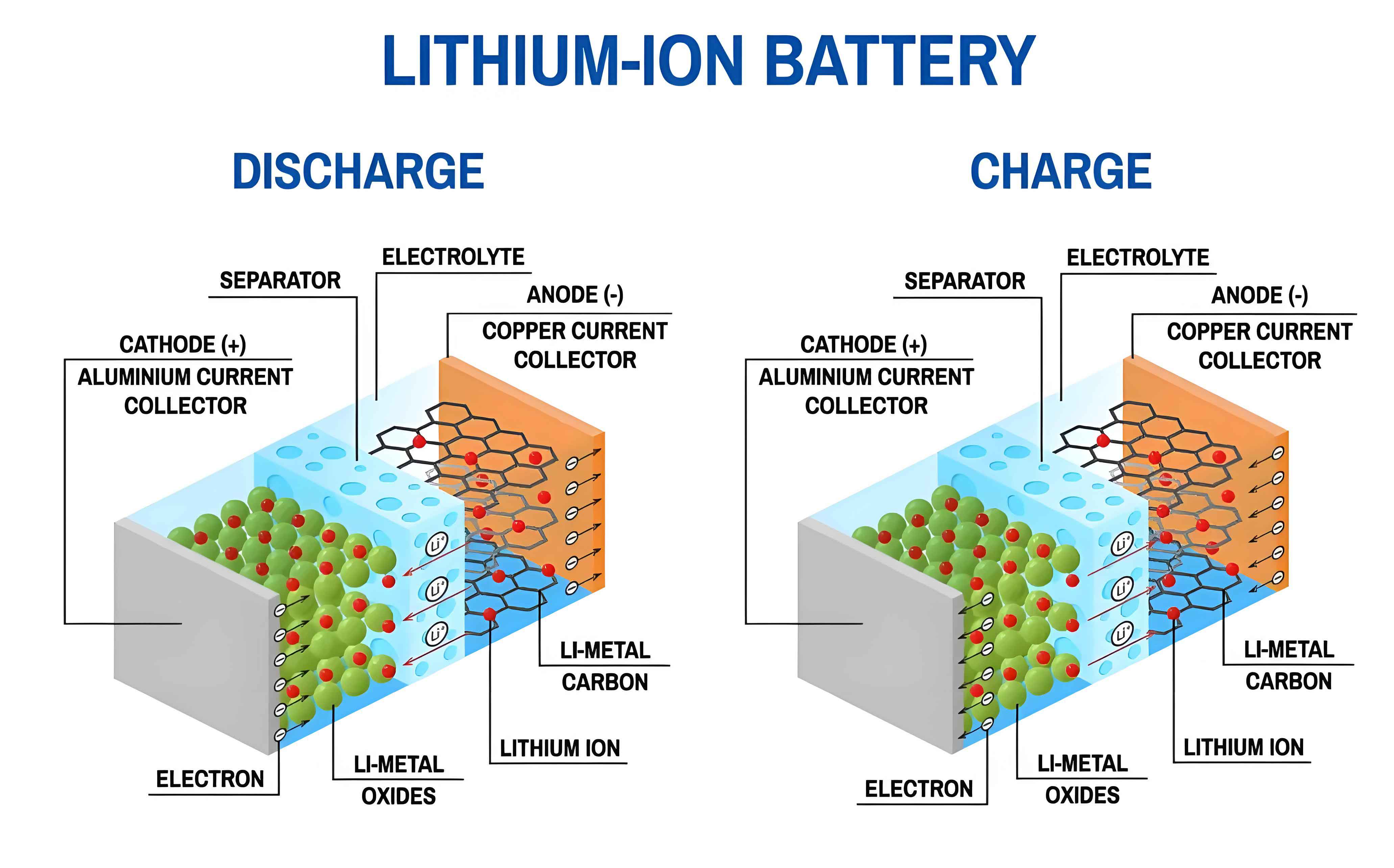
In a typical lithium-ion battery cathode slurry, the active material (e.g., LiCoO₂) provides the electrochemical capacity, the binder (e.g., Polyvinylidene Fluoride, PVDF) offers mechanical integrity, and the solvent (e.g., N-Methyl-2-pyrrolidone, NMP) facilitates processing. The conductive agent’s role is to bridge the insulating or semi-conducting active particles, ensuring rapid electron transport during charge and discharge cycles. The effective electrical conductivity of the composite electrode can be described by percolation theory. A simplified model for the effective conductivity ($\sigma_{eff}$) of a composite with conductive fillers in an insulating matrix is given by:
$$ \sigma_{eff} = \sigma_m \cdot (1 + \frac{\phi \cdot (\sigma_f – \sigma_m)}{\sigma_f + A \cdot \sigma_m}) $$
where $\sigma_m$ is the conductivity of the matrix (primarily binder/solvent/active material), $\sigma_f$ is the conductivity of the filler (conductive agent), $\phi$ is the volume fraction of the filler, and $A$ is a factor related to the geometry and orientation of the fillers. For a binary composite system like CB/Gr, the interaction between the different filler shapes—zero-dimensional CB nanoparticles and two-dimensional Gr sheets—creates a hybrid “point-and-plane” network, potentially leading to synergistic effects that lower the percolation threshold and enhance $\sigma_{eff}$.
| Material | Role | Key Property | Typical Value/Characteristic |
|---|---|---|---|
| LiCoO₂ | Active Material | Intrinsic Conductivity | ~10⁻⁶ S/cm |
| Carbon Black (CB) | Conductive Additive | Morphology / Conductivity | Nanoparticles (~200-300 nm), ~10² S/cm |
| Graphene (Gr) | Conductive Additive | Morphology / Conductivity | 2D Sheets, ~10⁶ S/cm |
| PVDF | Binder | Function | Provides adhesion |
| NMP | Solvent | Function | Dissolves PVDF, disperses components |
Experimental Investigation: Methodology and Design
The core of this investigation was to systematically vary the content and ratio of the CB/Gr composite within the cathode slurry and assess its impact. The baseline slurry composition was fixed with LiCoO₂ as the active material, PVDF as the binder, and NMP as the solvent. The experimental matrix focused on the conductive agent variables, as summarized below.
| Group ID | Total Conductive Agent Vol.% ($\phi_{com}$) | CB:Gr Mass Ratio ($m_{CB}:m_{Gr}$) | Primary Objective |
|---|---|---|---|
| A | 0.25%, 0.5%, 0.75%, 1% | 2 : 1 | Study effect of total content at high CB ratio |
| B | 0.25%, 0.5%, 0.75%, 1% | 1 : 2 | Study effect of total content at high Gr ratio |
Slurry preparation followed a meticulous procedure to ensure homogeneity. All solid components were dried to remove moisture. The process began with dispersing CB and Gr in NMP to form a binary conductive solution. Separately, PVDF was dissolved in NMP. These were combined before the gradual addition and dispersion of LiCoO₂ under controlled shear mixing. This sequence aims to promote the adsorption of conductive agents onto the active material surfaces.
Results: Multi-faceted Characterization
Electrochemical Impedance Spectroscopy (EIS) Analysis
EIS provides direct insight into the electrical resistance of the slurry. The Nyquist plots for slurries with different $\phi_{com}$ and $m_{CB}:m_{Gr}$ ratios were analyzed. The high-frequency semicircle diameter in the Nyquist plot correlates with the charge transfer resistance within the slurry’s conductive network. A key comparative observation was made against a slurry with only Gr ($\phi_{Gr}=0.5\%$).
For every total content ($\phi_{com}$) tested, the slurries with the CB/Gr composite exhibited a smaller semicircle diameter than the pure Gr slurry. This conclusively demonstrates the synergistic advantage of the composite. Furthermore, at a fixed $\phi_{com}$, slurries with a $m_{CB}:m_{Gr}$ ratio of 2:1 consistently showed lower impedance than those with a 1:2 ratio. The lowest overall impedance was recorded for the slurry with $\phi_{com}=0.5\%$ and $m_{CB}:m_{Gr}=2:1$. This suggests an optimal balance where CB particles effectively create “short-range” point contacts between LiCoO₂ particles and Gr sheets, while the Gr establishes “long-range” conductive pathways, without excessive filler content that might hinder ion transport or slurry rheology.
Morphological and Structural Insights from SEM and Raman
Scanning Electron Microscopy (SEM) images of the slurry with $\phi_{com}=0.5\%$ revealed distinct microstructures. In both 2:1 and 1:2 ratio samples, a relatively uniform distribution was observed. The sheet-like Gr appeared to coat or connect LiCoO₂ particles, forming a backbone network. The CB nanoparticles were seen dispersed between Gr sheets and LiCoO₂ particles, likely preventing Gr agglomeration and providing additional conductive bridges.
Raman spectroscopy offered information on the structural quality of the carbonaceous conductive agents. The characteristic D band (~1330 cm⁻¹, indicative of defects/disorder) and G band (~1580 cm⁻¹, indicative of graphitic order) were analyzed. The intensity ratios $I_D/I_G$ and $I_{2D}/I_G$ are informative.
| Condition ($m_{CB}:m_{Gr}$) | $I_D/I_G$ | $I_{2D}/I_G$ | Interpretation |
|---|---|---|---|
| 1 : 2 | 0.9576 | 0.6103 | Moderate disorder, few-layer Gr present |
| 2 : 1 | 0.9839 | 0.6908 | Slightly higher disorder, better exfoliation (higher $I_{2D}/I_G$) suggesting fewer Gr layers and potentially better intrinsic conductivity of the Gr component. |
| 0 : 3 (Pure Gr) | 0.9345 | 0.5648 | Lower $I_{2D}/I_G$ may indicate more re-stacking or agglomeration of Gr sheets. |
The Raman data supports the EIS findings. The composite with a 2:1 ratio showed the highest $I_{2D}/I_G$, suggesting the Gr within this composite was better exfoliated or had fewer layers, which enhances its electronic properties. The slightly higher $I_D/I_G$ may relate to the interface between CB and Gr, creating more edge sites without compromising the overall network conductivity.
Simulation Modeling for Network Validation
To theoretically validate the inferred conductive network structure from experiments, a static 3D electrostatics model was built using COMSOL Multiphysics software. The model simulated the slurry in a cylindrical container with electrodes. Key simplifications were made to render the problem computationally feasible while preserving the essential physics of percolation.
The number of particles was scaled down proportionally. If the number of LiCoO₂ particles is $N_{LCO}$, then the simulated numbers for CB ($N_{CB}$) and Gr ($N_{Gr}$) were determined based on the mass ratio, material densities, and a scaling factor. The governing equation solved in the domain is the current conservation law for electrostatics:
$$ -\nabla \cdot (\sigma \nabla V) = 0 $$
where $\sigma$ is the local electrical conductivity (assigned based on material) and $V$ is the electric potential. The impedance was calculated from the simulated potential and current distribution between the electrodes.
| Model Ref. | $\phi_{com}$ | $m_{CB}:m_{Gr}$ | Simulated $N_{CB}$ | Simulated $N_{Gr}$ | $N_{LCO}$ |
|---|---|---|---|---|---|
| M1 | 0.25% | 2:1 | 102 | 32 | 27 (fixed) |
| M2 | 0.25% | 1:2 | 54 | 73 | |
| M3 | 0.5% | 2:1 | 212 | 21 | |
| M4 | 0.5% | 1:2 | 107 | 162 | |
| M5 | 0.75% | 2:1 | 319 | 115 | |
| M6 | 0.75% | 1:2 | 160 | 230 | |
| M7 | 1% | 2:1 | 402 | 149 | |
| M8 | 1% | 1:2 | 214 | 295 |
A mesh independence study was conducted to ensure the results were not sensitive to the discretization. For model M1, the calculated impedance converged as the mesh was refined.
| Number of Elements | Calculated Impedance (Ω) | Status |
|---|---|---|
| 590,227 | 9890.7 | Baseline |
| 689,564 | 9890.6 | Selected (optimal balance) |
| 712,354 | 9890.6 | Converged |
| 834,556 | 9890.6 | Converged |
The simulation results produced Nyquist and Bode plots with trends that mirrored the experimental data. Crucially, the simulations confirmed that for a given $\phi_{com}$, models with a $m_{CB}:m_{Gr}$ ratio of 2:1 (M1, M3, M5, M7) consistently yielded lower simulated impedance than their 1:2 counterparts (M2, M4, M6, M8). Model M3 ($\phi_{com}=0.5\%$, $m_{CB}:m_{Gr}=2:1$) showed the lowest impedance in the simulation set, aligning perfectly with the experimental optimum. This agreement validates the hypothesized conductive network mechanism derived from the physical experiments.
Proposed Conductive Network Mechanism and Conclusion
Synthesizing the experimental and simulation evidence, a coherent mechanism for the conductive network in a lithium-ion battery cathode slurry with CB/Gr composite emerges. The optimized performance at $\phi_{com}=0.5\%$ and $m_{CB}:m_{Gr}=2:1$ arises from a complementary, three-dimensional hierarchical network:
- Gr-based “Long-range” Network: The two-dimensional Gr sheets coat and interconnect multiple LiCoO₂ particles, establishing a primary, high-conductivity pathway for electrons across larger distances within the electrode. Raman data suggests the Gr in this optimal composite is well-exfoliated, maximizing its contribution.
- CB-based “Short-range” Bridging: The zero-dimensional CB nanoparticles fill the interstices between Gr sheets and LiCoO₂ particles. They act as conductive “spot welds,” ensuring reliable point contacts that bridge gaps where Gr sheets might not directly connect. This significantly enhances the robustness and density of the percolation network.
- Anti-Agglomeration Effect: The presence of CB particles helps to physically separate Gr sheets, mitigating their tendency to re-stack or agglomerate, which would otherwise reduce their effective surface area and conductivity.
The synergy can be conceptually represented by an enhanced effective medium approximation for a hybrid filler system:
$$ \sigma_{eff, hybrid} = f(\phi_{CB}, \phi_{Gr}, \sigma_{CB}, \sigma_{Gr}, \Gamma) $$
where $\Gamma$ represents a positive interaction term accounting for the improved dispersion of Gr and the formation of additional CB-Gr-LiCoO₂ junctions that lower the overall percolation threshold compared to either filler alone.
In conclusion, this study systematically elucidates the influence of CB/Gr composite conductive agents on the cathode slurry of a lithium-ion battery. The optimal conductive network, yielding the lowest impedance, is formed at a total composite content of 0.5 vol.% with a CB to Gr mass ratio of 2:1. This configuration leverages CB for robust short-range connections and Gr for efficient long-range electron highways, creating a superior synergistic effect. The findings are corroborated by multi-method experimental characterization and validated by numerical simulation. This work provides a fundamental understanding and practical guidance for designing high-performance electrode formulations, ultimately contributing to the development of advanced lithium-ion battery with improved rate capability, energy density, and cycle life.