
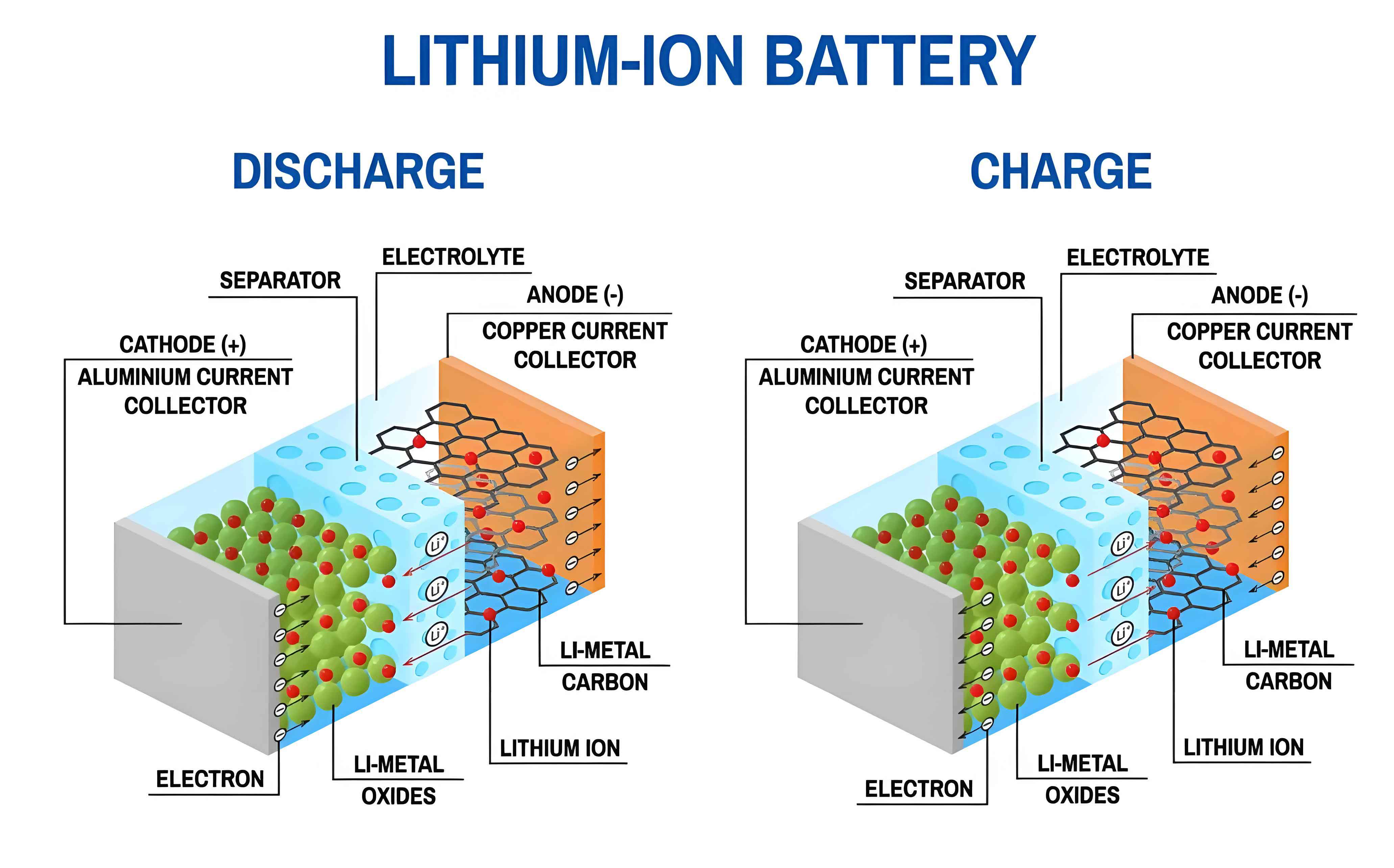
The accurate and reliable estimation of the State of Charge (SOC) is paramount for the safe, efficient, and durable operation of lithium-ion battery systems in applications ranging from electric vehicles to grid-scale energy storage. SOC, defined as the ratio of the remaining capacity to the nominal capacity, is a critical internal state that cannot be measured directly and must be inferred from measurable quantities such as terminal voltage and current. The precision of this estimation hinges fundamentally on the fidelity of the battery model used to represent its complex, nonlinear electrochemical dynamics.
Traditional approaches often rely on Equivalent Circuit Models (ECMs), which use networks of resistors (R), capacitors (C), and voltage sources to approximate the battery’s behavior. While computationally efficient, conventional integer-order ECMs (e.g., the Rint, Thevenin, or second-order RC models) possess inherent limitations. They struggle to fully capture the distributed, frequency-dependent processes inherent to electrochemical systems, such as the capacitive dispersion at electrode interfaces and the diffusion of lithium ions. This modeling gap can lead to significant SOC estimation errors, particularly under dynamic operating conditions or at extreme SOC levels. Consequently, there is a persistent need for model structures that more authentically represent the underlying physics of the lithium-ion battery.
This article addresses this challenge by proposing a systematic methodology for determining an optimal battery model structure based on the analysis of static Electrochemical Impedance Spectroscopy (EIS). EIS provides a powerful, non-invasive diagnostic tool that reveals the internal impedance characteristics of a lithium-ion battery across a wide frequency spectrum. By interpreting the EIS spectrum, we can identify distinct electrochemical processes and construct a Fractional-Order (FO) model that naturally embodies these dynamics. The core of our work involves: 1) deriving a parsimonious yet accurate second-order fractional-order equivalent circuit model from EIS data, 2) implementing an online parameter identification scheme using a Forgetting Factor Recursive Least Squares (FFRLS) algorithm tailored for the fractional-order structure, and 3) developing a robust state estimator by fusing the Extended Kalman Filter (EKF) with a Particle Filter (PF) to form an Extended Kalman Particle Filter (EKPF), thereby mitigating the linearization errors associated with the standard EKF. The proposed framework is rigorously validated using experimental data from a commercial lithium-ion battery, demonstrating superior accuracy in both terminal voltage fitting and SOC tracking compared to a traditional integer-order benchmark.
Static EIS Analysis and Fractional-Order Model Derivation
Electrochemical Impedance Spectroscopy operates by applying a small-amplitude sinusoidal current or voltage perturbation to a lithium-ion battery at rest and measuring the system’s response across a wide range of frequencies. The resulting impedance spectrum, typically plotted as a Nyquist curve (negative imaginary impedance vs. real impedance), serves as a unique “fingerprint” that decomposes the total cell impedance into contributions from various physical processes, each dominant in a specific frequency band. A typical EIS spectrum for a lithium-ion battery can be segmented into four characteristic regions, as summarized below.
| Frequency Region | Typical Shape in Nyquist Plot | Dominant Electrochemical Process | Electrical Representation |
|---|---|---|---|
| High Frequency (e.g., >1 kHz) | Intercept on Z’ real axis / small inductive loop | Ohmic resistance from electrolyte, contacts, and separator. | Series Resistor (RΩ) |
| Medium-High Frequency | Depressed or flattened semicircle | Charge transfer through the Solid Electrolyte Interphase (SEI) layer and associated double-layer effects. | Parallel R & CPE |
| Medium Frequency | Depressed semicircle (often larger) | Charge transfer kinetics at the electrode-electrolyte interface. | Parallel R & CPE |
| Low Frequency (e.g., <0.1 Hz) | Warburg-like sloping line (~45°) | Semi-infinite diffusion of lithium ions in the active material. | Warburg element or CPE (α≈0.5) |
The key insight for advanced modeling lies in the non-ideal, “depressed” nature of the semicircles. An ideal parallel RC circuit would produce a perfect semicircle centered on the real axis. The observed flattening and depression are attributed to the distributed time constants and surface inhomogeneity at the electrodes, a phenomenon known as constant phase element (CPE) behavior. This is modeled by replacing the ideal capacitor with a CPE, whose impedance is given by:
$$Z_{CPE}(s) = \frac{1}{Q s^{\alpha}}$$
where \(Q\) is the CPE coefficient (with units \(F \cdot s^{\alpha-1}\)), \(s\) is the complex Laplace variable, and \(\alpha\) is the dispersion exponent (\(0 \le \alpha \le 1\)). When \(\alpha = 1\), the CPE behaves as an ideal capacitor; when \(\alpha = 0\), it behaves as a pure resistor. For a lithium-ion battery, \(\alpha\) typically ranges between 0.7 and 0.9 for the interfacial processes, providing a much more accurate fit to the EIS data.
Guided by this analysis, we propose a Second-Order Fractional-Order Equivalent Circuit Model (FO-ECM) as the foundation for SOC estimation. This model systematically translates the EIS features into a lumped-parameter network.
The model consists of:
- A voltage source \(U_{OCV}(SOC)\), representing the open-circuit voltage, which is a nonlinear function of SOC.
- A series ohmic resistor \(R_0\), corresponding to the high-frequency real-axis intercept in the EIS, representing all pure ohmic losses.
- Two parallel \(R\)-\(CPE\) branches connected in series with \(R_0\):
- Branch 1 (\(R_1\), \(CPE_1\)): Models the medium-high frequency depressed semicircle (SEI layer dynamics).
- Branch 2 (\(R_2\), \(CPE_2\)): Models the medium frequency depressed semicircle (charge transfer dynamics).
The terminal voltage \(U_L(t)\) under a current \(I(t)\) (discharge positive) is given by:
$$ U_L(t) = U_{OCV}(SOC(t)) – I(t)R_0 – U_1(t) – U_2(t) $$
where \(U_1\) and \(U_2\) are the polarization voltages across the first and second \(R\)-\(CPE\) branches, respectively. Their dynamics are governed by fractional-order differential equations:
$$ \frac{d^{\alpha} U_1(t)}{dt^{\alpha}} = -\frac{U_1(t)}{R_1 Q_1} + \frac{I(t)}{Q_1} $$
$$ \frac{d^{\beta} U_2(t)}{dt^{\beta}} = -\frac{U_2(t)}{R_2 Q_2} + \frac{I(t)}{Q_2} $$
Here, \(\alpha\) and \(\beta\) are the fractional orders of the two CPEs (\(Q_1\) and \(Q_2\)), typically satisfying \(0<\alpha, \beta<1\). This formulation allows the model to accurately capture the memory and hereditary effects of the electrochemical system, which are intrinsic properties of a lithium-ion battery.
Fractional-Order Model Discretization and Online Parameter Identification
Direct implementation of fractional-order calculus in time-domain simulations and estimators is computationally intensive. To enable real-time application, we employ a model reduction technique that approximates the fractional-order dynamics with a high-order integer-state space model that is more tractable. For a circuit branch with impedance \(Z_{branch}(s) = R / (1 + R Q s^{\gamma})\), we can derive an approximated transfer function relating the current input to the voltage drop across the branch. Applying this to both branches leads to a discretized state-space model suitable for recursive algorithms.
Using the Grünwald-Letnikov definition and short memory principle, the fractional derivatives can be approximated. For a sampling period \(T_s\), the discrete-time state-space equations for the FO-ECM are:
$$ x_k = A_{k-1} x_{k-1} + B_{k-1} u_{k-1} $$
$$ y_k = U_{L,k} = U_{OCV}(SOC_k) – C x_k – D u_k $$
with the state vector \(x_k = [U_{1,k}, U_{2,k}, SOC_k]^T\), input \(u_k = I_k\), and output \(y_k\). The matrices are defined as:
$$ A_{k-1} = \begin{bmatrix} e^{-\frac{T_s}{\tau_1}} & 0 & 0 \\ 0 & e^{-\frac{T_s}{\tau_2}} & 0 \\ 0 & 0 & 1 \end{bmatrix}, \quad B_{k-1} = \begin{bmatrix} R_1 (1 – e^{-\frac{T_s}{\tau_1}}) \\ R_2 (1 – e^{-\frac{T_s}{\tau_2}}) \\ -\frac{\eta T_s}{Q_N} \end{bmatrix} $$
$$ C = [1, 1, 0], \quad D = R_0 $$
where \(\tau_1 = R_1 Q_1^{1/\alpha}\) and \(\tau_2 = R_2 Q_2^{1/\beta}\) are the effective time constants, \(\eta\) is the coulombic efficiency, and \(Q_N\) is the battery’s nominal capacity. The \(U_{OCV}(SOC)\) relationship is a pre-identified nonlinear function, often represented by a high-order polynomial or a look-up table.
The model parameters \(\theta = [R_0, R_1, \tau_1, R_2, \tau_2]^T\) are not constant but vary with SOC, temperature, aging, and other factors. To track these variations in real-time, we employ the Forgetting Factor Recursive Least Squares (FFRLS) algorithm. The FFRLS algorithm minimizes a weighted least-squares cost function, giving more weight to recent data, which is ideal for tracking time-varying parameters of a lithium-ion battery.
The recursive procedure at each time step \(k\) is:
- Compute Gain: $$ K_k = \frac{P_{k-1} \varphi_k}{\lambda + \varphi_k^T P_{k-1} \varphi_k} $$
- Update Parameter Estimate: $$ \hat{\theta}_k = \hat{\theta}_{k-1} + K_k (y_k – \varphi_k^T \hat{\theta}_{k-1}) $$
- Update Covariance Matrix: $$ P_k = \lambda^{-1} (P_{k-1} – K_k \varphi_k^T P_{k-1}) $$
Here, \(\varphi_k\) is the regression vector constructed from measured current and voltage, \(y_k\) is the measured terminal voltage, \(P_k\) is the error covariance matrix, and \(\lambda\) is the forgetting factor (\(0 < \lambda \leq 1\), typically 0.95-0.999). A smaller \(\lambda\) discounts old data faster, improving tracking of parameter changes in the lithium-ion battery but increasing sensitivity to measurement noise.
The Extended Kalman Particle Filter (EKPF) for Robust SOC Estimation
With an accurate model and online parameter identification, the final step is to design a state observer to estimate the hidden state vector \(x_k\), primarily the SOC. The Extended Kalman Filter (EKF) is a standard choice for nonlinear systems like our FO-ECM. It works by linearizing the system dynamics and measurement equations around the current state estimate. However, for highly nonlinear systems such as a lithium-ion battery, especially near the boundaries of SOC where the \(U_{OCV}(SOC)\) curve is steep, the first-order Taylor series expansion in the EKF can introduce significant linearization errors, leading to biased estimates or even divergence.
To overcome this limitation, we propose the use of a Particle Filter (PF), specifically a variant called the Extended Kalman Particle Filter (EKPF). The PF is a sequential Monte Carlo method that represents the posterior probability density function (PDF) of the state using a set of random samples (particles) with associated weights. It is capable of handling severe nonlinearities and non-Gaussian noise. The EKPF enhances the basic PF by using the EKF to generate a better proposal distribution for the particles, improving sampling efficiency.
The EKPF algorithm for SOC estimation in a lithium-ion battery proceeds as follows:
Initialization (k=0): Generate \(N\) initial particles \(\{x_0^{(i)}\}_{i=1}^N\) from the initial state distribution \(p(x_0)\), and set equal weights \(w_0^{(i)} = 1/N\).
For each time step k = 1, 2, …:
- EKF Prediction & Update for Each Particle:
For each particle \(i\), use the standard EKF steps (with the latest parameters \(\hat{\theta}_k\) from FFRLS) to generate a Gaussian proposal distribution.- Prediction:
$$ \hat{x}_{k|k-1}^{(i)} = A_{k-1} x_{k-1}^{(i)} + B_{k-1} u_{k-1} $$
$$ P_{k|k-1}^{(i)} = A_{k-1} P_{k-1}^{(i)} A_{k-1}^T + Q $$
where \(Q\) is the process noise covariance matrix. - Update:
$$ K_k^{(i)} = P_{k|k-1}^{(i)} H_k^T (H_k P_{k|k-1}^{(i)} H_k^T + R)^{-1} $$
$$ \hat{x}_{k}^{(i)} = \hat{x}_{k|k-1}^{(i)} + K_k^{(i)} (y_k – \hat{y}_{k|k-1}^{(i)}) $$
$$ P_{k}^{(i)} = (I – K_k^{(i)} H_k) P_{k|k-1}^{(i)} $$
where \(H_k = \frac{\partial}{\partial x}[U_{OCV}(SOC_k) – C x_k]\) is the measurement Jacobian, \(R\) is the measurement noise covariance, and \(\hat{y}_{k|k-1}^{(i)} = U_{OCV}(SOC_{k|k-1}^{(i)}) – C \hat{x}_{k|k-1}^{(i)} – D u_k\).
- Prediction:
- Importance Sampling: Draw a new particle \(x_k^{(i)}\) from the proposal distribution:
$$ x_k^{(i)} \sim \mathcal{N}(\hat{x}_{k}^{(i)}, P_{k}^{(i)}) $$ - Weight Update: Update the weight of each particle based on the measurement likelihood:
$$ w_k^{(i)} \propto w_{k-1}^{(i)} \cdot p(y_k | x_k^{(i)}) $$
where \(p(y_k | x_k^{(i)})\) is the likelihood of observing \(y_k\) given the particle state, often assumed Gaussian. Normalize the weights: \(\sum_{i=1}^N w_k^{(i)} = 1\). - State Estimation: The minimum mean square error (MMSE) estimate of the state (including SOC) is:
$$ \hat{x}_k = \sum_{i=1}^{N} w_k^{(i)} x_k^{(i)} $$ - Resampling: Calculate the effective sample size \(N_{eff} = 1 / \sum_{i=1}^N (w_k^{(i)})^2\). If \(N_{eff} < N_{thresh}\) (a threshold), perform resampling to avoid degeneracy. This involves drawing \(N\) new particles from the current set \(\{x_k^{(i)}\}\) with probabilities proportional to \(\{w_k^{(i)}\}\), and then resetting weights to \(1/N\).
This hybrid EKPF approach leverages the predictive power of the EKF to guide the particles towards high-likelihood regions of the state space, while the PF framework inherently handles the nonlinearities without approximation. This makes it particularly robust for estimating the SOC of a lithium-ion battery across its entire operating range.
Experimental Validation and Comparative Analysis
The proposed methodology was validated using experimental data from a commercial 18650 cylindrical lithium-ion battery with a Lithium Iron Phosphate (LFP) cathode and a nominal capacity of 1.1 Ah. A Hybrid Pulse Power Characterization (HPPC) test profile was employed at a constant temperature of 25°C. The HPPC test consists of repeated cycles, each involving a constant-current discharge pulse (to extract approximately 10% of the capacity) followed by a rest period and a charge pulse. This dynamic profile is well-suited for exciting the battery’s transient response and validating model accuracy and SOC estimation under realistic conditions.
The foundational \(U_{OCV}(SOC)\) relationship was first established by performing a low-current discharge test and correlating the relaxed open-circuit voltage with the corresponding SOC. The relationship was fitted to an 8th-order polynomial:
$$ U_{OCV}(z) = p_1 z^8 + p_2 z^7 + p_3 z^6 + p_4 z^5 + p_5 z^4 + p_6 z^3 + p_7 z^2 + p_8 z + p_9 $$
where \(z\) denotes SOC. This highly nonlinear curve, characteristic of LFP lithium-ion batteries, underscores the need for a robust nonlinear estimator like the EKPF.
The online parameter identification using the FFRLS algorithm successfully tracked the variation of the FO-ECM parameters throughout the HPPC test. The terminal voltage predicted by the identified FO-ECM showed excellent agreement with the measured voltage. For quantitative comparison, an integer-order second-order RC model (IO-ECM) was also identified using the same FFRLS framework. The voltage estimation errors are summarized below.
| Performance Metric | Proposed FO-ECM | Traditional IO-ECM |
|---|---|---|
| Mean Absolute Error (V) | 0.013 | 0.090 |
| Maximum Absolute Error (V) | 0.825 | 1.096 |
| Root Mean Square Error (V) | 0.124 | 0.675 |
The results clearly demonstrate the superior representational capability of the fractional-order model derived from EIS analysis. The FO-ECM reduces the mean voltage error by over 85% compared to the IO-ECM, providing a much more accurate basis for SOC estimation.
Finally, the SOC estimation performance of the EKPF algorithm using the FO-ECM was evaluated. The true SOC reference was calculated by high-precision coulomb counting. The EKPF was compared against a standard EKF using the same FO-ECM. The estimation results, particularly during a dynamic current pulse around 50% SOC, revealed the advantage of the particle filter’s framework. While both algorithms tracked the general trend, the EKPF exhibited significantly smaller error spikes and better adherence to the reference during sudden load changes, showcasing its enhanced handling of nonlinearities. A comparison of the overall SOC estimation error against using an IO-ECM with EKF is presented below.
| Performance Metric | EKPF with FO-ECM | EKF with IO-ECM |
|---|---|---|
| Mean Absolute SOC Error | 0.75% | 1.60% |
| Maximum Absolute SOC Error | 1.78% | 4.75% |
| Root Mean Square SOC Error | 0.42% | 5.28% |
The proposed framework achieves a mean SOC error of less than 1% and cuts the maximum error by more than half compared to the conventional approach. This confirms that the synergy between the EIS-derived fractional-order model and the robust EKPF estimator delivers highly accurate and reliable SOC estimation for lithium-ion batteries.
Conclusion
This article has presented a comprehensive, physics-informed framework for accurate State of Charge estimation in lithium-ion batteries. The core innovation lies in leveraging static Electrochemical Impedance Spectroscopy as a guiding tool for determining an optimal fractional-order equivalent circuit model structure. This model inherently captures the distributed, frequency-dependent electrochemical processes—such as SEI layer effects and charge transfer dynamics—that are glossed over by traditional integer-order models. The subsequent online identification of the time-varying model parameters via the FFRLS algorithm ensures the model adapts to the battery’s operating condition.
To address the critical challenge of nonlinear state estimation, we developed an Extended Kalman Particle Filter algorithm. The EKPF effectively combines the predictive capability of the EKF with the nonlinear handling strength of the Particle Filter, resulting in a robust estimator that minimizes linearization errors, especially in regions where the lithium-ion battery’s OCV-SOC characteristic is highly nonlinear.
Experimental validation on a commercial LFP lithium-ion battery under dynamic HPPC profiles confirmed the superiority of the proposed approach. The EIS-derived fractional-order model reduced terminal voltage fitting errors significantly compared to an integer-order benchmark. Consequently, the overall SOC estimation achieved a mean error below 1% and demonstrated superior tracking performance during transients. This methodology provides a principled pathway from electrochemical diagnostics to high-fidelity control-oriented models, enhancing the reliability and performance of battery management systems for the safe and efficient utilization of lithium-ion battery technology.