
The proliferation of electric vehicles (EVs) and portable electronics has cemented the lithium-ion battery as a cornerstone of modern energy storage technology. The global demand and production of lithium-ion batteries have experienced exponential growth. Consequently, a wave of spent lithium-ion batteries is anticipated as these power sources reach their end-of-life, typically between 3 to 10 years. These spent units contain not only hazardous substances like organic electrolytes but also valuable critical metals such as lithium, nickel, cobalt, and manganese. The sustainable and efficient recycling of spent lithium-ion batteries presents a significant technological and environmental challenge, yet it offers a crucial pathway to alleviate resource shortages and mitigate environmental pollution. In this review, I will summarize the latest research progress in the resource recovery and regeneration of spent lithium-ion batteries, covering pretreatment, element extraction, direct regeneration, and the upcycling of anode materials. I will also analyze the persistent challenges and propose future directions for this vital field.
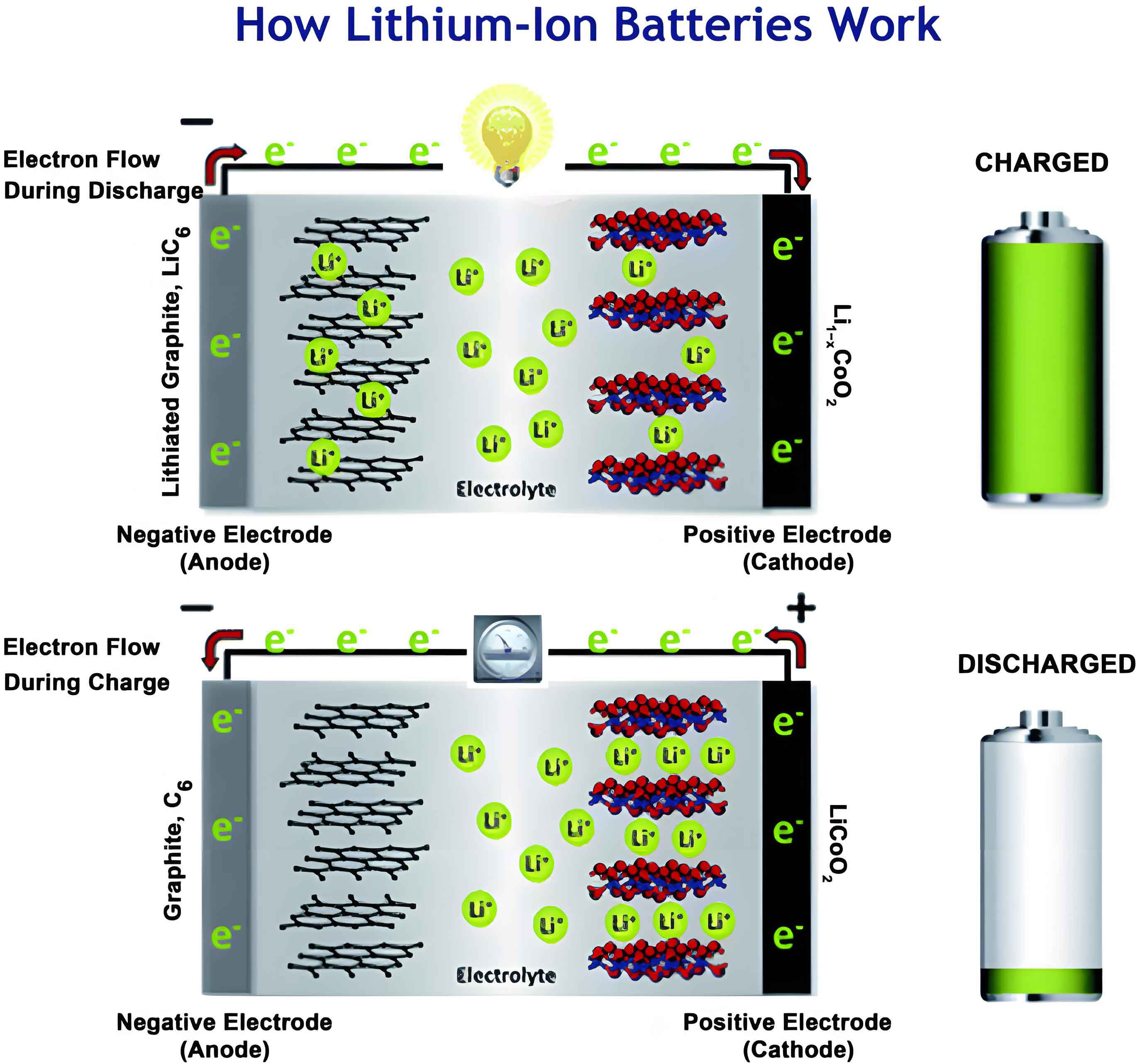
A typical lithium-ion battery is a complex assembly of several key components that work in concert to store and release energy through the shuttling of lithium ions. The cathode, usually a lithium metal oxide (e.g., LiCoO₂, LiNixCoyMn1−x−yO₂, LiFePO₄) coated on an aluminum foil current collector, serves as the source of lithium ions during discharge. The anode, typically graphite coated on a copper foil, hosts the intercalation of these ions. A porous polymer separator prevents physical contact between the electrodes while allowing ionic conduction. The electrolyte, a lithium salt (e.g., LiPF₆) dissolved in organic carbonates, provides the medium for ion transport. The specific composition of a spent lithium-ion battery directly influences the choice of recycling strategy. For instance, high-cobalt cathodes like LiCoO₂ have long been a primary recycling target due to cobalt’s value, while the rise of low-cobalt or cobalt-free cathodes like LiFePO₄ and high-nickel NCM has shifted focus towards lithium and nickel recovery. The table below summarizes common cathode chemistries and their key metal constituents.
| Cathode Material | Common Abbreviation | Key Metal Components | Approximate Metal Content (wt%)* |
|---|---|---|---|
| Lithium Cobalt Oxide | LCO | Li, Co | Li: ~7%; Co: ~60% |
| Lithium Nickel Manganese Cobalt Oxide | NCM (e.g., NCM111, NCM622) | Li, Ni, Co, Mn | Varies; e.g., NCM523: Ni~30%, Co~12%, Mn~17% |
| Lithium Iron Phosphate | LFP | Li, Fe, P | Li: ~4.5%; Fe: ~35% |
| Lithium Manganese Oxide | LMO | Li, Mn | Li: ~4%; Mn: ~61% |
*Values are approximate and depend on the specific stoichiometry and manufacturer.
Safe and effective recycling of a spent lithium-ion battery necessitates a thorough pretreatment stage. This stage aims to discharge residual energy, dismantle the battery, and separate its various components for downstream processing. The first critical step is complete discharge to prevent short-circuiting, fire, or explosion during handling. Methods include chemical discharge in conductive salt solutions (e.g., NaCl, Na₂SO₄) or physical discharge through external loads. Following discharge, mechanical crushing and sieving under inert atmospheres are employed to break down the battery casing and separate components based on size and physical properties. Techniques like magnetic separation and air classification are then used to isolate ferrous metals, aluminum, copper, and the fine “black mass” – a mixture of cathode and anode active materials. A significant challenge in pretreatment is the separation of the active material from the current collectors (Al and Cu foils). This often involves removing the polymeric binder, typically polyvinylidene fluoride (PVDF). While thermal treatment can decompose the binder, it risks releasing toxic gases like HF. Alternative methods using organic solvents (e.g., N-methyl-2-pyrrolidone) or emerging green reagents are being explored to dissolve the binder without harmful emissions. The recovery of the electrolyte, a mixture of volatile and toxic organic solvents and lithium salts, remains a complex but crucial task. Methods such as supercritical CO₂ extraction show promise for recovering these components in a reusable form.
The core of spent lithium-ion battery recycling lies in the extraction and recovery of valuable metals from the processed black mass, primarily focusing on the cathode material. The two predominant metallurgical approaches are pyrometallurgy and hydrometallurgy, often used in combination.
Pyrometallurgy involves high-temperature treatment to reduce metal oxides to more elementary forms. In traditional smelting, spent lithium-ion battery materials are fed into a furnace with a reductant (often coke or the battery’s own graphite). At high temperatures (often above 1000°C), metals like Co, Ni, Cu, and Fe are reduced to a metallic alloy, while lithium reports to the slag phase, from which recovery is challenging and inefficient. This process is robust and can handle mixed battery feeds but is energy-intensive and suffers from low lithium recovery rates. To address these drawbacks, modified pyrometallurgical approaches like carbothermic reduction roasting have been developed. By carefully controlling the temperature and atmosphere (e.g., inert or vacuum), and using specific additives, it is possible to selectively convert components at lower temperatures. For example, lithium can be converted to a water-soluble form like Li₂CO₃, while transition metals form oxides. The thermodynamics of such reactions can be described by the change in Gibbs free energy:
$$\Delta_r G^\circ = \Delta_r H^\circ – T\Delta_r S^\circ$$
Where a negative $$\Delta_r G^\circ$$ indicates a spontaneous reaction. The reduction of LiCoO₂ with carbon can proceed through various pathways depending on temperature:
$$6LiCoO_2 + C \rightarrow 3Li_2O + 2Co_3O_4 + CO \quad (\text{at lower T})$$
$$2LiCoO_2 + C \rightarrow Li_2O + 2CoO + CO$$
$$LiCoO_2 + C \rightarrow Li_2CO_3 + Co$$
The use of bio-based reductants (e.g., walnut shells, corn stover) or catalytic additives (e.g., NaOH) can further lower the required reduction temperature and improve selectivity.
Hydrometallurgy is a solution-based process that typically offers higher selectivity and lower energy consumption than traditional pyrometallurgy. The general process involves: Leaching: Valuable metals are dissolved from the solid cathode material into an aqueous acidic or alkaline solution. Common inorganic acids include H₂SO₄, HCl, and HNO₃, often paired with a reducing agent like H₂O₂ to enhance dissolution by reducing high-valence metals (e.g., Co³⁺, Mn⁴⁺). The leaching efficiency for a metal can be modeled by shrinking core kinetics. To mitigate environmental concerns from strong inorganic acids, organic acids (citric, oxalic, ascorbic acid) and deep eutectic solvents (DESs) are gaining attention as greener alternatives. Separation & Purification: The resulting pregnant leach solution (PLS) contains a mixture of metal ions (Li⁺, Ni²⁺, Co²⁺, Mn²⁺). Subsequent steps like solvent extraction, precipitation, or selective adsorption are employed to separate and purify individual metals. For instance, solvent extraction uses organic extractants that selectively bind to specific metal ions at different pH levels. Precipitation involves adjusting the pH or adding specific anions (e.g., oxalate, carbonate) to precipitate metals as pure salts. The table below compares the key characteristics of these two major extraction routes.
| Feature | Pyrometallurgy | Hydrometallurgy |
|---|---|---|
| Principle | High-temperature reduction & smelting | Acid/alkaline leaching followed by solution purification |
| Primary Input | Spent LIB black mass, reductant (coke, graphite) | Spent LIB black mass, leaching agents (acid, reductant) |
| Typical Output | Metal alloy (Co-Ni-Cu-Fe), slag (containing Li) | Individual high-purity metal salts (Li₂CO₃, NiSO₄, CoSO₄) |
| Lithium Recovery | Traditionally low (<50%), improved in modern roasting | Generally high (>90%) |
| Selectivity | Low; produces mixed alloys | High; enables separation of individual metals |
| Energy Consumption | Very High | Moderate |
| Environmental Impact | High (gas emissions, slag disposal) | Moderate (wastewater treatment needed) |
| Flexibility | High; can process mixed battery types | Lower; often optimized for specific chemistry |
A promising evolution is the development of “direct regeneration” techniques, which aim to repair and refurbish the degraded cathode or anode material without fully breaking it down to its constituent elements. This approach preserves the original structure and morphology of the active material, offering a potentially lower-cost and more energy-efficient recycling route. For cathode materials, direct regeneration often involves “relithiation” – the reintroduction of lithium into the lithium-deficient lattice of the spent material. This can be achieved through solid-state, hydrothermal, or electrochemical methods. In solid-state relithiation, the spent cathode powder is mixed with a lithium source (e.g., Li₂CO₃) and annealed at moderate temperatures to restore stoichiometry. Electrochemical relithiation involves using the spent cathode as an electrode in an electrochemical cell to drive lithium ions back into its structure. The success of these methods hinges on the specific degradation mechanisms of the spent lithium-ion battery cathode. For anode materials, particularly graphite, regeneration focuses on removing surface impurities (from the solid electrolyte interphase – SEI) and repairing structural defects. Methods include low-temperature thermal treatment, mild acid washing, and surface re-engineering. The table below summarizes common direct regeneration methods.
| Regeneration Method | Typical Process | Advantages | Challenges |
|---|---|---|---|
| Solid-State Relithiation | Annealing spent cathode with Li salt (600-950°C) | Simple, scalable, preserves particle morphology | High energy input, potential for impurity retention |
| Hydrothermal Relithiation | Heating spent cathode in Li-containing solution under pressure | Lower temperature, can restore morphology | Requires pressure vessels, control of uniformity |
| Electchemical Relithiation | Using spent cathode as a working electrode in Li⁺ electrolyte | High precision, ambient conditions | Slower, requires electrode preparation, scale-up |
| Anode (Graphite) Purification | Thermal treatment, acid/alkali washing, surface coating | Restores capacity, utilizes existing structure | Removing all impurities without damaging graphite |
Beyond simple regeneration for reuse in new lithium-ion batteries, the concept of “upcycling” spent materials into higher-value products is gaining traction. This is particularly relevant for graphite anodes. Instead of just recovering battery-grade graphite, researchers are converting spent graphite into advanced carbon materials. For example, through controlled oxidation and expansion, spent graphite can be transformed into expanded graphite with a worm-like structure, useful for thermal interface materials or advanced anodes. Further exfoliation can yield graphene or graphene oxide nanosheets. Spent graphite, sometimes along with residual metals from the anode, can also serve as a precursor for carbon-based catalysts in environmental applications, such as activating peroxymonosulfate for wastewater treatment. The formula for such catalytic activation might involve the generation of sulfate radicals (SO₄•⁻):
$$\text{Catalyst} + HSO_5^- \rightarrow SO_4^{\bullet -} + OH^- + \text{Catalyst}_{oxidized}$$
This approach creates a closed-loop for materials from a spent lithium-ion battery, moving beyond recycling into the realm of circular materials engineering.
Despite significant advancements, the recycling of spent lithium-ion batteries faces persistent hurdles. Technical Challenges: The diversity of battery chemistries, formats, and states of health makes automated disassembly and sorting complex. Efficient separation of finely mixed components from the black mass remains difficult. Many laboratory-scale processes struggle with scalability, cost, and the management of secondary waste streams. Economic Viability: The economics of recycling are sensitive to the market prices of recovered metals (especially Co, Ni, Li). High capital and operational costs for environmentally sound processes can undermine profitability, particularly when competing with virgin material extraction or informal recycling sectors. Policy and Infrastructure: A robust, regulated collection network for end-of-life lithium-ion batteries is still under development in many regions. Clear regulations, extended producer responsibility (EPR) schemes, and standardized protocols for recycled material quality are essential to create a stable market.
The future of spent lithium-ion battery recycling lies in the development of intelligent, flexible, and closed-loop systems. Research should focus on: 1) Smart Disassembly & Sorting: Integrating AI and robotics for safe, efficient, and precise battery dismantling. 2) Green Process Intensification: Designing low-energy, low-waste processes using green reagents (e.g., DES, bio-reductants) and combining unit operations (e.g., mechanochemical pretreatment). 3) Closed-Loop Direct Regeneration: Scaling up direct cathode/anode regeneration technologies and establishing quality standards for recycled active materials to facilitate their reintegration into the battery manufacturing supply chain. 4) System Integration & Lifecycle Analysis: Designing recycling plants that integrate renewable energy and employ holistic lifecycle assessment to minimize the overall carbon footprint. 5) Supportive Policy Frameworks: Governments must implement and enforce policies that incentivize eco-design for recyclability, mandate responsible collection, and support the market for secondary critical materials. The transition from a linear “take-make-dispose” model to a circular economy for lithium-ion batteries is not merely an option but a necessity for the sustainable future of electrification and energy storage.