
The relentless pursuit of higher energy density, enhanced safety, and longer cycle life in electrochemical energy storage has positioned the lithium-ion battery as a pivotal technology. However, the conventional liquid organic electrolytes that enabled its success also present intrinsic limitations, including flammability, leakage risks, and narrow electrochemical stability windows, which ultimately constrain the performance ceiling and safety assurance of the modern lithium-ion battery. In this context, the paradigm shift towards all-solid-state batteries (ASSBs), which replace volatile liquids with solid electrolytes, has gained monumental traction. As the core component of an ASSB, the solid-state electrolyte (SSE) dictates the battery’s overall performance, safety, and feasibility. This article, from a research perspective, provides a comprehensive overview of the applicative performance, modification strategies, and future trajectories of SSE materials, aiming to chart a course for their development and integration into the next-generation lithium-ion battery.
The fundamental appeal of the solid-state lithium-ion battery lies in its promise to overcome the safety hazards associated with organic solvents while simultaneously enabling the use of high-capacity electrodes like lithium metal. The evolution of SSEs can be categorized into three primary families: inorganic solid electrolytes (ISEs), polymer solid electrolytes (PSEs), and composite solid electrolytes (CSEs). Each class possesses distinct ion transport mechanisms, advantages, and shortcomings, as summarized in Table 1.
| Class | Representative Materials | Key Advantages | Primary Challenges | Common Modification Strategies |
|---|---|---|---|---|
| Inorganic SSEs (ISEs) | Oxides (e.g., LLZO, LATP), Sulfides (e.g., LGPS, Li6PS5Cl), Halides (e.g., Li3InCl6) | High ionic conductivity (especially sulfides), high mechanical modulus, wide electrochemical window (oxides/halides). | Poor interfacial contact, high grain boundary resistance (oxides), air/moisture sensitivity (sulfides), high cost, incompatibility with Li metal (some halides). | Elemental doping, sintering aids, interface engineering (buffer layers), microstructure control. |
| Polymer SSEs (PSEs) | PEO, PAN, PVDF, PMMA based with Li salts (e.g., LiTFSI). | Excellent flexibility, good interfacial wettability, ease of processing, low cost. | Low room-temperature ionic conductivity, low Li+ transference number, poor mechanical strength, narrow electrochemical window. | Cross-linking, blending, addition of plasticizers or nano-fillers. |
| Composite SSEs (CSEs) | Polymer matrix (e.g., PEO) + Active/Inactive inorganic fillers (e.g., LLZO, LATP particles). | Balanced properties: improved ionic conductivity and mechanical strength from fillers, good interfacial contact from polymer. | Optimization of filler/polymer ratio, interfacial compatibility between components, processing complexity. | Filler surface functionalization, use of 1D/2D fillers, design of asymmetric bilayer structures. |
The ion transport mechanism varies significantly across these materials. In crystalline ISEs, Li+ migration typically occurs via a vacancy or interstitial hopping mechanism through well-defined crystallographic pathways. The conductivity ($\sigma$) follows the Arrhenius relationship:
$$\sigma T = A \exp\left(-\frac{E_a}{k_B T}\right)$$
where $A$ is the pre-exponential factor, $E_a$ is the activation energy for ion migration, $k_B$ is Boltzmann’s constant, and $T$ is the temperature. Doping with aliovalent ions is a primary strategy to create charge-compensating defects (vacancies or interstitials) that enhance $\sigma$ and lower $E_a$. In contrast, ion transport in PSEs like poly(ethylene oxide) (PEO) is coupled to the segmental motion of the polymer chains above the glass transition temperature ($T_g$). The conductivity in such systems is often described by the Vogel–Fulcher–Tammann (VFT) equation:
$$\sigma = \sigma_0 \exp\left[-\frac{B}{T – T_0}\right]$$
where $\sigma_0$, $B$, and $T_0$ are fitting parameters. The primary goal in PSE research is to reduce crystallinity and $T_g$ to facilitate chain motion at room temperature. CSEs leverage a synergistic effect where the inorganic filler can both disrupt polymer crystallization (increasing amorphous content) and provide alternative Li+ conduction pathways.
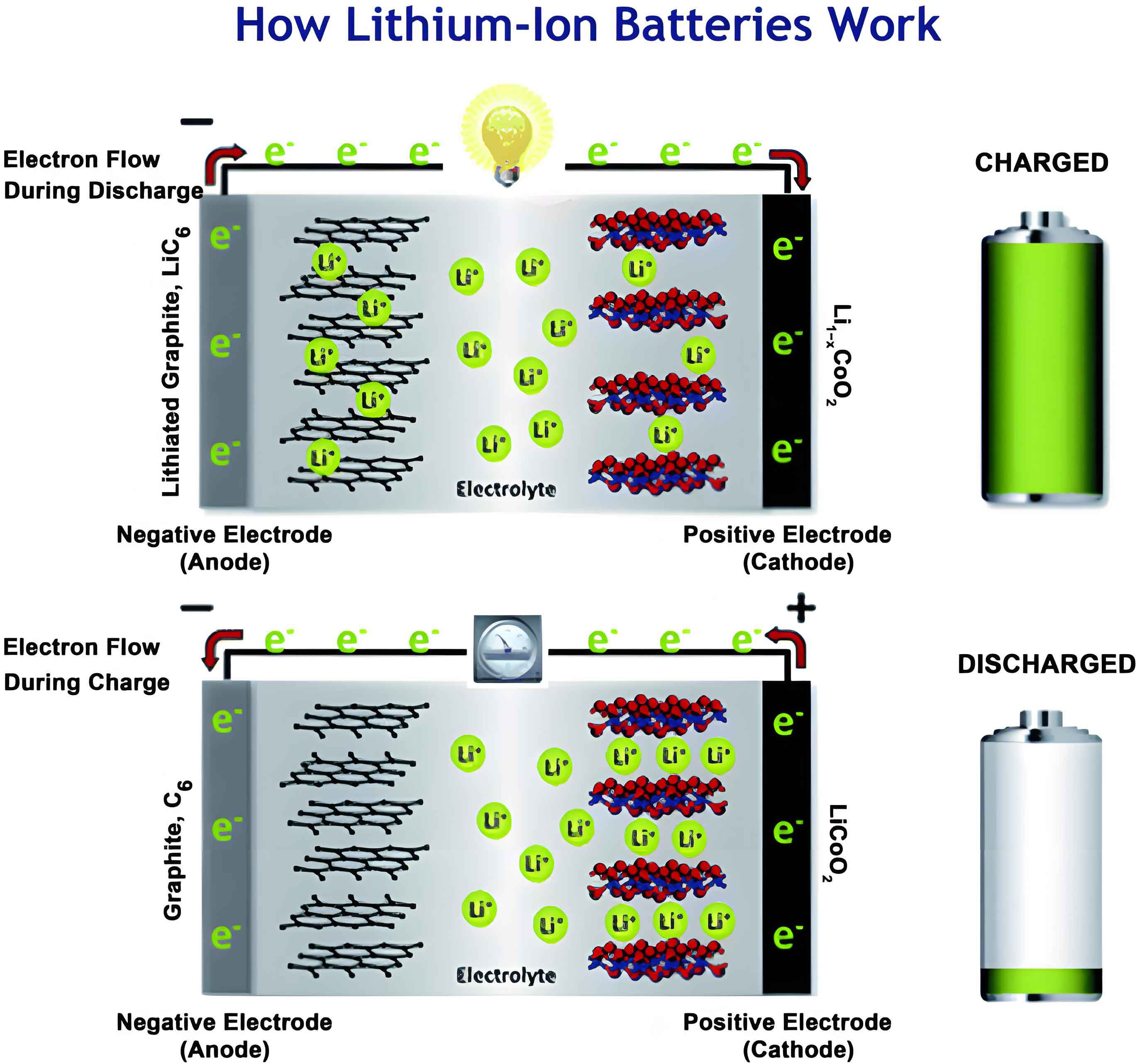
The drive to improve the lithium-ion battery is inextricably linked to applications like electric vehicles and grid storage, where energy density and absolute safety are paramount. The solid-state lithium-ion battery is widely seen as the key to unlocking these advanced applications.
Inorganic Solid-State Electrolytes: The Quest for Stability and Conductivity
ISEs are often benchmarked by their room-temperature ionic conductivity and stability. They are broadly classified into oxides, sulfides, and the emerging halides.
Oxide-Based Electrolytes: Striving for Balanced Performance
Oxide electrolytes are celebrated for their excellent stability against air and high-voltage cathodes. The perovskite-type Li3xLa2/3-xTiO3 (LLTO) exhibits high bulk conductivity but suffers from prohibitively high grain boundary resistance. Doping strategies at the A-site (La) or B-site (Ti) aim to modify the bottleneck size for Li+ migration and improve sinterability. For instance, co-doping with Sr2+ and Ta5+ (forming LiLa0.5Sr0.09TiTa0.09O3) expands the lattice and enhances total conductivity. The garnet-type Li7La3Zr2O12 (LLZO) is a leading candidate due to its stability against Li metal. Stabilizing its high-conductivity cubic phase at room temperature is crucial, often achieved through dual doping. For example, co-doping Li6.4Fe0.2La3Zr2O12 with Y3+ refines the grain structure and boosts conductivity to ~5.6×10⁻⁴ S cm-1. NASICON-type electrolytes like Li1.3Al0.3Ti1.7(PO4)3 (LATP) offer good stability but react with Li metal. Fluorine doping (e.g., Li1.3Al0.3Ti1.7P3O11.76F0.48) via a molten salt method has been shown to enhance densification and ionic conductivity up to 1.14×10⁻³ S cm-1.
| Material System | Modification | Room-Temp. $\sigma$ (S cm-1) | Key Improvement |
|---|---|---|---|
| Li0.24La0.587Ti0.98Sn0.02O3 | Sn4+ doping at B-site | ~2.96×10⁻⁴ | Increased Li+ vacancy concentration. |
| Li6.55Ge0.05La2.95Ca0.05Zr1.75Ta0.25O12 | Ge4+/Ta5+/Ca2+ co-doping | ~9.95×10⁻⁴ | Stabilized cubic phase, enhanced densification. |
| Li1.3Al0.3Ti1.7P3O11.76F0.48 | Fluorine doping | ~1.14×10⁻³ | Improved densification, lower sintering temperature. |
Sulfide-Based Electrolytes: The High-Conductivity Challenge
Sulfide electrolytes, such as Li10GeP2S12 (LGPS), can achieve ionic conductivities (>10-2 S cm-1) rivaling liquid electrolytes, making them extremely attractive for the solid-state lithium-ion battery. Their soft mechanical properties also enable good interfacial contact via cold pressing. However, their fatal flaw is extreme sensitivity to moisture, generating toxic H2S, and poor oxidative stability against high-voltage cathodes. Research focuses on improving stability via elemental substitution. For instance, substituting Ge in LGPS with Sr (Li10SrP2S12) has been predicted via machine learning to maintain high conductivity while improving interface stability with Li metal. Oxygen doping into argyrodites like Li6PS5Cl is another effective route to enhance air stability and electrochemical window. Glass-ceramic systems like Li7P2S8I can be made Li-rich to improve conductivity and cycling stability.
| Type | Example | Conductivity (S cm-1) | Stability Issue | Mitigation Strategy |
|---|---|---|---|---|
| Crystalline | Li10GeP2S12 (LGPS) | ~10-2 | Moisture (H2S), reacts with Li metal. | Elemental substitution (e.g., Se, Sr), protective coatings. |
| Argyrodite | Li6PS5Cl | ~10-3 | Narrow voltage window, moisture. | Oxygen doping (e.g., Li6PS5-2.5xO2.5xCl). |
| Glass-Ceramic | Li7P2S8I | ~10-3 | Interfacial reactions. | Creating Li-rich compositions (e.g., Li7.1P2S8.1I0.9). |
Halide-Based Electrolytes: The Rising Contender
Halide electrolytes (e.g., Li3InCl6, Li2ZrCl6) represent a promising new class with a favorable combination of properties: moderate ionic conductivity (~10-3 S cm-1), good deformability, high oxidative stability (>4 V vs. Li+/Li), and compatibility with oxide cathodes. Their main drawbacks are cost and reduction instability against Li metal. Fluorine doping has emerged as a powerful tool. Doping Li3InCl6 with F to form Li3InCl5.5F0.5 not only increases ionic conductivity but also widens the electrochemical window and improves moisture stability by forming a Li-F rich interface. Similarly, Mn doping in Li2ZrCl6 enhances conductivity. Structural engineering, such as creating Li-deficient compositions (e.g., Li2.31Y0.98Nb0.02Cl5.31), can promote a more favorable crystal symmetry (Pnma over P-3m1) for Li+ diffusion.
Polymer and Composite Electrolytes: Engineering Flexibility and Interface
While pure PSEs offer unmatched processability and electrode wetting, their low room-temperature conductivity remains a bottleneck for practical lithium-ion battery applications. Advanced fabrication and composite strategies are key to overcoming this.
Innovative processing can significantly enhance PSE performance. For instance, a three-dimensional porous membrane fabricated via electrospinning from a cross-linked network of lactic acid, polyacrylamide, and PEO (LA-PAM-PEO) demonstrated a high ionic conductivity of 6.1×10⁻⁴ S cm-1 and a remarkable mechanical strength of 7.83 MPa. The cross-linking and fibrous structure simultaneously reduced crystallinity and provided robustness to suppress Li dendrites. For polyvinylidene fluoride (PVDF)-based systems, horizontal centrifugal casting (HCC) has been shown to produce uniform, thin films with improved electrochemical stability. Incorporating functional fillers, such as dual metal-organic framework (MOF) cage nanoparticles into a PVDF-HFP matrix, creates hierarchical ion transport channels. This PSE achieved a high Li+ transference number (tLi+ = 0.62) and stable cycling for over 1,600 hours in a Li symmetric cell.
The composite approach synergizes the benefits of polymers and inorganic fillers. Adding active Li-ion conducting garnet fillers like Li6.25Ga0.25La3Zr2O12 (LGLZO) into a PEO matrix can reduce polymer crystallinity and provide additional conduction pathways. A CSE with 60 wt.% LGLZO exhibited a conductivity of 3.57×10⁻⁴ S cm-1 and stable Li plating/stripping for over 1,000 hours. More sophisticated designs include asymmetric bilayer CSEs. One reported design features a Li6PS5Cl-PEO layer facing the Li metal (for better wetting) and an LATP-PEO layer facing the cathode (for high-voltage stability). This bilayer CSE delivered a high discharge capacity of 156.3 mAh g-1 in a LiFePO4 full cell with 85% capacity retention after 400 cycles.
The role of the filler can be described by models considering percolation theory. The effective conductivity ($\sigma_{\text{eff}}$) of a CSE often follows a relationship that accounts for the conductivity of the polymer matrix ($\sigma_m$), the filler ($\sigma_f$), and the filler volume fraction ($\phi$):
$$\sigma_{\text{eff}} = \sigma_m \left( \frac{\phi_c – \phi}{\phi_c} \right)^{-s} \quad \text{for } \phi < \phi_c$$
$$\sigma_{\text{eff}} = \sigma_f \left( \frac{\phi – \phi_c}{1 – \phi_c} \right)^{t} \quad \text{for } \phi > \phi_c$$
where $\phi_c$ is the percolation threshold, and $s$ and $t$ are critical exponents. The goal is to design CSEs where $\phi$ exceeds $\phi_c$ for the conductive filler phase, creating a continuous network for Li+ transport.
Industrial Landscape and Future Perspectives
The global race to commercialize the solid-state lithium-ion battery has led to diverse technology pathways. Japanese and Korean corporations (e.g., Toyota, Samsung SDI) predominantly advance sulfide-based electrolytes, leveraging their high conductivity. Chinese and many Western entities (e.g., QuantumScape, WeLion) more frequently pursue oxide or composite polymer/oxide routes, prioritizing stability and manufacturability. Start-ups and established lithium-ion battery giants are investing heavily, with pilot production and automotive partnerships accelerating. It is anticipated that quasi-solid or semi-solid batteries will serve as transitional products before the full realization of all-solid-state systems.
| Region | Representative Entities | Preferred Electrolyte System | Development Stage |
|---|---|---|---|
| Japan/Korea | Toyota, Samsung SDI, LG Energy Solution | Sulfide | Prototype/Pilot, targeting ~2027-2030 for vehicles. |
| China | CATL, BYD, WeLion, Taibo | Oxide, Polymer/Oxide Composite | Semi-solid batteries in production; R&D on full solid-state. | North America/Europe | QuantumScape (Oxide), Solid Power (Sulfide), SES (Polymer) | Oxide, Sulfide, Polymer | Advanced prototyping, partnerships with automakers. |
Looking forward, the development of SSEs for the next-generation lithium-ion battery must address several cross-cutting and material-specific challenges:
- Interface Engineering: The solid-solid electrode/electrolyte interface remains the Achilles’ heel. Universal strategies include constructing artificial interphases (e.g., LiF-rich layers via in-situ reactions), applying isostatic pressure during operation, and developing compliant interfacial coatings.
- Stability Enhancement: For sulfides, fundamental material design using soft-hard acid-base (SHAB) principles and advanced coatings are needed to suppress H2S evolution. For halides and oxides, tailoring the composition to improve reduction stability against Li metal is critical.
- Processing Innovation: Low-temperature sintering techniques, scalable thin-film fabrication (e.g., aerosol deposition, screen printing), and water-mediated synthesis for halides can reduce cost and enable integration.
- Multiscale Modeling and AI: The integration of density functional theory (DFT), molecular dynamics (MD), and machine learning (ML) will dramatically accelerate the discovery and optimization of new SSE compositions by predicting properties like ionic conductivity, stability, and interfacial reactivity before synthesis.
- Holistic Cell Design: The success of an SSE cannot be divorced from the cell architecture. Future work must integrate electrolyte development with compatible electrode designs (e.g., composite cathodes with ionic conductors) and optimized cell manufacturing processes.
In conclusion, the transition to the solid-state lithium-ion battery represents one of the most significant evolutions in energy storage technology. While no single electrolyte material currently fulfills all requirements of high conductivity, wide stability, perfect interface, and low-cost processability, relentless research across oxide, sulfide, halide, and composite systems is rapidly closing the gap. Through continued innovation in material science, interface engineering, and advanced manufacturing, SSEs are poised to unlock the full potential of safe, high-energy-density batteries, ultimately powering a more sustainable and electrified future.