
The pursuit of global carbon neutrality has positioned the electric vehicle (EV) industry as a critical frontier. At the heart of this transition lies the lithium-ion battery, the dominant energy storage system providing power for modern transportation and grid storage. Despite continuous advancements, safety incidents stemming from lithium-ion battery failures persist, ranging from performance degradation to catastrophic thermal runaway and fire. These failures are often unpredictable, arising from latent manufacturing defects, inevitable aging processes, or operational faults. This review delves into the fundamental mechanisms behind critical operational faults—internal short circuits, overcharge/over-discharge, and external short circuits—and explores their intrinsic links to production flaws. Furthermore, it systematically categorizes and analyzes state-of-the-art fault detection methodologies. Finally, we prospect emerging technologies like gas sensing and digital twins, proposing that future research must integrate multi-defect screening, account for cell-to-cell inconsistency, model fault chain reactions, and develop adaptive warning thresholds that evolve with battery aging and environmental conditions.
1. Operational Faults and Their Underlying Mechanisms
The safe operation of a lithium-ion battery is compromised by several key fault modes, each with distinct triggers and progression pathways that threaten safety.
1.1 Internal Short Circuit (ISC) Fault
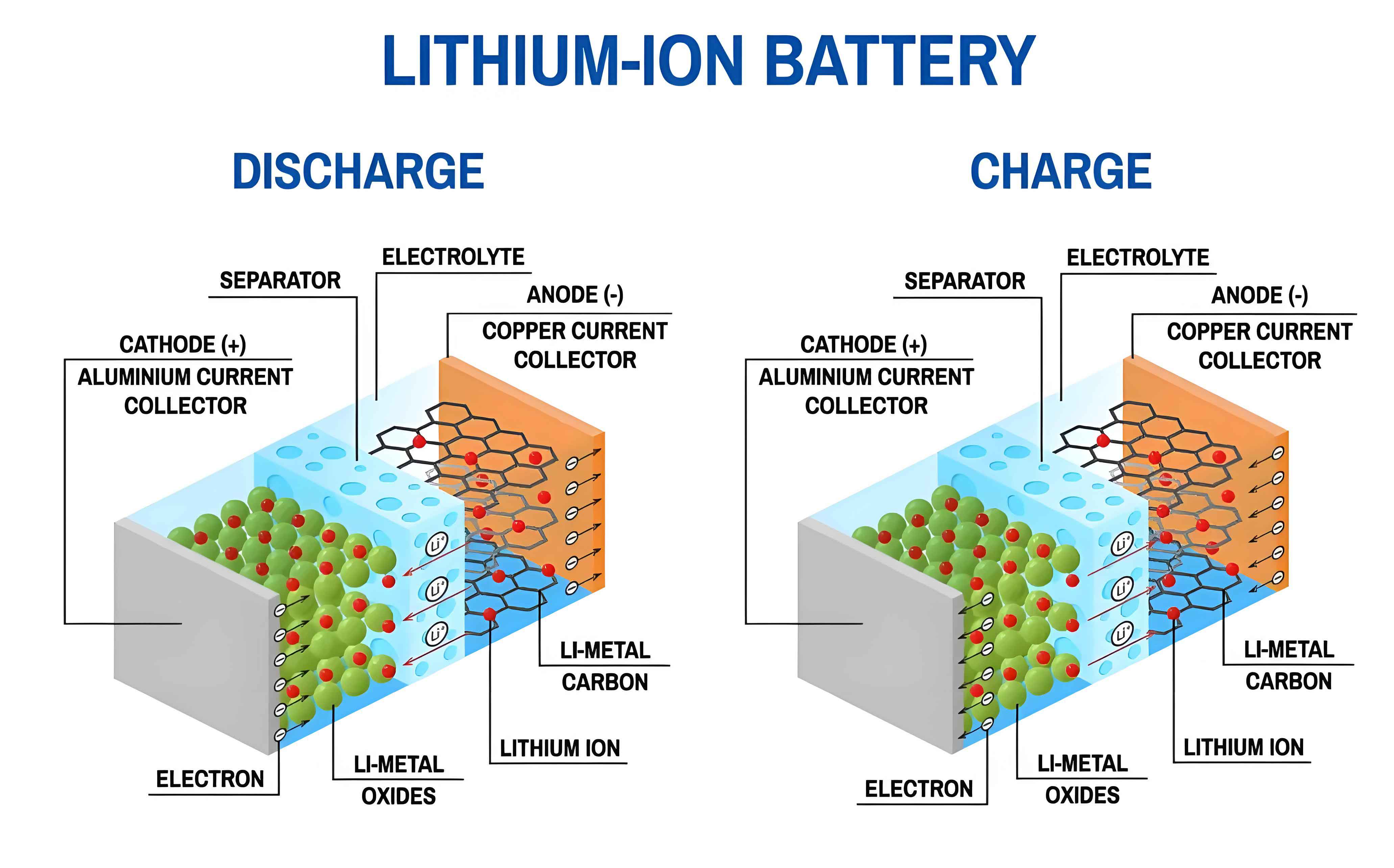
An ISC occurs when the anode and cathode within a lithium-ion battery come into direct physical contact, bypassing the separator. This can be triggered by mechanical abuse (crush, penetration) or, more insidiously, by the growth of lithium dendrites. During charging, especially under fast-charging or low-temperature conditions, lithium ions may plate as metallic lithium on the anode surface instead of intercalating. Over time, these deposits form dendrites that can penetrate the separator. Manufacturing defects such as electrode burrs, metallic contaminants (e.g., cobalt particles), and coating inhomogeneities that create local current hotspots significantly accelerate this process.
The evolution of an ISC can be categorized as “soft” or “hard,” depending on the separator’s response. A soft ISC may exhibit a slowly decaying voltage with limited immediate thermal consequence, while a hard ISC involves separator meltdown, leading to a rapid voltage drop and intense, localized heat generation. This heat can trigger a chain of exothermic side reactions, culminating in thermal runaway. The critical challenge is detecting the ISC during its early, low-heat generation phase before it cascades into an unstoppable event.
1.2 Overcharge and Over-discharge Faults
These faults arise from operating the lithium-ion battery beyond its voltage limits, often due to Battery Management System (BMS) or sensor failures, or exacerbated by cell inconsistencies within a pack.
Overcharging forces excess lithium ions into the anode. Beyond approximately 120% State of Charge (SOC), lithium plating intensifies. As overcharge continues (e.g., >140% SOC), severe side reactions occur: cathode structure degrades (oxygen release from layered oxides), electrolyte oxidizes, and gas generation causes cell swelling. Beyond a critical point (~167% SOC), massive heat generation leads to separator collapse and thermal runaway. The voltage during overcharge follows a characteristic trajectory before a sharp drop:
$$ V_{oc}(t) = OCV(SOC) + I_{chg}R_{int}(T, \eta) + \eta_{pol}(I_{chg}, t) $$
where $OCV$ is the open-circuit voltage, $I_{chg}$ is the charging current, $R_{int}$ is the internal resistance, and $\eta_{pol}$ represents increasing polarization overpotential due to side reactions.
Over-discharging drives the anode potential too high, causing copper dissolution from the current collector ($Cu \rightarrow Cu^{2+} + 2e^-$). The $Cu^{2+}$ ions migrate to the cathode, where they can redeposit as copper dendrites, posing a subsequent ISC risk. Simultaneously, excessive lithium insertion strains and damages the cathode crystal structure. Both processes lead to permanent capacity loss and increased impedance.
1.3 External Short Circuit (ESC) Fault
An ESC occurs when the cell’s terminals are connected by a very low-resistance external path, causing an abrupt and massive current surge. Triggers include coolant leakage, connector failure due to vibration, or physical damage to the pack. The instantaneous heat generation ($Q = I_{sc}^2 R_{int} t$) can be enormous, leading to rapid temperature rise, separator shutdown/melting, and electrolyte vaporization. The ESC process often shows three phases: an initial instantaneous current peak, a current decay phase limited by ion transport, and a final failure phase with venting and voltage collapse. An ESC in one cell within a pack can force abnormal currents through parallel cells, potentially inducing overcharge or over-discharge faults in neighboring units, creating a cascading failure risk.
The interrelationship between manufacturing defects, operational faults, and thermal runaway is complex and dynamic. Latent defects seed premature aging and local stress points, which under operational loads can initiate faults like ISC or accelerate degradation leading to inconsistency. These faults, in turn, generate heat and mechanical stress, further degrading components and potentially triggering other fault modes, creating a vicious cycle toward catastrophic failure.
2. Methodologies for Fault Detection in Lithium-Ion Batteries
Timely detection of incipient faults is paramount for lithium-ion battery safety. Detection methods can be broadly classified into model-based, signal-processing-based, and data-driven approaches.
2.1 Model-Based Fault Detection Methods
These methods leverage mathematical models of the lithium-ion battery to generate expected behavior. Discrepancies (residuals) between model predictions and measured signals (voltage, current, temperature) are analyzed to diagnose faults.
Key Models:
- Equivalent Circuit Models (ECM): Use RC networks to simulate voltage response. Simple but less physically descriptive.
$$ V_{term} = OCV(SOC) – I \cdot R_0 – V_{RC} $$
where $V_{RC}$ is the voltage across RC parallel branches. - Electrochemical Models (e.g., Pseudo-Two-Dimensional): Describe internal physico-chemical processes (diffusion, reaction kinetics). More accurate but computationally heavy.
- Fractional-Order Models: Capture diffusion dynamics more precisely than integer-order ECMs.
- Electrochemical-Thermal Coupled Models: Integrate heat generation with electrochemical states.
Residual Generation Techniques:
- State Estimation: Uses observers (Kalman Filter, Extended Kalman Filter) to estimate states like SOC. The innovation residual is monitored.
$$ \hat{x}_{k|k} = \hat{x}_{k|k-1} + K_k(z_k – H\hat{x}_{k|k-1}) $$
Faults cause the measurement residual $(z_k – H\hat{x}_{k|k-1})$ to exceed statistical bounds. - Parameter Estimation: Identifies model parameters (e.g., $R_0$, $C_{capacity}$) online. Sudden changes indicate faults (e.g., resistance drop for ISC).
- Parity Space: Creates algebraic relationships between inputs and outputs. Faults violate these parity equations.
Table 1 summarizes common model-based approaches.
| Model Type | Primary Detected Fault | Key Signals | Method Example |
|---|---|---|---|
| Equivalent Circuit Model (ECM) | ISC, Thermal Runaway Precursor | Voltage, Current | EKF with parameter estimation for $R_0$ change |
| Pseudo-2D Model | Sensor Fault, ISC | Voltage, Temperature | Nonlinear observer for electrolyte concentration gradient |
| Fractional-Order ECM | ESC, Slow Dynamics Anomalies | Voltage | Residual analysis from fractional calculus observer |
| Coupled Electrochemical-Thermal | ISC, Thermal Runaway | Voltage, Surface & Core Temperature | Joint state-parameter estimation |
2.2 Signal-Processing-Based Fault Detection Methods
These methods extract features directly from measured signals without requiring a complex model. They identify statistical anomalies or characteristic patterns associated with faults.
Common Techniques:
- Incremental Capacity (IC) / Differential Voltage (dV/dQ) Analysis: Transforms charge/discharge data to highlight phase transitions in electrode materials. Peak shifts, attenuation, or area changes indicate degradation or faults like ISC.
$$ IC = \frac{dQ}{dV} \approx \frac{\Delta Q}{\Delta V} $$ - Entropy Analysis: Uses Shannon entropy to quantify the disorder or inconsistency in signals (voltage, temperature) across a battery pack. A spike in entropy often signals a fault.
$$ H(X) = -\sum_{i=1}^{n} P(x_i) \log_2 P(x_i) $$ - Wavelet Transform: Decomposes signals to separate noise from fault-induced transients at different frequency bands.
- Outlier Detection (e.g., Local Outlier Factor – LOF): Identifies cells with signal patterns that deviate significantly from their neighbors in a pack.
Table 2 summarizes key signal-processing methods.
| Method | Target Fault | Extracted Feature / Indicator | Advantage |
|---|---|---|---|
| Incremental Capacity (IC) Analysis | ISC, Loss of Lithium Inventory | Peak position, height, and area of IC curve | Links external signals to internal electrochemical states |
| Shannon Entropy | Pack Inconsistency, Early ISC | Entropy value of voltage/temperature distribution | Simple to compute, effective for pack-level anomaly |
| Wavelet Transform + Thresholding | Micro-shorts, Abrupt voltage changes | Energy in specific frequency bands | Good at denoising and capturing transient features |
| Local Outlier Factor (LOF) | ISCs, Cell inconsistency | Local density deviation of a cell’s data point | Unsupervised, can identify subtle anomalies in a pack |
2.3 Data-Driven Fault Detection Methods
Leveraging machine learning and artificial intelligence, these methods learn the normal and faulty operation patterns of a lithium-ion battery directly from historical data.
Common Algorithms:
- Supervised Learning: Trained on labeled fault data.
- Support Vector Machines (SVM), Neural Networks (NN): Classify operational states (normal, overcharge, ISC, etc.).
- Long Short-Term Memory (LSTM) Networks: Model time-series data to predict voltage/temperature; large prediction errors signal faults.
- Unsupervised Learning: Discovers anomalies without labeled faults.
- Clustering (K-means, DBSCAN): Groups similar data; points far from any cluster center are potential faults.
- Autoencoders: Learn to compress and reconstruct normal data; high reconstruction error indicates anomaly.
Hybrid Approaches combining model-based residuals with data-driven classifiers (e.g., using SVM on features extracted from an ECM) are gaining popularity to enhance robustness and diagnostic accuracy.
3. Summary, Challenges, and Future Perspectives
Ensuring the safety of lithium-ion battery systems necessitates a deep understanding of fault mechanisms coupled with robust, early detection strategies. Current methods offer varying strengths: model-based approaches provide interpretability and fault isolation; signal-processing methods are lightweight and intuitive; data-driven techniques excel at pattern recognition in complex, nonlinear systems.
Persisting Challenges:
- Early-Stage Detection: Capturing the subtle signatures of incipient faults (e.g., soft ISC, early lithium plating) before they escalate remains difficult.
- Adaptability: Models and thresholds tuned for fresh cells become inaccurate as the lithium-ion battery ages and its parameters drift. Adaptive algorithms are needed.
- Fault Isolation and Diagnosis: Distinguishing between different fault types with similar symptoms (e.g., voltage drop from ISC vs. sensor fault) is challenging.
- Computational Burden: High-fidelity models and complex AI algorithms may be prohibitive for embedded BMS implementation.
- Data Scarcity: Data-driven methods require extensive, high-quality fault data for training, which is often lacking.
Future Outlook and Promising Directions:
- Multi-Physics Sensing and Fusion: Integrating beyond conventional voltage, current, and temperature sensing. Gas Sensors are highly promising, as different fault pathways (SEI decomposition, electrolyte oxidation, etc.) produce characteristic gas species (H₂, CO, CO₂, HF) before significant temperature rise. Real-time gas composition analysis could provide very early thermal runaway warnings.
- Digital Twin Technology: Creating a high-fidelity virtual replica of a physical lithium-ion battery or pack, updated in real-time with sensor data. The digital twin can run predictive simulations to forecast aging, stress hotspots, and fault progression, enabling predictive maintenance and virtual testing of safety scenarios.
- Explainable AI (XAI) for Diagnostics: Developing data-driven models that not only detect faults but also provide interpretable insights into the likely root cause (e.g., linking a detected anomaly to “lithium plating due to low-temperature fast charge”), enhancing trust and actionable response.
- Cloud-Edge Collaborative BMS: Offloading intensive computation (like digital twin updates or complex AI diagnostics) to the cloud, while the onboard BMS handles real-time, lightweight monitoring and emergency response. This enables continuous learning from fleet-wide data.
- In-Line and Non-Destructive Testing (NDT): Advanced imaging (X-ray computed tomography, ultrasound) and spectroscopy techniques used during manufacturing and throughout life can identify latent defects (electrode cracks, contamination) and monitor internal structural health, feeding critical data into lifetime prognostic models.
The future of lithium-ion battery safety lies in intelligent, adaptive, and multi-dimensional monitoring systems. By fusing physics-based models with data-driven insights from diverse sensors, and by implementing technologies like digital twins, we can transition from reactive fault detection to predictive health management. This will be essential for unlocking the full potential of lithium-ion batteries in applications demanding the highest levels of safety and reliability.