
The pursuit of sustainable energy solutions has placed lithium-ion battery technology at the forefront, particularly for electric vehicles and grid storage. Despite their advantages, safety remains a critical constraint. Among various failure modes, internal short circuits (ISCs) initiated by lithium dendrite growth are a predominant cause of thermal runaway—a catastrophic, self-perpetuating increase in temperature. Dendrites form due to lithium plating on the anode during suboptimal charging conditions, eventually penetrating the separator and creating a direct electronic path between electrodes. Understanding the coupled electrical and thermal response during such an event is paramount for designing safer cells and developing effective failure detection strategies.
This article investigates the electrothermal phenomena resulting from dendrite-induced ISCs through a physics-based modeling approach. By establishing an electrochemical-thermal coupled model, we simulate the initial short-circuit phase and analyze the influence of key geometric and material parameters on the resulting current, heat generation, and temperature distribution. The insights aim to provide foundational data for thermal monitoring and inform design choices to mitigate short-circuit severity.
Modeling Framework for Dendrite Internal Short Circuit
The analysis is based on a pseudo-two-dimensional (P2D) electrochemical model coupled with a three-dimensional thermal model, simulating a single repeating unit of a layered lithium-ion battery. The model incorporates an internal short-circuit channel representing a lithium dendrite that has fully breached the separator.
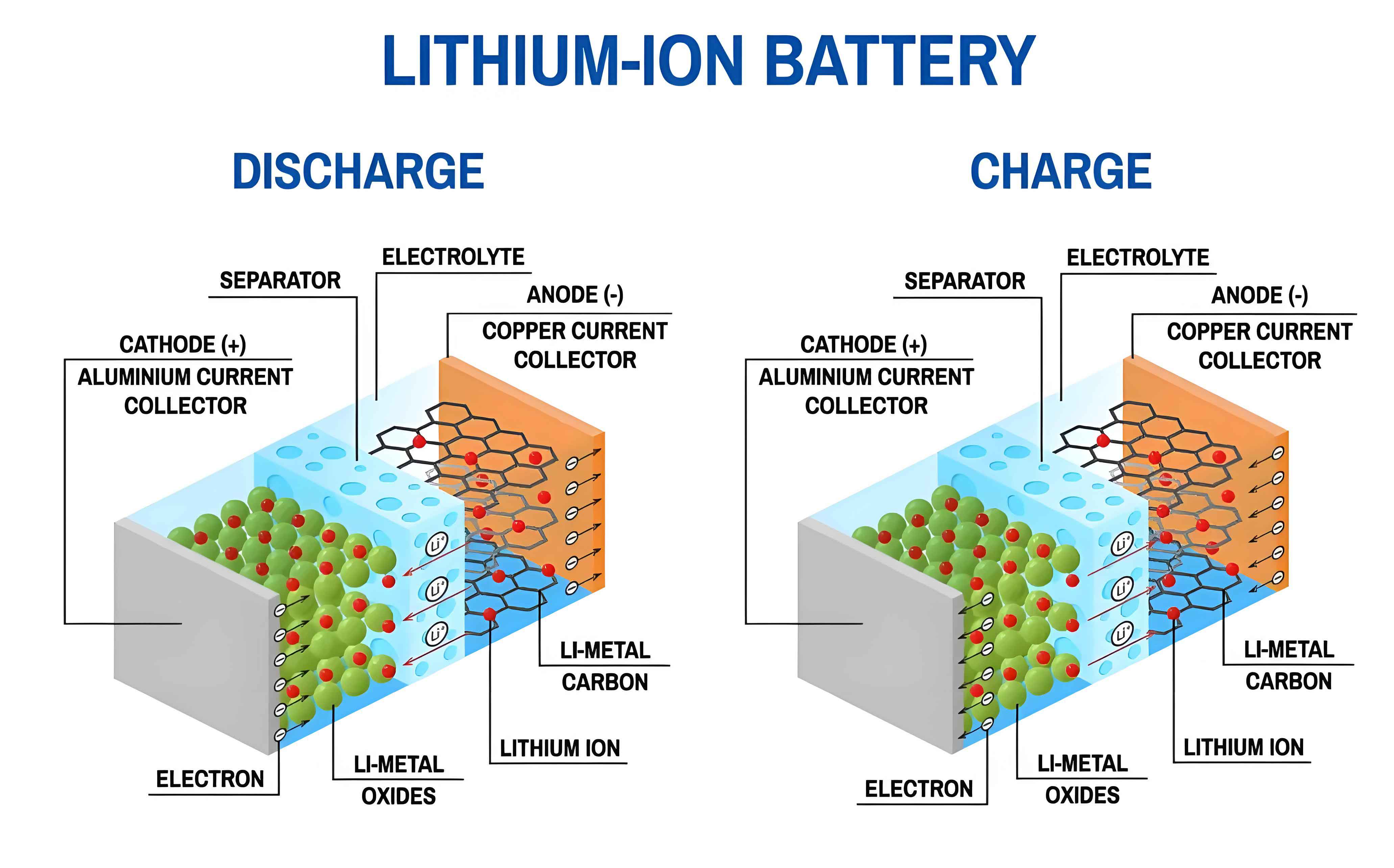
The electrochemical model governs lithium-ion transport and reaction kinetics. Lithium diffusion within solid electrode particles is described by Fick’s second law in spherical coordinates:
$$
\frac{\partial c_s}{\partial t} = D_s \left( \frac{\partial^2 c_s}{\partial r^2} + \frac{2}{r} \frac{\partial c_s}{\partial r} \right)
$$
where $c_s$ is the lithium concentration in the solid, $D_s$ is the solid-phase diffusion coefficient, and $r$ is the radial coordinate within the particle.
The charge conservation in the solid matrix is governed by:
$$
\nabla \cdot (\sigma_{i}^{eff} \nabla \phi_s) = -j_{tot}
$$
Here, $\phi_s$ is the solid potential, $\sigma_{i}^{eff}$ is the effective electronic conductivity, and $j_{tot}$ is the total volumetric current density from electrochemical reactions and the short-circuit path.
The lithium-ion concentration in the electrolyte obeys:
$$
\varepsilon_e \frac{\partial c_e}{\partial t} = \nabla \cdot (D_e^{eff} \nabla c_e) + \frac{1-t_+^0}{F} j_{Li}
$$
where $\varepsilon_e$ is the electrolyte phase volume fraction, $c_e$ is the electrolyte concentration, $D_e^{eff}$ is the effective electrolyte diffusivity, $t_+^0$ is the transference number, $F$ is Faraday’s constant, and $j_{Li}$ is the ionic current density.
The electrochemical reaction rate at the electrode/electrolyte interface is modeled by the Butler-Volmer equation:
$$
j = a_s i_0 \left[ \exp\left(\frac{\alpha_a F}{RT}\eta\right) – \exp\left(-\frac{\alpha_c F}{RT}\eta\right) \right]
$$
where $a_s$ is the specific surface area, $i_0$ is the exchange current density, $\alpha_a$ and $\alpha_c$ are anodic and cathodic transfer coefficients, $R$ is the gas constant, $T$ is temperature, and $\eta$ is the overpotential.
The thermal model solves the energy conservation equation:
$$
\rho C_p \frac{\partial T}{\partial t} = \nabla \cdot (k \nabla T) + q_{gen}
$$
where $\rho$ is density, $C_p$ is heat capacity, $k$ is thermal conductivity, and $q_{gen}$ is the volumetric heat generation rate. The heat generation comprises irreversible joule heating ($q_j$), reversible entropic heat ($q_r$), and polarization heat ($q_p$):
$$
q_{gen} = q_j + q_r + q_p
$$
with
$$
q_j = \sigma_{s}^{eff} \nabla \phi_s \cdot \nabla \phi_s + \kappa^{eff} \nabla \phi_e \cdot \nabla \phi_e
$$
and
$$
q_r = j \left( T \frac{\partial U}{\partial T} \right), \quad q_p = j \eta
$$
where $U$ is the open-circuit potential.
The short-circuit channel is modeled as a cylindrical lithium metal filament with high electronic conductivity ($\sigma_{Li}$), connecting the anode and cathode. Its resistance ($R_{ISC}$) is given by:
$$
R_{ISC} = \frac{L}{\sigma_{Li} \cdot A} = \frac{L}{\sigma_{Li} \cdot \pi r_d^2}
$$
where $L$ is the length (equal to separator thickness), and $r_d$ is the dendrite radius. The short-circuit current is calculated based on the potential difference across this channel.
The key geometric and material parameters for the baseline model are summarized in the following tables.
| Parameter | Value |
|---|---|
| Nominal Capacity | 0.4 Ah |
| Nominal Voltage | 3.7 V |
| Initial Voltage (SOC 100%) | 4.0 V |
| Component | Material | Thickness (μm) |
|---|---|---|
| Positive Current Collector | Aluminum | 6 |
| Positive Electrode | NCM | 40 |
| Separator | Polymer + LiPF₆ | 30 |
| Negative Electrode | Graphite (LixC6) | 60 |
| Negative Current Collector | Copper | 6 |
| Dendrite Channel (Baseline Radius) | Lithium Metal | 5 μm |
| Parameter | Negative Electrode | Separator | Positive Electrode | Lithium Dendrite |
|---|---|---|---|---|
| Density, $\rho$ (kg/m³) | 2300 | 940 | 2500 | 534 |
| Heat Capacity, $C_p$ (J/kg·K) | 750 | 1046 | 1000 | 3580 |
| Thermal Conductivity, $k$ (W/m·K) | 1.0 | 0.15 | 3.6 | 84.8 |
| Electrical Conductivity, $\sigma$ (S/m) | 100 | – | 100 | 1.0×10⁷ |
| Porosity / Volume Fraction | 0.31 | 0.4 | 0.29 | – |
Results and Discussion: Parametric Analysis of the Short-Circuit Event
The simulation focuses on the initial 0.01 seconds after the short circuit is established, capturing the instantaneous electrothermal response. The initial cell temperature is set to 293.15 K (20°C).
1. Influence of Lithium Dendrite Radius
The radius of the lithium dendrite ($r_d$) is a critical parameter as it directly defines the short-circuit resistance and cross-sectional area for current flow. Three cases were analyzed: $r_d$ = 1 μm, 5 μm, and 10 μm.
The short-circuit current ($I_{ISC}$) rises sharply upon initiation and then stabilizes within milliseconds. As shown in the analysis, a larger dendrite radius leads to a significantly higher steady-state short-circuit current due to the quadratic reduction in resistance ($R_{ISC} \propto 1/r_d^2$).
| Dendrite Radius, $r_d$ (μm) | Short-Circuit Current, $I_{ISC}$ (A) | Heat Generation Rate (W) | Peak Temperature (K) | Cell Voltage (V) |
|---|---|---|---|---|
| 1 | ~0.0004 | ~0.0017 | ~326 | ~1.62 |
| 5 | ~0.0017 | ~0.0070 | ~330 | ~1.64 |
| 10 | ~0.0036 | ~0.0145 | ~332 | ~1.66 |
The relationship between peak temperature and $r_d$ is non-linear. Increasing $r_d$ from 1 μm to 5 μm causes a 4 K jump, while a further increase to 10 μm results in only an additional 2 K rise. This saturation effect is attributed to the competing factors of increased current (and thus Joule heating) and the enhanced heat dissipation capability of the larger metallic dendrite volume, which has a high thermal conductivity. The heat generation power ($Q_{gen} \approx I_{ISC}^2 \cdot R_{ISC}$) shows a strong positive correlation with $r_d$. The cell voltage drops immediately after the short circuit and stabilizes at a lower value. A larger $r_d$ results in a slightly higher post-short voltage because the lower resistance draws more current, leading to a faster depletion of active lithium at the reaction interfaces, which increases polarization and effectively limits the voltage drop.
2. Influence of Separator Thickness
The separator thickness ($L_{sep}$) determines the length of the dendrite channel and influences both electrical and thermal behavior. Simulations were conducted for $L_{sep}$ = 20 μm, 25 μm, and 30 μm with a constant dendrite radius of 5 μm.
A thicker separator increases the length of the high-resistivity electrolyte path and the dendrite channel itself. Although the dendrite’s conductivity is extremely high, the overall internal resistance increases with separator thickness. This leads to a slight reduction in the short-circuit current and consequently, the heat generation rate and peak temperature.
| Separator Thickness, $L_{sep}$ (μm) | Short-Circuit Current at 0.01s (A) | Peak Temperature at 0.01s (K) |
|---|---|---|
| 20 | ~0.00173 | ~326.4 |
| 25 | ~0.001725 | ~326.1 |
| 30 | ~0.00170 | ~325.8 |
The separator material typically has a lower thermal conductivity (0.15 W/m·K) compared to the electrodes. A thicker separator thus creates a region with poorer heat dissipation between the electrodes, but this effect is counteracted by the lower heat generation due to reduced current. The net result is a marginal decrease in the local peak temperature. This suggests that while increasing separator thickness can slightly mitigate the initial temperature spike from a given dendrite, its primary safety benefit lies in delaying dendrite penetration.
3. Influence of Electrode Solid-Phase Volume Fraction and Thermal Conductivity
The solid-phase volume fraction ($\varepsilon_s$) in the electrodes affects the effective electrical and thermal properties, as well as the available surface area for reactions. The thermal conductivity ($k$) governs the rate of heat dissipation from the short-circuit hotspot.
Volume Fraction: Increasing $\varepsilon_s$ in either electrode leads to a higher initial short-circuit temperature. This is because a higher $\varepsilon_s$ increases the effective electronic conductivity and the density of reactive sites, facilitating greater current flow during the short. The effect is more pronounced in the negative electrode. For instance, varying the negative electrode’s $\varepsilon_s$ from 0.38 to 0.58 raised the temperature from ~319 K to ~331 K, whereas a similar change in the positive electrode’s $\varepsilon_s$ (0.52 to 0.72) resulted in an increase from ~322 K to ~328 K. This greater sensitivity is likely due to the properties of graphite and the location of the primary short-circuit joule heating.
Thermal Conductivity: As expected, increasing the thermal conductivity of electrode materials or the lithium dendrite itself enhances heat spreading and reduces the peak temperature. The relationship is inverse and significant. For example, increasing the dendrite’s $k$ from 24.8 to 144.8 W/m·K reduced the local hotspot temperature by approximately 5 K. This highlights the importance of material selection and thermal management design in mitigating the localized thermal effects of an internal short circuit within a lithium-ion battery.
4. Toward Thermal Runaway: Long-Term Temperature Evolution
The initial analysis above was conducted with a fixed boundary temperature, limiting the maximum temperature rise. To simulate the progression toward thermal runaway, this constraint was removed, and the simulation was extended in time. The heat generated by the internal short circuit continuously raises the local temperature.
The time to reach critical temperatures associated with the onset of thermal runaway was evaluated. For a dendrite radius of 5 μm, the localized temperature reached 390 K (a common trigger point for exothermic solid-electrolyte interphase decomposition) in approximately 4 seconds. For a larger, more severe short circuit with $r_d$ = 10 μm, this critical temperature was reached in only about 1.8 seconds. This underscores how dendrite size critically impacts the time available for safety interventions before catastrophic failure ensues. The hottest spot consistently remains at or near the interface between the lithium dendrite and the negative electrode, providing a potential target location for embedded thermal sensors.
Conclusion
This study employed a coupled electrochemical-thermal model to investigate the electrothermal effects following a lithium dendrite-induced internal short circuit in a lithium-ion battery. The parametric analysis reveals key insights:
- The dendrite radius has a dominant, non-linear impact on the short-circuit severity. Larger radii cause substantially higher short-circuit currents and initial heat generation, significantly shortening the time to reach thermal runaway trigger temperatures.
- While increasing separator thickness can marginally reduce the initial current and temperature spike for a given dendrite size, its main safety role is as a mechanical barrier to delay dendrite penetration.
- Electrode design parameters like solid-phase volume fraction significantly influence the short-circuit behavior, with the negative electrode properties being particularly sensitive.
- Materials with higher thermal conductivity, both in the electrodes and the metallic dendrite itself, help dissipate the localized heat, reducing the peak temperature.
The findings provide critical data for the thermal management and safety design of lithium-ion battery systems. They highlight the importance of preventing lithium plating and dendrite formation during operation. Furthermore, the identification of the dendrite-negative electrode interface as the primary hotspot informs optimal placement for temperature monitoring sensors within battery packs. This work establishes a framework for assessing short-circuit risks and contributes to the development of safer energy storage solutions based on lithium-ion battery technology.