
In the context of global carbon neutrality goals, the rapid integration of renewable energy sources like wind and solar into power grids has intensified the demand for energy storage systems. Electrochemical energy storage, particularly using lithium-ion batteries, has emerged as a pivotal solution due to its high energy density and efficiency. Among these, lithium iron phosphate (LiFePO4) batteries are widely adopted in energy storage applications because of their inherent safety, long cycle life, and stability. However, safety concerns persist, as thermal runaway—a catastrophic failure mode—can be triggered by abusive conditions such as electrical, thermal, or mechanical stress. While extensive research has focused on thermal runaway under idle conditions, the impact of operational states, specifically discharge processes, remains underexplored. This study aims to bridge this gap by examining the thermal runaway characteristics of a commercial 52 Ah prismatic LiFePO4 battery under different discharge powers coupled with thermal abuse. The findings are intended to inform safety protocols and battery management system designs for electrochemical energy storage plants.
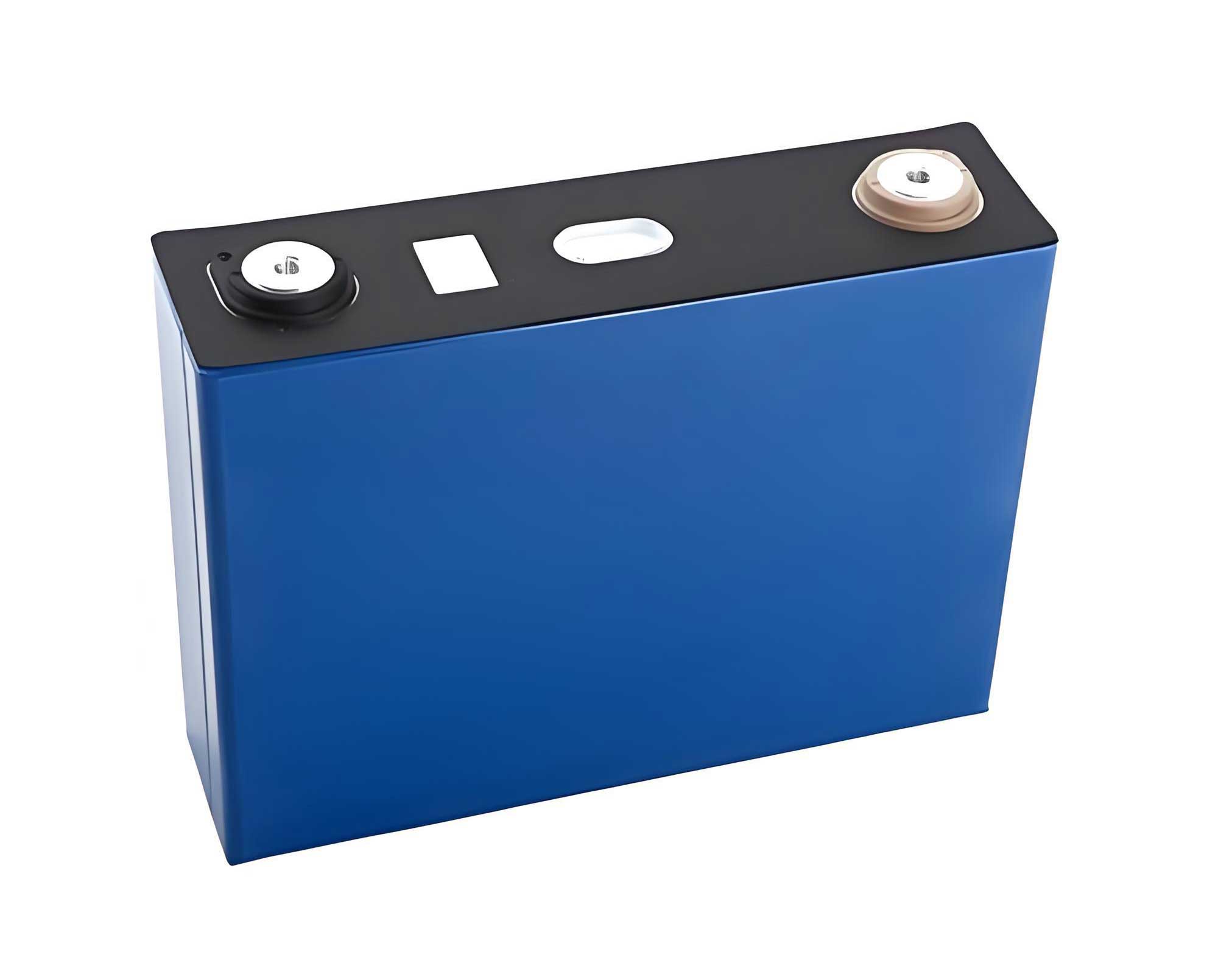
The experimental setup involved a 52 Ah aluminum-cased prismatic LiFePO4 battery, commonly used in energy storage and backup power systems. The battery features a LiFePO4 cathode and graphite anode, with a nominal voltage of 3.2 V and a charge-discharge voltage range of 2.0–3.65 V. Prior to testing, all batteries underwent three charge-discharge cycles to ensure consistency and were stabilized at 75% state-of-charge (SOC) to reflect typical operational windows. The test platform comprised a combustion chamber, a battery cycler, and a data acquisition system. Thermal abuse was induced using a 400 W external heater attached to one large face of the battery, while simultaneous constant-power discharge was applied at rates of 20.8 W (1C equivalent for 8 hours), 41.6 W (2C for 4 hours), 83.2 W (4C for 2 hours), and 166.4 W (8C for 1 hour), alongside a control case with no discharge. Temperature was monitored via K-type thermocouples at multiple locations, voltage was recorded, and gas emissions were analyzed. Each condition was replicated to ensure reproducibility.
The thermal runaway process was categorized into four stages: preheating, pressure release, thermal runaway, and decay. Key parameters such as valve opening time (t_v), thermal runaway trigger time (t_tr), surface temperatures, and voltage profiles were analyzed. The lifepoe4 battery exhibited distinct behaviors under discharge conditions. For instance, the valve opening occurred earlier with higher discharge powers, indicating accelerated internal pressure buildup. The thermal runaway trigger time also decreased, suggesting that discharge operations hasten the onset of catastrophic failure. To quantify these effects, Table 1 summarizes the characteristic times and temperatures across different discharge powers.
| Discharge Power (W) | Valve Opening Time, t_v (s) | Thermal Runaway Trigger Time, t_tr (s) | Valve Opening Temperature, T_sv (°C) | Maximum Temperature, T_max (°C) | Maximum Temperature Rise Rate (°C/s) |
|---|---|---|---|---|---|
| 0 (No Discharge) | 850 ± 8 | 1276 ± 7 | 142.8 ± 1.1 | 301.6 ± 4.8 | 2.82 |
| 20.8 | 820 ± 20 | 1263 ± 15 | 140.5 ± 1.5 | 300.0 ± 7.3 | 2.65 |
| 41.6 | 783 ± 23 | 1257 ± 31 | 138.2 ± 2.0 | 297.1 ± 10.4 | 2.50 |
| 83.2 | 728 ± 20 | 1239 ± 32 | 135.0 ± 1.8 | 289.3 ± 13.6 | 2.30 |
| 166.4 | 651 ± 42 | 1204 ± 41 | 130.1 ± 3.2 | 274.6 ± 17.2 | 1.95 |
The data clearly show that discharge power accelerates thermal runaway initiation. Compared to the no-discharge case, the 166.4 W discharge reduced t_v by 23.4% and t_tr by 5.6%. This acceleration is attributed to reduced battery stability during discharge, which lowers the temperature thresholds for internal side reactions. Conversely, the severity of thermal runaway, indicated by T_max and maximum temperature rise rate, decreased with higher discharge powers. For example, T_max dropped by 9.0% at 166.4 W, while the temperature rise rate fell by 53.3%. This reduction is linked to the lower SOC at thermal runaway onset, as discharge consumes energy, thereby diminishing the exothermic reactions during failure.
Voltage profiles provided further insights into the internal state of the lifepoe4 battery. Under no discharge, voltage remained stable at 3.33 V until around 157°C, when a gradual decline began due to separator shrinkage. In contrast, discharge cases exhibited more complex voltage dynamics. Upon discharge initiation, voltage dropped instantaneously due to ohmic losses, described by: $$U = U_{OCV} – I R$$ where \(U\) is the working voltage, \(U_{OCV}\) is the open-circuit voltage, \(I\) is the current, and \(R\) represents internal resistance. For constant-power discharge, \(I = P / U\), making the voltage behavior nonlinear. As heating continued, voltage fluctuations intensified, with sharp drops occurring near the valve opening time. This shift in voltage decline window offers an earlier warning signal for thermal runaway, enhancing safety monitoring. The energy discharged prior to thermal runaway was calculated for each condition, as shown in Table 2, correlating with the reduced SOC and mitigated failure severity.
| Discharge Power (W) | Discharge Energy (Wh) | Residual SOC at Thermal Runaway (%) | Voltage Fluctuation Magnitude (V) |
|---|---|---|---|
| 20.8 | 6.49 | 71.1 | 0.02–0.05 |
| 41.6 | 13.15 | 67.1 | 0.04–0.08 |
| 83.2 | 24.96 | 60.0 | 0.06–0.12 |
| 166.4 | 42.27 | 49.6 | 0.10–0.20 |
Temperature evolution during thermal runaway was modeled using heat generation equations. The overall energy balance for the lifepoe4 battery can be expressed as: $$m C_p \frac{dT}{dt} = Q_{gen} – Q_{loss}$$ where \(m\) is the battery mass, \(C_p\) is the specific heat capacity, \(T\) is temperature, \(Q_{gen}\) is the heat generation rate, and \(Q_{loss}\) is heat loss to surroundings. During discharge, \(Q_{gen}\) includes joule heating and reversible entropic heat: $$Q_{gen} = I (U_{OCV} – U) + I T \frac{dU_{OCV}}{dT}$$ Under thermal abuse, additional exothermic reactions from electrolyte decomposition and electrode interactions dominate. The accelerated timeline under discharge suggests that these reactions initiate at lower temperatures, aligning with the observed earlier valve opening.
To further analyze the thermal runaway progression, consider the temperature rise rate versus temperature, often used to identify critical points. For the lifepoe4 battery, the maximum temperature rise rate (\(\frac{dT}{dt}_{max}\)) decreased with discharge power, as quantified in Table 1. This trend underscores the dual role of discharge: while it hastens the onset, it also reduces the intensity of thermal runaway. The underlying mechanism involves competing factors—discharge lowers SOC, which typically slows thermal runaway, but it also degrades battery stability, advancing failure. Our experiments indicate that the stability degradation prevails, leading to net acceleration.
Gas emission analysis during thermal runaway revealed compositions including electrolyte vapors, carbon oxides, and hydrocarbons. Discharge operations did not significantly alter gas species but affected release timing. Earlier valve opening under discharge led to premature gas venting, which could influence fire risks in confined spaces. The lifepoe4 battery’s safety valve design, rated at 0.6 MPa, consistently burst at lower temperatures under discharge, emphasizing the need for pressure management in operational systems.
In practical energy storage applications, lifepoe4 batteries often operate under dynamic power loads. Our findings imply that during fault conditions involving thermal abuse, discharge currents can exacerbate the speed of thermal runaway, necessitating faster response from battery management systems. However, the reduced severity offers a silver lining, potentially limiting collateral damage. For instance, in a grid-scale storage facility, high-power discharge during a thermal event might trigger earlier alarms but result in less violent failures.
To generalize these results, we propose a correlation between discharge power and thermal runaway parameters. Based on empirical data, the valve opening time can be approximated as: $$t_v = t_{v0} e^{-k P}$$ where \(t_{v0}\) is the valve opening time at zero discharge, \(P\) is discharge power, and \(k\) is a constant derived from fitting. Similarly, the maximum temperature follows a linear decay: $$T_{max} = T_{max0} – \alpha P$$ where \(T_{max0}\) is the maximum temperature without discharge and \(\alpha\) is a coefficient. These relationships aid in risk assessment for lifepoe4 battery systems under varying operational stresses.
The voltage behavior serves as a critical diagnostic tool. The earlier voltage drops during discharge provide a larger time window for预警. Implementing voltage-based algorithms that monitor deviations beyond typical operating ranges could enhance early detection of thermal runaway in lifepoe4 batteries. For example, a sudden voltage dip coupled with rising temperature might indicate impending failure, triggering shutdown procedures.
In conclusion, this experimental study comprehensively evaluates the thermal runaway characteristics of a 52 Ah lifepoe4 battery under different discharge powers. Discharge operations accelerate the thermal runaway process, with higher powers leading to earlier valve opening and trigger times. Conversely, the severity of thermal runaway, measured by peak temperature and temperature rise rate, is mitigated due to energy dissipation and lower SOC. Voltage profiles exhibit greater fluctuations under discharge, offering earlier warning signs. These insights underscore the importance of considering operational states in safety assessments for energy storage systems. Future work should explore cyclic discharge profiles and larger battery modules to further refine safety guidelines for lifepoe4 battery deployments.
From an engineering perspective, these findings suggest that battery management systems for lifepoe4 batteries should incorporate real-time monitoring of both temperature and voltage, with adaptive thresholds based on discharge rates. Additionally, thermal management designs must account for the accelerated heat generation during combined discharge and abuse conditions. As the adoption of lifepoe4 batteries grows in renewable energy integration, such safety-oriented research becomes paramount to ensuring reliable and secure energy storage infrastructures.