
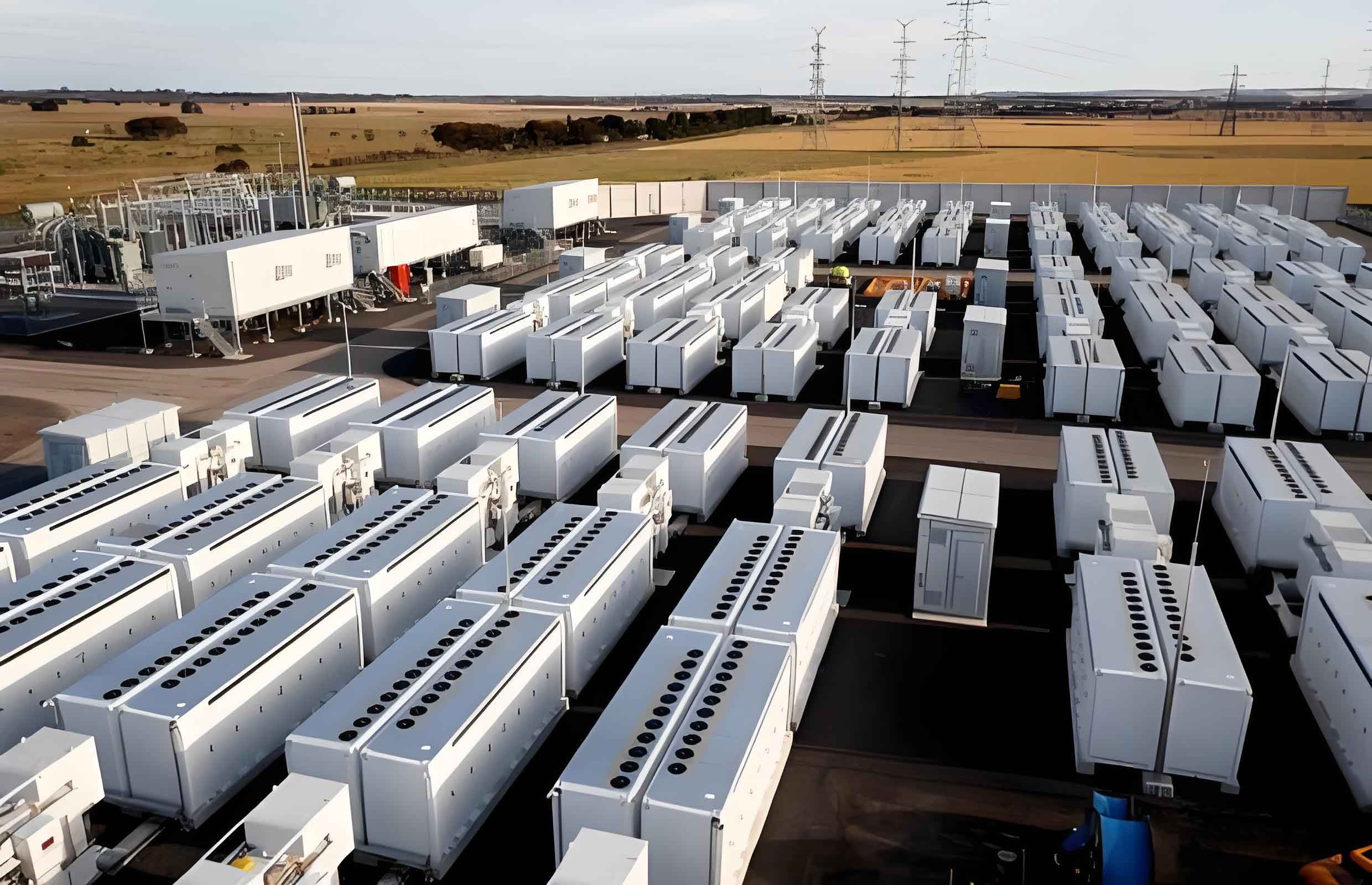
In the context of achieving carbon peak and carbon neutrality goals, large-scale cell energy storage systems are rapidly developing to address the volatility of renewable energy generation. These systems play a vital role in modern power grids with high penetrations of clean energy. However, during long-term operation, short-circuit faults such as pole-to-pole and pole-to-ground faults can occur due to insulation aging, improper operation, or other failures. Pole-to-pole faults, in particular, often involve low transition resistance, generating massive direct current (DC) short-circuit currents that severely threaten the safety and integrity of the battery system. Traditional DC protection calculation and configuration methods are ill-suited for the unique architecture of large-scale cell energy storage systems. The lack of appropriate protection can lead to catastrophic failures, resulting in significant economic losses and safety hazards. Therefore, accurate short-circuit analysis and the design of effective protection strategies are of paramount importance for the reliable operation of cell energy storage systems.
This study focuses on developing a comprehensive methodological framework for analyzing short-circuit faults and designing protection schemes for large-scale cell energy storage systems. We begin by establishing and validating a simplified yet accurate model for a single battery cell under short-circuit conditions. Based on this model, we derive universal analytical formulas for calculating steady-state fault currents for both intra-cluster and inter-cluster short circuits. These formulas are applicable to systems with arbitrary numbers of battery cells and cover various fault scenarios. We analyze the factors influencing the magnitude of short-circuit currents and their variation patterns. Finally, we evaluate different protection schemes and propose a cost-effective, fuse-based protection configuration, detailing the optimal placement of fuses and the methodology for calculating their required interrupting capacities. The proposed approach provides a practical and theoretical foundation for the preliminary design and protection engineering of large-scale cell energy storage installations.
Short-Circuit Model of a Single Battery Cell
The foundation for system-level fault analysis is an accurate model of the individual battery cell under short-circuit conditions. We propose a simplified DC steady-state model consisting of an internal electromotive force (EMF) $E$, an internal resistance $R_n$, and a fault impedance $R_f$. The equivalent circuit is shown below.
$$E – I \cdot R_n – I \cdot R_f = 0$$
The internal EMF $E$ is dependent on the state of charge (SOC), temperature, current, and aging. For short-circuit analysis, which concerns the current within the first few seconds after fault initiation, the SOC, temperature, and aging state can be considered constant. Therefore, $E$ is treated as a constant value. To analyze the worst-case scenario (maximum current), $E$ is selected as the battery’s full-charge voltage. The internal resistance $R_n$ is assumed constant within the relevant range and is taken as the battery’s DC internal resistance. The fault impedance $R_f$ represents the combined resistance of the fault path, including any arc resistance and connection resistance.
To validate this model, a short-circuit test was performed on a 280 Ah lithium iron phosphate (LFP) battery cell. The cell’s full-charge voltage was 3.65 V, and its DC internal resistance was 0.4 mΩ. The cell’s terminals were directly connected via cables and a short-circuit tester, with a combined impedance of approximately 1.8 mΩ. The experimentally measured peak short-circuit current was 1604 A. Using the proposed model, the calculated current is $I = E / (R_n + R_f) = 3.65 \text{ V} / (0.4 \text{ mΩ} + 1.8 \text{ mΩ}) = 1659 \text{ A}$. The error between the calculated and measured values is approximately 3.4%, which is deemed acceptable for protection analysis and system design purposes. This validated model is subsequently used for all system-level fault calculations.
Architecture of a Large-Scale Cell Energy Storage System
A typical large-scale cell energy storage system has a hierarchical architecture. Multiple battery cells are connected in series to form a battery module. Several modules are then connected in series to create a battery cluster or string. Finally, multiple clusters are connected in parallel to a common DC bus, forming the complete battery energy storage system (BESS), which is interfaced with the power conversion system (PCS). For the purpose of deriving general formulas, the concept of a module can be abstracted, and we consider $n$ battery cells connected in series per cluster. The system consists of $M$ such clusters connected in parallel. The cable impedances between cells and clusters are relatively small and are neglected in the analytical derivations to simplify the formulas, resulting in slightly conservative (higher) current estimates, which is acceptable for protection design.
Generalized Short-Circuit Fault Analysis
Large-scale cell energy storage systems are typically ungrounded. The primary short-circuit faults are categorized as: 1) Intra-cluster pole-to-pole fault, 2) Inter-cluster pole-to-pole fault, and 3) Double line-to-ground fault. The first two are the most severe due to the low impedance path. Generalized formulas are derived for each.
1. Intra-Cluster Pole-to-Pole Fault
Consider a fault within a single cluster, where the short occurs between two points inside the cluster, effectively shorting $n-k$ series cells. The parameter $k$ ($0 \le k \le n$) represents the number of cells between the positive terminal of the cluster and the fault point. The remaining $n-k$ cells are within the fault loop. $M$ is the total number of clusters. $I_1$ is the current supplied to the fault point from each of the $(M-1)$ healthy clusters. $I_2$ is the current circulating within the faulted cluster from the non-shorted section into the fault point. Applying Kirchhoff’s voltage law to the relevant loops yields the following equations:
$$kE + (M-1)I_1 k R_n + R_f[(M-1)I_1 + I_2] = nE – I_1 n R_n$$
$$(n-k)E – I_2 (n-k)R_n = R_f[(M-1)I_1 + I_2]$$
Solving these equations provides the general formulas for the fault currents:
$$I_1 = \frac{E(n-k)}{ R_f \frac{M n}{n-k} + [(M-1)k + n] R_n }$$
$$I_2 = \frac{E[(M-1)k + n]}{ R_f \frac{M n}{n-k} + [(M-1)k + n] R_n }$$
$$\text{Fault Point Current: } I_f = (M-1)I_1 + I_2 = \frac{E n M}{ R_f \frac{M n}{n-k} + [(M-1)k + n] R_n }$$
Analysis of these formulas reveals key insights for the cell energy storage system:
- The fault point current $I_f$ depends only on the number of shorted cells $(n-k)$ and not on the physical location $k$.
- Both $I_1$ (current from healthy clusters) and $I_f$ increase as the number of shorted cells $(n-k)$ increases (i.e., as $k$ decreases). The most severe case for external current contribution occurs when the fault is at the cluster terminals ($k=0$ or $k=n$).
- For a terminal fault ($k=0$), the currents simplify to: $I_1 = I_2 = nE / (n R_n + M R_f)$.
2. Inter-Cluster Pole-to-Pole Fault
This fault occurs between two different clusters at arbitrary points. Let the fault occur in Cluster 1 after $k_1$ cells from its positive terminal and in Cluster 2 after $k_2$ cells from its positive terminal ($k_1, k_2 < n$). The system is solved using the loop-current method. Defining three loop currents $I_1$, $I_2$, and $I_3$, we establish the following matrix equation $A \cdot [I_1, I_2, I_3]^T = U$:
$$
A = \begin{bmatrix}
\frac{n R_n}{M-2} + n R_n & -k_2 R_n & -(n-k_2)R_n \\
-k_2 R_n & R_f + (k_1+k_2)R_n & -R_f \\
-(n-k_2)R_n & -R_f & R_f + (2n – k_1 – k_2)R_n
\end{bmatrix}, \quad
U = \begin{bmatrix}
0 \\
(k_1 – k_2)E \\
(k_2 – k_1)E
\end{bmatrix}
$$
Solving for $I_1$, $I_2$, $I_3$ allows calculation of all branch currents in the cell energy storage system:
$$
\begin{aligned}
I_f &= I_2 – I_3 \quad &\text{(Fault Point Current)} \\
I_{F1u} &= -I_2 \quad &\text{(Current from Cluster 1 positive side)} \\
I_{F1d} &= -I_3 \quad &\text{(Current from Cluster 1 negative side)} \\
I_{F2u} &= I_2 – I_1 \quad &\text{(Current from Cluster 2 positive side)} \\
I_{F2d} &= I_3 – I_1 \quad &\text{(Current from Cluster 2 negative side)} \\
I_{oth} &= I_1 / (M-2) \quad &\text{(Current from each other healthy cluster)}
\end{aligned}
$$
Analysis of these solutions shows that the inter-cluster fault current $I_f$ increases with the “module difference” $|k_1 – k_2|$. The maximum current from the positive or negative side of a cluster is proportional to the number of cells between the terminal and the fault point.
3. Double Line-to-Ground Fault
This fault is analogous to the intra-cluster or inter-cluster pole-to-pole fault, but the fault impedance $R_f$ is replaced by the sum of the two grounding resistances. Since grounding resistances are typically on the order of tens to hundreds of ohms—much larger than direct pole-to-pole contact resistance—the resulting fault current is significantly smaller and often comparable to or less than the normal load current. Therefore, while monitoring is important, the primary protection focus for a cell energy storage system remains on mitigating low-impedance pole-to-pole faults.
Simulation Verification and Parametric Analysis
The derived formulas were verified against detailed time-domain simulation models built in a specialized power systems simulation tool. The example system consisted of $M=8$ clusters, each with 15 modules in series, and each module containing 14 cells in series (i.e., $n = 15 \times 14 = 210$ cells per cluster). Cell parameters were: $E = 3.65 \text{ V}$, $R_n = 0.4 \text{ mΩ}$, and a fault impedance $R_f = 2 \text{ mΩ}$ was assumed.
Intra-Cluster Fault Results
Calculations were performed for varying numbers of shorted modules within a cluster. The key results comparing theoretical calculation and simulation for the fault point current ($I_f$), the current from healthy clusters ($I_1$), and the internal cluster fault current ($I_2$) showed excellent agreement, with relative errors consistently below 4%. This validates the accuracy and utility of the derived formulas for rapid protection analysis, bypassing the need for lengthy system-level simulations. The trends are summarized below:
| Shorted Modules (n-k) | Current from Healthy Clusters $I_1$ (kA) | Internal Cluster Current $I_2$ (kA) | Total Fault Current $I_f$ (kA) |
|---|---|---|---|
| 1 | 0.06 | 6.62 | 7.03 |
| 5 | 0.49 | 8.29 | 11.70 |
| 10 | 1.68 | 8.40 | 20.17 |
| 15 (Terminal) | 7.67 | 7.67 | 61.32 |
The data confirms that $I_1$ and $I_f$ increase monotonically with the number of shorted cells, while $I_2$ remains relatively stable. The maximum fault current for the cell energy storage system occurs during a terminal fault.
Inter-Cluster Fault Results
A comprehensive analysis of faults between Cluster 1 and Cluster 2 at all possible module positions was conducted. The results, calculated using the matrix method, were again verified against simulations with high accuracy. The key findings for the cell energy storage system are:
- Fault Point Current ($I_f$): Increases with the absolute difference $|k_1 – k_2|$. It is symmetrical with respect to the cluster midpoint. For a given module difference, the current is minimum when the fault is near the middle of both clusters and increases towards the terminals. An inter-cluster fault with module difference $m$ produces a lower $I_f$ than an intra-cluster fault shorting $m$ modules.
- Cluster Branch Currents: The current flowing from a cluster’s positive or negative terminal into the fault point is directly proportional to the number of cells ($k_i$ or $n-k_i$) between that terminal and the fault point.
- Other Clusters’ Current ($I_{oth}$): Increases with the module difference $|k_1 – k_2|$.
Protection Strategy for Cell Energy Storage Systems
Based on the fault analysis, short-circuit currents can reach tens of kiloamperes. Interrupting such high-magnitude DC currents requires special measures. While DC circuit breakers are technically capable, their cost for installation on every cluster and at the PCS interface in a large cell energy storage system is prohibitive. Furthermore, battery cells subjected to high short-circuit currents often suffer permanent damage (e.g., swelling, thermal runaway), necessitating replacement. Therefore, the primary protection objective is to rapidly isolate the fault to prevent cascading damage and fire, not necessarily to preserve the faulty components. A fuse-based protection scheme is a cost-effective and reliable solution for this purpose.
Fuse Placement Analysis
The goal is to place fuses at strategic locations to reliably interrupt fault currents for all possible short-circuit scenarios in the cell energy storage system. Considering typical fault locations (F1-F6 as illustrated in a system diagram), the following fuse placement scheme is proposed:
- Cluster Fuses ($C_{p1}…C_{pM}$, $C_{e1}…C_{eM}$): Installed at the positive and negative terminals of each cluster inside the cluster’s junction box. These protect against faults drawing high currents from other parallel clusters (e.g., terminal faults F3).
- Mid-Cluster Fuse ($N_1…N_M$): A single fuse installed at the electrical midpoint (after $n/2$ cells) within each cluster’s series string. This position maximizes the probability of isolating an internal fault within the cluster itself. The optimality can be proven: for a string of $n$ cells, placing a fuse at position $h$ minimizes the number of faults that bridge across it. The probability $\eta$ of the fuse being in the fault loop is given by:
$$\eta = 1 – \frac{C^2_h + C^2_{n-h}}{C^2_n}$$
Maximizing $\eta$ yields $h = n/2$. - PCS/Bus Fuses ($D_p$, $D_e$): Installed at the positive and negative terminals of the main DC bus or at the PCS input. These protect the PCS and buswork from faults fed by all clusters simultaneously.
After any fault interruption, all fuses in the system that have been subjected to the short-circuit current should be replaced, as they may have undergone partial degradation even if they did not blow.
Fuse Selection and Maximum Current Calculation
Selecting fuses with appropriate interrupting ratings requires calculating the maximum possible current each fuse might experience in the cell energy storage system. Using the derived formulas, these maximum currents are:
| Fuse Location | Maximum Current Formula | Description |
|---|---|---|
| Cluster Terminal Fuses ($C_p$, $C_e$) | $I_{C_{max}} = \dfrac{(M-1)nE}{nR_n + M R_f}$ | Occurs during a terminal fault (F3) in another cluster. |
| Mid-Cluster Fuse ($N$) | $I_{N_{max}} = \max\left( \dfrac{(M-1)nE}{4MR_f + (M+1)nR_n}, \dfrac{nE}{nR_n + M R_f} \right)$ | The first term is for a central intra-cluster fault. The second is for a terminal fault within its own cluster. The larger value governs. |
| PCS/Bus Fuses ($D_p$, $D_e$) | $I_{D_{max}} = \dfrac{M n E}{n R_n + M R_f}$ | Occurs during a bus terminal fault (F6) where all $M$ clusters contribute current. |
These formulas provide a direct method for specifying the required interrupting capacity of each fuse in the cell energy storage system during the design phase. A practical design margin (e.g., 20-25%) should be added to these calculated values.
Conclusion
This study presents a comprehensive methodology for the analysis of short-circuit faults and the design of protection systems for large-scale cell energy storage systems. We established and validated a simplified battery cell short-circuit model. Based on this model, we derived universal analytical formulas for calculating steady-state fault currents for both intra-cluster and inter-cluster pole-to-pole faults. These formulas were verified against detailed simulations, showing high accuracy with errors less than 4%, making them a valuable and efficient tool for protection analysis. The parametric study revealed key relationships, such as the increase of fault current with the number of shorted cells in an intra-cluster fault and the influence of the module difference on inter-cluster fault currents.
Given the extremely high magnitude of short-circuit currents, a cost-effective fuse-based protection strategy was proposed and analyzed in detail. The optimal placement of fuses at cluster terminals, at the midpoint of each cluster, and at the main DC bus was determined. Crucially, we provided explicit formulas for calculating the maximum prospective current through each fuse, enabling proper device selection. This integrated approach—covering fault modeling, universal current calculation, and a practical protection configuration scheme—provides a solid theoretical and practical foundation. It can be widely applied during the preliminary design and engineering stages of various large-scale cell energy storage projects to enhance their safety, reliability, and economic viability.