
The proliferation of distributed generation, particularly from photovoltaic (PV) sources, has made the on grid inverter a critical component in modern power systems. Its primary function is to convert DC power from sources like PV panels into high-quality AC power synchronized with the utility grid. Among various filter topologies, the LCL filter is prevalently adopted for on grid inverter applications due to its superior high-frequency harmonic attenuation capability compared to simple L filters. However, the LCL filter introduces a resonant peak that can destabilize the control system. Furthermore, the performance of an on grid inverter is heavily reliant on accurate grid synchronization and robust current control, especially under non-ideal grid conditions characterized by voltage imbalances, frequency deviations, and background harmonics.
Traditional control schemes often combine a Phase-Locked Loop (PLL) for synchronization with a Proportional-Integral (PI) controller in the synchronous rotating (dq) frame for current regulation. While effective in balanced sinusoidal conditions, this approach has notable shortcomings. The conventional Synchronous Reference Frame PLL (SRF-PLL) struggles with accurate phase and frequency extraction under unbalanced grid voltages. Simultaneously, the PI controller, despite its simplicity, exhibits limited gain at frequencies other than DC, leading to poor tracking of sinusoidal references and weak suppression of low-order harmonics in the on grid inverter output current. These limitations can degrade the power quality injected into the grid and potentially violate grid codes.
To address these challenges, this article proposes a comprehensive control strategy for a three-phase LCL-type on grid inverter. The strategy integrates a Double Second-Order Generalized Integrator Phase-Locked Loop (DSOGI-PLL) for robust grid synchronization under unbalanced conditions and an innovative current regulator based on Adaptive Quasi-Proportional Resonance combined with Harmonic Compensation (AQPR-HC). This current control is implemented within a capacitive current active damping framework to stabilize the LCL resonance. We will delve into the mathematical formulation of the system, the principles of DSOGI-PLL, the design of the AQPR-HC controller, and present extensive simulation results validating the strategy’s efficacy in both steady-state and dynamic operation.
System Topology and Mathematical Model of the LCL On Grid Inverter
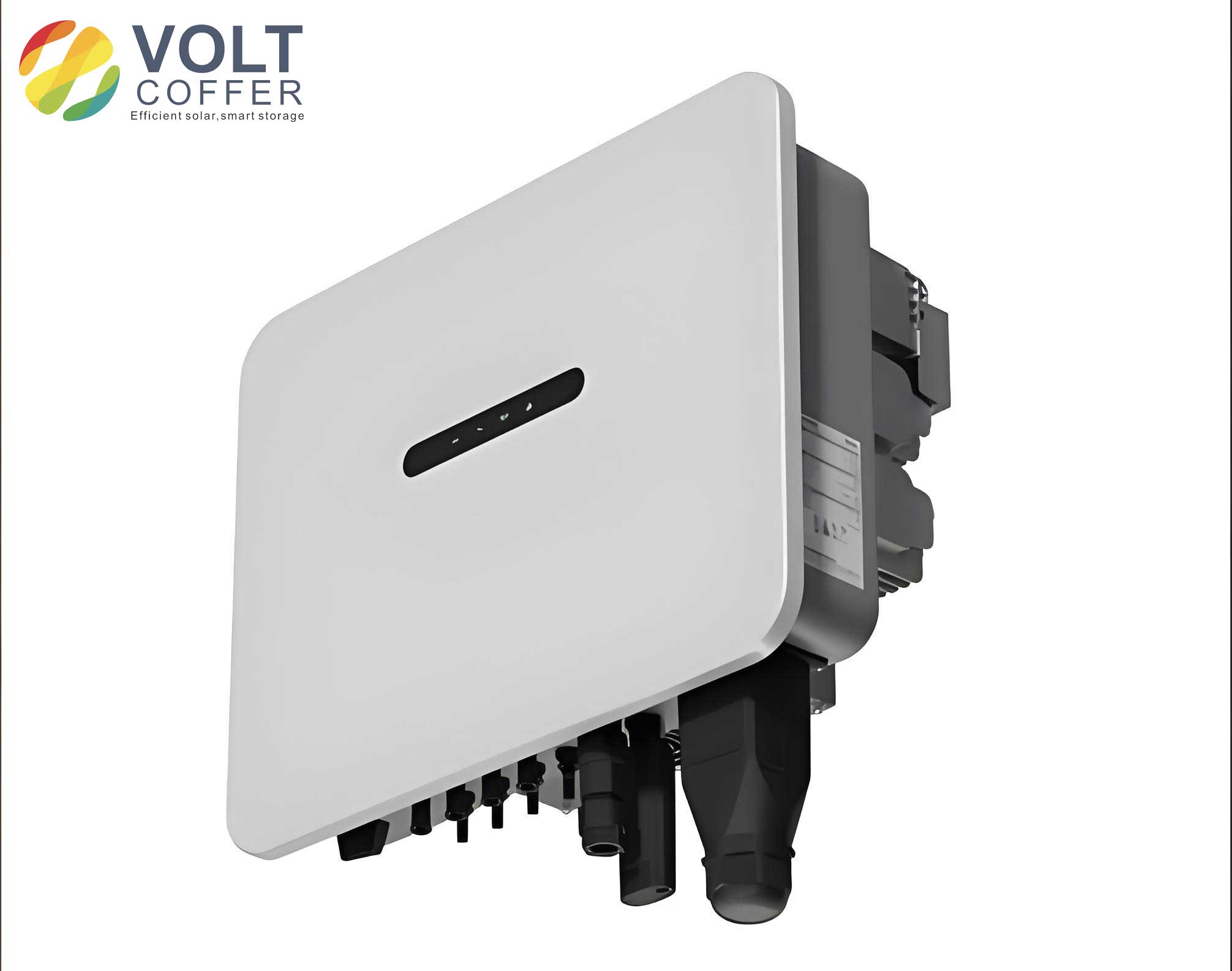
The power circuit of a three-phase LCL-type on grid inverter is depicted below. It typically consists of a DC source (e.g., from a PV array via a DC-DC converter), a three-phase voltage-source inverter (VSI), and an LCL filter connected to the grid.
The state-space equations for one phase (e.g., phase ‘a’) of the LCL filter can be derived using Kirchhoff’s laws. Defining the inverter-side inductor current \( i_{1} \), the capacitor voltage \( u_{c} \), and the grid-side current \( i_{2} \) as state variables, we have:
$$ L_{1} \frac{di_{1a}}{dt} = u_{ia} – u_{ca} $$
$$ C \frac{du_{ca}}{dt} = i_{1a} – i_{2a} $$
$$ L_{2} \frac{di_{2a}}{dt} = u_{ca} – u_{ga} $$
where \( u_{ia} \) is the inverter output voltage, \( u_{ga} \) is the grid voltage, \( L_1 \) and \( L_2 \) are the inverter-side and grid-side inductances, and \( C \) is the filter capacitance. Transforming these equations into the complex frequency (s) domain facilitates control analysis. The open-loop transfer function from the inverter output voltage \( U_i(s) \) to the grid current \( I_2(s) \), ignoring the grid voltage as a disturbance, is:
$$ G_{ol}(s) = \frac{I_2(s)}{U_i(s)} = \frac{1}{L_1 L_2 C s^3 + (L_1 + L_2)s} $$
This transfer function clearly reveals a pair of undamped complex poles at the resonant frequency \( \omega_{res} \), given by:
$$ \omega_{res} = \sqrt{\frac{L_1 + L_2}{L_1 L_2 C}} $$
The Bode plot of \( G_{ol}(s) \) shows a pronounced peak at \( \omega_{res} \), which can lead to instability when enclosed within a feedback loop. A common and effective solution is capacitive current feedback active damping. By feeding back the capacitor current \( i_c \) (where \( i_c = C \frac{du_c}{dt} \)) through a proportional gain \( K_c \), a virtual resistor is placed in parallel with the filter capacitor, damping the resonance. The block diagram of this scheme with a generic current controller \( G_c(s) \) is shown below.
The closed-loop transfer function with capacitive current feedback becomes:
$$ G_{cl}(s) = \frac{I_2(s)}{I_{2ref}(s)} = \frac{K_{PWM} G_c(s)}{L_1 L_2 C s^3 + K_c K_{PWM} L_2 C s^2 + (L_1+L_2)s + K_{PWM}G_c(s)} $$
where \( K_{PWM} \) is the gain of the inverter bridge. Proper selection of \( K_c \) can effectively damp the resonant peak. The remaining design task is to synthesize \( G_c(s) \) to achieve accurate reference tracking and disturbance rejection.
Robust Grid Synchronization: The DSOGI-PLL
Accurate knowledge of the grid voltage’s phase angle \( \theta \) is paramount for the Park transformation used in current control and for achieving unity power factor operation in an on grid inverter. Under ideal grid conditions, a standard SRF-PLL suffices. However, during voltage sags or in the presence of unbalanced faults, the grid voltage contains both positive and negative sequence components. The SRF-PLL, which locks onto the fundamental frequency component, can be significantly disturbed by the negative-sequence component, leading to oscillations in the estimated phase and frequency.
The Second-Order Generalized Integrator (SOGI) is a building block that acts as an adaptive band-pass filter. For an input signal \( u \), the SOGI generates two orthogonal outputs: \( u’ \) (in-phase) and \( qu’ \) (quadrature, 90° lagged). Its transfer functions are:
$$ D(s) = \frac{u'(s)}{u(s)} = \frac{k \omega_g s}{s^2 + k \omega_g s + \omega_g^2} $$
$$ Q(s) = \frac{qu'(s)}{u(s)} = \frac{k \omega_g^2}{s^2 + k \omega_g s + \omega_g^2} $$
where \( \omega_g \) is the grid frequency and \( k \) is a damping factor determining the bandwidth. While a single SOGI can filter harmonics, it cannot separate sequence components.
The Double SOGI (DSOGI) extends this concept for three-phase systems. It processes the \( \alpha\beta \) components of the grid voltage (\( u_\alpha, u_\beta \)) through two independent SOGIs. The four resulting signals (\( u’_\alpha, qu’_\alpha, u’_\beta, qu’_\beta \)) are then used to compute the positive-sequence (\( u_{\alpha\beta}^+ \)) and negative-sequence (\( u_{\alpha\beta}^- \)) components in the stationary frame using the following relationship:
$$ \begin{bmatrix} u_\alpha^+ \\ u_\beta^+ \end{bmatrix} = \frac{1}{2} \begin{bmatrix} 1 & -q \\ q & 1 \end{bmatrix} \begin{bmatrix} u_\alpha \\ u_\beta \end{bmatrix} = \frac{1}{2} \begin{bmatrix} u_\alpha’ – qu_\beta’ \\ qu_\alpha’ + u_\beta’ \end{bmatrix} $$
The extracted positive-sequence component \( u_{\alpha\beta}^+ \) is then fed into a standard Park transform and PI-based frequency/phase estimator, forming the DSOGI-PLL. This structure effectively filters out the negative-sequence component and harmonics before the PLL, ensuring a clean, oscillation-free estimate of the grid phase angle \( \theta \) even during imbalances. This robust synchronization is crucial for the stable operation of the on grid inverter under real-world grid conditions.
Advanced Current Control: AQPR-HC Strategy
With accurate synchronization provided by the DSOGI-PLL, the next challenge is precise current control. The industry-standard PI controller in the dq-frame performs well for DC setpoints but requires multiple decoupling terms and is inherently poor at tracking sinusoidal signals or rejecting harmonic disturbances without high gains, which compromise stability.
Proportional-Resonant (PR) controllers, implemented directly in the stationary (αβ) frame, offer an elegant solution. An ideal PR controller has an infinite gain at a specific resonant frequency \( \omega_0 \), enabling zero steady-state error for sinusoidal signals at that frequency. Its transfer function is:
$$ G_{PR}(s) = K_p + \frac{2K_r s}{s^2 + \omega_0^2} $$
However, an ideal resonator is sensitive to frequency variations. A slight deviation between the controller’s \( \omega_0 \) and the actual grid frequency \( \omega_g \) drastically reduces its gain. The Quasi-Proportional-Resonant (QPR) controller addresses this by introducing a bandwidth term \( \omega_c \):
$$ G_{QPR}(s) = K_p + \frac{2K_r \omega_c s}{s^2 + 2\omega_c s + \omega_0^2} $$
The term \( \omega_c \) widens the resonant peak, providing high gain over a frequency range \( [\omega_0 – \omega_c, \omega_0 + \omega_c] \). This makes the controller robust against small grid frequency drifts, a critical feature for a practical on grid inverter. The Bode plot of a QPR controller shows a significantly wider high-gain region compared to the ideal PR.
To specifically suppress dominant low-order harmonics (e.g., 3rd, 5th, 7th) in the on grid inverter output current—which may originate from grid background distortion or nonlinearities—we propose paralleling the fundamental QPR compensator with multiple Harmonic Compensators (HC). Each HC is a resonant controller tuned to the harmonic frequency of interest. The complete Adaptive QPR with Harmonic Compensation (AQPR-HC) controller’s transfer function is:
$$ G_{AQPR-HC}(s) = K_p + \frac{2K_{r1} \omega_c s}{s^2 + 2\omega_c s + \omega_0^2} + \sum_{h=3,5,7,…} \frac{2K_{rh} \omega_c s}{s^2 + 2\omega_c s + (h\omega_0)^2} $$
Here, \( K_{r1} \) is the resonant gain for the fundamental, and \( K_{rh} \) is the gain for the h-th harmonic. This structure allows the on grid inverter controller to simultaneously track the fundamental current reference with zero error and actively damp specific harmonic currents. The “adaptive” aspect can be realized by updating \( \omega_0 \) in real-time with the frequency estimated by the DSOGI-PLL, ensuring the resonant peaks always align with the actual grid fundamental and harmonic frequencies.
The final control architecture for the on grid inverter is as follows: Grid voltages are measured and processed by the DSOGI-PLL to obtain the phase angle \( \theta \) and sequence components. The power control block (e.g., based on active/reactive power commands \( P_{ref}, Q_{ref} \)) generates current references in the dq-frame (\( i_{dref}, i_{qref} \)). These are transformed to the stationary αβ-frame (\( i_{\alpha ref}, i_{\beta ref} \)). The AQPR-HC controllers process the error between these references and the measured grid currents \( i_{2\alpha}, i_{2\beta} \). The capacitive currents \( i_{c\alpha}, i_{c\beta} \) are fed back with gain \( K_c \) for active damping. The resulting control signals are transformed to the abc frame and used to generate PWM signals for the inverter switches.
Simulation Analysis and Performance Validation
To validate the proposed control strategy for the LCL on grid inverter, a detailed simulation model was built. The key system parameters are summarized in Table 1.
| Parameter | Symbol | Value | Unit |
|---|---|---|---|
| DC Link Voltage | \( U_{dc} \) | 700 | V |
| Inverter-side Inductance | \( L_1 \) | 1.9 | mH |
| Grid-side Inductance | \( L_2 \) | 0.76 | mH |
| Filter Capacitance | \( C \) | 5 | µF |
| Grid Voltage (phase) | \( U_g \) | 220 | V (RMS) |
| Grid Frequency | \( f_0 \) | 50 | Hz |
| Switching Frequency | \( f_{sw} \) | 10 | kHz |
| Proportional Gain | \( K_p \) | 0.5 | – |
| Fundamental Resonant Gain | \( K_{r1} \) | 50 | – |
| Harmonic Resonant Gains | \( K_{r3}, K_{r5}, K_{r7} \) | 15, 10, 6 | – |
| Resonator Bandwidth | \( \omega_c \) | 6 | rad/s |
| Cap. Current Feedback Gain | \( K_c \) | 0.15 | – |
Steady-State Performance
Under nominal grid conditions (balanced 50 Hz, 220 V), the on grid inverter with the proposed AQPR-HC and DSOGI-PLL control operates stably. The grid current perfectly tracks its sinusoidal reference and is in phase with the grid voltage, demonstrating unity power factor operation. The active and reactive power outputs quickly settle to their commanded values (\( P_{ref} = 10 kW, Q_{ref} = 0 \)) with minimal transient.
To evaluate harmonic suppression, the Total Harmonic Distortion (THD) of the grid current was analyzed and compared against a traditional PI-based control in the dq-frame. The results are summarized in Table 2.
| Control Strategy | Fundamental Current (A) | THD | Notable Harmonic Reduction |
|---|---|---|---|
| PI Control (dq-frame) | 18.14 | 3.26% | – |
| Proposed AQPR-HC Control | 36.28 | 0.97% | 3rd, 7th harmonics significantly reduced. |
The AQPR-HC controller reduces the current THD by approximately 70%, showcasing its superior harmonic suppression capability for the on grid inverter.
Dynamic Performance and Robustness
The dynamic resilience of the on grid inverter control was tested under various disturbances:
1. Grid Voltage Sag: At t=0.2s, a 20% voltage dip was applied. The DSOGI-PLL maintained stable synchronization. The current controller increased the current magnitude to maintain constant active power injection, as expected, with a smooth and stable transient.
2. Grid Frequency Step: The grid frequency was stepped from 50 Hz to 55 Hz at t=0.2s. The adaptive nature of the controllers (both PLL and AQPR-HC) allowed the system to re-synchronize and maintain regulated sinusoidal current output within a few cycles.
3. Load Step Change: The power reference was stepped from 5 kW (half load) to 10 kW (full load). The on grid inverter current increased proportionally with a fast dynamic response and no overshoot or instability, demonstrating excellent command tracking.
Performance Under Distorted Grid Conditions
A severe test involves operating the on grid inverter when the grid voltage itself is distorted. In the simulation, the grid voltage was polluted with 10% 3rd-order negative-sequence and 5% 5th-order positive-sequence harmonics. The proposed strategy’s performance was again compared with PI control.
| Control Strategy | Fundamental Current (A) | THD under Distortion |
|---|---|---|
| PI Control (dq-frame) | 37.34 | 5.25% |
| Proposed AQPR-HC Control | 38.68 | 2.42% |
Even when the grid voltage is highly distorted, the AQPR-HC controller in the on grid inverter effectively suppresses the propagation of grid voltage harmonics into the output current, maintaining a THD well below typical grid code limits (e.g., 5%), whereas the PI controller fails to do so.
Conclusion
This article has presented a robust and high-performance control strategy for three-phase LCL-type on grid inverter systems. The integration of a DSOGI-PLL solves the critical grid synchronization problem under unbalanced voltages, providing a clean and accurate phase angle for control transformations. The novel AQPR-HC current controller, implemented within a capacitive current feedback active damping scheme, fundamentally enhances the on grid inverter‘s capability. It achieves zero steady-state error for the fundamental current, provides inherent robustness against grid frequency variations, and actively suppresses dominant low-order harmonics.
Simulation results under a wide range of conditions—steady-state, dynamic transients (voltage sag, frequency shift, load change), and operation with a severely distorted grid—consistently demonstrate the superiority of the proposed method. Key outcomes include a significant reduction in grid current THD (below 1% under ideal grid and ~2.4% under heavily distorted grid), stable operation during imbalances, and excellent dynamic response. This combination of features makes the proposed strategy a compelling solution for ensuring the high power quality and reliable grid integration required of modern on grid inverter in renewable energy applications.