
In the context of increasing integration of renewable energy sources, photovoltaic on-grid inverters play a pivotal role in converting DC power from solar panels to AC power synchronized with the grid. However, practical operation often encounters three-phase voltage imbalance, which adversely affects the performance and stability of on-grid inverters. This imbalance leads to distorted output waveforms, reduced power quality, and potential overloading of power electronic components. To address these challenges, I design an automated control method for steady-state error in photovoltaic on-grid inverters, specifically considering three-phase voltage imbalance. The method focuses on minimizing output voltage and current errors through a systematic approach involving data processing, steady-state function construction, controller design, and strategy implementation. This article presents the methodology in detail, supported by mathematical formulations, tables, and experimental validation, aiming to enhance the robustness and accuracy of on-grid inverter control under unbalanced conditions.
The foundation of the method lies in constructing a steady-state function for the on-grid inverter that incorporates three-phase voltage imbalance. Data acquisition systems are employed to collect operational data from the inverter, such as voltage and current measurements. To ensure reliability, the raw data is smoothed using a processing technique. Let the observed operational parameter be denoted by $$ \xi $$, and a random parameter by $$ \psi $$. The actual value after smoothing is given by:
$$ \xi_1 = \psi \times \xi $$
A weighted function $$ E(p) $$ is defined for data points, where $$ p $$ is the independent variable:
$$ E(p) = \begin{cases} \frac{(1-p)^3}{3}, & p < 1 \\ 0, & \text{else} \end{cases} $$
The smoothing curve $$ s $$ is expressed as a function of the data fitting parameters $$ t $$, $$ k $$, and $$ \lambda $$, and the data point $$ r $$:
$$ s = t + k r + \lambda r^2 $$
This preprocessing step reduces noise and enhances the accuracy of subsequent analyses. With smoothed data, the steady-state function for the on-grid inverter is developed. Three-phase voltage imbalance is quantified by the imbalance degree $$ k $$, calculated from the phase voltages $$ U_a $$, $$ U_b $$, and $$ U_c $$:
$$ k = \frac{|U_a – U_b| + |U_b – U_c| + |U_c – U_a|}{3|U_a|} $$
This metric captures the deviation from ideal balanced conditions. The steady-state function $$ M $$ for the on-grid inverter is then formulated as a sum involving the imbalance degree and the three-phase currents $$ I_i $$ (for $$ i = 1,2,3 $$), normalized by the output current $$ I_1 $$:
$$ M = \sum_{i=1}^{3} \frac{k I_i^2}{I_1} $$
This function encapsulates the dynamic behavior of the on-grid inverter under unbalanced voltages, serving as a basis for error control. The control objectives are explicitly defined: minimize the steady-state error of output voltage (i.e., the difference between actual and reference voltage) and minimize the steady-state error of output current (i.e., the difference between actual and reference current). These targets guide the design of the automated controller for the on-grid inverter.
To achieve the control objectives, I design an automated controller for steady-state error in the on-grid inverter. The controller structure integrates input variables, control parameters, and feedback mechanisms to regulate the steady-state function. Key control parameters are computed based on feature and deviation quantities. Let $$ \beta_{i|j} $$ and $$ \beta_{j|i} $$ represent control aspects for different input variables $$ x_i $$ and $$ x_j $$, with $$ n $$ as the number of input variables. The feature quantity $$ \beta_{ij} $$ is derived as:
$$ \beta_{ij} = \frac{\beta_{i|j} + \beta_{j|i}}{2n} $$
where $$ \beta_{i|j} $$ is expressed using a Gaussian kernel with variance $$ \sigma_i $$:
$$ \beta_{i|j} = \frac{\exp\left(-\frac{\|x_i – x_j\|^2}{2\sigma_i^2}\right)}{\sum_{k \neq i} \exp\left(-\frac{\|x_i – x_k\|^2}{2\sigma_i^2}\right)} $$
The deviation quantity $$ \eta_{ij} $$ is calculated from variables $$ y_i $$ and $$ y_j $$:
$$ \eta_{ij} = \frac{(1 + y_i – y_j^2)^{-1}}{\sum_{k \neq i} (1 + y_k – y_j^2)^{-1}} $$
Using these, the control parameter $$ z $$ is obtained as:
$$ z = \sum_{i} \sum_{j} \beta_{ij} \log\left(\frac{\beta_{ij}}{\eta_{ij}}\right) $$
This parameter optimizes the controller’s response. The controller operates through optimization, prediction, and feedback stages. For prediction, the output at future times is estimated. Let $$ w $$ be the current output value, $$ y_0 $$ the input variable value, $$ s $$ a random constant, and $$ h $$ the time to the next instant. The prediction result $$ G $$ is:
$$ G = \frac{[z \cdot (w \cdot s + h) – y_0 \cdot (s + h)]^2}{2} $$
Feedback mechanisms then correct errors based on this prediction. The complete automated controller $$ H $$ for the on-grid inverter steady-state error is defined as:
$$ H = G + \frac{2\lambda_1 \beta_{ij} \eta_{ij}}{z^2 + 2\lambda_2 z + h_1^2} $$
with $$ h_1 $$ given by:
$$ h_1 = G + \frac{\lambda_3 z}{z + h_2} $$
Here, $$ \lambda_1 $$, $$ \lambda_2 $$, and $$ \lambda_3 $$ are weighting parameters that adjust based on operational conditions, and $$ h_2 $$ is the transfer function of input variables. This controller dynamically adjusts control parameters to minimize steady-state errors in the on-grid inverter, ensuring robust performance under three-phase voltage imbalance.
The control strategy is implemented through an algorithm that generates control signals. Let $$ u(t) $$ denote the control signal at time $$ t $$, and $$ e(t) $$ the current error value. The cumulative error is $$ \sum e(t) $$. The control algorithm incorporates proportional, integral, and derivative terms with weights $$ k_1 $$, $$ k_2 $$, and $$ k_3 $$:
$$ u(t) = k_1 \cdot e(t) + k_2 \cdot \sum e(t) + k_3 \cdot \frac{de(t)}{dt} $$
This algorithm outputs control actions to regulate the on-grid inverter. If the control outcome meets predefined standards, the process terminates; otherwise, parameters are recalibrated for iterative improvement. The integration of this algorithm with the controller enables fully automated steady-state error control for on-grid inverters, adapting to real-time changes in voltage imbalance.
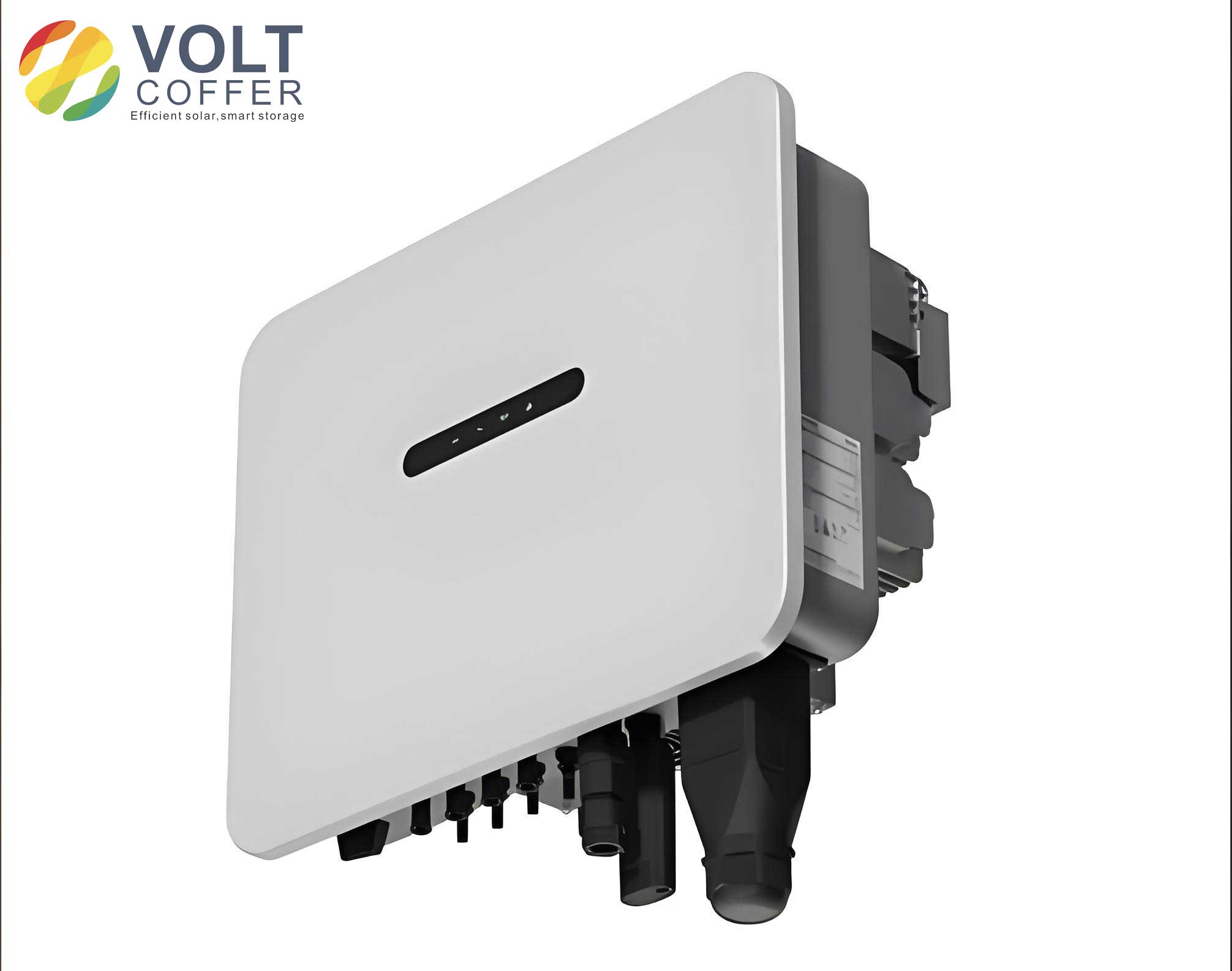
To validate the method, experimental tests were conducted in a controlled laboratory environment. The setup included a photovoltaic on-grid inverter, a data acquisition system, a three-phase voltage imbalance generator, controllers, oscilloscopes, and power sources. Key parameters were configured as shown in Table 1, ensuring consistency across trials. The on-grid inverter was operated under various imbalance conditions, and data was collected for analysis.
| Parameter | Value |
|---|---|
| Rated Power of On-Grid Inverter | 1000 W |
| Rated Voltage of On-Grid Inverter | 22 V |
| Rated Current of On-Grid Inverter | 42.3 A |
| Rated Voltage of Imbalance Generator | 22 V |
| Rated Current of Imbalance Generator | 42.3 A |
| Three-Phase Imbalance Ratio | 1:1:1 |
| Imbalance Phase Difference | 90 degrees between phases |
| Output Frequency of Imbalance Generator | 50 Hz |
| Controller Sampling Frequency | 15 kHz |
| Weight Parameter in Control Algorithm | 0.5 |
| Integral Parameter in Control Algorithm | 0.01 |
| Derivative Parameter in Control Algorithm | 0.001 |
Data smoothing was applied to voltage and current measurements, as illustrated in Figure 4 (refer to the image link for visual representation). The processed data revealed fluctuations in voltage and more stable current patterns, highlighting the need for effective control in the on-grid inverter. The proposed method (denoted as Method 1) was compared against two existing approaches: an adaptive feedback-based control method (Method 2) and a cross-layer design with filtering technique (Method 3). Initial steady-state errors were recorded for multiple on-grid inverter units, followed by application of the control methods. Results are summarized in Table 2, showing the reduction in steady-state error after control.
| On-Grid Inverter ID | Initial Steady-State Error (V) | Steady-State Error After Control (V) – Method 1 | Steady-State Error After Control (V) – Method 2 | Steady-State Error After Control (V) – Method 3 |
|---|---|---|---|---|
| #01 | 0.42 | 0.12 | 0.31 | 0.38 |
| #02 | 0.43 | 0.13 | 0.32 | 0.39 |
| #03 | 0.45 | 0.14 | 0.28 | 0.38 |
| #04 | 0.44 | 0.14 | 0.31 | 0.39 |
| #05 | 0.51 | 0.13 | 0.33 | 0.37 |
| #06 | 0.48 | 0.12 | 0.34 | 0.39 |
| #07 | 0.48 | 0.13 | 0.35 | 0.36 |
| #08 | 0.47 | 0.12 | 0.36 | 0.38 |
| #09 | 0.46 | 0.11 | 0.32 | 0.39 |
| #10 | 0.42 | 0.12 | 0.31 | 0.38 |
Method 1 consistently achieved lower steady-state errors compared to Methods 2 and 3, demonstrating superior control performance for the on-grid inverter. For instance, in on-grid inverter #01, the error reduced from 0.42 V to 0.12 V with Method 1, whereas Method 2 reduced it to 0.31 V and Method 3 to 0.38 V. This trend holds across all units, indicating the effectiveness of the proposed automated control in minimizing errors under three-phase voltage imbalance.
Robustness was evaluated by varying the three-phase voltage imbalance degree using the imbalance generator. The robustness metric, defined as the ability to maintain low error despite imbalance changes, was recorded for each method. Results are plotted in Figure 5 (refer to the image link for visual representation). Method 1 showed minimal fluctuations and a steady increase in robustness, while Methods 2 and 3 exhibited significant volatility and lower overall robustness. This underscores the reliability of the proposed method for on-grid inverters in dynamic environments.
The mathematical formulations further support these findings. For example, the steady-state function $$ M $$ directly incorporates imbalance degree $$ k $$, enabling the controller to adapt to unbalanced conditions. The control parameter $$ z $$, derived from feature and deviation quantities, optimizes responses through the algorithm $$ u(t) $$. Consider a scenario where the on-grid inverter faces a sudden imbalance: the controller quickly adjusts $$ \lambda_1 $$, $$ \lambda_2 $$, and $$ \lambda_3 $$ to recalibrate $$ H $$, thereby reducing errors. This adaptability is crucial for real-world applications where grid conditions are unpredictable.
Additional analyses involve sensitivity studies of the on-grid inverter to parameter variations. Using the steady-state function, I computed the partial derivatives with respect to key variables. For instance, the sensitivity of $$ M $$ to changes in phase voltage $$ U_a $$ is:
$$ \frac{\partial M}{\partial U_a} = \sum_{i=1}^{3} \frac{I_i^2}{I_1} \cdot \frac{\partial k}{\partial U_a} $$
where $$ \frac{\partial k}{\partial U_a} $$ is derived from the imbalance degree formula. This analysis helps in fine-tuning the controller for specific on-grid inverter models. Moreover, the control algorithm’s integral term $$ k_2 \cdot \sum e(t) $$ ensures that historical errors are accounted for, enhancing long-term stability in the on-grid inverter operation.
In practice, the automated control method can be implemented in digital signal processors (DSPs) or field-programmable gate arrays (FPGAs) for real-time operation in on-grid inverters. The computational load is manageable, as the formulas involve basic arithmetic and logarithmic functions. For example, the control parameter $$ z $$ requires summation over input variables, which scales linearly with system size. This efficiency makes the method suitable for large-scale deployments of on-grid inverters in solar farms or distributed generation systems.
Future work could explore integration with machine learning techniques to predict imbalance patterns and pre-adjust control parameters. Also, extending the method to multi-objective optimization, such as simultaneously minimizing harmonic distortion and steady-state error in on-grid inverters, would be beneficial. The proposed framework provides a foundation for these advancements, emphasizing the importance of considering three-phase voltage imbalance in on-grid inverter design.
In conclusion, I have presented an automated control method for steady-state error in photovoltaic on-grid inverters that explicitly addresses three-phase voltage imbalance. By constructing a steady-state function, designing a robust controller, and implementing a dynamic control algorithm, the method effectively reduces output voltage and current errors. Experimental tests confirm its superiority over existing approaches in terms of error reduction and robustness. This work contributes to enhancing the reliability and performance of on-grid inverters in renewable energy systems, paving the way for more resilient power grids. The methodologies outlined here, including mathematical models and empirical validations, offer valuable insights for researchers and engineers working on on-grid inverter technologies.