
The integration of distributed renewable energy sources, particularly photovoltaic (PV) systems, into the utility grid has become a cornerstone of the modern energy transition. The core device enabling this integration is the grid tied inverter, which must perform the critical task of converting the DC power from solar panels into high-quality AC power that is perfectly synchronized with the grid’s voltage in frequency, phase, and amplitude. Achieving this synchronization is paramount for stable grid operation, high power quality, and safety. The technology responsible for this precise synchronization is the Phase-Locked Loop (PLL). This article explores the limitations of conventional single-phase PLLs and presents a detailed analysis of an optimized strategy based on a Second-Order Generalized Integrator (SOGI) for superior performance in grid tied inverter applications.
The fundamental objective of a PLL in a grid tied inverter is to accurately and rapidly track the phase angle ($\theta_g$) of the utility voltage ($v_g$). This estimated angle ($\hat{\theta}$) is then used to generate the current reference for the inverter’s control system, ensuring the output current is injected in phase with the grid voltage. In three-phase systems, the natural $120^\circ$ phase shift between voltages provides inherent information for constructing a rotating reference frame. However, for single-phase systems, which are prevalent in residential and smaller commercial PV installations, the challenge is more complex as there is only one voltage signal available.
The conventional method for single-phase PLLs involves creating an artificial two-phase stationary ($\alpha\beta$) system from the single measured voltage, $v_\alpha$. This is typically done by introducing a quarter-cycle ($T/4$) delay to generate the orthogonal component, $v_\beta$.
$$ v_\alpha(t) = V_m \cos(\omega_g t + \phi) $$
$$ v_\beta(t) = v_\alpha(t – T/4) = V_m \cos(\omega_g t + \phi – \pi/2) = V_m \sin(\omega_g t + \phi) $$
These components are then transformed into a synchronous rotating ($dq$) frame using the Park transformation matrix, where the rotation angle is the PLL’s estimated angle $\hat{\theta} = \widehat{\omega_g} t$.
$$
\begin{bmatrix}
v_d \\
v_q
\end{bmatrix}
=
\begin{bmatrix}
\cos\hat{\theta} & \sin\hat{\theta} \\
-\sin\hat{\theta} & \cos\hat{\theta}
\end{bmatrix}
\begin{bmatrix}
v_\alpha \\
v_\beta
\end{bmatrix}
$$
When the PLL is perfectly locked ($\hat{\theta} = \omega_g t + \phi$), the $q$-axis component $v_q$ becomes zero. Therefore, the control objective is to drive $v_q$ to zero using a Proportional-Integral (PI) regulator. The output of the PI controller corrects the estimated frequency, which is then integrated to obtain the phase angle. The block diagram of this conventional structure is summarized below.
| Component | Function | Mathematical Expression/Description |
|---|---|---|
| Orthogonal Signal Generation (OSG) | Creates $v_\beta$ from $v_\alpha$ | $v_\beta(s) = e^{-sT/4} \cdot v_\alpha(s)$ |
| Park Transform | Converts $\alpha\beta$ to $dq$ frame | $v_q = -v_\alpha \sin\hat{\theta} + v_\beta \cos\hat{\theta}$ |
| PI Controller & Integrator | Drives $v_q$ to zero, estimates phase | $\widehat{\omega_g} = 2\pi f_0 + (K_p + \frac{K_i}{s}) \cdot v_q$, $\quad \hat{\theta} = \frac{1}{s} \widehat{\omega_g}$ |
The primary weakness of this method lies in the OSG stage. The fixed $T/4$ time delay is only exact at the nominal grid frequency (e.g., 50 Hz or 60 Hz). During grid frequency deviations or transients, this delay no longer corresponds to a perfect $90^\circ$ phase shift, leading to a steady-state phase error in the locked signal. Furthermore, the delay inherently slows down the dynamic response of the PLL, as any change in $v_\alpha$ is reflected in $v_\beta$ only after a 5 ms delay (for 50 Hz). This can degrade the performance of the overall grid tied inverter control during grid disturbances.
To overcome these limitations, the Second-Order Generalized Integrator (SOGI) presents an elegant solution. The SOGI is an adaptive filter that can generate two orthogonal signals ($v’_{\alpha}$ and $v’_{\beta}$) from a single input $v_{\alpha}$ without any inherent time delay. Its structure is based on an internal resonance at a tunable frequency $\omega’$. The standard SOGI topology, often called the SOGI Quadrature Signal Generator (SOGI-QSG), is governed by the following transfer functions, where $k$ is a damping factor that determines the bandwidth:
$$ D(s) = \frac{v’_{\alpha}(s)}{v_{\alpha}(s)} = \frac{k \omega’ s}{s^2 + k \omega’ s + \omega’^2} $$
$$ Q(s) = \frac{v’_{\beta}(s)}{v_{\alpha}(s)} = \frac{k \omega’^2}{s^2 + k \omega’ s + \omega’^2} $$
$D(s)$ acts as a band-pass filter centered at $\omega’$, providing the in-phase component. Crucially, $Q(s)$ provides the quadrature component ($-90^\circ$ shifted) without a time delay; its phase response is exactly $-90^\circ$ at the resonant frequency $\omega’$ regardless of the value of $k$. The key innovation in a SOGI-PLL is to use the PLL’s own estimated frequency $\hat{\omega}$ as the resonant frequency $\omega’$ for the SOGI block. This creates an adaptive, frequency-feedback loop. The block diagram of the SOGI-PLL illustrates this integration.
The estimated frequency $\hat{\omega}$ from the PI controller is fed back to the SOGI, adjusting its resonant point in real-time. When locked, $\hat{\omega} = \omega_g$, and the SOGI perfectly generates the orthogonal signals at the actual grid frequency, eliminating the error caused by a fixed delay. The dynamic response is significantly faster because the orthogonal signal $v’_{\beta}$ is generated almost instantaneously through the filter’s internal feedback, not by waiting for a time delay. This structure offers superior noise filtering and harmonic rejection due to the SOGI’s band-pass characteristic, which is highly beneficial for a grid tied inverter operating in a potentially distorted grid environment.
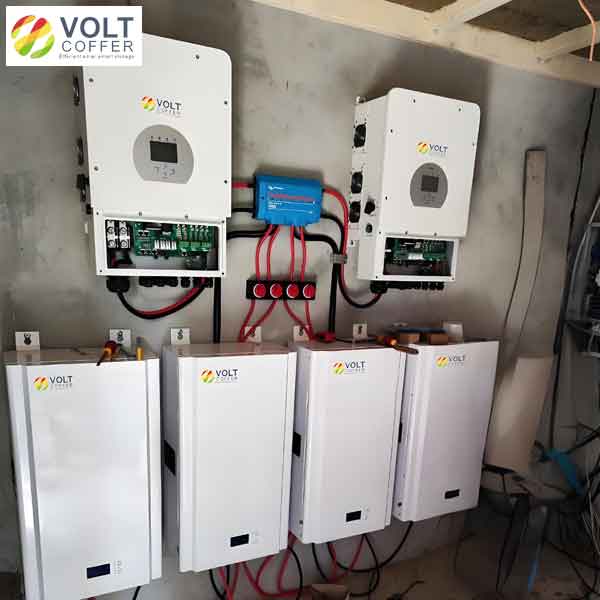
The practical implementation of this advanced PLL technology is embedded within modern grid tied inverter systems, including advanced hybrid models. The core controller, typically a high-performance Digital Signal Processor (DSP), executes the SOGI-PLL algorithm in real-time. The fast and accurate phase angle it provides is critical for the current control loop, which governs the insulated-gate bipolar transistors (IGBTs) or silicon carbide MOSFETs in the inverter’s power stage. This ensures the generated AC waveform is a clean sine wave locked to the grid. The DC link, often connected to a PV array and/or a battery system via DC-DC converters, provides the power source. The entire operation underscores how a robust synchronization strategy like the SOGI-PLL is vital for the efficient, stable, and compliant operation of any grid tied inverter.
To quantitatively compare the performance of the conventional delayed PLL and the SOGI-PLL, we can analyze key metrics relevant to a grid tied inverter.
| Performance Metric | Conventional Delay-Based PLL | SOGI-Based PLL | Implication for Grid Tied Inverter |
|---|---|---|---|
| Orthogonal Generation | Fixed $T/4$ time delay ($e^{-sT/4}$) | Adaptive filter, no delay (Transfer functions $D(s)$, $Q(s)$) | SOGI-PLL is immune to phase errors caused by grid frequency deviations. |
| Dynamic Response | Slowed by the inherent delay. Settling time typically > 1-2 grid cycles. | Very fast. Settling time can be within a fraction of a cycle, adjustable via $k$. | Faster response to grid phase jumps or faults, improving transient stability of the inverter. |
| Harmonic Rejection | Limited. The delay does not filter harmonics. | Good. The SOGI’s band-pass characteristic ($D(s)$) attenuates frequency components far from $\omega’$. | Better performance in distorted grid conditions, leading to cleaner synchronization signals and lower harmonic current injection. |
| Frequency Adaptability | Poor. Performance degrades if grid frequency shifts from nominal. | Excellent. The feedback of $\hat{\omega}$ makes it inherently adaptive to frequency variations. | Essential for operation in weak grids or microgrids where frequency can fluctuate. |
| Implementation Complexity | Low. Simple delay buffer and transforms. | Moderate. Requires implementation of second-order transfer functions and frequency feedback. | Easily handled by modern DSPs. The performance benefit far outweighs the slight increase in code complexity. |
The mathematical superiority of the SOGI-PLL can be further analyzed through its linearized model near lock-in. Assuming small phase errors ($\Delta \theta = \theta_g – \hat{\theta}$), the $q$-axis voltage can be approximated as $v_q \approx V_m \Delta \theta$, where $V_m$ is the grid voltage amplitude. In the SOGI-PLL, the relationship is filtered by the SOGI dynamics. The closed-loop transfer function from the actual phase $\theta_g$ to the estimated phase $\hat{\theta}$ can be derived, revealing a characteristic equation whose roots determine the stability and response speed. By properly selecting the PI gains ($K_p$, $K_i$) and the SOGI damping factor $k$, one can place the poles for optimal performance—achieving a critically damped or slightly underdamped response for the grid tied inverter‘s synchronization loop. The tuning often follows guidelines to ensure a balance between speed and filtering, for example, setting $k = \sqrt{2}$ for a balance between stability margin and harmonic rejection.
Simulation and experimental results consistently demonstrate the advantages. Under a phase jump condition (e.g., a $30^\circ$ sudden shift in grid voltage), the conventional PLL exhibits a slow, oscillatory recovery taking multiple cycles to re-synchronize due to its delayed feedback path. In contrast, the SOGI-PLL settles to the new phase within one cycle. Similarly, during a frequency ramp, the conventional PLL shows a persistent phase tracking error, while the SOGI-PLL tracks the phase accurately with minimal error. For a grid tied inverter, this means the inverter remains compliant with grid codes requiring rapid re-synchronization after brief grid disturbances and maintains high-quality power injection even during frequency transients.
In conclusion, the synchronization mechanism is a critical subsystem within any grid tied inverter. The traditional method of generating an orthogonal signal via a quarter-cycle delay presents fundamental limitations in dynamic response and frequency adaptability. The integration of a Second-Order Generalized Integrator into the PLL structure offers a sophisticated and highly effective solution. By providing delay-less, adaptive, and filtered orthogonal signals, the SOGI-PLL enables faster, more accurate, and more robust phase locking. This optimization directly translates to improved performance of the grid tied inverter, including enhanced stability during grid transients, better power quality under distorted grid conditions, and reliable operation across a wider range of grid frequencies. As grid requirements become more stringent and penetration of inverter-based resources increases, advanced synchronization techniques like the SOGI-PLL will remain essential for the secure and efficient integration of renewable energy.