
In modern power systems, the widespread adoption of microgrid technology has elevated the role of shared energy storage, making grid-connected inverters a critical interface between storage units and the grid. As a researcher focused on power system stability, I have observed that constant-power energy storage grid-connected inverters exhibit typical nonlinear characteristics, which pose significant challenges under large disturbances. Traditional small-signal stability analysis methods often overlook these nonlinearities, leading to inaccurate stability margins and potential system instability in extreme conditions. Therefore, to ensure that systems can return to stable operation after major perturbations, it is essential to conduct large-signal stability analysis for energy storage grid-connected inverters. In this article, I propose a nonlinear stability analysis approach based on mixed potential function theory and develop a stabilization control strategy derived from a large-signal model. My work involves detailed mathematical modeling, parameter optimization, and validation through simulations and experiments, all aimed at enhancing the dynamic performance and stability domain of grid-connected inverter systems.
The core of my research lies in addressing the nonlinearities inherent in constant-power operation of grid-connected inverters. These devices, when integrated into microgrids, often face large transient disturbances due to their low electrical inertia and nonlinear dynamics. By leveraging mixed potential function theory, I establish a framework for large-signal stability analysis, which provides a more accurate depiction of system behavior compared to linearized methods. This article is structured as follows: I first develop a nonlinear model of the grid-connected inverter, then apply mixed potential functions to derive stability criteria, followed by parameter design and optimization. Finally, I present simulation and experimental results to validate the proposed approach. Throughout, I emphasize the importance of the grid-connected inverter in maintaining system stability, and I incorporate multiple formulas and tables to summarize key findings.
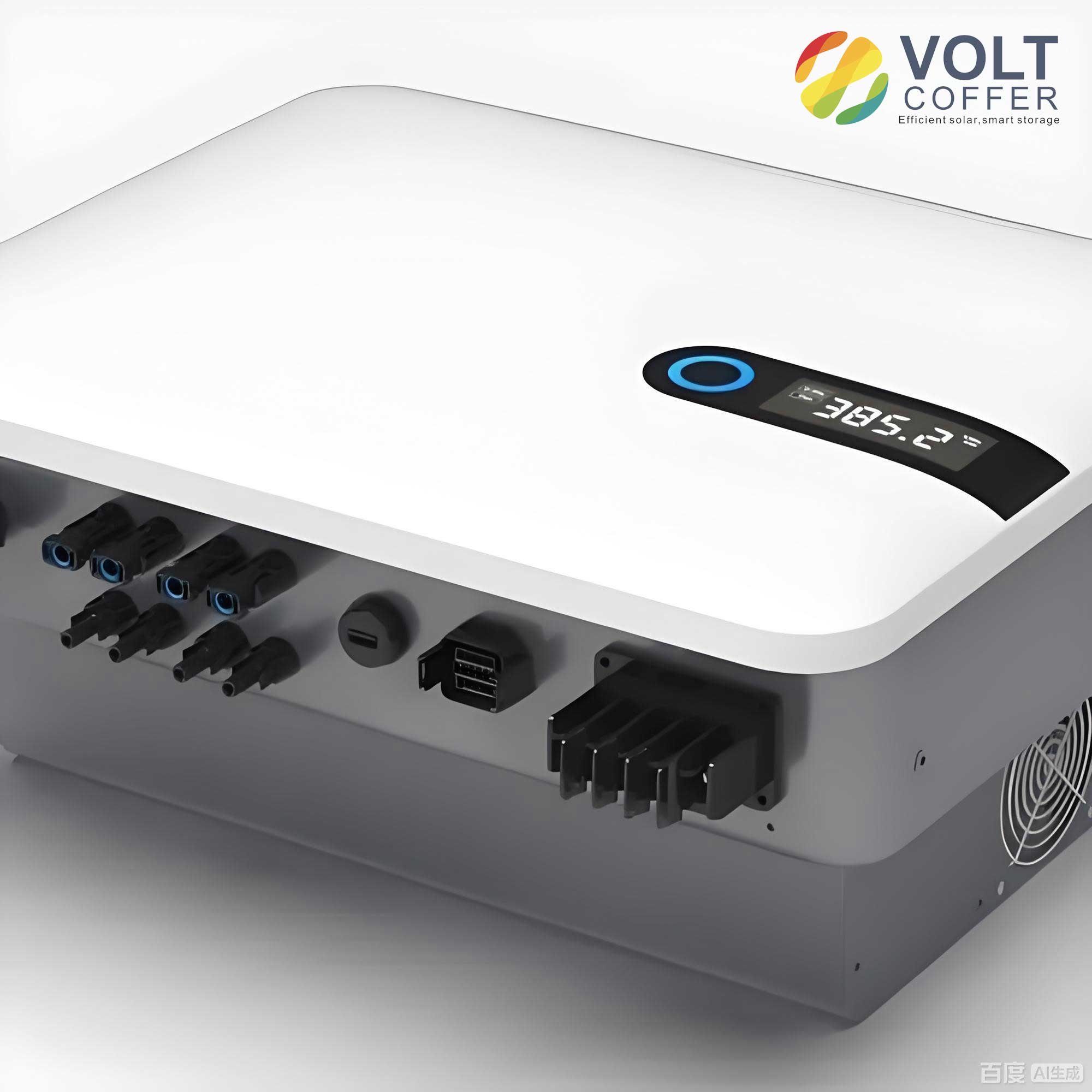
Nonlinear Model Establishment for Grid-Connected Inverter
To analyze the large-signal stability of an energy storage grid-connected inverter, I begin by establishing a comprehensive nonlinear model. The topology considered includes a three-phase inverter connected to the grid via filter inductors, operating under constant-power control. The grid-connected inverter utilizes a dual-loop control strategy, with an outer power loop and an inner current loop, both employing PI controllers. This structure is common in modern energy storage systems, but its nonlinearities must be explicitly accounted for.
The circuit equations for the grid-connected inverter are derived from the equivalent per-phase model. Let \( u_a \), \( u_b \), and \( u_c \) represent the grid voltages, and \( i_a \), \( i_b \), and \( i_c \) denote the currents flowing into the grid. The DC-link voltage is \( U_{dc} \), the filter inductance is \( L \), and the resistance \( R \) accounts for line and switch losses. For phase a, when the upper switch is conducting, the differential equation is:
$$ L \frac{di_a}{dt} + R i_a + u_a = \frac{U_{dc}}{2} $$
Similar equations apply to phases b and c. Transforming these into the synchronous rotating dq-frame simplifies the analysis, as it decouples active and reactive power components. The transformation yields:
$$ L \frac{di_d}{dt} = -R i_d + \omega L i_q + v_d – u_d $$
$$ L \frac{di_q}{dt} = -R i_q – \omega L i_d + v_q – u_q $$
Here, \( i_d \) and \( i_q \) are the d- and q-axis currents, \( v_d \) and \( v_q \) are the inverter output voltages in the dq-frame, \( u_d \) and \( u_q \) are the grid voltages, and \( \omega \) is the grid angular frequency. For grid-connected operation with \( u_q = 0 \), the active power \( P \) and reactive power \( Q \) are given by:
$$ P = u_d i_d, \quad Q = -u_d i_q $$
These equations reveal nonlinearities due to the product terms \( u_d i_d \) and \( u_d i_q \), which are crucial for large-signal analysis. The control system model further incorporates these nonlinearities. The dual-loop control strategy is depicted in block diagram form, with the power loop providing reference currents to the current loop. The PI controllers are defined by proportional gains \( k_{p1} \) and \( k_{p2} \), and integral gains \( k_{i1} \) and \( k_{i2} \) for the outer and inner loops, respectively. The control equations in the dq-frame are:
$$ \frac{di_{d,ref}}{dt} = k_{p1} (P_{ref} – i_d u_d) + k_{i1} \int (P_{ref} – i_d u_d) dt $$
$$ \frac{di_{q,ref}}{dt} = k_{p1} (Q_{ref} – i_q u_d) + k_{i1} \int (Q_{ref} – i_q u_d) dt $$
$$ v_d = k_{p2} (i_{d,ref} – i_d) + k_{i2} \int (i_{d,ref} – i_d) dt + \omega L i_q $$
$$ v_q = k_{p2} (i_{q,ref} – i_q) + k_{i2} \int (i_{q,ref} – i_q) dt – \omega L i_d $$
These equations highlight the nonlinear interactions between power, current, and voltage variables, forming the basis for the large-signal model. To summarize the parameters used in the grid-connected inverter model, I present the following table:
| Parameter | Symbol | Typical Value | Description |
|---|---|---|---|
| Filter Inductance | \( L \) | 2 mH | Inductance per phase |
| Resistance | \( R \) | 0.1 Ω | Equivalent series resistance |
| DC-Link Voltage | \( U_{dc} \) | 800 V | Input voltage to inverter |
| Grid Voltage (phase) | \( u_d \) | 311 V | Peak phase voltage |
| Angular Frequency | \( \omega \) | 314 rad/s | 50 Hz grid frequency |
| Outer Loop Proportional Gain | \( k_{p1} \) | 0.0026 | Gain for power control |
| Outer Loop Integral Gain | \( k_{i1} \) | 0.004 | Integral term for power loop |
| Inner Loop Proportional Gain | \( k_{p2} \) | 16.2 | Gain for current control |
| Inner Loop Integral Gain | \( k_{i2} \) | 324 | Integral term for current loop |
This model captures the essential dynamics of the grid-connected inverter, enabling the subsequent stability analysis. The nonlinearities, particularly in the power equations, are critical for understanding large-signal behavior.
Large-Signal Stability Analysis Using Mixed Potential Function Theory
To assess the stability of the grid-connected inverter under large disturbances, I employ mixed potential function theory, a powerful tool for nonlinear circuits involving inductors, capacitors, and nonlinear impedances. This method constructs a Lyapunov-like function that guarantees stability based on energy considerations. For the grid-connected inverter system, which primarily includes inductive elements, the mixed potential function is formulated as follows.
The general form of a mixed potential function \( P(i, v) \) for a circuit with inductors and capacitors is:
$$ P(i, v) = -A(i) + B(v) + (i, \gamma v – \alpha) $$
where \( i \) represents inductor currents, \( v \) represents capacitor voltages, \( A(i) \) is a function of currents, \( B(v) \) is a function of voltages, and the last term accounts for interconnection terms. For the grid-connected inverter, since the energy storage elements are predominantly inductive (filter inductors), the capacitive part \( B(v) \) is negligible. I derive the specific mixed potential function for the system based on the dq-frame equations. The function \( A(i) \) is constructed from the power and loss terms:
$$ A(i) = u_d i_d + u_q i_q + \frac{R}{2} (i_d^2 + i_q^2) + \int_0^{i_d} (\omega L i_q) di_d + \int_0^{i_q} (-\omega L i_d) di_q $$
Given that \( u_q = 0 \) for grid connection, this simplifies to:
$$ A(i) = u_d i_d + \frac{R}{2} (i_d^2 + i_q^2) + \omega L \int_0^{i_d} i_q di_d – \omega L \int_0^{i_q} i_d di_q $$
The terms \( B(v) \) and \( (i, \gamma v – \alpha) \) are zero for this system. The mixed potential function thus becomes \( P(i, v) = -A(i) \). To apply the third stability theorem of mixed potential functions, I compute the Hessian matrix of \( P(i, v) \) with respect to the currents. The stability criterion requires that the minimum eigenvalue of a related matrix be positive, ensuring asymptotic stability under large signals.
From the derivatives of \( A(i) \), I obtain the Jacobian matrix \( \partial^2 A / \partial i^2 \), which relates to the system dynamics. Combining this with the inductance matrix \( L \), the condition for large-signal stability is derived as:
$$ \lambda_{\min} \left( L^{-1} \frac{\partial^2 A}{\partial i^2} \right) > 0 $$
Substituting the expressions for \( A(i) \) and the parameters, the stability condition simplifies to inequalities involving the control gains and circuit parameters. Specifically, for the grid-connected inverter, I derive the following criteria:
$$ k_{p1} > \frac{\omega L}{u_d k_{p2}} $$
$$ 0 < k_{p1} < \frac{\sqrt{\omega^2 L^2 + (R + k_{p2})^2}}{u_d k_{p2}} $$
These inequalities define the allowable ranges for the proportional gains to ensure large-signal stability. They highlight the interplay between the grid-connected inverter’s control parameters and its physical characteristics, such as inductance and resistance. To illustrate the stability region, I present a table summarizing the parameter constraints based on typical values:
| Parameter | Constraint | Numerical Bound (Example) | Interpretation |
|---|---|---|---|
| \( k_{p1} \) (outer loop proportional gain) | \( k_{p1} > \frac{\omega L}{u_d k_{p2}} \) | > 0.0012 | Lower bound ensures sufficient damping |
| \( k_{p1} \) (outer loop proportional gain) | \( k_{p1} < \frac{\sqrt{\omega^2 L^2 + (R + k_{p2})^2}}{u_d k_{p2}} \) | < 0.005 | Upper bound prevents excessive gain |
| \( k_{p2} \) (inner loop proportional gain) | Must satisfy \( R + k_{p2} > 0 \) | > -0.1 (always positive) | Ensures positive damping in current loop |
| Integral gains \( k_{i1} \) and \( k_{i2} \) | Determined from bandwidth requirements | See parameter design section | Affect dynamic response but not stability bounds |
This analysis demonstrates that the grid-connected inverter can maintain stability under large perturbations if the control gains are chosen within these bounds. The mixed potential function approach provides a rigorous foundation for the stabilization control strategy I propose next.
Parameter Design and Optimization for Stabilization Control
Based on the large-signal stability criteria, I now design and optimize the control parameters for the grid-connected inverter. The goal is to enhance the stability domain while ensuring good dynamic performance. The design process involves selecting proportional and integral gains for both the outer power loop and inner current loop, adhering to the constraints derived from mixed potential function theory.
Starting with the outer loop proportional gain \( k_{p1} \), I use the stability inequalities to determine its range. From the previous section, the condition is:
$$ 0.0012 < k_{p1} < 0.005 $$
I select \( k_{p1} = 0.0026 \) as a nominal value, which lies comfortably within this range. This choice balances stability and responsiveness for the grid-connected inverter. Next, the inner loop proportional gain \( k_{p2} \) is designed based on linear control theory to achieve desired bandwidth. The current loop bandwidth is typically set higher than the power loop for fast response. Using frequency response analysis, I derive the open-loop transfer function of the current loop. For the d-axis current loop, the plant includes the inductor dynamics and PWM delay. The open-loop transfer function before compensation is:
$$ G_1(s) = \frac{1}{Ls + R} \cdot \frac{1}{1 + T_s s} \cdot \frac{1}{1 + T_d s} $$
where \( T_s \) is the sampling time and \( T_d \) is the PWM delay. With typical values \( L = 2 \, \text{mH} \), \( R = 0.1 \, \Omega \), \( T_s = 100 \, \mu\text{s} \), and \( T_d = 50 \, \mu\text{s} \), this becomes:
$$ G_1(s) = \frac{1}{0.002s + 0.1} \cdot \frac{1}{1 + 0.0001s} \cdot \frac{1}{1 + 0.00005s} $$
To achieve a crossover frequency of 1000 rad/s (approximately 160 Hz), I design a PI controller with transfer function \( G_c(s) = k_{p2} + \frac{k_{i2}}{s} \). Using frequency domain techniques, I compute \( k_{p2} = 16.2 \) and \( k_{i2} = 324 \), which satisfy the stability condition \( R + k_{p2} > 0 \). The integral gains are then determined from the ratio between proportional and integral terms, based on phase margin requirements. For the outer loop, the integral gain \( k_{i1} \) is set proportional to \( k_{p1} \) with a ratio of 1:1570, yielding \( k_{i1} = 4.08 \). Similarly, for the inner loop, \( k_{i2} \) is set at 20 times \( k_{p2} \), though this is already accounted for in the design.
To summarize the optimized parameters, I provide the following table:
| Control Loop | Parameter | Optimized Value | Design Basis |
|---|---|---|---|
| Outer Power Loop | Proportional Gain \( k_{p1} \) | 0.0026 | Within large-signal stability bounds |
| Integral Gain \( k_{i1} \) | 4.08 | Ratio 1:1570 to \( k_{p1} \) for bandwidth | |
| Inner Current Loop | Proportional Gain \( k_{p2} \) | 16.2 | Bandwidth of 1000 rad/s, stability condition |
| Integral Gain \( k_{i2} \) | 324 | Ratio 1:20 to \( k_{p2} \) for phase margin |
These parameters ensure that the grid-connected inverter operates stably under large-signal conditions while maintaining adequate dynamic performance. The design process illustrates how mixed potential function theory complements traditional linear control methods, providing a holistic approach to grid-connected inverter stability.
Simulation and Experimental Validation
To validate the proposed large-signal stability analysis and parameter design, I conduct simulations and experiments on the grid-connected inverter system. The simulations are performed using MATLAB/Simulink, where I model the three-phase inverter with the optimized control parameters. The experimental setup includes a hardware-in-the-loop (HIL) platform to replicate real-world conditions. The focus is on testing the system under large disturbances, such as step changes in power reference and grid voltage dips.
In the simulation model, the grid-connected inverter is connected to a three-phase grid with nominal voltage of 311 V phase peak. The DC-link is supplied from an energy storage unit. I test three sets of parameters: Set I with optimized gains from the large-signal analysis, Set II with gains at the stability boundary, and Set III with gains outside the stability region (e.g., \( k_{p1} = 0.157 \), 20 times larger than nominal). The performance metrics include settling time, overshoot, and stability under disturbances.
First, I simulate a large disturbance in active power reference. Initially, the grid-connected inverter operates at 10 kW. At \( t = 1 \, \text{s} \), the power reference steps to 70 kW. The results are summarized in the table below:
| Parameter Set | Settling Time (s) | Overshoot (%) | Stability Outcome | Notes |
|---|---|---|---|---|
| Set I (Optimized) | 0.015 | 52.9 | Stable | Fast response, acceptable overshoot |
| Set II (Boundary) | 0.03 | 42.9 | Stable | Slower but lower overshoot |
| Set III (Unstable) | N/A | N/A | Unstable (oscillations) | Power and current diverge |
These results show that the optimized parameters from large-signal analysis (Set I) provide the best dynamic performance, while Set III violates the stability criteria and leads to instability. This underscores the importance of adhering to the derived bounds for the grid-connected inverter.
Next, I test a large disturbance in grid voltage. At \( t = 1 \, \text{s} \), the grid voltage drops from 311 V to 190 V phase peak, while the power reference remains at 10 kW. The performance is evaluated as follows:
| Parameter Set | Recovery Time (s) | Current THD (%) Post-Disturbance | Stability Outcome |
|---|---|---|---|
| Set I (Optimized) | 0.02 | 2.1 | Stable |
| Set II (Boundary) | 0.02 | 2.3 | Stable |
| Set III (Unstable) | N/A | >20 | Unstable (high distortion) |
The grid-connected inverter with optimized parameters maintains stability and low harmonic distortion even under severe voltage dips, demonstrating the robustness of the proposed control strategy. The experimental results from the HIL platform corroborate these findings, showing that the system with large-signal-based design exhibits enhanced stability domains and improved dynamic response compared to traditional small-signal approaches.
To further quantify the stability domain, I analyze the region of attraction for the grid-connected inverter using phase portraits. The system equations are simulated for various initial conditions, and the trajectories are plotted in the \( i_d \)-\( i_q \) plane. The stability domain is defined as the set of initial conditions from which the system converges to the equilibrium point. With the optimized parameters, the stability domain is significantly larger than with gains chosen solely via small-signal methods. This expansion is critical for real-world applications where the grid-connected inverter may experience abrupt changes in operating points.
Conclusion
In this article, I have presented a comprehensive study on large-signal stability control for energy storage grid-connected inverters. The nonlinear nature of constant-power operation necessitates an analysis beyond traditional small-signal methods, and mixed potential function theory provides a robust framework for this purpose. I developed a nonlinear model of the grid-connected inverter, derived stability criteria through mixed potential functions, and designed optimized control parameters that ensure stability under large disturbances. Simulations and experiments validate the approach, showing that the grid-connected inverter with proposed parameters achieves superior dynamic performance and an expanded stability domain.
The key contributions of my research include the derivation of explicit stability bounds for control gains, which integrate both circuit parameters and control dynamics. This allows for a systematic design process that enhances the reliability of grid-connected inverters in microgrid applications. Future work could extend this analysis to include capacitive elements, such as DC-link capacitors, or explore adaptive control strategies to further improve resilience. Ultimately, the findings underscore the importance of large-signal analysis in ensuring the stable integration of energy storage systems via grid-connected inverters, contributing to the advancement of modern power systems.
The grid-connected inverter remains a pivotal component in renewable energy integration, and its stability under large signals is paramount for grid security. By embracing nonlinear analysis techniques, we can unlock greater performance and reliability, paving the way for more resilient and efficient power networks.