
The global energy landscape is undergoing a profound transformation driven by the rapid integration of renewable energy sources like photovoltaics and wind power. As their share in the power generation mix continues to rise, the grid-connected inverter, the critical interface between these distributed resources and the main grid, has become a focal point of research and development. The stability and power transfer capability of these inverters are paramount for the secure operation of modern power systems. Among the prevalent control strategies, grid-following inverters, which synchronize their output to the grid’s voltage and frequency, are widely deployed. A key component in such systems is the Phase-Locked Loop (PLL), responsible for extracting the grid phase angle to enable vector-oriented control.
Under strong grid conditions characterized by low impedance and high short-circuit capacity, the PLL and the inverter control can often be analyzed independently. However, in practical scenarios involving long transmission lines or areas with high penetration of inverter-based resources, the grid can exhibit weak characteristics—high impedance and a low Short-Circuit Ratio (SCR). In such weak grids, the traditional vector current control of a grid-connected inverter faces significant challenges. The PLL, typically fed by the voltage at the Point of Common Coupling (PCC), introduces a dynamic coupling between the inverter’s control, the grid impedance, and the inverter’s own output. This interaction often manifests as a destabilizing effect, notably a negative incremental resistance characteristic, which severely limits the maximum achievable stable output power. While reducing the bandwidth of the PLL or the outer control loops can enhance stability, it comes at the cost of sluggish dynamic response. Therefore, developing a control method that extends the stability boundary—bringing the dynamic power limit closer to the static power limit—without sacrificing performance is crucial.
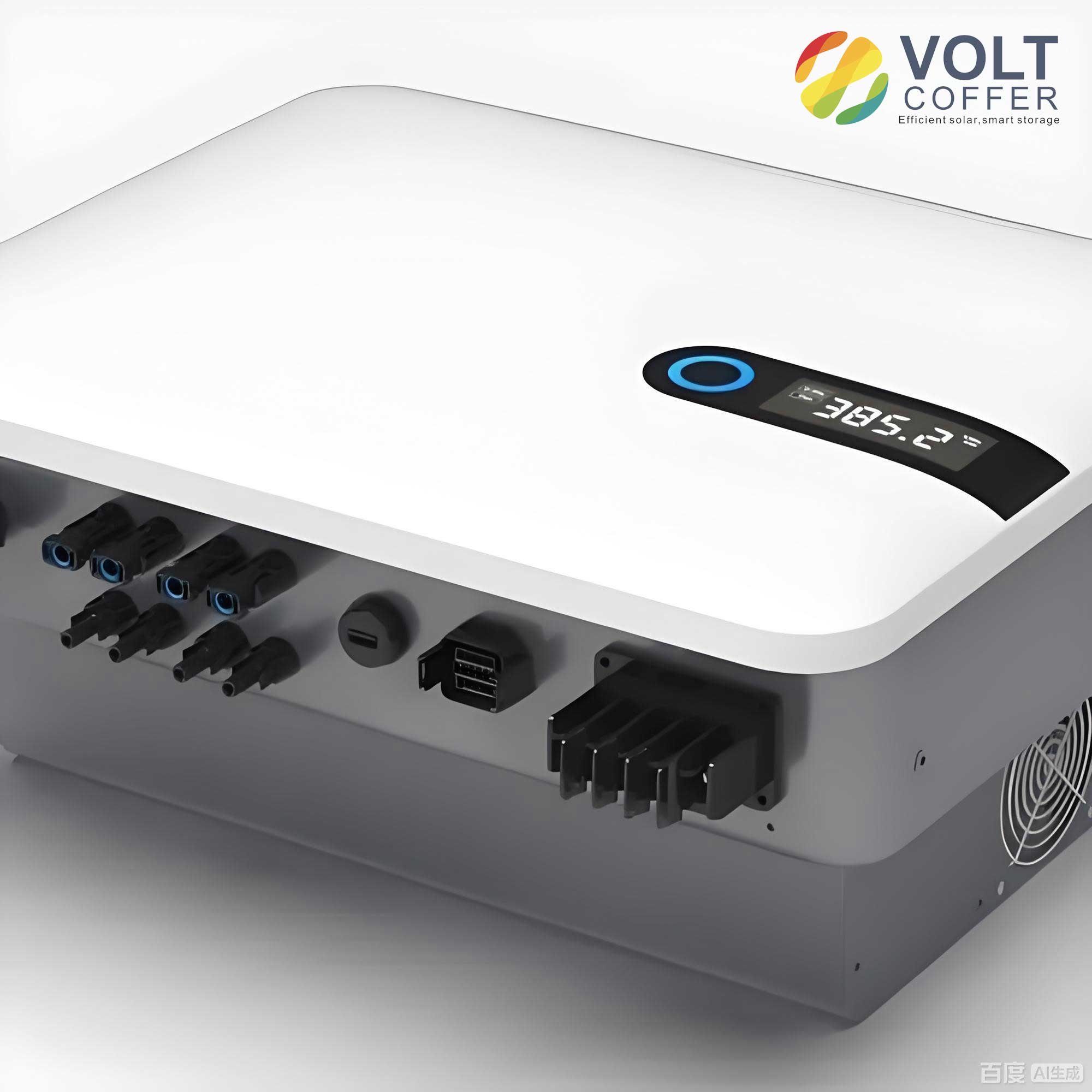
This article delves into the small-signal stability limitations of a conventional vector-controlled grid-connected inverter and proposes an impedance tuning method based on voltage feedback to mitigate the destabilizing influence of the PLL. The core of the analysis begins with establishing a comprehensive mathematical model.
Small-Signal Modeling and Impedance Analysis
The system under study is a three-phase, two-level voltage source inverter with an LCL output filter, utilizing classic vector current control in the synchronous (d-q) reference frame. The control structure includes a PLL for synchronization, a fast inner current loop, and outer loops for active power and AC voltage magnitude regulation. To analyze stability, a linearized small-signal state-space model is derived.
The differential equations for the LCL filter and grid impedance in the three-phase (abc) frame are first transformed into the d-q frame synchronized by the PLL output angle \(\theta_{pll}^{ctrl}\). The linearized versions of these circuit equations, along with the linearized models for the PLL, current controllers, power/voltage controllers, and measurement filters, are combined to form the state-space representation. The state vector \(\Delta \mathbf{x}\) includes perturbations in grid-side currents, capacitor voltages, inverter-side currents, controller integrator states, PLL angle and integrator, and filtered power/voltage measurements.
The linearized system can be expressed as:
$$
\Delta \dot{\mathbf{x}} = \mathbf{A} \cdot \Delta \mathbf{x} + \mathbf{B} \cdot \Delta \mathbf{u}
$$
where \(\Delta \mathbf{u} = [\Delta P^*, \Delta V_o^*]^T\) represents reference changes. For stability analysis around an operating point, the input references are considered zero, simplifying the system to \(\Delta \dot{\mathbf{x}} = \mathbf{A} \cdot \Delta \mathbf{x}\). The stability is determined by the eigenvalues of the state matrix \(\mathbf{A}\). The matrix \(\mathbf{A}\) is large (14×14) and can be partitioned into blocks related to different subsystems:
$$
\mathbf{A} = \begin{bmatrix}
\mathbf{A}_1 & \mathbf{A}_2 \\
\mathbf{A}_3 & \mathbf{A}_4
\end{bmatrix}
$$
Where \(\mathbf{A}_1\) primarily contains terms from the plant (LCL filter and grid) and current controller gains, \(\mathbf{A}_2\) contains coupling terms from the outer loops, \(\mathbf{A}_3\) contains terms from the PLL and power calculation, and \(\mathbf{A}_4\) contains the dynamics of the outer loop integrators and filters. Specific elements, such as \(A_{12,5}\) and \(A_{13,5}\), embed the operating point conditions (\(i_{cd0}, v_{oq0}\), etc.) and controller parameters, highlighting the power-dependent nature of stability.
$$
\begin{aligned}
A_{12,5} &= \left( -\omega L_f i_{cq0} – K_{p-i} i_{cd0} \right) / L_f + v_{oq0} / L_f \\
A_{13,5} &= -K_{p-i} K_{p-P} / L_f
\end{aligned}
$$
An alternative and insightful approach is the impedance-based model. The grid-connected inverter system can be represented by a Norton equivalent circuit, where the inverter is a controlled current source in parallel with an output admittance \(Y(s)\), and the grid is a voltage source in series with an impedance \(Z_g(s)\).
Table 1: Transfer Function Blocks for Impedance Model
| Block | Description | Transfer Matrix |
|---|---|---|
| \(\mathbf{B_{Lg}}, \mathbf{B_{Cf}}\) | Grid Inductor & Filter Capacitor | $$ \begin{bmatrix} sL_g+R_g & -\omega L_g \\ \omega L_g & sL_g+R_g \end{bmatrix}^{-1}, \begin{bmatrix} sC_f & -\omega C_f \\ \omega C_f & sC_f \end{bmatrix} $$ |
| \(\mathbf{B_{Lf}}, \mathbf{B_{decpl}}\) | Filter Inductor & Decoupling | $$ \begin{bmatrix} sL_f+R_f & -\omega L_f \\ \omega L_f & sL_f+R_f \end{bmatrix}^{-1}, \begin{bmatrix} 0 & -\omega L_f \\ \omega L_f & 0 \end{bmatrix} $$ |
| \(\mathbf{G_{PI-I}}, \mathbf{G_{PI-PV}}\) | Current Controller & Power/Voltage Controller | $$ \begin{bmatrix} K_{p-i}+\frac{K_{i-i}}{s} & 0 \\ 0 & K_{p-i}+\frac{K_{i-i}}{s} \end{bmatrix}, \begin{bmatrix} K_{p-P}+\frac{K_{i-P}}{s} & 0 \\ 0 & -(K_{p-V}+\frac{K_{i-V}}{s}) \end{bmatrix} $$ |
| \(\mathbf{G_{PLL}}\) | Phase-Locked Loop | $$ \frac{ K_{p- pll}s + K_{i-pll} }{s^2 + 2\zeta_{pll}\omega_{n-pll} s + \omega_{n-pll}^2 } \begin{bmatrix} 0 & 0 \\ 1 & 0 \end{bmatrix} $$ |
| \(\mathbf{B_{v}}, \mathbf{B_{i}}\) | Voltage & Current Measurement Coupling | $$ \begin{bmatrix} 1 & 0 \\ 0 & 1 \end{bmatrix}, \begin{bmatrix} 1 & 0 \\ 0 & 1 \end{bmatrix} $$ |
| \(\mathbf{B_{pll-V_o}}, \mathbf{B_{pll-I_c}}\) | PLL Coupling via Vo and Ic | $$ \begin{bmatrix} 0 & V_{o} \\ 0 & 0 \end{bmatrix}, \begin{bmatrix} 0 & i_{cq0} \\ 0 & -i_{cd0} \end{bmatrix} $$ |
Using the block diagram algebra, the overall inverter output admittance \(Y(s)\) is derived as a function of these blocks and the operating point. The grid impedance is simply \(Z_g(s) = sL_g + R_g\). The stability of the interconnected system is then assessed using the generalized Nyquist criterion applied to the loop gain \(Y(s)Z_g(s)\) or by examining the minor loop gain. A simplified but revealing form of the admittance matrix near the fundamental frequency can be approximated as:
$$
Y(s) \approx \begin{bmatrix}
\dfrac{1}{sL_f + R_f + R_d} & \dfrac{-\omega L_f – G_{PLL}(s) \cdot X_m}{sL_f + R_f} \\
\dfrac{\omega L_f + G_{PLL}(s) \cdot X_m}{sL_f + R_f} & \dfrac{1}{sL_f + R_f + R_q}
\end{bmatrix}
$$
where \(R_d = V_o/i_{cd0} > 0\), \(R_q = V_o/(-i_{cq0}) > 0\), and \(X_m = V_o/I_{max} > 0\) are positive resistances and reactance related to the operating point. The key observation is the presence of the PLL transfer function \(G_{PLL}(s)\) in the off-diagonal terms. At low frequencies, \(G_{PLL}(s)\) acts近似 as a proportional gain, introducing a negative resistance component in the effective impedance seen by the grid. This is the primary source of instability in weak grids. The ideal, unconditionally stable admittance for a simple inductor would be:
$$
Y_{ideal}(s) = \begin{bmatrix}
\dfrac{1}{sL_f} & 0 \\
0 & \dfrac{1}{sL_f}
\end{bmatrix}
$$
The discrepancy between \(Y(s)\) and \(Y_{ideal}(s)\), primarily the PLL-induced off-diagonal terms, defines the stability challenge. Analysis shows that for a very weak grid (e.g., SCR=1), the static power limit might be 1.0 per unit (p.u.), but the small-signal dynamic stability limit can be as low as 0.6 p.u., creating a significant restriction on the usable capacity of the grid-connected inverter.
Voltage-Feedback Impedance Tuning Control
To address this limitation, an impedance tuning strategy is proposed. The core idea is to inject a compensating feedback signal that actively cancels the destabilizing feedback path introduced by the PLL. The principle can be understood from the small-signal block diagram. The PLL, through its coupling blocks \(\mathbf{B_{pll-V_c}}\) and \(\mathbf{B_{pll-V_o}}\), creates positive feedback loops that degrade stability.
The proposed method introduces an additional feedback path. It takes the measured capacitor voltage in the controller’s d-q frame (\(\Delta \mathbf{v}_{cdq}^{ctrl}\)), which is already influenced by the PLL coupling, and processes it to generate a corrective signal. The compensation requires two steps:
- First, apply a transformation using the inverse of \((\mathbf{I} – \mathbf{B_{pll-V_o}})\) to effectively “subtract” the PLL’s own coupling effect from the measured voltage, approximating the voltage perturbation in a stationary frame.
- Second, multiply this signal by \(-\mathbf{B_{pll-V_c}}\) and feed it forward into the modulation signal. This effectively adds a negative feedback that cancels the original positive feedback path through \(\mathbf{B_{pll-V_c}}\) in the main control loop.
The implementation within the control structure is relatively straightforward. An additional parallel branch is added to the current controller output. This branch calculates a compensation voltage \(\mathbf{v}_{comp,dq}\) as:
$$
\begin{bmatrix}
v_{comp,d} \\
v_{comp,q}
\end{bmatrix} = -G_{comp}(s) \cdot
\begin{bmatrix}
0 & V_o^* \\
0 & 0
\end{bmatrix} \cdot
\begin{bmatrix}
v_{cd}^{ctrl} \\
v_{cq}^{ctrl}
\end{bmatrix}
$$
where \(G_{comp}(s)\) is a designed compensator, often simply a gain, intended to approximate the inverse PLL coupling effect over the frequency range of concern. This compensation voltage is then added to the output of the current controllers before modulation.
This method offers a significant advantage: it directly targets the source of instability (the PLL coupling) without needing to drastically reduce the bandwidth of the PLL or the outer control loops. Consequently, the grid-connected inverter can retain its fast dynamic response for power tracking and voltage support while achieving a much wider stability region. The dynamic power limit can be extended to approach the static power limit.
Simulation Validation and Results
To validate the effectiveness of the proposed impedance tuning control, time-domain simulations were conducted comparing the conventional vector control and the improved control under weak grid conditions (low SCR). The grid-connected inverter was tasked with ramping up its output power.
Case 1: Conventional Control Strategy. The active power reference was stepped from 0 to 700W (0.875 p.u.) in increments of 200W every 0.5 seconds. The system remained stable up to 400W (0.5 p.u.). However, at the 600W (0.75 p.u.) step, the system became unstable. The d- and q-axis currents began to oscillate with growing magnitude, and the PLL lost synchronization, as evidenced by its frequency and angle deviating significantly from the grid nominal values. This confirms the severe dynamic power limitation of the traditional method.
Table 2: Stability Performance Comparison
| Control Method | Stable Power Range (p.u.) | PLL Synchronization at High Power | Dynamic Response |
|---|---|---|---|
| Conventional Vector Control | Up to ~0.6 p.u. | Lost beyond ~0.6 p.u. | Fast (when stable) |
| Proposed Impedance Tuning Control | Up to ~0.875 p.u. (tested) | Maintained | Remains Fast |
Case 2: Improved Control with Impedance Tuning. Under identical weak grid conditions and the same power ramp profile, the system with the proposed compensation remained stable throughout the entire power range up to 700W. The d- and q-axis currents tracked their references smoothly without oscillations, and the PLL maintained accurate synchronization, with its frequency and phase angle tightly regulated. This demonstrates that the impedance tuning method successfully expanded the stability boundary, allowing the grid-connected inverter to operate reliably at much higher power levels, closely approaching its static capability limit.
Conclusion
This article has presented a detailed analysis of the small-signal stability constraints inherent in conventionally controlled grid-following inverters, particularly under weak grid conditions. The modeling, via both state-space and impedance-based approaches, clearly identifies the negative resistance behavior introduced by the Phase-Locked Loop as the principal factor limiting dynamic power transfer. To overcome this limitation, a voltage-feedback-based impedance tuning control method is proposed. This strategy actively injects a compensating signal designed to cancel the destabilizing PLL coupling effect directly within the control loop. The key advantage of this approach is its ability to significantly enhance the stability margin and extend the dynamic power limit—often bringing it near the static limit—without compromising the fast dynamic response of the inner current and outer control loops. Simulation studies confirm the superior performance of the proposed method, showcasing stable operation at power levels where the conventional control fails. This makes the impedance tuning technique a valuable solution for enhancing the reliability and utilization of grid-connected inverter systems in future power networks with high penetration of renewable energy.