
Harnessing solar energy efficiently presents a significant challenge due to its inherently low energy density and discontinuous availability, which fluctuates with seasonal, daily, geographical, and climatic variations. To maximize the energy yield from photovoltaic installations, the implementation of solar tracking systems has become a crucial area of research and development. Empirical data conclusively demonstrates the substantial benefits of such systems: single-axis trackers can increase power generation by approximately 25% compared to fixed installations, while dual-axis trackers can achieve gains of up to 35%. This paper details the comprehensive design and implementation of a high-precision, dual-axis solar tracking system specifically engineered to optimize the performance of solar panels. The system employs a hybrid control strategy, merging the reliability of astronomical calculation with the adaptive precision of a feedback-based search algorithm, ensuring robust and accurate sun-following capability under diverse weather conditions.
1. Mechanical System Design
The mechanical design prioritizes stability, precision, and resistance to environmental factors such as wind loading. The chosen configuration is a pedestal-type, altitude-azimuth dual-axis system. This design offers a compact footprint, simplified installation, and excellent scalability for larger solar panel arrays. The system provides two rotational degrees of freedom: one for altitude (elevation) and one for azimuth (horizontal).
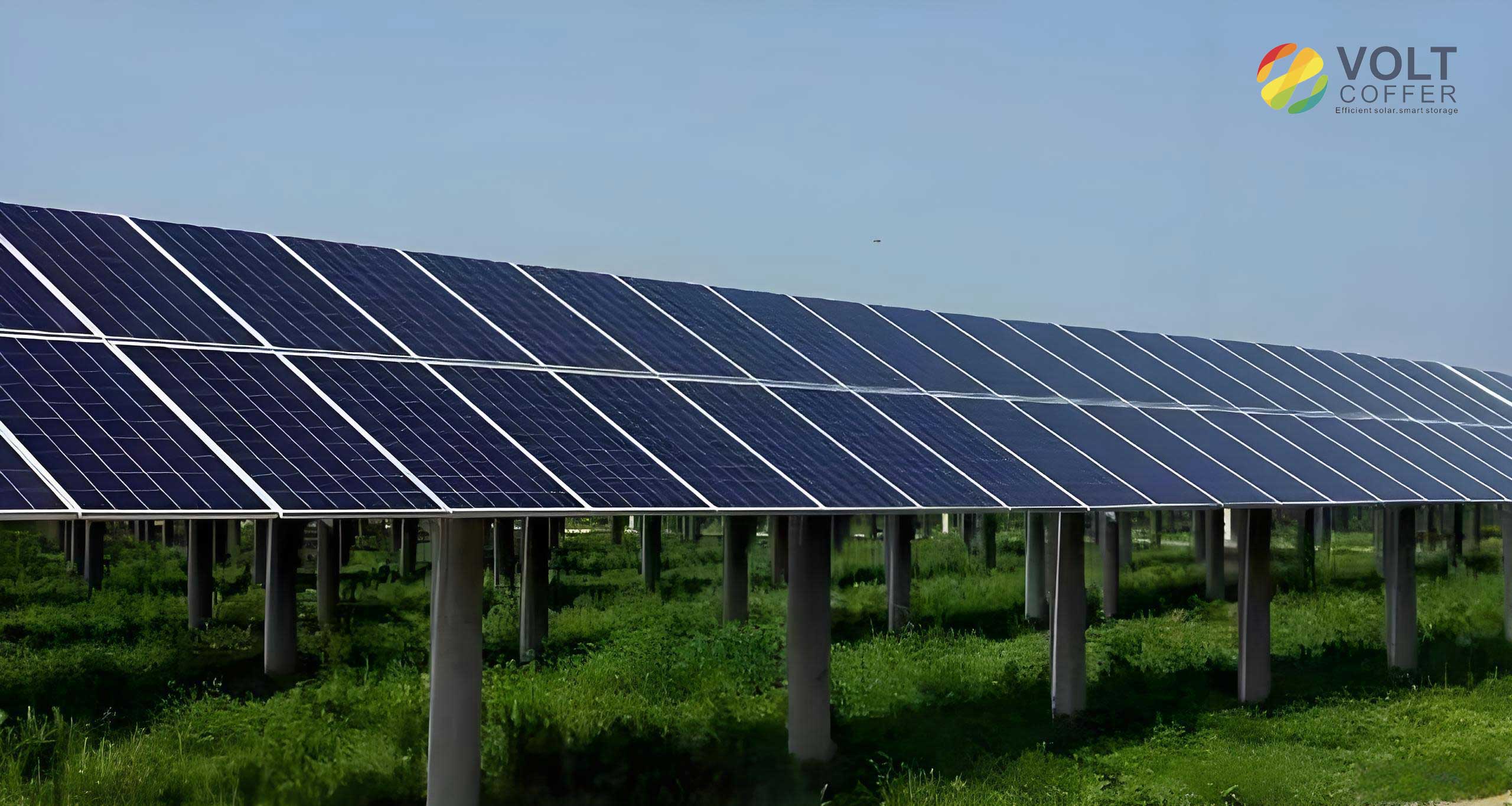
The core structure consists of a sturdy vertical column acting as the main support. A horizontal axis is mounted on top of this column via bearings, forming the pivot for altitude adjustment. The solar panel mounting frame, constructed from lightweight aluminum alloy, is attached to this horizontal axis. The azimuth movement is achieved by rotating the entire upper assembly, including the column’s head and the attached frame, around the vertical axis. This two-degree-of-freedom design allows the solar panels to be oriented precisely toward the sun’s position in the sky throughout the day.
The drive mechanisms are selected for their precision and holding torque. The azimuth drive utilizes a stepper motor coupled to a worm gear reducer. The worm gear provides a high reduction ratio, offering precise angular control and, critically, a self-locking feature that prevents back-driving under wind loads, ensuring the solar panels maintain position without consuming power. For the altitude axis, an electric linear actuator with an integrated potentiometer is employed. The actuator offers a compact and powerful solution for tilting the solar panel frame, while the potentiometer provides real-time feedback on the extension length, which correlates directly to the tilt angle.
This mechanical system is designed to achieve a rotational range of 0° to 180° in azimuth and a tilt range from 5° to 90° in altitude, enabling full hemispherical coverage for sun tracking.
| Mechanical Component | Function | Key Feature |
|---|---|---|
| Vertical Column & Base | Primary structural support and azimuth rotation axis. | Provides stability and a pivot for 180° horizontal rotation. |
| Worm Gear Reducer | Connects stepper motor to the vertical axis for azimuth drive. | High precision, high reduction ratio, and self-locking. |
| Stepper Motor | Drives the azimuth rotation via the worm gear. | Provides precise open-loop positional control. |
| Horizontal Axis & Bearings | Forms the pivot for the altitude (tilt) movement of the frame. | Enables smooth elevation adjustment of the solar panels. |
| Electric Linear Actuator | Drives the altitude angle by extending/retracting to tilt the frame. | Compact, powerful, with integrated position feedback (potentiometer). |
| Aluminum Mounting Frame | Holds and supports the solar panels. | Lightweight yet rigid structure to minimize inertia. |
2. Control System Hardware Architecture
The control system is built around a dedicated microcontroller unit (MCU), which serves as the central brain for all decision-making and actuation commands. The hardware architecture is modular, comprising sensing, processing, actuation, and user interface modules.
The core controller selected is a high-performance, low-power 8-bit MCU, chosen for its robust peripheral set, computational capability, and reliability in industrial applications. It executes the main tracking algorithms, processes sensor data, and generates control signals for the motors.
Sensing Module: This includes a Real-Time Clock (RTC) chip, which provides accurate date and time information essential for the astronomical calculations. A voltage sensing circuit is implemented to continuously monitor the open-circuit or operating voltage of the solar panels. This voltage signal is the primary feedback for the adaptive tracking algorithm and for assessing ambient light intensity.
Actuation Module: This consists of driver circuits for the two actuators. The stepper motor is driven by a dedicated chopper driver, which efficiently controls the current to the motor coils, enabling precise micro-stepping for smooth and accurate azimuth rotation. The electric linear actuator is controlled via a relay or an H-bridge circuit to manage its extension and retraction, with its position feedback (potentiometer voltage) read by the MCU’s analog-to-digital converter (ADC).
Safety & Interface Module: Limit switches are installed at the extremes of both rotational axes to prevent mechanical damage from over-travel. An LCD display provides a user interface for showing real-time data such as calculated sun angles, solar panel voltage, system status, and time. Manual control buttons allow for system calibration, manual override, and mode selection.
3. Hybrid Control Strategy: Theory and Implementation
The heart of the tracking system’s intelligence lies in its control strategy. To achieve both reliability and high precision, a hybrid approach is adopted, combining open-loop astronomical tracking with closed-loop optimization.
3.1. Solar Position Algorithm (Open-Loop Tracking)
This method calculates the sun’s position theoretically based on astronomical equations, requiring only the local latitude, longitude, date, and time. The primary outputs are the solar altitude angle (α) and the solar azimuth angle (γ).
The solar altitude angle is the angle between the sun’s rays and the horizontal plane. It is calculated using the following formula:
$$ \sin α = \sin \phi \sin δ + \cos \phi \cos δ \cos ω $$
where:
\( \phi \) = Latitude of the location (degrees).
\( δ \) = Solar declination angle (degrees).
\( ω \) = Solar hour angle (degrees).
The solar azimuth angle, measured from true south (positive westward, negative eastward), is given by:
$$ \sin γ = \frac{\cos δ \sin ω}{\cos α} $$
The solar declination angle (δ), which varies with the day of the year (n, where n=1 on January 1), is approximated by:
$$ δ = 23.45^\circ \times \sin\left( 360^\circ \times \frac{284 + n}{365} \right) $$
The solar hour angle (ω) is related to the local solar time (t, in hours):
$$ ω = (t – 12) \times 15^\circ $$
Each hour corresponds to 15° of rotation, with ω=0 at solar noon.
Based on these calculated angles (α, γ), the controller determines the required angular displacement for each axis and commands the actuators accordingly. This method is inherently stable and unaffected by cloud cover but can suffer from cumulative errors due to mechanical inaccuracies, misalignment, or imprecise timing.
3.2. Hill-Climbing Algorithm (Closed-Loop Tracking)
To compensate for the open-loop system’s errors, a closed-loop optimization technique known as the Hill-Climbing Algorithm (HCA) is employed. This method uses the instantaneous power output (or voltage, which is proportional under constant irradiance conditions) of the solar panels as the feedback signal. The fundamental principle is that the maximum power point for a fixed load corresponds closely to the orientation where the solar panel surface is normal to the sun’s rays.
The algorithm operates in a cyclical search pattern:
1. Measure: Record the current solar panel output voltage (V_current).
2. Perturb: Command a small incremental movement in one axis (e.g., altitude).
3. Measure Again: Record the new voltage (V_new).
4. Compare & Decide: If V_new > V_current, the movement increased power, so the next perturbation will be in the same direction. If V_new < V_current, the movement decreased power, so the next perturbation will be in the opposite direction.
5. Repeat: This process runs continuously for both axes, typically with a slow period to avoid unnecessary actuator wear and to allow the system to settle.
This method can perfectly correct for any static or dynamic misalignment. However, its performance degrades under rapidly changing irradiance conditions (e.g., fast-moving clouds), as it may misinterpret a cloud-induced drop in voltage as being caused by an incorrect orientation.
3.3. Hybrid Strategy Operation
The strengths and weaknesses of the two methods are complementary. The implemented hybrid strategy uses the Solar Position Algorithm as the primary, coarse tracking method. It positions the solar panels close to the theoretical sun position.
Simultaneously, the system monitors the solar panel voltage. A voltage threshold is empirically defined to distinguish between “bright sun” and “dim/cloudy” conditions. When the voltage consistently exceeds this threshold, indicating stable, strong irradiance, the Hill-Climbing Algorithm is activated as a fine-tuning loop. It makes small, corrective adjustments around the position set by the astronomical tracker to find the true power maximum. When the voltage falls below the threshold, the HCA is suspended to prevent false corrections due to clouds, and the system relies solely on the open-loop tracking.
This hybrid approach ensures reliable, all-weather operation while maintaining very high tracking accuracy during optimal conditions, thereby maximizing the total daily energy harvest from the solar panels.
| Control Method | Principle | Advantages | Disadvantages |
|---|---|---|---|
| Solar Position Algorithm (Open-Loop) | Calculates sun position from time/date/location. | Robust to clouds; no sensors needed; stable operation. | Susceptible to cumulative errors from misalignment, etc. |
| Hill-Climbing Algorithm (Closed-Loop) | Seeks maximum power point by perturbing position. | Automatically corrects all forms of error; high precision. | Can fail under rapidly changing irradiance (e.g., clouds). |
| Hybrid Strategy | Uses open-loop for coarse positioning, closed-loop for fine-tuning in good weather. | Combines reliability of open-loop with precision of closed-loop; all-weather capable. | Slightly more complex software logic; requires threshold tuning. |
4. Software Implementation and Flow
The system software orchestrates the hardware components to execute the hybrid control strategy. The program flow is designed to be deterministic and energy-efficient.
Main Program Flow: Upon initialization, the system performs self-checks and initializes peripherals (RTC, ADC, motor drivers). It then enters the main control loop. The loop first reads the current time from the RTC. If it is before sunrise or after sunset (calculated based on location and date), the system commands the actuators to move the solar panels to a predefined “stow” position (often vertical or facing dawn direction for the next morning) and enters a low-power sleep mode until the next scheduled check. If it is daytime, the software proceeds with the tracking routine.
Tracking Routine:
1. Sun Position Calculation: The current date, time, and location constants are used to compute the theoretical solar altitude (α_target) and azimuth (γ_target) using the formulas in Section 3.1.
2. Open-Loop Actuation: The system reads the current actuator positions (from the actuator potentiometer and the stepper motor’s step count). It calculates the error between the target and current angles for both axes. Proportional control signals are generated to drive the stepper motor and linear actuator to minimize these errors. This brings the solar panels to the astronomically calculated position.
3. Weather Assessment & HCA Activation: After the open-loop move is complete, the system samples the solar panel voltage multiple times to establish a stable reading (V_sample). It compares V_sample to the preset “sunny condition” threshold (V_threshold).
4. Conditional HCA Execution: If V_sample > V_threshold, the Hill-Climbing subroutine is called. This subroutine will execute the perturb-and-observe cycle independently for the altitude and azimuth axes for a defined period or number of iterations, fine-tuning the position.
5. Loop Delay & Continuation: After completing the HCA cycle (or skipping it if conditions were poor), the program waits for a defined interval (e.g., 1-5 minutes). After the delay, the loop repeats, starting again with checking the time.
5. Experimental Performance Analysis
A comparative test was conducted to quantify the performance gain offered by the dual-axis tracking system. Two identical solar panels with the specifications below were used:
| Parameter | Value |
|---|---|
| Rated Power | 200 W |
| Dimensions | 1580 mm × 808 mm × 50 mm |
| Weight | 15 kg |
One solar panel was mounted on the developed dual-axis tracking system. The other was fixed at the locally optimal annual tilt angle (approximately equal to the location’s latitude). Both solar panels were connected to identical resistive loads, and their instantaneous output power was logged simultaneously at regular intervals throughout a clear sunny day.
The results, plotted as power versus time of day, showed a characteristic curve for the fixed panel—a bell shape centered around solar noon. The curve for the tracked solar panel was significantly fuller and maintained near-peak power levels for a much longer duration during the middle of the day. The tracked panel’s power output also rose earlier in the morning and declined later in the afternoon compared to the fixed panel.
Integration of the power curves over the entire day provided the total energy yield. The dual-axis tracking system increased the daily energy harvest by approximately 31% compared to the fixed-tilt installation. This result aligns with and slightly exceeds the typical literature values, validating the effectiveness of the mechanical design and the hybrid control strategy. The slight outperformance may be attributed to the high precision of the hybrid control, which minimizes cosine loss throughout the day.
6. Conclusion
The design and implementation of a high-precision, dual-axis solar tracking system have been presented. The system features a robust and simple pedestal-type mechanical structure driven by a stepper motor for azimuth and a linear actuator for altitude, offering a reliable platform for solar panels. Its core innovation lies in the sophisticated hybrid control strategy, which seamlessly integrates a reliable astronomical sun-position algorithm with an adaptive hill-climbing optimization routine. This combination ensures accurate tracking that is resilient to both the cumulative errors of open-loop systems and the confusion caused by cloudy weather in pure closed-loop systems.
Experimental validation confirms the system’s practical efficacy, demonstrating a significant increase in energy yield—around 31%—compared to a fixed-tilt configuration. This improvement directly translates to a higher return on investment for photovoltaic installations and a greater utilization of available solar resources. Future work could focus on enhancing the system’s intelligence, such as integrating predictive weather data to preemptively adjust the tracking strategy or employing more advanced maximum power point tracking (MPPT) algorithms that directly optimize the power electronic converter’s operation in conjunction with physical panel orientation. The developed system provides a effective, scalable, and practical solution for maximizing the output of solar panels across a wide range of applications.