
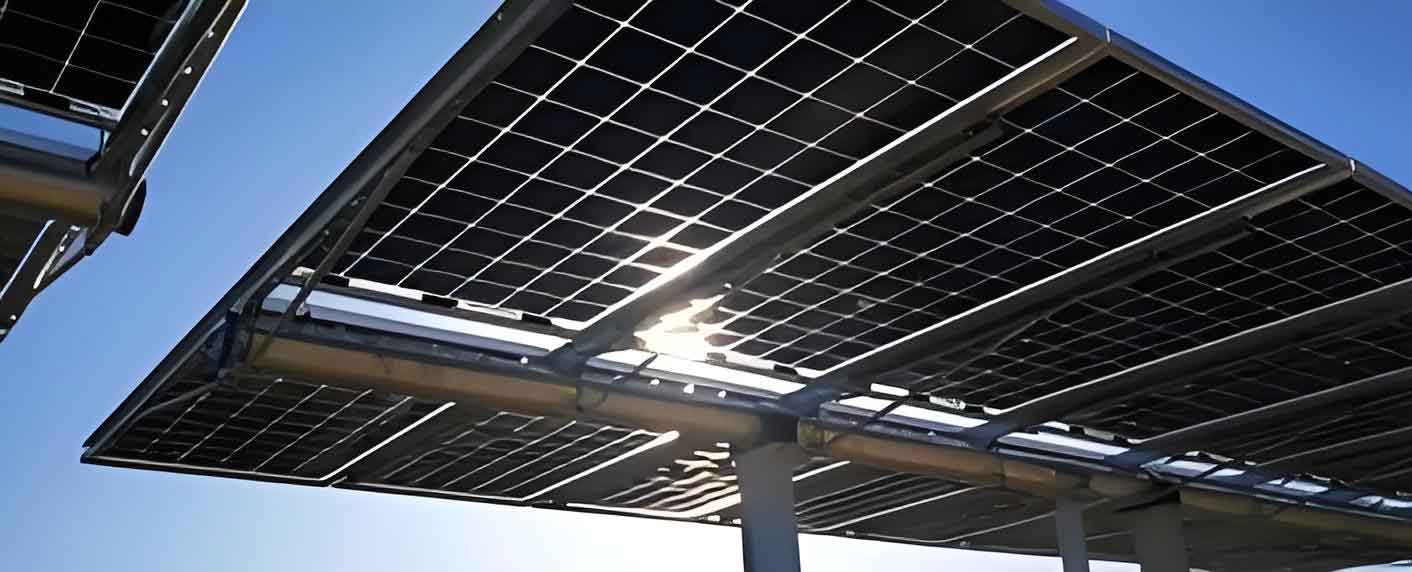
The efficient operation of photovoltaic power plants is contingent upon maintaining the cleanliness of the solar panel surfaces. Dust, bird droppings, and other debris significantly reduce the light transmittance, leading to a substantial drop in power generation efficiency. Automated cleaning robots have emerged as a critical solution for large-scale installations. The reliability and structural integrity of these robots, particularly their walking mechanism which traverses the often delicate solar panel arrays, are paramount. This analysis focuses on the static structural performance of a key component within such a robot’s locomotion system, employing finite element methods to ensure its design robustness.
The walking mechanism under investigation features a symmetrical design on both the left and right sides. Each side consists of several integrated subsystems: a walking synchronous belt for traction, a synchronous belt drive mechanism for power transmission, an auxiliary support wheel system for stability and load distribution, and a primary structural support frame. This support frame serves as the backbone of the entire walking assembly. It is responsible for bearing the total mass of the cleaning robot and withstanding dynamic and static loads transmitted during operation, such as the belt tension forces. A failure or excessive deformation in this frame could lead to catastrophic malfunction, potentially damaging the expensive solar panel surfaces. Therefore, a detailed static structural analysis is essential to validate its design before physical prototyping and deployment.
1. Methodology and Pre-Processing
The analysis follows a structured engineering simulation workflow, beginning with geometric modeling and simplification, followed by material definition, discretization (meshing), application of boundary conditions and loads, solving, and finally, post-processing of the results.
1.1. Geometric Modeling and Simplification
The three-dimensional solid model of the walking mechanism support frame was created using SolidWorks 2013, leveraging its advanced sheet metal and weldment design features. The model includes the main support beam, the active (motor-driven) pulley bracket, the passive (idler) pulley bracket, and reinforcing gussets. To enhance computational efficiency without sacrificing result accuracy, the model was judiciously simplified prior to analysis. Features with negligible impact on global structural stiffness and stress distribution, such as small fillets, chamfers, and minor fastener holes, were suppressed. The active pulley bracket, passive pulley bracket, support beam, and gussets were treated as a single connected body, representing the welded or bolted final assembly. This simplification reduces the mesh complexity and solver time dramatically.
1.2. Material Properties Definition
Material selection is driven by the need for a high strength-to-weight ratio to keep the robot’s total mass below a target threshold (e.g., 10 kg) to ensure it does not overload the solar panel mounting structure. Aluminum alloy 6061-T6 was chosen for the support frame due to its excellent machinability, good weldability, and favorable mechanical properties. The material properties assigned in the simulation are summarized in the table below:
| Property | Value | Unit |
|---|---|---|
| Material | Aluminum Alloy 6061-T6 | – |
| Density (ρ) | 2700 | kg/m³ |
| Young’s Modulus (E) | 69 | GPa |
| Poisson’s Ratio (ν) | 0.33 | – |
| Yield Strength (σ_y) | ≥ 240 | MPa |
| Ultimate Tensile Strength (σ_u) | ≥ 260 | MPa |
2. Finite Element Model Generation
2.1. Mesh Generation Strategy
Mesh generation is a critical step that balances computational cost with result accuracy. ANSYS Meshing was used within the Workbench environment. A mixed meshing strategy was employed:
- Automatic Method for Main Body: The primary support beam was meshed using the automatic method, which intelligently uses a combination of tetrahedral and hexahedral elements.
- Localized Refinement: Areas of anticipated high-stress concentration, namely the pulley brackets where belt forces are applied and the connection points to the auxiliary wheels, were targeted for mesh refinement. A localized sizing control was applied to generate a finer mesh in these regions.
- Element Type and Quality: Second-order (quadratic) tetrahedral elements (SOLID187 in ANSYS) were primarily used. These elements better approximate curved geometries and provide higher accuracy in stress calculations compared to their first-order counterparts. The mesh quality was assessed using the Skewness metric, where a value of 0 indicates a perfect equilateral element and 1 indicates a degenerate element. The final mesh achieved an average skewness of 0.35, with less than 1% of elements exceeding 0.95, confirming a high-quality mesh suitable for analysis.
The final discretized model consisted of the following:
| Metric | Count |
|---|---|
| Nodes | ~113,500 |
| Elements | ~58,000 |
2.2. Loads and Boundary Conditions
Accurate simulation requires realistic constraints and forces. The support frame interacts with other components at specific locations:
- Fixed Supports (Boundary Conditions): The interfaces where the auxiliary support wheels attach to the main frame are considered fixed constraints. In reality, these wheels roll, but for a conservative static analysis simulating the robot at rest or moving slowly, constraining these points provides a valid representation of the reaction forces from the solar panel frame. All degrees of freedom (translations and rotations) are set to zero at these connection points.
- Static Structural Loads: Two primary loads are applied:
- Robot Weight (Gravity): A standard earth gravity load (9.81 m/s²) is applied to the entire structure. Assuming a total robot mass (including cleaning mechanisms, water tanks, etc.) of 80 kg, and symmetry, each side of the walking mechanism carries approximately 400 N. This load is automatically calculated by the software based on the defined density and volume.
- Synchronous Belt Tension Force (F_Q): This is a critical operational load. The force exerted by the timing belt on the pulley shafts (the “bearing pressure” or “shaft load”) is calculated based on drive parameters. The formula is derived from power transmission fundamentals:
The design power \( P_d \) is calculated from the nominal motor power \( P_m \):
$$ P_d = K_A \cdot P_m $$
where \( K_A \) is the application/service factor, assumed to be 1.2 for moderate shock loads, and \( P_m \) is 0.07 kW.
The belt speed \( v \) is:
$$ v = \frac{\pi \cdot d_1 \cdot n_1}{60 \times 1000} $$
where \( d_1 \) is the driving pulley pitch diameter (56.6 mm) and \( n_1 \) is its rotational speed (50 rpm).
The calculated belt tension force \( F_Q \) applied radially to each pulley bracket is then:
$$ F_Q = \frac{1000 \cdot P_d}{v} $$
Substituting the values yields \( F_Q \approx 560 \, \text{N} \). This force is applied as a concentrated force on the inner bearing surfaces of both the active and passive pulley brackets, directed radially inward towards the center of the pulley.
The applied loads and constraints are summarized below:
| Load/Boundary Condition | Type | Magnitude/Location |
|---|---|---|
| Fixed Support | Constraint | All DOFs fixed at auxiliary wheel connection points |
| Standard Earth Gravity | Body Load | 9.81 m/s² applied globally |
| Belt Tension Force | Concentrated Force | 560 N on each pulley bracket bearing seat |
3. Results and Discussion
The static structural analysis was solved using the ANSYS Mechanical solver. The primary results of interest are the deformation (displacement) and the stress distribution within the support frame, specifically the von Mises stress, which is used to predict yielding in ductile materials like aluminum.
3.1. Deformation Analysis
The total deformation contour plot reveals the displacement magnitude of the structure under the combined loads. The maximum deformation was found to be 0.048 mm, located near the center of the main support beam. This is an exceptionally small deflection, on the order of micrometers. The deformation pattern shows a smooth gradient, with the ends constrained by the wheel supports bending slightly downward under the weight and the central section experiencing minimal flexure. For a structure spanning across solar panel arrays, such minimal deformation is highly desirable as it ensures stable contact and alignment of the driving wheels and belts, preventing slippage or misalignment that could hinder movement or damage the solar panel surface.
3.2. Stress Analysis
The equivalent (von Mises) stress contour plot is the key indicator of structural safety. The von Mises stress \( \sigma_{vm} \) is calculated from the stress tensor components and compared to the material yield strength. For a state of plane stress, it is given by:
$$ \sigma_{vm} = \sqrt{\sigma_{xx}^2 + \sigma_{yy}^2 – \sigma_{xx}\sigma_{yy} + 3\tau_{xy}^2} $$
The analysis identified a maximum von Mises stress of 31.12 MPa. This stress concentration occurs at the sharp re-entrant corners or fillet regions where the vertical pulley brackets connect to the horizontal support beam—a typical location for stress risers.
The most important comparison is between the maximum operational stress and the material’s yield strength. The safety factor \( N \) can be calculated as:
$$ N = \frac{\sigma_y}{\sigma_{max}} $$
Using the yield strength of Al 6061-T6 (240 MPa) and the maximum simulated stress (31.12 MPa):
$$ N = \frac{240 \, \text{MPa}}{31.12 \, \text{MPa}} \approx 7.7 $$
This high safety factor indicates a very robust and conservative design under the assumed static loads. The structure is far from yielding, providing ample margin to account for dynamic factors (shocks from uneven solar panel surfaces, starting/stopping inertia), unmodeled loads, material imperfections, and potential fatigue over the robot’s lifetime.
The key numerical results are consolidated in the following table:
| Result Parameter | Maximum Value | Location | Design Allowable | Status |
|---|---|---|---|---|
| Total Deformation | 0.048 mm | Mid-span of central beam | ~1-2 mm (Typical tolerance) | Safe |
| Von Mises Stress | 31.12 MPa | Bracket-to-beam fillet | 240 MPa (Yield Strength) | Safe |
| Calculated Safety Factor | ≈ 7.7 | – | > 2 (Common requirement) | More than Adequate |
4. Conclusion and Design Implications
The static finite element analysis of the walking mechanism support frame for the solar panel cleaning robot confirms that the initial design is structurally sound and exceeds basic strength requirements for the applied loads. The maximum deformation is negligible (0.048 mm), ensuring operational stability on the solar panel array. The maximum stress (31.12 MPa) is significantly lower than the yield strength of Aluminum 6061, resulting in a high safety factor of approximately 7.7.
However, this high safety factor also reveals a significant opportunity for design optimization. The structure is clearly over-engineered for its static load case. This presents a prime opportunity for lightweighting, which is a critical objective for mobile robots to reduce inertia, improve energy efficiency, and minimize the load on the solar panel mounting structures. Potential optimization avenues include:
- Topology Optimization: Using the current design space and load paths as a starting point, material can be intelligently redistributed or removed from low-stress regions (where stress is much less than 31 MPa) to create a lighter, yet equally strong, lattice-like structure.
- Geometric Refinement: Adding larger fillets or smooth transitions at the identified stress concentration points (bracket junctions) can further reduce the peak stress, potentially allowing for even more aggressive material removal elsewhere.
- Material Grade Reassessment: A lower-grade (and potentially lower-cost) aluminum alloy with a yield strength closer to the operational stress could be evaluated, provided fatigue life and dynamic factors are thoroughly analyzed.
- Dynamic and Fatigue Analysis: As a logical next step, a transient dynamic analysis simulating the robot moving over panel gaps and a fatigue analysis based on cyclic loading from daily operation should be conducted. These analyses would define more realistic load spectra and could validate a lighter optimized design.
In summary, while the presented support frame design is unequivocally safe for its intended duty on a solar panel farm, the static analysis provides a solid foundation and clear directive for a subsequent weight-reduction optimization cycle. This process will lead to a more efficient, cost-effective, and high-performance walking mechanism for automated solar panel cleaning systems.