
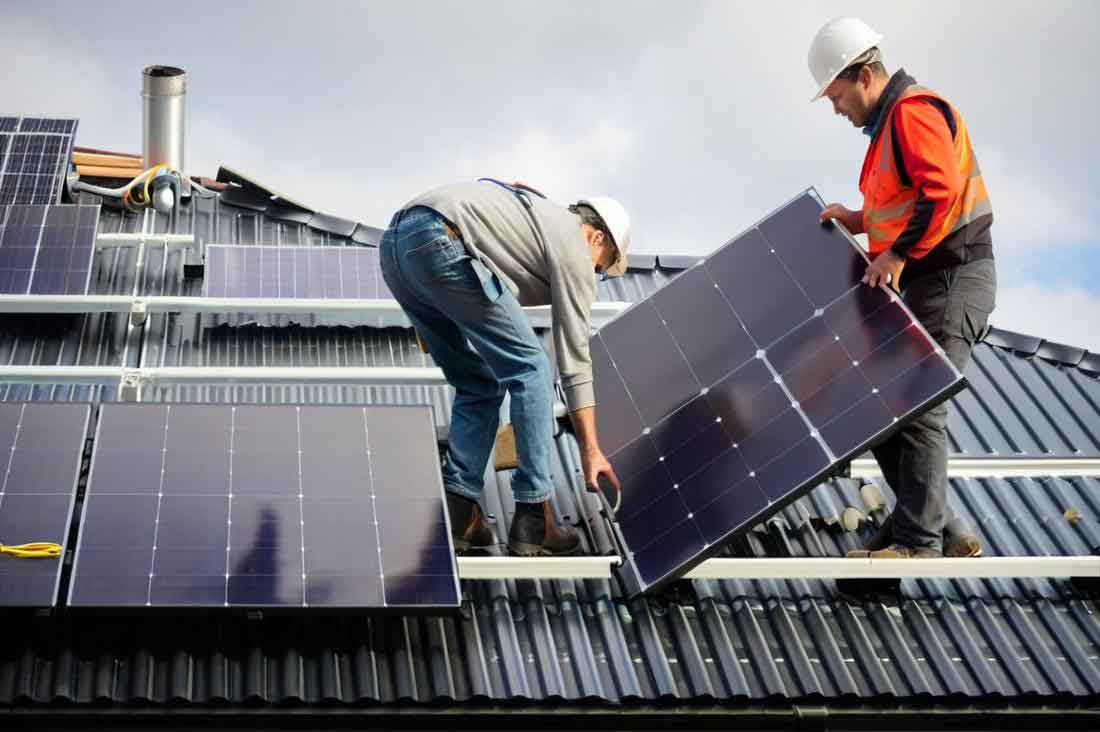
As a researcher in construction machinery, I have focused on developing innovative solutions for the renewable energy sector, particularly for solar panel installation. Solar energy is a clean, abundant, and sustainable source, with photovoltaic power generation becoming a cornerstone of global energy strategies. The installation of solar panels is a critical phase in photovoltaic projects, often conducted in large-scale, remote areas like desert solar farms. Manual installation is labor-intensive, inefficient, and prone to safety risks, necessitating mechanized approaches. However, existing machinery faces stability challenges due to high lifting heights, extensive arm reaches, and harsh environmental conditions such as uneven terrain and strong winds. In this article, I present a detailed exploration of an auto-leveling tower arm system designed specifically for solar panel installation machinery. This system integrates telescoping mechanisms, dynamic counterweight balancing, and robust structural components to enhance stability, adaptability, and efficiency. By leveraging first-person insights, I will delve into the design principles, mathematical modeling, and practical applications, emphasizing the role of this system in advancing solar panel deployment. Throughout, the term “solar panel” will be frequently highlighted to underscore its relevance.
The demand for mechanized solar panel installation has led to various machinery types, each with distinct working characteristics. Common designs include multi-link swing systems, hinge-axis rotating boom systems, and multi-axis telescopic systems. Multi-link swing systems utilize hydraulic cylinders to drive linked arms, enabling the grasping and placement of solar panels through coordinated movements. Hinge-axis rotating boom systems feature a four-bar linkage at the base for swinging motion, combined with rotating booms equipped with grippers and suction cups for handling solar panels. Multi-axis telescopic systems incorporate telescoping columns, horizontal arms, and vertical arms to achieve precise solar panel positioning. While these systems offer functional benefits, they often struggle with stability under load, especially when dealing with the substantial overturning moments generated by extended arms and elevated solar panel placements. In desert environments, where ground slopes and wind loads exacerbate instability, the need for a more reliable solution is paramount. My work addresses these issues by introducing a self-leveling tower arm system that combines telescoping capabilities with automatic counterweight adjustment, ensuring optimal balance during solar panel installation operations.
The core of this innovation is the tower arm system, which comprises a telescoping tower, a rotating drive assembly, a telescoping horizontal arm, a vertical arm, a counterweight device, and a traction guidance mechanism. This system is mounted on a crawler chassis, providing mobility across rough terrain. The telescoping tower consists of four tower sections that extend and retract synchronously to adjust the working height. The rotating drive assembly, located atop the tower, enables the horizontal arm to revolve horizontally, covering a wide area for solar panel placement. The horizontal arm includes three arm sections that telescope to vary the reach, while the vertical arm, attached to the front end of the horizontal arm, features a gripper and suction cup for handling solar panels. The counterweight device, equipped with load-bearing wheels, moves along the horizontal arm in synchrony with the arm sections to maintain balance. This integrated design allows for a working height of up to 6 meters and a reach of 2 to 6 meters, accommodating diverse solar panel installation scenarios. The system’s ability to self-level through dynamic counterweight shifting minimizes the bending moments on the tower and rotating assembly, enhancing overall stability during solar panel handling.
Telescoping mechanisms in such machinery are critical for achieving variable reach and height. They can be categorized into independent telescoping and synchronous telescoping. Independent telescoping involves sequential movement of adjacent sections, often using hydraulic cylinders with locking pins, but it can be slower and less coordinated. Synchronous telescoping, employed in this system, uses wire rope arrangements to link multiple sections, ensuring simultaneous extension or retraction. For the horizontal arm, which has two telescoping stages, a single hydraulic cylinder drives the second arm section, while wire ropes connect the sections to achieve a speed-increasing effect. When the hydraulic cylinder extends the second arm section by a distance \( a \), the third arm section extends by \( 2a \) relative to the first section. This relationship is expressed mathematically as follows: let \( x_2 \) be the displacement of the second arm section and \( x_3 \) be the displacement of the third arm section. Then, the wire rope configuration yields:
$$x_3 = 2 x_2$$
If the hydraulic cylinder stroke is \( a \), then \( x_2 = a \) and \( x_3 = 2a \), resulting in a total arm extension of \( 2a \) from the first section’s front end. This synchronous telescoping method ensures smooth and efficient adjustment of the arm’s reach, which is essential for precise solar panel placement. Similarly, the tower employs three telescoping stages. With the same principle, the displacements of the third and fourth tower sections, \( x_3 \) and \( x_4 \), relative to the first section, are related to the second section’s displacement \( x_2 \) by:
$$x_3 = 2 x_2, \quad x_4 = 3 x_2$$
Thus, for a hydraulic cylinder stroke \( b \) for the second tower section, the third section moves \( 2b \) and the fourth section moves \( 3b \), enabling a significant height adjustment from 3.6 meters to 7.5 meters. This multi-stage telescoping is vital for accessing elevated solar panel mounting points while maintaining structural integrity. The wire ropes are externally routed for ease of inspection and tension adjustment, contrasting with internal designs that may hinder maintenance. By optimizing the synchronization, the system reduces the time required for positioning, thereby accelerating solar panel installation cycles.
The auto-leveling feature is a hallmark of this system, addressing the overturning moments caused by the weight of the tower arm structure and the solar panels. The counterweight device moves in opposition to the horizontal arm sections: when the arm extends, the counterweight retracts, and vice versa. This dynamic balancing keeps the system’s center of gravity near the tower’s rotation axis, minimizing the load on the rotating drive and tower structure. To quantify this, let’s define the key parameters. Let \( m_0 \) be the mass of the head assembly, which includes the horizontal arm, vertical arm, and gripper. Let \( m_1 \) be half the mass of a solar panel, accounting for partial loading during balance calculations. Let \( m_2 \) be the mass of the counterweight. In the fully retracted arm position, the distance from the head assembly’s center of gravity to the rotation axis is \( c_1 \), the solar panel’s center of gravity is at 2 meters from the axis, and the counterweight’s center of gravity is at distance \( d \) from the axis. In the fully extended arm position, these distances become \( c_2 \) for the head assembly, 6 meters for the solar panel, and \( d + 2 \) meters for the counterweight, as the counterweight moves 2 meters opposite to the arm’s extension. Moment equilibrium conditions in both positions are given by:
For the fully retracted arm:
$$m_0 c_1 + 2 m_1 = m_2 d$$
For the fully extended arm:
$$m_0 c_2 + 6 m_1 = m_2 (d + 2)$$
Solving these equations simultaneously determines the optimal counterweight mass \( m_2 \) and its baseline distance \( d \). From the first equation, we express \( m_2 \):
$$m_2 = \frac{m_0 c_1 + 2 m_1}{d}$$
Substituting into the second equation:
$$\frac{m_0 c_1 + 2 m_1}{d} (d + 2) = m_0 c_2 + 6 m_1$$
Expanding and rearranging:
$$(m_0 c_1 + 2 m_1)(d + 2) = d(m_0 c_2 + 6 m_1)$$
$$m_0 c_1 d + 2 m_0 c_1 + 2 m_1 d + 4 m_1 = m_0 c_2 d + 6 m_1 d$$
$$m_0 c_1 d – m_0 c_2 d + 2 m_0 c_1 + 4 m_1 = 4 m_1 d$$
$$d(m_0 c_1 – m_0 c_2 – 4 m_1) = -2 m_0 c_1 – 4 m_1$$
Thus,
$$d = \frac{-2 m_0 c_1 – 4 m_1}{m_0 c_1 – m_0 c_2 – 4 m_1} = \frac{2 m_0 c_1 + 4 m_1}{m_0 c_2 – m_0 c_1 + 4 m_1}$$
Once \( d \) is calculated, \( m_2 \) can be derived. This balancing approach ensures that the overturning moment is reduced by over 1 ton-meter, equivalent to the moment induced by a Level 5 wind load, significantly enhancing stability during solar panel installation. The counterweight movement is synchronized via traction ropes: one rope pulls the counterweight forward when the arm retracts, and another pulls it backward when the arm extends, guided by pulleys on the arm sections. This mechanism maintains continuous balance as the arm adjusts for different solar panel positions.
The structural components of the tower arm system are designed for high rigidity and durability. The horizontal arm consists of three sections: the first arm section, second arm section, and third arm section, along with a hydraulic cylinder for the second section’s telescoping. Each section features load-bearing rollers on the top and bottom to support bending loads during extension and retraction, while side guide sliders prevent lateral deflection. The wire rope system for synchronous telescoping is externally mounted for easy maintenance. The first arm section also includes a counterweight rail and traction device to facilitate the counterweight’s movement. The table below summarizes the key components and their functions in the horizontal arm:
| Component | Function | Key Features |
|---|---|---|
| First Arm Section | Base section fixed to the rotating drive | Equipped with counterweight rail and guide pulleys |
| Second Arm Section | Telescopes via hydraulic cylinder | Has attachment points for wire ropes and rollers |
| Third Arm Section | Extends synchronously with second section | Front end connects to vertical arm; rear has rope fixings |
| Hydraulic Cylinder | Drives second section telescoping | Single-cylinder design with precise control |
| Wire Ropes | Enable synchronous telescoping | Externally routed for inspection and tensioning |
| Counterweight Rail | Guides counterweight movement | Integrated into first arm section structure |
The tower is constructed from four tower sections: the first, second, third, and fourth sections, with a hydraulic cylinder for the second section’s telescoping. Given the reduced bending moments due to counterbalancing, the tower primarily withstands compressive loads, but guide sliders are still provided for stability during telescoping. Two sets of wire ropes are used for each telescoping stage, arranged symmetrically—for instance, lower ropes for the second and third sections, and upper ropes for the third and fourth sections—ensuring even force distribution. The tower sections employ large cross-section, thin-walled designs to maximize the moment of inertia and minimize elastic deformation, which is crucial for maintaining precision when handling solar panels at height. The rotating drive assembly includes an upper saddle, lower saddle, slewing bearing, and drive motor. The upper saddle connects to the horizontal arm, while the lower saddle is fixed to the tower top; both are welded structures transitioning from square to circular shapes to accommodate loads. The vertical arm comprises an outer tube, inner tube, and a hydraulic cylinder for extension, allowing the gripper and suction cup to adjust vertically for solar panel placement.
The counterweight device is a critical element for auto-leveling. It includes a support plate, counterweight blocks, load-bearing wheel sets, horizontal wheel sets, traction rope fixing blocks, and anti-tipping blocks. The counterweight blocks are bolted onto the support plate, and the load-bearing wheels roll along the rail on the horizontal arm. The horizontal wheels and anti-tipping blocks prevent sway and overturning. Traction ropes are secured to the support plate via fixing blocks, ensuring synchronized movement with the arm sections. This design allows the counterweight to shift precisely, counteracting the moment changes as the arm extends or retracts during solar panel handling. By optimizing the counterweight mass and travel distance, the system achieves near-perfect balance, reducing the strain on the tower and enhancing safety.
In practical application, the entire machine integrates the tower arm system with a crawler chassis, power and control system, a lifting platform for solar panels, and the gripper with suction cups. The tower arm system provides four degrees of freedom: three telescoping axes (tower, horizontal arm, vertical arm) and one rotating axis. The gripper adds three rotational degrees of freedom via electric actuators, enabling fine angular adjustments for solar panel alignment. The crawler chassis positions the lifting platform at the front for loading solar panels and houses the power system at the rear, with the tower arm system centrally located to optimize weight distribution. The table below outlines the key performance parameters of the machine, emphasizing its capabilities for solar panel installation:
| Parameter | Value | Description |
|---|---|---|
| Solar Panel Installation Height | 6 m | Maximum vertical reach for placing solar panels |
| Horizontal Arm Minimum Reach | 2 m | Fully retracted arm distance from tower axis |
| Horizontal Arm Maximum Reach | 6 m | Fully extended arm distance for wide coverage |
| Machine Minimum Height | 3.6 m | Tower fully retracted for transport or low clearance |
| Machine Maximum Height | 7.5 m | Tower fully extended for high solar panel mounting |
| Tail Swing Radius | 2.7 m | Space required behind machine during operation |
| Machine Weight | 9.5 t | Total weight including chassis and tower arm system |
| Track Center Distance | 2 m | Distance between crawler tracks for stability |
| Track Wheelbase | 2.5 m | Length of track contact for ground pressure distribution |
| Tower Telescoping Stages | 3 | Number of telescoping sections in the tower |
| Tower Single-Stage Stroke | 1.3 m | Extension per tower section for height adjustment |
| Arm Telescoping Stages | 2 | Number of telescoping sections in the horizontal arm |
| Arm Single-Stage Stroke | 2 m | Extension per arm section for reach adjustment |
| Vertical Arm Stroke | 0.6 m | Vertical adjustment range for fine-tuning solar panel position |
Stability analysis is paramount for ensuring safe operation during solar panel installation. The worst-case scenarios involve fully extended tower and arm configurations, combined with wind loads, solar panel weights, and ground slopes. Three critical conditions are evaluated: forward tipping with wind from the front, the arm fully extended, and a solar panel attached; backward tipping with wind from the rear, the arm retracted, and no solar panel; and side tipping with lateral wind, the arm fully extended sideways, and a solar panel attached. The machine’s placement on the chassis is adjusted to ensure forward and backward stability are not inferior to side stability. With the auto-leveling system, the overturning moment is reduced by more than 1 ton-meter, which equates to the moment from a Level 5 wind. This significantly improves the machine’s resilience. The table below summarizes the stability outcomes under various conditions, highlighting the system’s robustness for solar panel installation in challenging environments:
| Condition | Ground Slope | Wind Resistance Level | Notes |
|---|---|---|---|
| Fully Extended, No Side Supports | 0° | Level 11 | Maximum wind resistance on flat ground |
| Fully Extended, No Side Supports | 21° | Level 6 | Wind resistance on sloped terrain |
| Fully Extended, Full Load, No Wind | 26° | N/A | Maximum ground slope without tipping |
The mathematical basis for these stability assessments involves calculating the overturning moments and comparing them to the restoring moments from the machine’s weight and counterweight. Let \( W \) be the total weight of the machine, \( h_g \) the height of the center of gravity, \( L \) the horizontal distance from the center of gravity to the tipping axis, and \( M_w \) the moment due to wind load. The overturning moment \( M_o \) is given by:
$$M_o = W \cdot L + M_w$$
The restoring moment \( M_r \) depends on the weight distribution and ground reaction. For stability, \( M_r \) must exceed \( M_o \) by a safety factor. With the auto-leveling system, \( L \) is minimized due to counterweight adjustment, reducing \( M_o \). For example, with a fully extended arm and a solar panel load, the wind load moment can be estimated using the formula for wind force \( F_w \):
$$F_w = \frac{1}{2} \rho v^2 C_d A$$
where \( \rho \) is air density, \( v \) is wind speed, \( C_d \) is the drag coefficient, and \( A \) is the projected area of the machine. The moment \( M_w = F_w \cdot h_w \), with \( h_w \) being the height of the wind force application. By integrating these calculations, the system demonstrates compliance with safety standards for solar panel installation in winds up to 20 m/s (Level 9) on level ground, and up to 10 m/s (Level 5) on 21° slopes. This ensures reliable operation even in desert photovoltaic projects where sudden gusts are common.
In conclusion, the auto-leveling tower arm system represents a significant advancement in mechanized solar panel installation. By combining synchronous telescoping, dynamic counterweight balancing, and robust structural design, it addresses the stability challenges posed by high lifts, long reaches, and adverse environmental conditions. The system’s ability to self-adjust during operation reduces the reliance on external supports, streamlining the installation process and enhancing efficiency. From a first-person perspective, I have detailed the design principles, mathematical modeling, and practical implementations, underscoring how this innovation can accelerate solar panel deployment in large-scale projects. Future developments may integrate smart control systems for real-time balance optimization and adaptive response to wind and terrain variations. As the demand for solar energy grows, such machinery will play a pivotal role in making solar panel installation safer, faster, and more cost-effective, contributing to the global transition to renewable energy. Throughout this exploration, the focus on solar panels has been emphasized to highlight the system’s dedicated application in advancing photovoltaic technology.