
In recent years, the global push towards carbon neutrality has accelerated the adoption of green energy solutions across industries. As part of this transition, the oil and gas sector is actively seeking ways to reduce its carbon footprint, particularly in field operations where traditional diesel-powered equipment dominates. I have been involved in researching and implementing battery energy storage system technology to replace diesel engines in logging vehicles, which are essential for oil well logging and perforation tasks. This shift not only aligns with environmental goals but also enhances operational efficiency and reduces noise pollution. In this article, I will detail the comprehensive application of battery energy storage system in logging vehicles, covering model establishment, computational analysis, and system design, with an emphasis on formulas and tables to summarize key findings.
The traditional logging vehicle relies on a diesel engine to power the winch system, leading to significant fuel consumption and emissions. To address this, my team and I developed a battery energy storage system-based electric drive solution. This system utilizes a battery energy storage system to supply power to the winch motor, eliminating the need for diesel. The core components include the original vehicle chassis, a battery energy storage system pack, a winch assembly, and auxiliary systems like pneumatic and cooling circuits. The three-dimensional layout was designed using UG software to ensure minimal structural changes, maintaining user familiarity while integrating the battery energy storage system seamlessly. The battery energy storage system packs are distributed in side boxes around the vehicle’s lower body, optimizing space and weight distribution. This design preserves the vehicle’s functionality while upgrading its performance with a battery energy storage system.
The electrical control principle of the battery energy storage system-driven logging vehicle is centered on a DC bus system. The battery energy storage system pack connects to the DC bus via a converter, allowing bidirectional energy flow. This setup enables the use of external power sources for charging. The DC bus distributes power in three paths: first, to the motor controller that drives the winch motor; second, to a converter for low-voltage appliances like lighting; and third, to an inverter for high-power equipment such as ground instruments and air conditioning. This configuration ensures efficient energy management and reliability. The battery energy storage system is key to this design, providing stable power for various operations while supporting energy recovery during winch descent. By leveraging a battery energy storage system, we achieve a cleaner and more sustainable power source for logging tasks.
To analyze the performance of the winch unit, I focused on a 7000 m logging winch as a case study. The winch drum parameters were calculated by considering cable layers, ignoring fluid buoyancy and resistance for simplification. The diameter of the drum with n layers of cable is given by the formula: $$D(n) = D + [(n-1) \times 1.732 + 1] \times d$$ where D is the base drum diameter, and d is the cable diameter. The cable length underground, Hi, is derived from the total cable length minus the wrapped length on the drum. The cable mass Gi(n) is calculated as: $$Gi(n) = Hi \times 0.516 \times 9.85$$ where 0.516 kg/m is the cable mass per meter, and 9.85 m/s² is gravitational acceleration. The torque on the drum, Mi, is then: $$Mi = Pi(n) \times \frac{D(n)}{2}$$ where Pi(n) is the load force. Based on these formulas, I compiled a detailed table of parameters for each cable layer, as shown below.
| Layer n | Diameter D(n) (mm) | Underground Cable Length Hi (m) | Cable Mass Gi(n) (kg) | Normal Torque M1i (N·m) | Emergency Torque M2i (N·m) |
|---|---|---|---|---|---|
| 1 | 477.70 | 7699.9 | 39135.61 | 9982.8 | 15417.4 |
| 2 | 499.69 | 7579.1 | 38521.55 | 10289.0 | 15973.9 |
| 3 | 521.69 | 7453.0 | 37880.46 | 10574.7 | 16509.9 |
| 4 | 543.68 | 7321.5 | 37212.33 | 10838.9 | 17024.4 |
| 5 | 565.68 | 7184.7 | 36517.18 | 11080.8 | 17516.5 |
| 6 | 587.68 | 7042.7 | 35794.99 | 11299.5 | 17985.4 |
| 7 | 609.67 | 6895.2 | 35045.78 | 11494.0 | 18430.2 |
| 8 | 631.67 | 6742.5 | 34269.53 | 11663.6 | 18850.0 |
| 9 | 653.67 | 6584.5 | 33466.25 | 11807.2 | 19243.8 |
| 10 | 675.66 | 6421.1 | 32635.94 | 11924.0 | 19610.9 |
| 11 | 697.66 | 6252.4 | 31778.61 | 12013.1 | 19950.3 |
| 12 | 719.66 | 6078.4 | 30894.24 | 12073.6 | 20261.0 |
| 13 | 741.65 | 5899.1 | 29982.83 | 12104.7 | 20542.3 |
| 14 | 763.65 | 5714.5 | 29044.40 | 12105.4 | 20793.3 |
| 15 | 785.64 | 5524.5 | 28078.94 | 12074.8 | 21013.0 |
| 16 | 807.64 | 5329.3 | 27086.45 | 12012.1 | 21200.5 |
| 17 | 829.64 | 5128.7 | 26066.93 | 11916.3 | 21355.0 |
| 18 | 851.63 | 4922.8 | 25020.37 | 11786.6 | 21475.5 |
| 19 | 873.63 | 4711.5 | 23946.79 | 11622.1 | 21561.2 |
| 20 | 895.63 | 4495.0 | 22846.17 | 11421.8 | 21611.2 |
| 21 | 917.62 | 4273.1 | 21718.52 | 11185.0 | 21624.6 |
| 22 | 939.62 | 4045.9 | 20563.85 | 10910.6 | 21600.5 |
| 23 | 961.62 | 3813.4 | 19382.14 | 10597.8 | 21538.0 |
| 24 | 983.61 | 3575.6 | 18173.40 | 10245.8 | 21436.2 |
| 25 | 1005.61 | 3332.5 | 16937.63 | 9853.6 | 21294.2 |
| 26 | 1027.61 | 3084.0 | 15674.83 | 9420.3 | 21111.1 |
| 27 | 1049.60 | 2830.2 | 14385.00 | 8945.0 | 20886.1 |
| 28 | 1071.60 | 2571.2 | 13068.14 | 8426.9 | 20618.2 |
| 29 | 1093.59 | 2306.7 | 11724.25 | 7865.0 | 20306.6 |
| 30 | 1115.59 | 2037.0 | 10353.32 | 7258.5 | 19950.4 |
| 31 | 1137.59 | 1762.0 | 8955.37 | 6606.5 | 19548.6 |
| 32 | 1159.58 | 1481.6 | 7530.38 | 5908.0 | 19100.4 |
| 33 | 1181.58 | 1195.9 | 6078.37 | 5162.3 | 18604.9 |
| 34 | 1203.58 | 904.9 | 4599.32 | 4368.3 | 18061.1 |
| 35 | 1225.57 | 608.6 | 3093.25 | 3525.2 | 17468.3 |
| 36 | 1247.57 | 307.0 | 1560.14 | 2632.2 | 16825.5 |
| 37 | 1269.57 | 0 | 0 | 1688.2 | 16131.8 |
From this table, the maximum torque during normal operation is M1i_max = 12105.4 N·m at a cable depth of around 5714 m, while during emergency scenarios, it reaches M2i_max = 21624.6 N·m at 4273 m depth. These values are critical for selecting the motor and designing the battery energy storage system. The winch assembly consists of a motor, reducer, and drum, with the motor driving the drum via the reducer. The motor chosen is a Danfoss EM-PMI300-T310-2200+RES1 model, coupled with a Rexroth EGFT8150F reducer having a gear ratio i = 73. The drum speed range is determined based on logging requirements: the cable line speed varies from 20 m/h to 9500 m/h, corresponding to drum speeds from $$n_{\text{min}} = \frac{20}{\pi \times 60 \times D_{\text{mid}}} = 0.12 \text{ r/min}$$ to $$n_{\text{max}} = \frac{9500}{\pi \times 60 \times D_{\text{max}}} = 39.7 \text{ r/min}$$ where D_mid is the average drum diameter. The motor speed range is then: $$n_{\text{motor min}} = n_{\text{min}} \times i = 8.76 \text{ r/min}$$ and $$n_{\text{motor max}} = n_{\text{max}} \times i = 2898.1 \text{ r/min}$$. The motor’s torque characteristics ensure it can handle both normal and emergency loads, with the maximum torque requirement being 21624.6 N·m, which is below the motor’s capability of 25550 N·m when considering the gear ratio. This validation confirms that the motor, powered by the battery energy storage system, meets operational demands.
The power requirements for the winch were analyzed to size the battery energy storage system appropriately. The maximum power during normal operation occurs at the highest drum speed and torque: $$P_{\text{max}} = M1i_{\text{max}} \times n_{\text{drum max}} \times \frac{2\pi}{60} = 50.3 \text{ kW}$$. The motor’s power curve shows it can deliver up to 90 kW at 2898.1 r/min, exceeding this requirement. This margin ensures reliable performance, especially when the battery energy storage system supplies power under varying conditions. To determine the total energy consumption, I considered two primary logging vehicle operations: logging and perforation. The energy usage per operation day was calculated based on work done during cable hoisting, as the battery energy storage system recovers energy during descent. The work done by the drum during hoisting is: $$W_{\text{drum}} = \frac{1}{2} \times Hi \times Gi(n) = 1.41 \times 10^8 \text{ N·m}$$. Converting to electrical energy with an efficiency η = 0.82: $$W_{\text{winch}} = \frac{W_{\text{drum}}}{3.6 \times 10^6 \times \eta} = 47.5 \text{ kW·h}$$. Additional power consumers include air conditioning, ground instruments, pumps, and lighting. The daily energy consumption was summarized in the following table.
| Device | Power (kW) | Logging Energy (kW·h) | Perforation Energy (kW·h) |
|---|---|---|---|
| Winch Operation | 90.000 | 47.500 | 142.500 |
| Air Conditioning | 3.000 | 36.000 | 27.000 |
| Ground Instruments | 1.000 | 12.000 | 9.000 |
| Cooling Water Pump | 0.750 | 9.000 | 6.750 |
| Outlets | 0.500 | 6.000 | 4.500 |
| Air Compressor | 0.500 | 6.000 | 4.500 |
| AC Lighting | 0.104 | 1.248 | 0.936 |
| DC Lighting | 0.078 | 0.936 | 0.702 |
| Total | 95.932 | 118.684 | 195.888 |
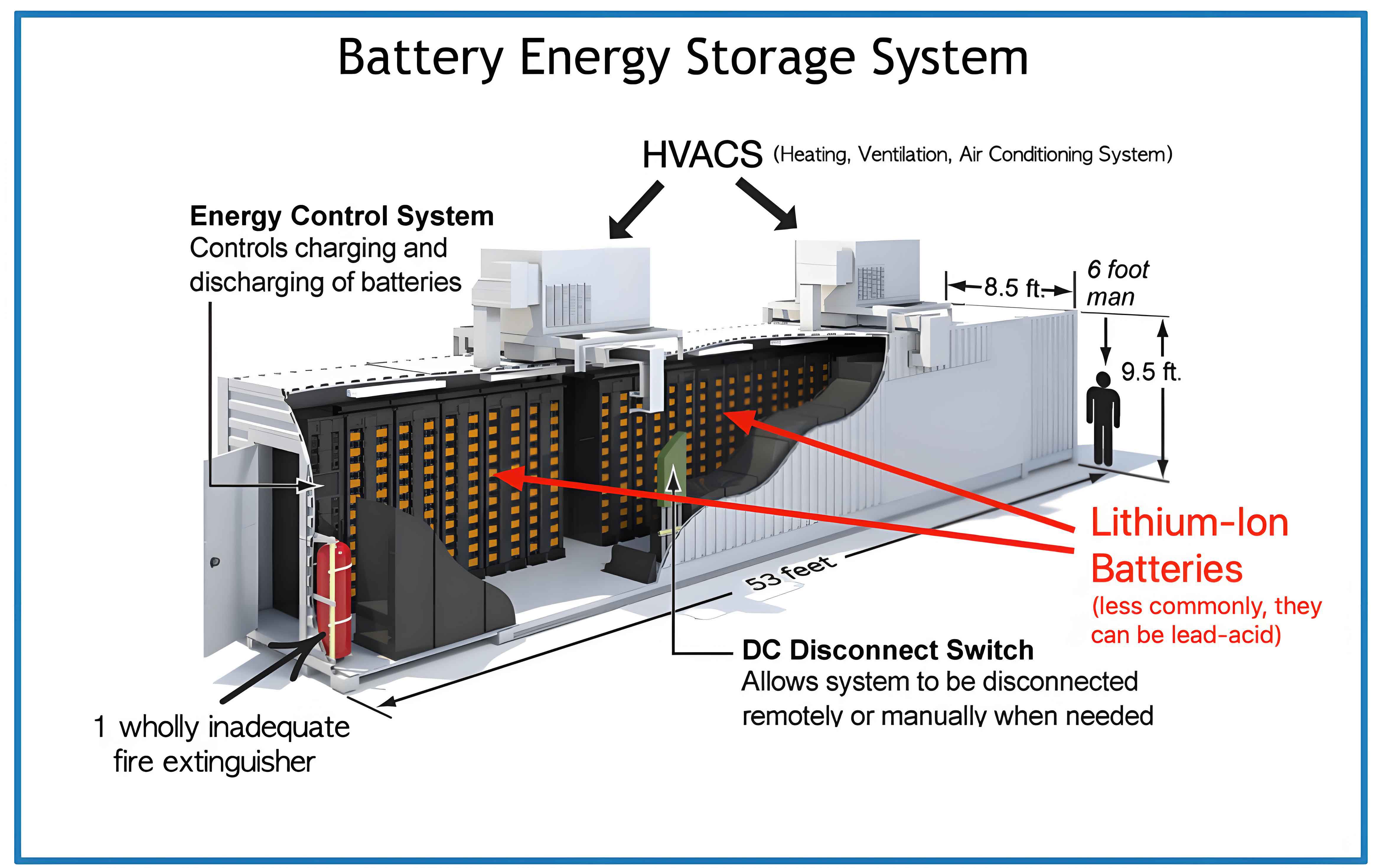
Note that perforation operations involve three rounds per day, leading to a higher total energy use. The maximum daily consumption is 195.888 kW·h for perforation. To ensure reliability, the battery energy storage system capacity is sized with an 80% discharge depth: $$W_{\text{total}} = \frac{195.888}{0.8} \approx 244.86 \text{ kW·h}$$. In practice, we selected a 286 kW·h battery energy storage system pack to provide a safety margin. This battery energy storage system uses lithium iron phosphate (LFP) chemistry, known for its safety, long life, and environmental friendliness. The system is configured with two parallel battery packs to enhance reliability, each capable of supplying the required voltage to the motor drive system. The battery energy storage system design includes 40 standard battery boxes and 2 high-voltage boxes, with a nominal voltage of 700 V and capacity of 204 Ah, totaling 286 kW·h. This battery energy storage system is integral to the vehicle’s operation, ensuring continuous power during extended logging tasks.
Thermal management is crucial for the battery energy storage system to maintain performance and longevity. During charging and discharging, the battery energy storage system generates heat, which must be dissipated to prevent overheating. For this application, a liquid cooling system was chosen over air cooling due to its higher efficiency. The maximum heat dissipation requirement was calculated based on a 0.5C charge/discharge rate, resulting in 4.5 kW of heat generation. Accounting for 20% transmission loss, the required cooling capacity is 5.62 kW, so a 6 kW water chiller was selected. Conversely, in cold environments, the battery energy storage system needs heating to operate effectively. To raise the temperature from -20°C to 10°C, the total heat energy required is 72,801 kJ. Assuming a 1.5-hour warm-up period, the heating power needed is 13.4 kW, leading to the selection of a 14 kW heater. These thermal systems ensure the battery energy storage system remains within optimal temperature ranges, enhancing durability and safety. The integration of such thermal management highlights the sophistication of modern battery energy storage system technology in harsh field conditions.
In conclusion, the application of battery energy storage system in logging vehicles represents a significant advancement towards greener oilfield operations. Through detailed modeling and calculation, I have demonstrated that a battery energy storage system can reliably replace diesel engines, providing sufficient power for winch operations while reducing emissions and noise. The battery energy storage system capacity of 286 kW·h meets the energy demands of both logging and perforation tasks, supported by efficient thermal management. This implementation not only aligns with carbon reduction goals but also offers economic benefits through lower fuel costs and maintenance. Future work could explore larger-scale deployments of battery energy storage system in other oilfield equipment, further leveraging this technology for sustainable development. Overall, the battery energy storage system proves to be a robust solution, paving the way for more eco-friendly practices in the energy sector.