
In the realm of lunar exploration, the battery energy storage system plays a pivotal role in ensuring the uninterrupted operation of probes during the extended lunar night, which lasts up to 14 Earth days. Unlike satellites in Earth orbit, where eclipse periods are relatively short, lunar missions face unique challenges due to prolonged energy deprivation. This scenario heightens the risk of over-discharge in lithium-ion batteries, which are commonly employed for their high energy density and long cycle life. As a researcher focused on advancing battery energy storage system technologies, I have conducted a series of experiments to investigate the effects of over-discharge on battery performance, particularly capacity and self-discharge characteristics. Understanding these impacts is critical for designing robust battery energy storage systems that can withstand the harsh conditions of lunar surfaces, where maintenance and replacement are impractical.
The core of this study revolves around simulating over-discharge conditions akin to those encountered during lunar nights, where parasitic loads or self-discharge might drive battery voltage to zero. By subjecting batteries to controlled over-discharge events using resistive loads, I aimed to quantify the degradation in key performance metrics. The findings not only shed light on the inherent vulnerabilities of battery energy storage systems but also suggest mitigation strategies, such as activation cycles, to restore functionality. This research underscores the importance of optimizing battery energy storage system designs for deep-space missions, where reliability and longevity are paramount.
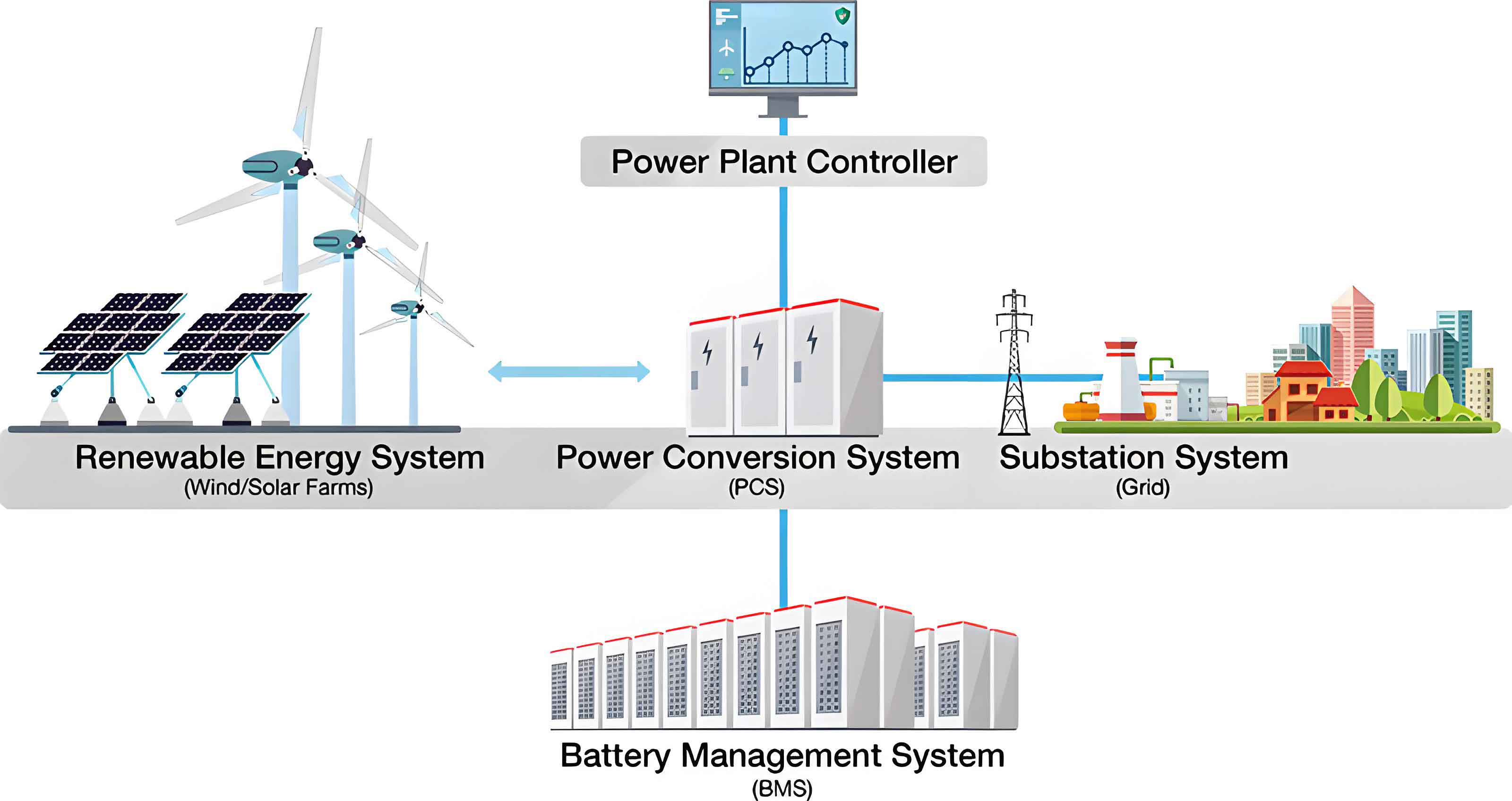
To provide a visual context for the challenges faced by battery energy storage systems in lunar environments, consider the following depiction of an energy storage setup. This illustrates the integration of batteries within a larger system, highlighting the need for robust management against over-discharge.
In this work, I utilized INR3365 series lithium-ion batteries with a nominal capacity of 5 Ah, as they are representative of cells used in space applications. These batteries typically have a discharge cut-off voltage of 2.75 V; discharging below this threshold is defined as over-discharge. The experimental protocol involved multiple phases: initial over-discharge testing, self-discharge evaluations at specific voltages, activation cycles, and post-activation performance assessments. Each phase was designed to mimic real-world scenarios in a battery energy storage system, ensuring that the results are applicable to lunar missions. The overarching goal was to develop a comprehensive model for predicting battery behavior under stress, thereby enhancing the resilience of battery energy storage systems.
The over-discharge tests were performed by connecting batteries to a 1 Ω resistor to simulate a constant load, gradually draining them to 0 V. This method replicates the slow discharge process that might occur during a lunar night due to minimal operational loads. The duration of over-discharge varied across samples, ranging from short periods (e.g., 2 days) to extended ones (up to 286 days), to capture a wide spectrum of degradation effects. Table 1 summarizes the experimental matrix, detailing the over-discharge conditions for each battery. This structured approach allows for a systematic analysis of how time under over-discharge influences the battery energy storage system’s health.
| Battery ID | Over-Discharge Protocol | Duration |
|---|---|---|
| 2655/2656 | Normal discharge to 2.75 V, no over-discharge | 0 days |
| 2650/2654 | Discharge to 200 mV | ~16 hours |
| 430/389 | Discharge to 100 mV, then 1 Ω load to 0 V | 2 days |
| 2626 | Multi-step discharge to 50 mV, then 1 Ω load | 7 days total |
| 501 | Similar multi-step discharge with extended 1 Ω load | 14 days total |
| 409/493 | Discharge to 100 mV, then 1 Ω load to 0 V | 62 days |
| 344/351 | Discharge to 100 mV, then 1 Ω load to 0 V | 128 days |
| 333/425 | Discharge to 100 mV, then 1 Ω load to 0 V | 286 days |
Following over-discharge, I assessed self-discharge characteristics by charging batteries to 3.5 V using a constant current-constant voltage (CC-CV) method and then open-circuit storing them for 14 days. Voltage decay during storage was monitored, with the drop calculated as a metric of self-discharge severity. This phase is crucial for evaluating the stability of a battery energy storage system after a deep discharge event. The voltage decay $\Delta V$ can be expressed as:
$$\Delta V = V_{\text{initial}} – V_{\text{final}}$$
where $V_{\text{initial}}$ is the voltage at the start of storage (3.5 V) and $V_{\text{final}}$ is the voltage after 14 days. A larger $\Delta V$ indicates higher self-discharge, which compromises the efficiency of the battery energy storage system. The results, plotted over time, revealed a clear trend: longer over-discharge durations led to greater voltage drops, implying accelerated self-discharge. For instance, batteries over-discharged for 286 days exhibited a $\Delta V$ of approximately 0.15 V, compared to near-zero drops for normal batteries. This underscores the vulnerability of battery energy storage systems to prolonged over-discharge.
To quantify capacity loss, I performed activation cycles consisting of four charge-discharge loops using a 2-day formation protocol. This process helps reform the solid-electrolyte interphase (SEI) layer, which may degrade during over-discharge. The capacity $C$ in each cycle was measured by discharging at 2.5 A to 2.75 V after charging to progressively higher voltages (3.9 V, 4.0 V, 4.1 V). The capacity fade rate $F$ can be calculated as:
$$F = \frac{C_{\text{initial}} – C_{\text{post}}}{C_{\text{initial}}} \times 100\%$$
where $C_{\text{initial}}$ is the original capacity before testing and $C_{\text{post}}$ is the capacity after activation. Table 2 presents the capacity data and fade rates for all batteries. Notably, over-discharged cells showed minor capacity reductions, typically under 6%, but the decline did not scale linearly with over-discharge time. This suggests that while over-discharge harms the battery energy storage system, the damage may saturate after a certain point, possibly due to equilibrium conditions at near-zero voltage.
| Battery ID | Over-Discharge Duration | Initial Capacity (mAh) | Post-Activation Capacity (mAh) | Capacity Fade Rate (%) |
|---|---|---|---|---|
| 2656 | 0 days | 5565 | 5462 | 1.85 |
| 2655 | 0 days | 5532 | 5438 | 1.70 |
| 2650 | ~16 hours | 5530 | 5454 | 1.37 |
| 2654 | ~16 hours | 5542 | 5468 | 1.33 |
| 389 | 2 days | 5600 | 5512 | 1.57 |
| 430 | 2 days | 5635 | 5495 | 2.48 |
| 2626 | 7 days | 5524 | 5365 | 2.88 |
| 501 | 14 days | 5615 | 5410 | 3.65 |
| 409 | 62 days | 5634 | 5370 | 4.68 |
| 493 | 62 days | 5656 | 5387 | 4.76 |
| 344 | 128 days | 5656 | 5289 | 6.48 |
| 351 | 128 days | 5592 | 5318 | 4.90 |
| 333 | 286 days | 5609 | 5292 | 5.65 |
| 425 | 286 days | 5620 | 5298 | 5.73 |
After activation, I reevaluated self-discharge at 3.5 V to see if the cycles improved performance. The voltage drops decreased significantly compared to pre-activation levels, indicating that reforming the SEI layer mitigated self-discharge. This recovery is vital for battery energy storage systems in lunar applications, where periodic activation might be incorporated into mission protocols to extend lifespan. The self-discharge rate $\eta$ can be modeled as:
$$\eta = \frac{\Delta V}{V_{\text{initial}} \times t} \times 100\%$$
where $t$ is the storage time (14 days). For example, a battery over-discharged for 128 days showed a $\eta$ reduction from 0.43% per day pre-activation to 0.21% post-activation, highlighting the efficacy of activation. This reinforces the concept that a well-designed battery energy storage system should include remedial measures to counteract over-discharge effects.
Further analysis involved charging batteries to 4.1 V and storing them for 14 days to assess self-discharge at full charge. The capacity before and after storage was measured to compute the self-discharge rate $\eta_{\text{cap}}$ based on capacity loss:
$$\eta_{\text{cap}} = \frac{C_{\text{pre-storage}} – C_{\text{post-storage}}}{C_{\text{pre-storage}}} \times 100\%$$
Table 3 summarizes these results, showing that over-discharge duration correlates positively with $\eta_{\text{cap}}$, reaching up to 6.16% for batteries over-discharged for 128 days. This trend emphasizes that over-discharge not only impairs immediate performance but also induces lasting self-discharge, which could deplete a battery energy storage system over multiple lunar cycles. The data suggests that for every 10-day increase in over-discharge, $\eta_{\text{cap}}$ rises by approximately 0.1%, though this relationship may be nonlinear due to complex electrochemical processes.
| Battery ID | Over-Discharge Duration | Capacity Pre-Storage (mAh) | Capacity Post-Storage (mAh) | Self-Discharge Rate (%) |
|---|---|---|---|---|
| 2656 | 0 days | 5474 | 5300 | 3.18 |
| 2655 | 0 days | 5533 | 5311 | 4.01 |
| 2650 | ~16 hours | 5505 | 5362 | 2.60 |
| 2654 | ~16 hours | 5516 | 5355 | 2.92 |
| 389 | 2 days | 5552 | 5317 | 4.23 |
| 430 | 2 days | 5551 | 5300 | 4.52 |
| 2626 | 7 days | 5377 | 5127 | 4.65 |
| 501 | 14 days | 5373 | 5105 | 4.99 |
| 409 | 62 days | 5355 | 5077 | 5.19 |
| 493 | 62 days | 5332 | 5064 | 5.03 |
| 344 | 128 days | 5311 | 5026 | 5.37 |
| 351 | 128 days | 5355 | 5025 | 6.16 |
| 333 | 286 days | 5317 | 5035 | 5.30 |
| 425 | 286 days | 5292 | 5001 | 5.50 |
To delve deeper into the degradation mechanisms, I analyzed copper (Cu) content in the anodes of select over-discharged batteries using atomic emission spectroscopy. During over-discharge, the anode potential rises sufficiently to oxidize Cu current collectors, leading to Cu dissolution and subsequent deposition on the cathode, which can cause internal short circuits. The Cu content $w_{\text{Cu}}$ was measured as a percentage of the anode mass. As shown in Table 4, over-discharged batteries had detectable Cu, but the levels did not increase proportionally with time, possibly because the reaction kinetics slow as voltage approaches zero. This phenomenon can be described by the Nernst equation for Cu oxidation:
$$E = E^0 – \frac{RT}{nF} \ln Q$$
where $E$ is the electrode potential, $E^0$ is the standard potential, $R$ is the gas constant, $T$ is temperature, $n$ is the number of electrons transferred, $F$ is Faraday’s constant, and $Q$ is the reaction quotient. As $E$ nears zero, the driving force for Cu oxidation diminishes, limiting further dissolution. This insight is crucial for modeling failure modes in battery energy storage systems.
| Battery ID | Over-Discharge Duration | Copper Content (%) |
|---|---|---|
| 2626 | 7 days | 0.4 |
| 493 | 62 days | 1.2 |
| 344 | 128 days | 1.1 |
Dissection of over-discharged batteries revealed physical damage, particularly anode active material detachment near the cell core. This “dusting” effect reduces the interfacial contact between the electrode and current collector, increasing internal resistance $R_{\text{int}}$ and contributing to capacity fade. The resistance rise can be approximated by:
$$R_{\text{int}} = R_{\text{initial}} + \Delta R_{\text{detachment}}$$
where $\Delta R_{\text{detachment}}$ scales with the extent of material loss. Such degradation underscores the need for robust electrode designs in battery energy storage systems to withstand mechanical stress during over-discharge.
Additionally, I conducted cycle life tests on a subset of batteries to evaluate long-term performance after over-discharge. The cells underwent 40 cycles at 100% depth of discharge (DOD) between 3.0 V and 4.2 V. The capacity retention $R_{\text{cycle}}$ after $N$ cycles can be expressed as:
$$R_{\text{cycle}} = \frac{C_N}{C_1} \times 100\%$$
where $C_N$ is the capacity at cycle $N$ and $C_1$ is the initial capacity. The results indicated that batteries subjected to over-discharge for up to 7 days exhibited similar retention trends to normal cells, suggesting that activation cycles can largely restore cycle stability. This resilience is promising for battery energy storage systems in lunar missions, where periodic deep discharges might occur.
In summary, this study highlights the significant impact of over-discharge on battery energy storage systems for lunar exploration. Key findings include: (1) Self-discharge accelerates with over-discharge duration but can be mitigated through activation; (2) Capacity fade is modest and non-linear with time, plateauing after extended periods; (3) Copper dissolution and anode detachment are primary degradation mechanisms; and (4) Activation cycles effectively recover performance, supporting the integration of remedial protocols in battery energy storage system management. These insights inform the design of more durable batteries, ensuring reliable power during prolonged lunar nights. Future work should focus on real-time monitoring and adaptive charging strategies to prevent over-discharge, ultimately advancing battery energy storage system technology for deep-space applications.
The implications for lunar missions are profound. A battery energy storage system that can endure over-discharge without catastrophic failure will enhance mission longevity and reduce risks. By incorporating the findings into battery management algorithms, engineers can optimize charging-discharging profiles, perhaps using models that predict voltage decay based on over-discharge history. For instance, the self-discharge rate $\eta$ could be dynamically adjusted using an empirical formula:
$$\eta(t_{\text{od}}) = \eta_0 + k \cdot \ln(1 + t_{\text{od}})$$
where $\eta_0$ is the baseline rate, $k$ is a constant, and $t_{\text{od}}$ is the over-discharge duration. Such models would allow proactive maintenance of battery energy storage systems, crucial for autonomous operations on the Moon.
In conclusion, the resilience of battery energy storage systems under over-discharge conditions is a critical factor for the success of lunar exploration. Through systematic testing and analysis, this research provides a foundation for improving battery designs and management strategies. As we venture further into space, developing robust battery energy storage systems will remain a cornerstone of mission planning, ensuring that power is always available when needed most.