
As the global energy landscape shifts towards renewable sources, the integration of intermittent resources like solar and wind power necessitates robust grid support mechanisms. Among these, battery energy storage systems have emerged as a pivotal technology, providing essential services such as peak shaving and frequency regulation to enhance grid stability and efficiency. In my research, I focus on lithium iron phosphate (LiFePO₄) batteries, which are widely adopted in battery energy storage systems due to their high energy density, thermal stability, and safety profile. However, the operational demands of grid services—particularly the varying current rates and cyclic stresses in peak shaving and frequency regulation modes—pose significant challenges to battery longevity and thermal management. Understanding the thermal behavior and aging characteristics of these battery energy storage systems under realistic conditions is crucial for optimizing their deployment and ensuring safe, reliable operation. This study aims to bridge this gap by developing a comprehensive thermal simulation model and conducting experimental validation based on actual grid operation scenarios.
To delve into the thermal dynamics, I first established a finite element simulation model for a LiFePO₄ battery module, replicating the specifications used in practical battery energy storage systems. The module consists of eight 220 Ah cells connected in series, each with dimensions of 350 mm × 150 mm × 60 mm. The electrothermal coupling was modeled using fundamental principles of battery heat generation and heat transfer. The heat generation rate in a single cell, denoted as \( q \), is derived from the energy balance during charge and discharge cycles, expressed as:
$$ q = \frac{I}{V} \left( (E_0 – E) + T \frac{dE_0}{dT} \right) = \frac{I}{V} \left( IR + T \frac{dE_0}{dT} \right) $$
where \( I \) is the current (A), \( V \) is the cell volume (m³), \( E_0 \) is the open-circuit voltage (V), \( E \) is the terminal voltage (V), \( T \) is the absolute temperature (K), \( R \) is the ohmic resistance (Ω), and \( \frac{dE_0}{dT} \) is the temperature coefficient of the open-circuit voltage. For LiFePO₄ cells, typical parameter values were assigned: density \( \rho = 2200 \, \text{kg/m}^3 \), specific heat capacity \( c = 1000 \, \text{J/(kg·K)} \), and anisotropic thermal conductivities \( \lambda_x = \lambda_y = \lambda_z = 1.5 \, \text{W/(m·K)} \). The heat transfer within the battery module is governed by the three-dimensional unsteady heat conduction equation:
$$ \rho c \frac{\partial T}{\partial t} = \lambda_x \frac{\partial^2 T}{\partial x^2} + \lambda_y \frac{\partial^2 T}{\partial y^2} + \lambda_z \frac{\partial^2 T}{\partial z^2} + q $$
I implemented this model in COMSOL Multiphysics, coupling the lithium-ion battery module with the heat transfer in solids module. The mesh was finely discretized to capture temperature gradients, and boundary conditions were set to simulate natural convection with a heat transfer coefficient of \( h = 5 \, \text{W/(m}^2 \cdot \text{K)} \) at an ambient temperature of 25°C. The current profiles for peak shaving and frequency regulation were imported from actual operation data of a battery energy storage station in Jiangsu, China, covering a simulation period of 30,000 to 40,000 seconds. These profiles represent realistic scenarios: peak shaving involves near-constant charge-discharge cycles at around 0.5C, while frequency regulation entails rapid, shallow cycles with current rates fluctuating up to 0.5C but averaging 0.18C.
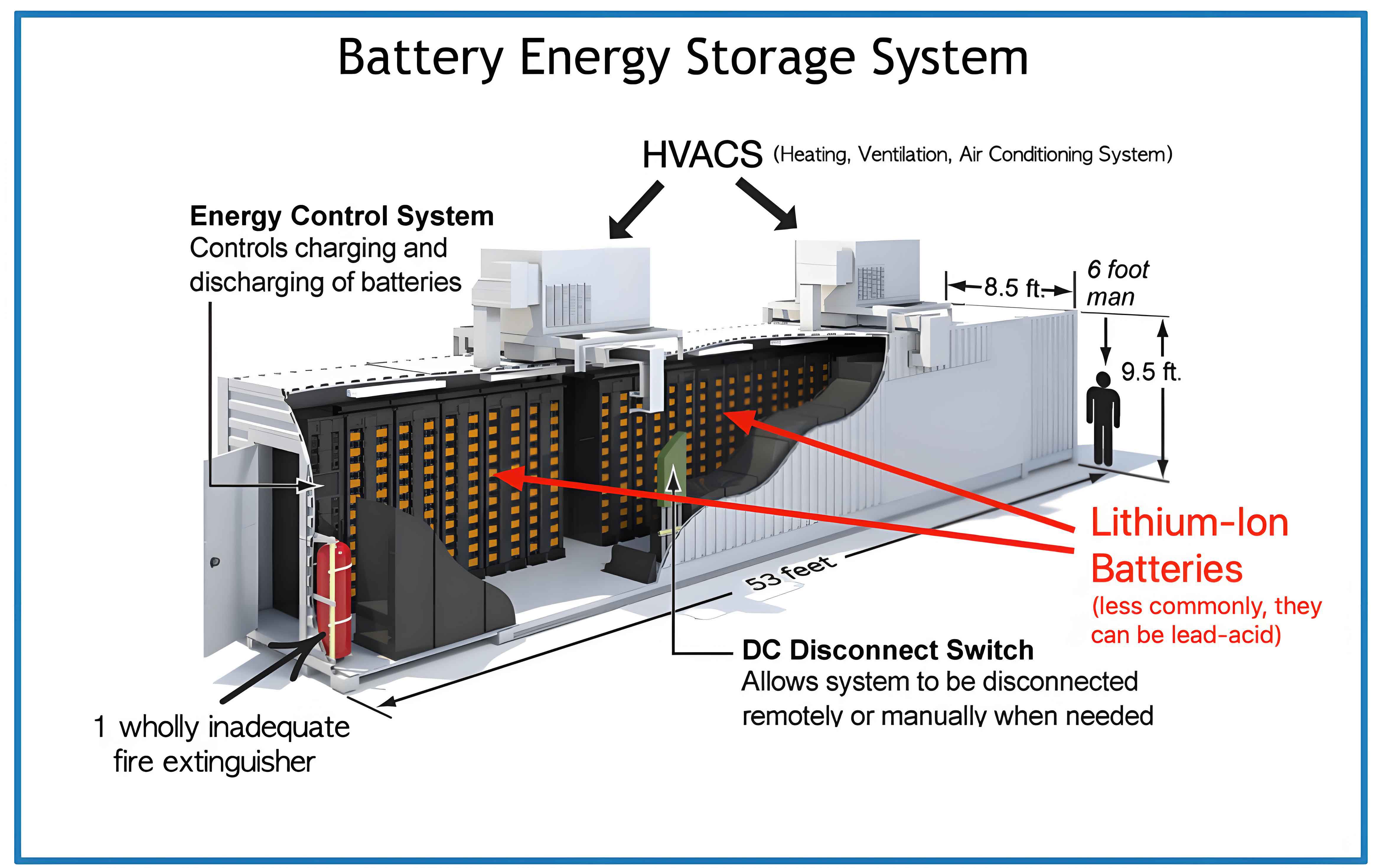
Complementing the simulation, I designed an experimental setup to validate the thermal model and assess the long-term performance of battery energy storage systems under these grid service modes. The test platform included a battery module identical to the simulation specifications, comprising eight series-connected 220 Ah LiFePO₄ cells with a nominal voltage of 25.6 V. The module was housed in a temperature-controlled chamber maintained at 25°C, and a battery testing system (BT60V300AC2) was used to apply the current profiles. Temperature sensors were attached to each cell’s terminals to monitor real-time thermal variations, while voltage and current data were logged continuously. The experimental protocol involved cyclic aging tests: for peak shaving, the state of charge (SOC) ranged from 10% to 90% over 3–4 hours per cycle; for frequency regulation, the SOC varied within the same range but over 23–26 hours per cycle due to lower average currents. Capacity checks were periodically conducted to track health state (SOH) degradation, calculated as:
$$ \text{SOH} = \frac{C_{\text{current}}}{C_{\text{nominal}}} \times 100\% $$
where \( C_{\text{current}} \) is the measured capacity and \( C_{\text{nominal}} \) is the initial capacity (220 Ah). This dual approach—simulation and experiment—allows for a holistic analysis of thermal behavior and aging in battery energy storage systems.
The simulation results revealed distinct thermal patterns for peak shaving and frequency regulation modes. In peak shaving, the higher average current rate (0.5C) led to significant heat accumulation, particularly in the central cells of the module. The temperature distribution showed a gradient from the center to the edges, with maximum temperatures reaching up to 35.3°C and a temperature difference of approximately 4.7°C within the module. This can be attributed to the reduced heat dissipation in inner cells and the continuous high-current cycling. In contrast, frequency regulation exhibited milder thermal effects due to the lower average current (0.18C); temperatures remained between 26°C and 28°C, with minimal gradients and a maximum temperature difference of around 3°C. The transient temperature profiles from simulation, summarized in Table 1, highlight these disparities over key time intervals.
| Operation Mode | Average Temperature Range (°C) | Maximum Temperature (°C) | Maximum Temperature Difference (°C) | Simulation Time (s) |
|---|---|---|---|---|
| Peak Shaving | 30.5 – 35.3 | 35.3 | 4.7 | 30,000 – 40,000 |
| Frequency Regulation | 26.2 – 27.5 | 27.5 | 3.0 | 30,000 – 40,000 |
Experimentally, the thermal data corroborated the simulation trends. For peak shaving, the module’s average temperature stabilized around 32-37°C after initial cycles, with cell-to-cell differences up to 6°C, slightly higher than simulated values due to real-world factors like cell inconsistencies and sensor accuracy. In frequency regulation, temperatures hovered near 26-28°C, aligning closely with simulations. A comparative analysis of simulated versus experimental average temperatures, as shown in Table 2, demonstrates the model’s accuracy with errors below 1.8°C, validating its utility for predicting thermal behavior in battery energy storage systems.
| Mode | Simulated Average Temperature (°C) | Experimental Average Temperature (°C) | Absolute Error (°C) |
|---|---|---|---|
| Peak Shaving | 33.5 | 35.0 | 1.5 |
| Frequency Regulation | 26.8 | 27.3 | 0.5 |
Beyond thermal aspects, the aging behavior of battery energy storage systems under these modes was critically assessed. Over approximately 750 hours of testing, the cumulative discharge capacity and SOH were monitored. Table 3 presents the experimental data for both modes at various cycle counts. Notably, at a similar total discharge capacity of around 18,000 Ah, the peak shaving mode exhibited a more pronounced capacity fade (SOH of 98.1%) compared to frequency regulation (SOH of 99.6%). This degradation can be modeled using an empirical aging equation that relates capacity loss to current stress and thermal exposure:
$$ \Delta C = k \cdot I_{\text{avg}}^n \cdot \exp\left(-\frac{E_a}{RT}\right) \cdot t $$
where \( \Delta C \) is the capacity loss, \( k \) is a pre-exponential factor, \( I_{\text{avg}} \) is the average current rate, \( n \) is the stress exponent (typically ~1 for LiFePO₄), \( E_a \) is the activation energy, \( R \) is the universal gas constant, \( T \) is temperature, and \( t \) is time. The higher \( I_{\text{avg}} \) in peak shaving (0.5C versus 0.18C) accelerates lithium-ion de/intercalation, leading to faster degradation of active materials. Additionally, the elevated temperatures in peak shaving exacerbate side reactions, further shortening battery lifespan. This underscores the importance of thermal management in optimizing the longevity of battery energy storage systems.
| Mode | Cycle Count | Total Discharge Capacity (Ah) | Remaining Capacity (Ah) | SOH (%) |
|---|---|---|---|---|
| Peak Shaving | 67 | 11,062.5 | 237.9 | 99.5 |
| 100 | 18,124.3 | 234.1 | 98.1 | |
| 186 | 33,257.2 | 232.0 | 97.2 | |
| 236 | 42,303.6 | 230.3 | 96.6 | |
| Frequency Regulation | 10 | 5,698.1 | 239.8 | 100.0 |
| 20 | 11,887.1 | 238.6 | 99.6 | |
| 30 | 17,900.1 | 238.3 | 99.4 |
To further explore the implications for battery energy storage systems, I extended the simulation to a high-rate frequency regulation scenario, where the average current was increased to 0.5C with peaks up to 1.2C. This mode, though not standard in practice, was analyzed to assess thermal risks. The results, summarized in Table 4, show that temperatures surged to 37.9°C with a maximum difference of 4.5°C, exceeding those in normal peak shaving. This highlights the trade-off between grid response speed and battery safety: higher currents improve frequency regulation agility but can induce thermal runaway risks and accelerate aging. Thus, for sustainable operation, battery energy storage systems should adhere to recommended current limits, such as the 0.5C threshold for 220 Ah cells in grid services.
| Parameter | Value |
|---|---|
| Average Current Rate | 0.5C |
| Maximum Current Rate | 1.2C |
| Simulation Duration | 16,000 s |
| Maximum Temperature | 37.9°C |
| Minimum Temperature | 33.4°C |
| Maximum Temperature Difference | 4.5°C |
The thermal uniformity within battery energy storage systems is another critical factor influencing performance. From both simulation and experiment, I derived a non-dimensional parameter, the thermal homogeneity index \( \Theta \), defined as:
$$ \Theta = 1 – \frac{\Delta T_{\text{max}}}{T_{\text{avg}}} $$
where \( \Delta T_{\text{max}} \) is the maximum temperature difference and \( T_{\text{avg}} \) is the average module temperature. For peak shaving, \( \Theta \) ranged from 0.85 to 0.87, indicating moderate homogeneity, while frequency regulation achieved \( \Theta \) values of 0.89 to 0.91, reflecting better thermal consistency. This index can guide the design of cooling strategies for battery energy storage systems, such as enhanced airflow or liquid cooling, to maintain \( \Theta \) above 0.9 for optimal life and safety.
In discussing the broader applications, the findings emphasize that battery energy storage systems must be tailored to specific grid roles. For peak shaving, where high energy throughput is required, thermal management systems should prioritize heat dissipation from central cells to mitigate hotspots. In frequency regulation, the focus can shift towards minimizing cycling losses and maintaining low average temperatures. Moreover, the simulation model developed here offers a predictive tool for early-stage design and risk assessment of battery energy storage systems, enabling operators to simulate various scenarios before deployment. For instance, by inputting different current profiles, one can forecast temperature rises and plan cooling infrastructure accordingly, reducing the need for costly retrofits.
Looking ahead, advancements in battery energy storage systems could integrate real-time thermal monitoring with adaptive control algorithms. Using the heat generation equation \( q \) and thermal model, a dynamic management system could adjust current rates based on temperature feedback, optimizing both grid service performance and battery health. This approach aligns with the trend towards smart grids, where battery energy storage systems act as responsive assets. Additionally, the aging model presented can be refined with machine learning techniques to predict SOH degradation under complex multi-stress conditions, further enhancing the reliability of battery energy storage systems.
In conclusion, this study provides a comprehensive analysis of thermal and aging behaviors in battery energy storage systems operating under peak shaving and frequency regulation modes. Through finite element simulation and experimental validation, I demonstrated that peak shaving, with its higher average current rates, leads to elevated temperatures and faster capacity fade compared to frequency regulation. The thermal model showed good accuracy, with errors within 1.8°C, making it a valuable tool for designing and operating battery energy storage systems. Key recommendations include adhering to current rate limits, implementing targeted cooling for peak shaving applications, and leveraging simulation for proactive thermal management. As battery energy storage systems continue to play a vital role in grid stability, such insights will be crucial for maximizing their efficiency, safety, and lifespan in the evolving energy landscape.