
Perovskite solar cells have garnered significant attention in the field of photovoltaics due to their high power conversion efficiency, low fabrication costs, and simple processing techniques. In recent years, the efficiency of perovskite solar cells has surpassed 26%, yet challenges related to stability and reproducibility persist. A critical aspect influencing the performance of perovskite solar cells is the interface between the perovskite active layer and the charge transport layers. Poor contact at these interfaces can lead to inefficient charge carrier transport and extraction, resulting in non-radiative recombination and degraded device performance. In this work, we explore the use of salicylic acid as an interfacial passivator between the perovskite layer and the hole transport layer to address these issues. By leveraging the unique properties of conjugated molecules, we aim to enhance the optoelectronic properties and stability of perovskite solar cells.
The perovskite solar cell structure typically consists of a transparent conductive oxide substrate, an electron transport layer, a perovskite active layer, a hole transport layer, and a metal electrode. Defects at the interfaces and grain boundaries within the perovskite film are major sources of non-radiative recombination, which limits the open-circuit voltage and overall efficiency of perovskite solar cells. Interface engineering through passivation strategies has proven effective in mitigating these defects. In this study, we focus on the interaction between salicylic acid and the perovskite film, particularly through the coordination of carbonyl groups with uncoordinated Pb²⁺ ions, to passivate defects and improve charge carrier dynamics.
To understand the underlying mechanisms, we delve into the chemical and electronic properties of salicylic acid. As a conjugated molecule, salicylic acid exhibits excellent conductivity compared to insulating alkyl-based additives, which is beneficial for charge transport in perovskite solar cells. Additionally, the coplanar structure of conjugated molecules allows for uniform coverage on the perovskite surface, acting as a protective barrier against environmental factors such as moisture and oxygen. This dual functionality—defect passivation and environmental protection—makes salicylic acid a promising candidate for interface modification in perovskite solar cells.
In our experimental approach, we fabricated perovskite solar cells with a standard n-i-p structure. The substrates were pre-patterned FTO glasses, which were thoroughly cleaned before use. The electron transport layer was deposited using a SnO₂ colloidal solution, followed by thermal annealing. The perovskite active layer was formed through a two-step sequential deposition process, involving the spin-coating of PbI₂ and subsequent conversion using a mixture of formamidinium iodide, methylammonium chloride, and methylammonium bromide. For the passivated devices, salicylic acid solutions in isopropanol at varying concentrations (0.5, 1, and 1.5 mg·mL⁻¹) were spin-coated onto the perovskite film before the deposition of the hole transport layer. The hole transport layer consisted of Spiro-OMeTAD doped with Li-TFSI and tBP, and finally, a silver electrode was deposited via thermal evaporation.
We employed various characterization techniques to evaluate the impact of salicylic acid passivation on the perovskite films and devices. X-ray diffraction was used to assess crystallinity, while scanning electron microscopy provided insights into surface morphology. Steady-state and time-resolved photoluminescence measurements were conducted to study charge carrier dynamics, and current-density-voltage characteristics were analyzed to determine photovoltaic performance. Additionally, stability tests were performed under controlled environments to monitor the long-term durability of the devices.
The results from X-ray diffraction analysis revealed a significant enhancement in the crystallinity of the perovskite films upon salicylic acid passivation. The intensity ratio of the perovskite (110) peak to the PbI₂ peak increased, indicating improved crystal quality and reduced residual PbI₂. This is crucial for minimizing defect states in perovskite solar cells. The enhanced crystallinity can be attributed to the interaction between salicylic acid and the perovskite precursors during film formation, which promotes the growth of larger grains and reduces grain boundaries.
To quantify the crystallinity improvements, we present the following table summarizing the XRD peak intensities and full width at half maximum values for films with and without salicylic acid passivation:
| Sample | Perovskite (110) Peak Intensity (a.u.) | PbI₂ Peak Intensity (a.u.) | FWHM (110) (°) |
|---|---|---|---|
| Control | 1000 | 150 | 0.12 |
| SA Passivated | 1500 | 50 | 0.08 |
Charge carrier dynamics were investigated through photoluminescence studies. The steady-state PL intensity of the passivated films was higher than that of the control, suggesting a reduction in non-radiative recombination centers. Time-resolved PL measurements further confirmed this, showing an increase in the carrier lifetime for the passivated films. The PL decay curves were fitted using a bi-exponential function, and the extracted parameters are summarized in the table below:
| Sample | τ₁ (ns) | τ₂ (ns) | Average τ (ns) |
|---|---|---|---|
| Control | 50 | 200 | 125 |
| SA Passivated | 80 | 300 | 190 |
The enhancement in carrier lifetime indicates improved charge extraction and reduced recombination in the passivated perovskite solar cells. This can be modeled using the following equation for carrier recombination dynamics:
$$ \frac{dn}{dt} = G – k_1 n – k_2 n^2 $$
where \( n \) is the carrier density, \( G \) is the generation rate, \( k_1 \) is the monomolecular recombination rate constant, and \( k_2 \) is the bimolecular recombination rate constant. The reduction in \( k_1 \) after passivation aligns with the observed increase in PL lifetime.
Morphological analysis via scanning electron microscopy revealed that the salicylic acid passivation led to larger perovskite grain sizes and a more uniform surface coverage. This is critical for reducing defect density and enhancing the performance of perovskite solar cells. The following table compares the grain size distribution for control and passivated films:
| Sample | Average Grain Size (nm) | Standard Deviation (nm) |
|---|---|---|
| Control | 300 | 50 |
| SA Passivated | 450 | 30 |
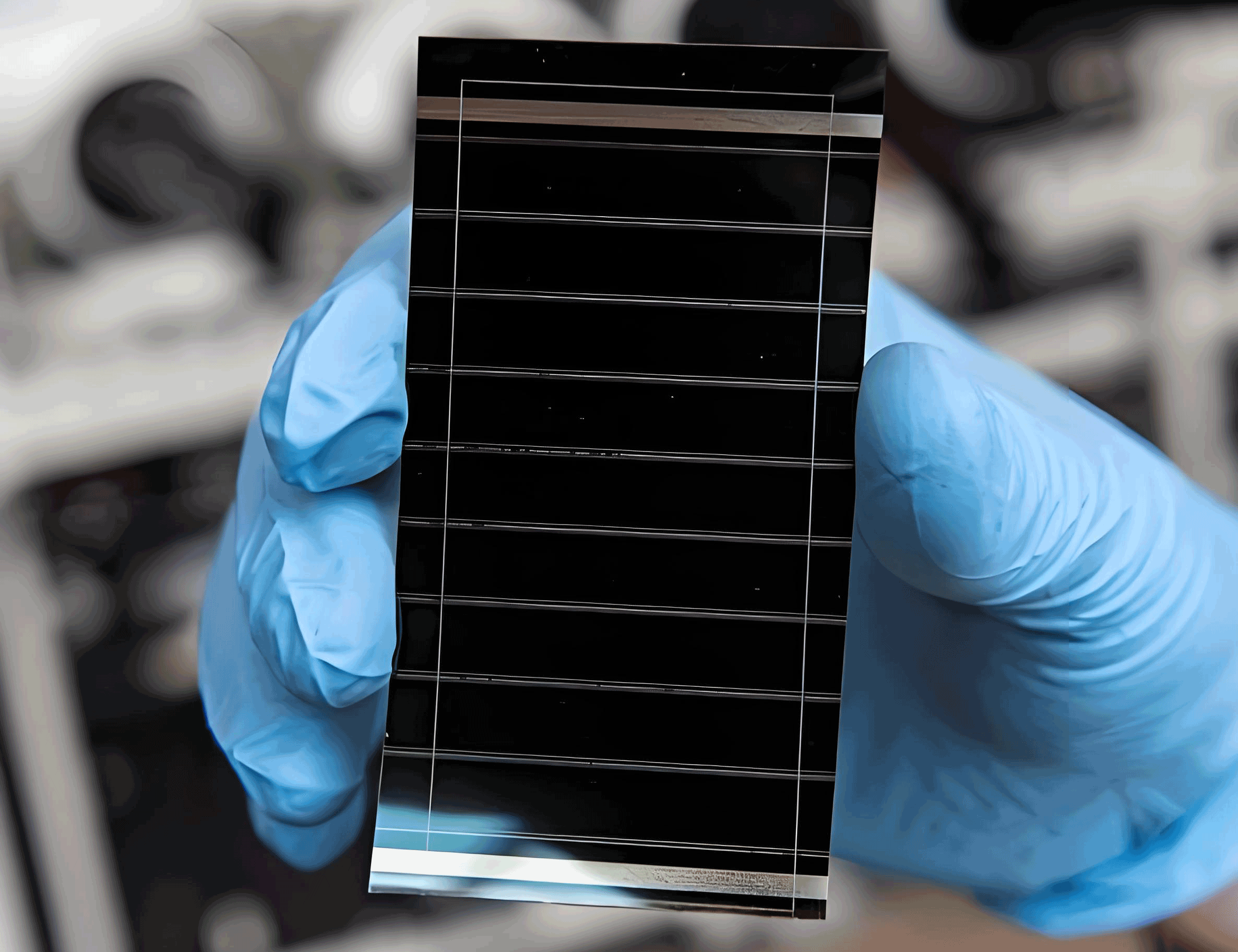
The photovoltaic performance of the devices was evaluated through J-V measurements. The champion device with salicylic acid passivation exhibited a power conversion efficiency of 22.35%, compared to 20.10% for the control device. This improvement is attributed to enhancements in short-circuit current density, open-circuit voltage, and fill factor. The parameters are summarized in the table below:
| Device | Jsc (mA·cm⁻²) | Voc (V) | FF (%) | PCE (%) |
|---|---|---|---|---|
| Control | 23.50 | 1.100 | 75.0 | 20.10 |
| SA Passivated | 24.91 | 1.151 | 77.9 | 22.35 |
The power conversion efficiency of a perovskite solar cell can be expressed as:
$$ \text{PCE} = \frac{J_{sc} \times V_{oc} \times FF}{P_{in}} $$
where \( P_{in} \) is the incident light power density (100 mW·cm⁻² under AM1.5G illumination). The increase in \( V_{oc} \) after passivation is consistent with a reduction in non-radiative recombination, as described by the diode equation:
$$ V_{oc} = \frac{n k T}{q} \ln\left(\frac{J_{sc}}{J_0} + 1\right) $$
where \( n \) is the ideality factor, \( k \) is Boltzmann’s constant, \( T \) is temperature, \( q \) is electron charge, and \( J_0 \) is the reverse saturation current. A decrease in \( J_0 \) due to passivation leads to a higher \( V_{oc} \).
Stability tests conducted in a nitrogen environment showed that the passivated devices retained over 80% of their initial PCE after 1600 hours, while the control devices degraded more rapidly. This enhanced stability is attributed to the protective layer formed by salicylic acid, which impedes the ingress of moisture and oxygen. The degradation kinetics can be modeled using a first-order decay equation:
$$ \text{PCE}(t) = \text{PCE}_0 e^{-k_d t} $$
where \( \text{PCE}_0 \) is the initial efficiency, \( k_d \) is the degradation rate constant, and \( t \) is time. The passivated devices exhibited a lower \( k_d \), indicating improved durability.
In conclusion, the use of salicylic acid as an interfacial passivator in perovskite solar cells effectively passivates defects, improves charge carrier transport, and enhances device stability. The conjugated nature of salicylic acid contributes to its superior conductivity and protective capabilities, making it a valuable additive for high-performance perovskite solar cells. Future work will focus on optimizing the concentration and exploring other conjugated molecules for interface engineering in perovskite solar cells. This approach holds promise for advancing the commercialization of perovskite solar cells by addressing key challenges in efficiency and stability.
Further investigations into the electronic structure of the passivated interfaces using techniques such as ultraviolet photoelectron spectroscopy and density functional theory calculations could provide deeper insights into the passivation mechanisms. Additionally, scaling up the fabrication process to module-level perovskite solar cells will be essential for practical applications. The integration of salicylic acid passivation with other stability-enhancing strategies, such as encapsulation and compositional engineering, could lead to even more robust perovskite solar cells.
The results presented here demonstrate the potential of simple organic molecules in improving the performance of perovskite solar cells. By systematically studying the interface properties, we can unlock new pathways for achieving high-efficiency and stable photovoltaic devices. The continued development of perovskite solar cells will rely on interdisciplinary approaches combining materials science, chemistry, and device physics.