
In recent years, perovskite solar cells have achieved remarkable progress, with power conversion efficiencies exceeding 26% for organic-inorganic hybrid variants. However, the stability of these devices remains a critical challenge for commercialization. Among the various factors affecting stability, environmental humidity during fabrication and operation plays a pivotal role. In this study, I investigate the influence of humidity on the formation and performance of CsPbIBr2 perovskite solar cells, focusing on the crystallization kinetics, phase transitions, and defect formation mechanisms. The insights gained from this work aim to provide guidance for optimizing fabrication conditions and enhancing the long-term stability of perovskite solar cells.
CsPbIBr2, a fully inorganic perovskite material, is considered an ideal candidate for top cells in tandem solar cells due to its suitable bandgap and thermal stability. However, its sensitivity to moisture often leads to phase instability and degradation, limiting practical applications. I systematically examined the effects of relative humidity (RH) ranging from 0% to 60% on the film formation process, structural properties, and photovoltaic performance. The results reveal that humidity accelerates crystallization but can also induce defects and reduce film coverage, ultimately impacting the efficiency and durability of perovskite solar cells.
The precursor solution for CsPbIBr2 was prepared by dissolving PbBr2 and CsI in dimethyl sulfoxide (DMSO) at a 1:1 molar ratio, stirred at 60°C for 4 hours. Films were spin-coated under controlled humidity conditions and annealed at 40°C for 1 minute followed by 280°C for 5 minutes. The device structure consisted of FTO/c-TiO2/CsPbIBr2/Spiro-OMeTAD/Ag, fabricated in environments with varying RH levels. Characterization techniques included UV-Vis spectroscopy, X-ray diffraction (XRD), scanning electron microscopy (SEM), X-ray photoelectron spectroscopy (XPS), photoluminescence (PL) spectroscopy, and electrochemical impedance spectroscopy (EIS).
Under humid conditions, water molecules interact with DMSO in the precursor solution, forming PbBr2•DMSO–H2O complexes. This interaction enhances the mobility of CsI ions, facilitating the phase transition to α-CsPbIBr2 even at low temperatures (40°C). The crystallization process can be described by the following kinetic equation: $$ \frac{dX}{dt} = k (1 – X)^n $$ where \( X \) is the fraction of crystallized material, \( k \) is the rate constant, and \( n \) is the Avrami exponent. Humidity increases \( k \), leading to faster nucleation and growth. However, at RH above 40%, excessive moisture promotes the formation of larger intermediate phases like 2PbBr2•2DMSO–H2O, which hinder the conversion to 3D perovskite structures and reduce film continuity.
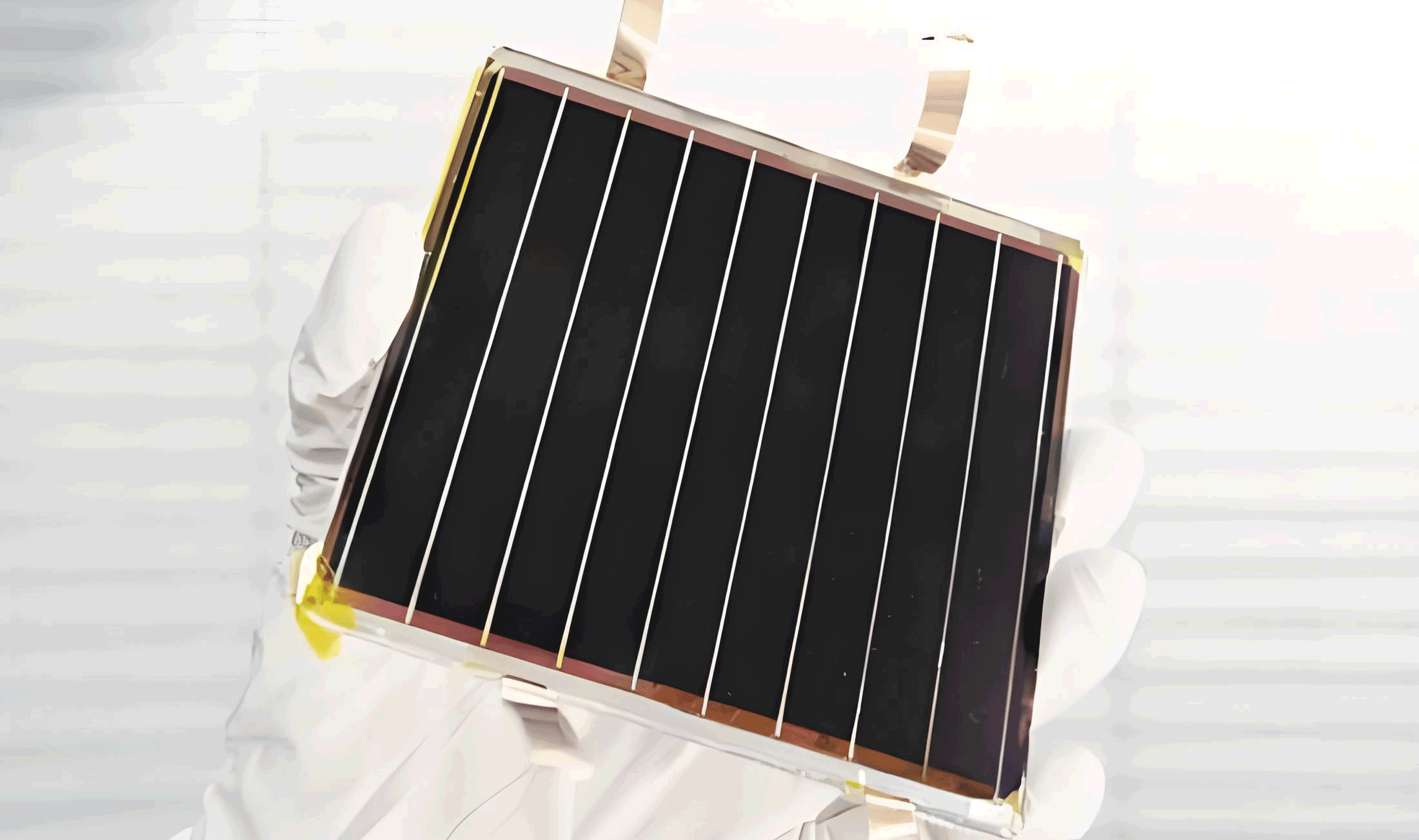
The optical properties of CsPbIBr2 films were significantly affected by humidity. UV-Vis spectra showed a red-shift in absorption onset with increasing RH, indicating changes in bandgap and phase composition. The Tauc plot method was used to determine the optical bandgap: $$ (\alpha h\nu)^2 = A (h\nu – E_g) $$ where \( \alpha \) is the absorption coefficient, \( h\nu \) is photon energy, \( A \) is a constant, and \( E_g \) is the bandgap. For films prepared at RH 0%, the bandgap was approximately 2.10 eV, corresponding to α-CsPbIBr2. At higher humidity levels, additional absorption features appeared, suggesting phase segregation and the formation of secondary compounds like CsPbI1+XBr2+2X.
XRD analysis confirmed that humidity lowers the energy barrier for α-phase formation. In dry conditions (RH 0%), the film primarily consisted of CsI-PbBr2•DMSO intermediates, which transformed into α-CsPbIBr2 after high-temperature annealing. In contrast, under humid conditions, α-phase formation occurred at lower temperatures due to the presence of PbBr2•DMSO–H2O complexes. The crystallite size and orientation were also influenced, with films transitioning from (100) and (200) facets to (110) facets as humidity increased, eventually leading to δ-phase formation over time.
Film morphology, as observed by SEM, evolved from dense, continuous layers at low humidity to discontinuous networks and islands at high humidity. This reduction in coverage directly impacted the performance of perovskite solar cells. The defect density in the films was quantified using space-charge-limited current (SCLC) measurements. The trap density \( n_{\text{trap}} \) was calculated as: $$ n_{\text{trap}} = \frac{2 V_{\text{TFL}} \epsilon_r \epsilon_0}{q L^2} $$ where \( V_{\text{TFL}} \) is the trap-filled limit voltage, \( \epsilon_r \) is the relative permittivity (8 for CsPbIBr2), \( \epsilon_0 \) is the vacuum permittivity, \( q \) is the electron charge, and \( L \) is the film thickness. The results showed an increase in defect density with humidity, from \( 2.54 \times 10^{15} \) cm⁻³ at RH 0% to \( 1.46 \times 10^{16} \) cm⁻³ at RH 40%, due to enhanced Pb⁰ defect formation and halide volatilization.
XPS analysis revealed chemical changes on the film surface. In dry conditions, O 1s peaks indicated the presence of O₂ molecules, while under humidity, O₂⁻ species were detected, reacting with Pb⁰ defects to form PbO. This oxidation process passivated defects but also contributed to phase instability. The atomic percentages of elements shifted with humidity, as summarized in Table 1.
| RH (%) | Cs (%) | Pb (%) | I (%) | Br (%) | O (%) |
|---|---|---|---|---|---|
| 0 | 12.67 | 27.90 | 11.49 | 47.21 | 0.73 |
| 15 | 11.64 | 25.94 | 10.57 | 43.53 | 7.57 |
| 25 | 10.84 | 25.00 | 10.88 | 38.20 | 15.08 |
| 40 | 9.98 | 27.19 | 11.36 | 33.82 | 17.66 |
| 60 | 10.83 | 24.10 | 10.20 | 33.16 | 25.13 |
The photovoltaic performance of CsPbIBr2 perovskite solar cells deteriorated with increasing humidity. Current-density-voltage (J-V) measurements under AM1.5G illumination showed a decline in power conversion efficiency (PCE) from 10.79% at RH 0% to 0.10% at RH 60%. This was primarily due to reductions in short-circuit current density (Jsc) and open-circuit voltage (Voc), as detailed in Table 2. The fill factor (FF) also decreased at higher humidity levels, indicating increased series resistance and charge recombination.
| RH (%) | PCE (%) | Jsc (mA/cm²) | Voc (V) | FF (%) | Rs (Ω) | Rsh (Ω) |
|---|---|---|---|---|---|---|
| 0 | 10.79 | 12.87 | 1.22 | 68.40 | 707.18 | 13081.19 |
| 15 | 7.64 | 10.52 | 1.17 | 61.87 | 161.63 | 23452.65 |
| 25 | 7.49 | 9.84 | 1.25 | 61.05 | 109.67 | 10789.47 |
| 40 | 4.87 | 7.73 | 0.93 | 69.50 | 61.81 | 21911.62 |
| 60 | 0.10 | 0.69 | 0.58 | 26.06 | 7.00 | 2628.34 |
Electrochemical impedance spectroscopy (EIS) provided insights into charge transport and recombination. Nyquist plots fitted with equivalent circuit models showed an increase in series resistance (Rs) and charge transfer resistance (Rtrans) with humidity, as listed in Table 3. This suggests higher energy losses and reduced charge collection efficiency in devices fabricated under humid conditions.
| RH (%) | Rs (Ω) | Rtrans (Ω) | Ctrans (F) |
|---|---|---|---|
| 0 | 75.5 | 421.7 | 1.38 × 10⁻⁸ |
| 15 | 119.6 | 1241.0 | 1.01 × 10⁻⁸ |
| 25 | 174.0 | 1966.0 | 1.73 × 10⁻⁸ |
| 40 | 209.5 | 6255.0 | 4.6 × 10⁻⁹ |
| 60 | 600.7 | 68512.0 | 1.20 × 10⁻⁷ |
The stability of CsPbIBr2 perovskite solar cells was evaluated by storing unencapsulated devices in ambient air (RH ≤ 20%). Devices prepared at RH 40% retained 96% of their initial PCE after 1656 hours, attributed to the formation of PbO, which stabilizes the α-phase. In contrast, devices made under dry conditions showed gradual degradation due to phase transitions induced by adsorbed water. The phase transition kinetics can be modeled using the Johnson-Mehl-Avrami-Kolmogorov equation: $$ X = 1 – \exp(-k t^n) $$ where \( X \) is the fraction transformed, \( k \) is the rate constant, \( t \) is time, and \( n \) is the dimensionality. Humidity increases \( k \) for the δ-phase transformation, accelerating degradation.
External quantum efficiency (EQE) spectra and integrated current densities decreased with humidity, consistent with the reduction in Jsc. The ideal diode factor \( n \) derived from Voc vs. light intensity plots increased from 1.45 at RH 0% to 1.92 at RH 25%, indicating enhanced recombination at interfaces. At higher humidity, \( n \) decreased to 0.85, suggesting defect-dominated behavior. This highlights the dual role of humidity: it promotes crystallization but also introduces defects that compromise the performance of perovskite solar cells.
In conclusion, humidity profoundly influences the fabrication and stability of CsPbIBr2 perovskite solar cells. While moderate humidity accelerates crystallization and lowers the formation temperature of the α-phase, excessive moisture leads to discontinuous films, defect formation, and phase instability. The formation of PbO under humid conditions can passivate defects and enhance stability, but it requires careful control of environmental conditions during fabrication. These findings underscore the importance of optimizing humidity levels to achieve high-efficiency and durable perovskite solar cells. Future work should focus on developing encapsulation strategies and additive engineering to mitigate humidity-induced degradation, paving the way for the commercialization of perovskite solar cells.
The mechanisms uncovered in this study provide a foundation for improving the reproducibility and performance of perovskite solar cells under practical operating conditions. By understanding the interplay between humidity, crystallization, and defect chemistry, we can design more robust materials and processes for next-generation photovoltaic technologies.