
Perovskite solar cells have emerged as a promising alternative to conventional silicon-based photovoltaics due to their high absorption coefficients, tunable bandgaps, and cost-effective fabrication processes. However, the instability of perovskite materials under environmental stressors and the complexity of device architectures, particularly the reliance on hole-transport layers (HTLs), pose significant challenges. In this study, we explore a novel approach to simplify the structure of perovskite solar cells by eliminating the HTL, thereby reducing costs and fabrication steps, while addressing the inherent issues of charge recombination and degradation. We focus on the application of a phosphine oxygen-based molecule, specifically [bis(4-methoxyphenyl)phosphooxy]aminobutyric ester (POM), as a surface modifier for the perovskite layer. This modification aims to passivate surface defects, enhance hole transport, and improve the overall stability of hole-transport-layer-free perovskite solar cells. Through comprehensive characterization and device testing, we demonstrate that POM-treated perovskite solar cells achieve superior photovoltaic performance and environmental resilience compared to unmodified counterparts.
The pursuit of high-efficiency perovskite solar cells has led to extensive research on interface engineering to mitigate non-radiative recombination and optimize charge extraction. In conventional n-i-p structured perovskite solar cells, the HTL plays a critical role in facilitating hole transport, but it often introduces instability due to hygroscopic additives and high costs. By removing the HTL, we can streamline the device architecture to a simple ITO/SnO2/perovskite/Ag configuration. However, this simplification exacerbates interfacial recombination at the perovskite/electrode junction, limiting the power conversion efficiency (PCE) and operational lifetime. To overcome this, we employed POM as a multifunctional modifier, leveraging its phosphine oxide groups for defect passivation, methoxy substituents for hole conductivity, and hydrophobic nature for moisture resistance. Our investigation delves into the structural, optical, and electronic properties of POM-modified perovskite films, correlating them with the enhanced performance of the resulting perovskite solar cells.
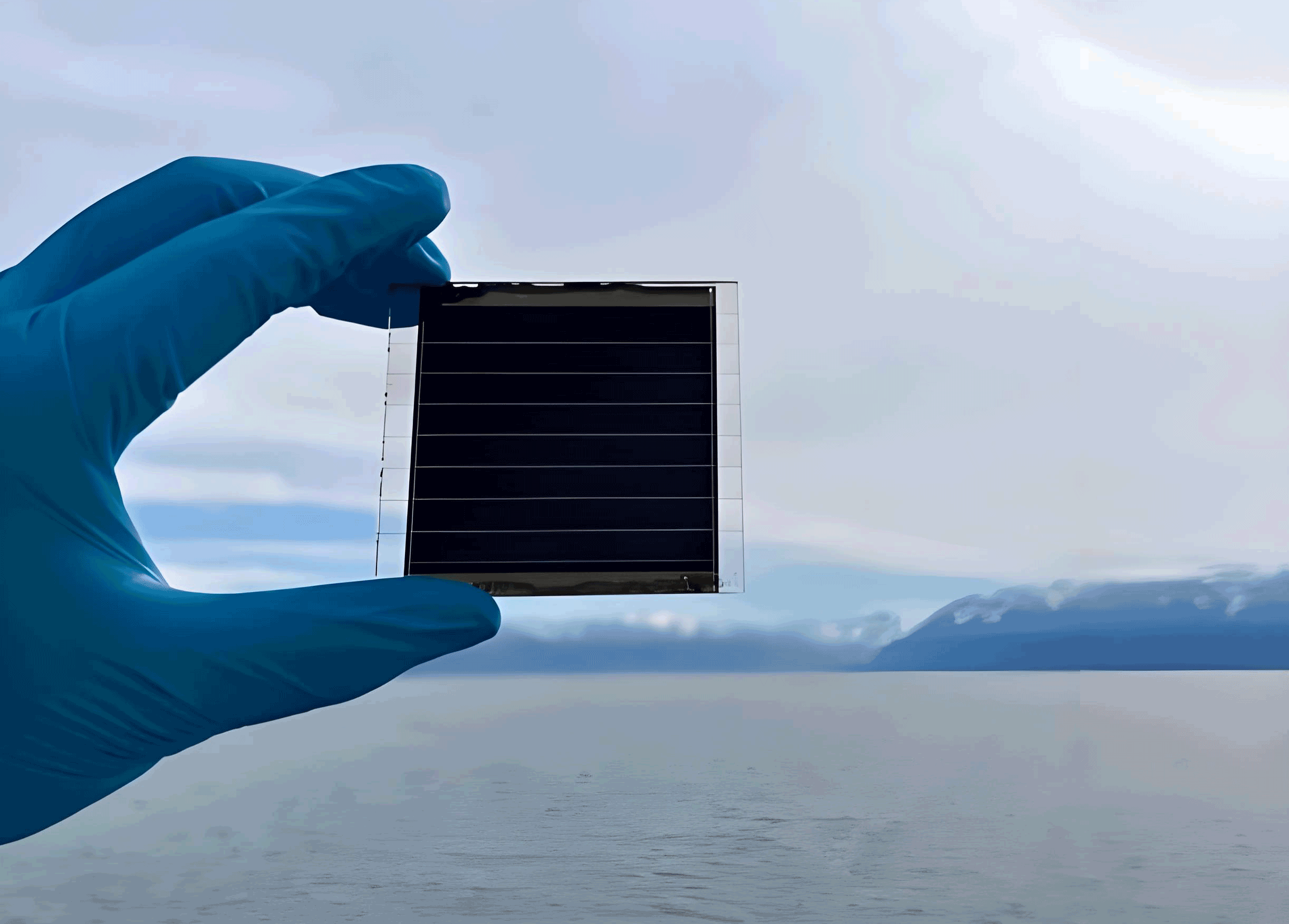
We began by fabricating hole-transport-layer-free perovskite solar cells using a sequential deposition method. The electron transport layer (ETL) was prepared by spin-coating a SnO2 colloidal solution onto cleaned ITO substrates, followed by annealing. The perovskite active layer, composed of a mixed-cation formulation (e.g., FA+, MA+, Cs+ with halides), was deposited via a one-step anti-solvent process in a nitrogen environment. For POM modification, a solution of POM in chlorobenzene was spin-coated onto the perovskite surface and annealed. Finally, a silver electrode was thermally evaporated to complete the device. We characterized the films using X-ray diffraction (XRD), ultraviolet-visible (UV-Vis) spectroscopy, scanning electron microscopy (SEM), photoluminescence (PL), and time-resolved photoluminescence (TRPL). Device performance was evaluated through current density-voltage (J-V) measurements under AM 1.5G illumination and external quantum efficiency (EQE) analysis.
The XRD patterns of the perovskite films, with and without POM modification, revealed distinct peaks corresponding to the crystalline planes of the perovskite phase. The POM-treated film exhibited slightly intensified diffraction peaks, indicating improved crystallinity and reduced defect density. This aligns with the role of POM in passivating undercoordinated Pb2+ sites through its phosphine oxide groups. The UV-Vis absorption spectra showed enhanced light harvesting in the visible range for the POM-modified perovskite solar cell, contributing to higher photocurrent generation. To quantify the optical properties, we calculated the absorption coefficient (α) using the Tauc plot method for direct bandgap materials:
$$ \alpha h\nu = A(h\nu – E_g)^{1/2} $$
where \( h\nu \) is the photon energy, \( A \) is a constant, and \( E_g \) is the bandgap. The bandgap remained approximately 1.55 eV for both films, but the POM-modified sample demonstrated a higher absorption edge, consistent with reduced parasitic absorption losses.
Surface morphology analysis via SEM indicated that the POM layer resulted in a smoother and more uniform perovskite film with reduced pinholes, which minimizes shunt paths and enhances charge collection in the perovskite solar cell. The cross-sectional images confirmed that the POM modification did not significantly alter the grain boundaries vertically, suggesting that the passivation occurs primarily at the surface. This is crucial for maintaining the integrity of the perovskite layer while improving interface properties.
Steady-state PL measurements demonstrated a noticeable increase in emission intensity for the POM-modified perovskite film, signifying suppressed non-radiative recombination. This was further corroborated by TRPL decay curves, which were fitted using a bi-exponential function to extract carrier lifetimes:
$$ I(t) = I_0 + A_1 \exp\left(-\frac{t}{\tau_1}\right) + A_2 \exp\left(-\frac{t}{\tau_2}\right) $$
where \( \tau_1 \) and \( \tau_2 \) represent the fast and slow decay components, respectively, associated with trap-assisted and bimolecular recombination. The POM-treated film exhibited prolonged lifetimes (e.g., \( \tau_1 = 29.8 \) ns and \( \tau_2 = 184.7 \) ns) compared to the control (\( \tau_1 = 18.4 \) ns and \( \tau_2 = 93.3 \) ns), indicating effective defect passivation and enhanced charge carrier diffusion in the perovskite solar cell. The average lifetime (\( \tau_{avg} \)) was calculated as:
$$ \tau_{avg} = \frac{A_1 \tau_1^2 + A_2 \tau_2^2}{A_1 \tau_1 + A_2 \tau_2} $$
This increase in \( \tau_{avg} \) directly correlates with improved open-circuit voltage and fill factor in the devices.
To evaluate the photovoltaic performance, we fabricated hole-transport-layer-free perovskite solar cells with the structure ITO/SnO2/perovskite/Ag, both with and without POM modification. The J-V curves under reverse and forward scans revealed negligible hysteresis in the POM-based devices, attributable to better interface quality. The key parameters, including short-circuit current density (\( J_{sc} \)), open-circuit voltage (\( V_{oc} \)), fill factor (FF), and PCE, are summarized in Table 1. The POM-modified perovskite solar cell achieved a champion PCE of 22.32%, a significant improvement over the control device (20.39%). This enhancement stems from the synergistic effects of reduced recombination and facilitated hole extraction at the perovskite/Ag interface.
| Device | Scan Direction | \( V_{oc} \) (V) | \( J_{sc} \) (mA/cm²) | FF (%) | PCE (%) |
|---|---|---|---|---|---|
| POM-PVK | Reverse | 1.16 | 23.45 | 73.60 | 22.32 |
| POM-PVK | Forward | 1.15 | 23.45 | 74.62 | 21.72 |
| Control PVK | Reverse | 1.15 | 22.10 | 71.98 | 20.39 |
| Control PVK | Forward | 1.13 | 21.70 | 74.15 | 20.35 |
The EQE spectra further validated the enhanced photoresponse of the POM-based perovskite solar cell, with integrated \( J_{sc} \) values matching the J-V measurements. The improvement in \( J_{sc} \) can be attributed to the higher charge collection efficiency, as described by the charge collection probability (\( \eta_{cc} \)):
$$ \eta_{cc} = 1 – \frac{\tau_{tr}}{\tau_{rec}} $$
where \( \tau_{tr} \) is the transit time and \( \tau_{rec} \) is the recombination lifetime. With POM modification, \( \tau_{rec} \) increases, leading to higher \( \eta_{cc} \) and thus higher \( J_{sc} \).
Stability testing under ambient conditions (20–25°C, 30% relative humidity) demonstrated that the POM-modified perovskite solar cell retained over 90% of its initial PCE after 30 days, whereas the control degraded to 70%. This enhanced stability is linked to the hydrophobic nature of POM, which impedes moisture ingress. Water contact angle measurements confirmed an increase from 36.1° for the control to 73.5° for the POM-treated film, highlighting the superior moisture resistance. The degradation kinetics can be modeled using a first-order decay equation:
$$ \text{PCE}(t) = \text{PCE}_0 \exp(-kt) $$
where \( \text{PCE}_0 \) is the initial efficiency and \( k \) is the degradation rate constant. The lower \( k \) value for the POM device underscores its improved durability.
To further analyze the charge transport dynamics, we employed electrochemical impedance spectroscopy (EIS) on the perovskite solar cells. The Nyquist plots revealed a larger recombination resistance (\( R_{rec} \)) and lower series resistance (\( R_s \)) for the POM-modified device, indicating suppressed charge recombination and efficient carrier transport. The equivalent circuit model, comprising resistors and constant phase elements, was used to fit the data, and the extracted parameters are listed in Table 2. The increase in \( R_{rec} \) correlates with the higher \( V_{oc} \) and FF observed in the J-V characteristics.
| Device | \( R_s \) (Ω cm²) | \( R_{rec} \) (kΩ cm²) | Capacitance (μF/cm²) |
|---|---|---|---|
| POM-PVK | 5.2 | 1.8 | 0.45 |
| Control PVK | 6.7 | 1.2 | 0.52 |
The enhanced performance of the POM-based perovskite solar cell can be rationalized by the energy level alignment at the perovskite/Ag interface. The work function of Ag (≈4.3 eV) aligns favorably with the valence band maximum of the perovskite (≈5.4 eV) when modified with POM, which has a highest occupied molecular orbital (HOMO) level of ≈5.2 eV. This reduces the energy barrier for hole injection, as described by the Schottky-Mott rule:
$$ \phi_b = \phi_m – \chi_s $$
where \( \phi_b \) is the Schottky barrier height, \( \phi_m \) is the metal work function, and \( \chi_s \) is the electron affinity of the semiconductor. With POM, \( \phi_b \) decreases, facilitating ohmic contact formation.
In conclusion, our study demonstrates that phosphine oxygen molecular modification with POM significantly boosts the efficiency and stability of hole-transport-layer-free perovskite solar cells. By passivating surface defects, enhancing hole transport, and imparting hydrophobicity, POM addresses the key limitations of simplified device architectures. The champion PCE of 22.32% and remarkable environmental stability underscore the potential of this approach for commercializing low-cost and durable perovskite solar cells. Future work will focus on optimizing the POM concentration and exploring its application in large-area modules to advance the scalability of perovskite solar cell technology.
Further investigations into the long-term degradation mechanisms under operational conditions, such as light soaking and thermal cycling, are essential to validate the robustness of POM-modified perovskite solar cells. Additionally, the integration of POM with other interface engineering strategies could unlock further improvements in performance. Overall, this work provides a foundational framework for developing efficient and stable hole-transport-layer-free perovskite solar cells, contributing to the broader adoption of perovskite-based photovoltaics.