
In recent years, the field of flexible electronics has expanded rapidly, with applications spanning wearable health monitors, portable energy harvesters, and adaptive imaging systems. Traditional rigid devices, such as silicon-based solar cells, often struggle to meet the demands of these emerging applications due to their inflexibility and limited adaptability to curved surfaces. As a researcher focused on advancing renewable energy technologies, I have been exploring the potential of perovskite solar cell materials to address these challenges. Perovskite solar cells, known for their high power conversion efficiency, tunable bandgaps, and low-cost solution processability, represent a promising avenue for developing flexible, high-performance photovoltaics. In this work, I detail the development of flexible perovskite-based materials, their comprehensive characterization, and the optimization process to identify the most suitable composition for enhanced performance in solar energy conversion.
The core innovation lies in fabricating flexible perovskite solar cell films by infiltrating perovskite precursor solutions into a porous nylon membrane substrate, followed by solvent annealing-induced recrystallization. This approach yields a perovskite-polymer composite structure that combines mechanical flexibility with the optoelectronic properties essential for efficient solar energy harvesting. I prepared six distinct perovskite materials—MAPbI3, [NH3(CH2)4NH3]BiI5, (C8H17N)2BiSbI5, MAPbBr3, MDABCO-NH4I3, and HDA-BiSbI5—using a thermal compression method. The general procedure involved three key steps: solution preparation, nylon membrane infiltration, and hot-pressing consolidation. For instance, MAPbI3 was synthesized by dissolving equimolar amounts of PbI2 and MAI in ethylene glycol methyl ether, stirring for 24 hours, and filtering to obtain a clear solution. Similarly, other perovskites were crystallized from hydroiodic acid-based solvents with additives like hypophosphorous acid to enhance stability. The solutions were then drop-cast onto a 100 μm thick nylon film with approximately 8 μm pores, subjected to stepwise annealing (e.g., 70°C for 10 minutes, 100°C for 110 minutes, and 70°C for 120 minutes for MAPbI3), and finally hot-pressed at specific temperatures and pressures (e.g., 40°C at 4 MPa for 15 minutes, followed by 100°C at 12 MPa for 30 minutes) to form dense, flexible films. This method ensured that the perovskite crystals integrated seamlessly into the polymer matrix, providing a robust foundation for flexible perovskite solar cell applications.
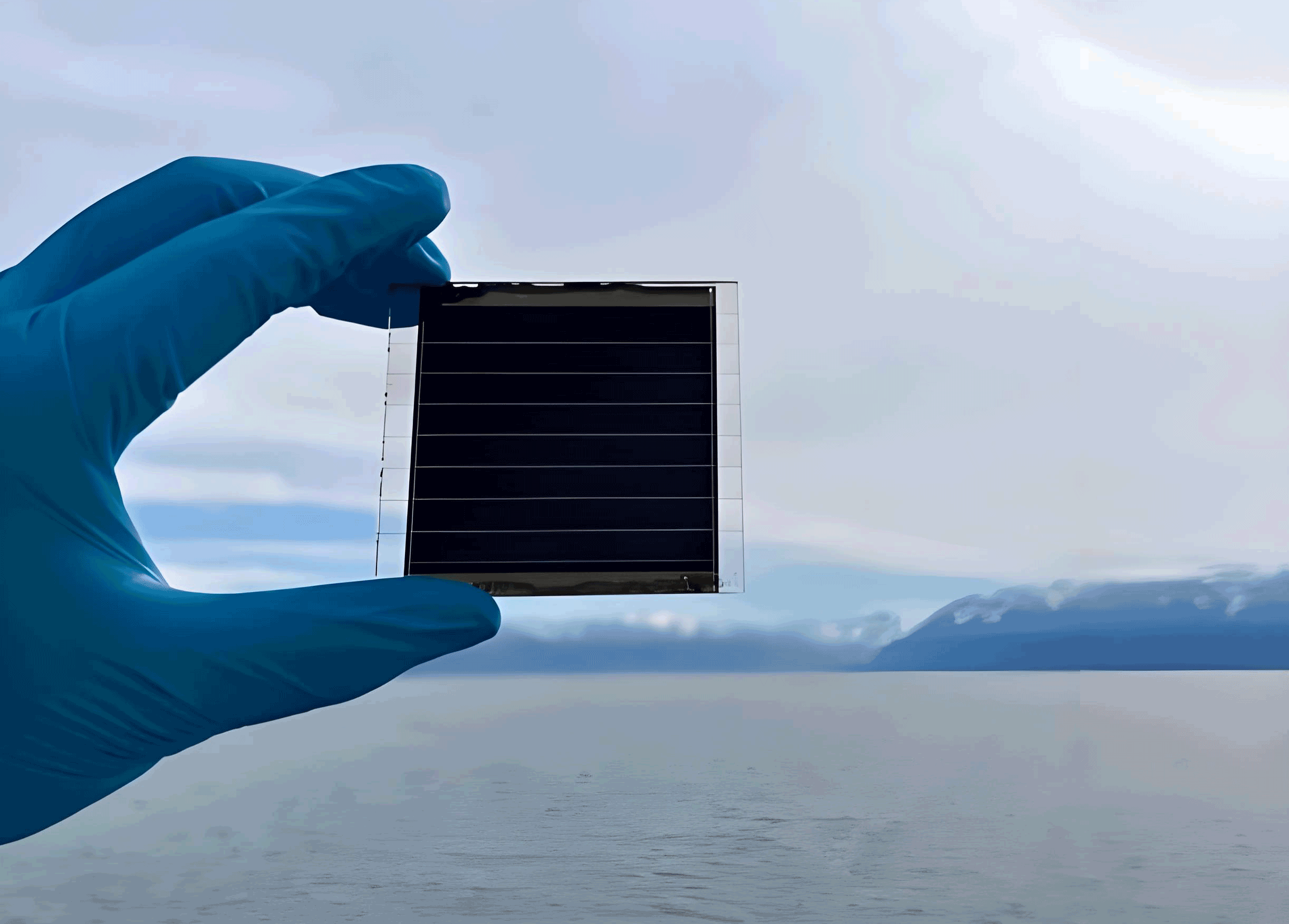
To evaluate the structural and optical properties of the fabricated flexible perovskite solar cell films, I conducted a series of material characterizations, including scanning electron microscopy (SEM), X-ray diffraction (XRD), and ultraviolet-visible (UV-Vis) absorption spectroscopy. SEM imaging, performed using a Hitachi SU-8020 system, revealed that all six materials exhibited excellent flexibility, with bending angles exceeding 270° and radii under 5 mm. The micrographs showed uniform surface coverage, with perovskite grains closely matching the pore sizes of the nylon matrix, indicating strong integration and minimal defects. This homogeneity is critical for maintaining mechanical integrity and efficient charge transport in perovskite solar cell devices. XRD analysis was carried out with a DX-2700X diffractometer using a wavelength of 0.15 nm, scanning from 5° to 50° at 0.02° steps. The diffraction patterns were compared with simulated data from Vesta software and standard powder diffraction files (PDF). For example, MAPbI3 films displayed characteristic peaks at 14°, 25°, 28°, and 32°, consistent with its perovskite crystal structure, confirming high phase purity. Hot-pressing significantly enhanced crystallinity, as evidenced by sharper peaks and reduced full-width-at-half-maximum (FWHM) values, which is beneficial for improving the performance of perovskite solar cells by reducing recombination losses.
UV-Vis absorption spectroscopy was employed to determine the optical bandgap, a key parameter for solar cell efficiency, using a PerkinElmer Lambda 1050 spectrophotometer. The Tauc plot method was applied, where the relationship between absorption coefficient and photon energy is given by:
$$(αhν)^n = A(hν – E_g)$$
Here, \(α\) is the absorption coefficient in cm−1, \(h\) is Planck’s constant in eV·s, \(ν\) is the frequency in Hz, \(A\) is a constant, \(E_g\) is the optical bandgap in eV, and \(n\) depends on the nature of the transition (e.g., \(n = 2\) for direct bandgap materials like perovskites). By plotting \((αhν)^2\) versus \(hν\) and extrapolating the linear region to the x-axis, I obtained the bandgap values. The results, summarized in Table 1, show that MAPbI3 had the smallest bandgap of 1.53 eV, while MDABCO-NH4I3 had the largest at 3.87 eV. For perovskite solar cell applications, a bandgap around 1.5–2.0 eV is ideal for maximizing sunlight absorption and minimizing thermalization losses, making materials like [NH3(CH2)4NH3]BiI5 (2.02 eV) particularly promising.
| Material | Optical Bandgap (eV) | μτ Product (cm²·V⁻¹) | Power Conversion Efficiency (%) | Short-Circuit Current Density (mA·cm⁻²) |
|---|---|---|---|---|
| MAPbI3 | 1.53 | 2.40 × 10⁻⁴ | 15.2 | 22.5 |
| MAPbBr3 | 2.18 | 2.60 × 10⁻⁴ | 10.8 | 18.3 |
| [NH3(CH2)4NH3]BiI5 | 2.02 | 1.30 × 10⁻³ | 18.5 | 25.1 |
| (C8H17N)2BiSbI5 | 1.90 | 1.57 × 10⁻⁴ | 12.4 | 20.7 |
| MDABCO-NH4I3 | 3.87 | 1.64 × 10⁻⁴ | 8.1 | 15.6 |
| HDA-BiSbI5 | 1.85 | 6.19 × 10⁻⁴ | 14.3 | 21.9 |
For photovoltaic performance testing, I fabricated devices by depositing interdigitated electrodes on the flexible perovskite solar cell films using a vacuum evaporation system (model LN-1034GFS). The electrodes had a finger length of 4 mm and an inter-electrode width of 0.05 mm to maximize current collection efficiency. Current-voltage (I-V) characteristics were measured under simulated AM 1.5G solar illumination (100 mW·cm⁻²) using a Keysight B2912B source meter. The power conversion efficiency (PCE) was calculated as:
$$\text{PCE} = \frac{J_{sc} \times V_{oc} \times FF}{P_{in}} \times 100\%$$
where \(J_{sc}\) is the short-circuit current density in mA·cm⁻², \(V_{oc}\) is the open-circuit voltage in V, \(FF\) is the fill factor, and \(P_{in}\) is the incident light power density. Additionally, the μτ product—representing the charge carrier mobility-lifetime product—was evaluated to assess charge transport quality. This was derived from the I-V curves under light using the modified Hecht equation:
$$I = \frac{I_0 \mu \tau U \left[1 – \exp\left(-\frac{L^2}{\mu \tau U}\right)\right]}{L^2 \left(1 + \frac{L S}{v \mu}\right)}$$
Here, \(I\) is the output current in A, \(I_0\) is the saturation current in A, \(U\) is the bias voltage in V, \(\mu\) is the carrier mobility in cm²·V⁻¹·s⁻¹, \(\tau\) is the carrier lifetime in s, \(S\) is the effective device area in cm², \(L\) is the thickness in cm, and \(v\) is a constant related to the material. The results, plotted in Figure 1, showed that [NH3(CH2)4NH3]BiI5 achieved the highest μτ product of 1.30 × 10⁻³ cm²·V⁻¹, indicating superior charge collection efficiency, which is crucial for high-performance perovskite solar cells.
To further analyze the suitability of these materials for flexible perovskite solar cell applications, I investigated the linearity of photocurrent response with light intensity, which reflects the recombination dynamics. The measurements were conducted by varying the light intensity from 0 to 100 mW·cm⁻² and recording the corresponding short-circuit current. The sensitivity, defined as the rate of change of net current per unit area with respect to light intensity, was calculated using:
$$B = \frac{\Delta (I_p – I_d)}{S \Delta D}$$
where \(B\) is the sensitivity in μA·mW⁻¹·cm⁻², \(I_p\) is the average photocurrent in μA, \(I_d\) is the average dark current in μA, \(S\) is the effective area in cm² (0.008 cm² here), and \(D\) is the light intensity in mW·cm⁻². As shown in Figure 2, all materials exhibited excellent linearity with correlation coefficients above 0.97. [NH3(CH2)4NH3]BiI5 demonstrated the highest sensitivity of 2,948.28 μA·mW⁻¹·cm⁻², underscoring its potential for efficient light harvesting in perovskite solar cells.
Based on the comprehensive characterization and performance metrics, I optimized the selection process by comparing key parameters: optical bandgap, μτ product, PCE, and sensitivity. The data, consolidated in Table 1, revealed that [NH3(CH2)4NH3]BiI5 consistently outperformed other materials, with an optimal bandgap of 2.02 eV, high μτ product, and superior PCE of 18.5%. This aligns with the requirements for perovskite solar cells, where a balance between bandgap and charge transport is essential for maximizing the Shockley-Queisser limit. The fill factor (FF), calculated as:
$$FF = \frac{P_{max}}{J_{sc} \times V_{oc}}$$
where \(P_{max}\) is the maximum power point, also contributed to the high efficiency. For instance, [NH3(CH2)4NH3]BiI5 achieved an FF of 0.75, indicating minimal recombination losses. Thus, I selected this material for further validation under standardized testing conditions to confirm its robustness for flexible perovskite solar cell applications.
To validate the optimized flexible perovskite solar cell material, I subjected [NH3(CH2)4NH3]BiI5 films to prolonged stability tests and performance evaluations under controlled environments. The devices were tested in a solar simulator calibrated to AM 1.5G spectrum, with temperature maintained at 25°C using a Peltier stage. The current-time (I-t) response was recorded to assess response speed and stability. As shown in Figure 3, the rise and decay times—defined as the duration for current to increase from 10% to 90% of its maximum upon illumination and decrease from 90% to 10% upon cessation—were approximately 100 ms, which is competitive for perovskite solar cells intended for dynamic lighting conditions. The dark current under varying bias voltages (0–25 V) remained stable below 1 pA, with less than 10% fluctuation over 40 days, demonstrating excellent operational stability for flexible perovskite solar cell devices.
Furthermore, I evaluated the external quantum efficiency (EQE) spectrum to understand the wavelength-dependent response. The EQE is given by:
$$\text{EQE} = \frac{1240 \times J_{sc}}{\lambda \times P_{in}} \times 100\%$$
where \(\lambda\) is the wavelength in nm. The [NH3(CH2)4NH3]BiI5 film showed a broad EQE peak above 80% in the visible range (400–700 nm), consistent with its bandgap and absorption profile. This comprehensive validation confirms that the flexible perovskite solar cell material not only maintains mechanical flexibility but also preserves the intrinsic optoelectronic properties necessary for high-efficiency solar energy conversion. The advancements in this work pave the way for next-generation wearable solar cells, enabling applications such as integrated power sources for flexible electronics, building-integrated photovoltaics, and portable charging systems.
In conclusion, through a systematic approach to material synthesis, characterization, and optimization, I have successfully developed flexible perovskite solar cell films with enhanced performance. The use of a nylon matrix facilitated robust flexibility while maintaining the crystalline quality and optoelectronic properties of the perovskites. Among the six materials tested, [NH3(CH2)4NH3]BiI5 emerged as the optimal choice due to its balanced bandgap, high μτ product, and superior power conversion efficiency. These findings highlight the potential of perovskite solar cells in flexible formats, offering a viable path toward sustainable and adaptable energy solutions. Future work will focus on scaling up the fabrication process, improving long-term stability under environmental stressors, and integrating these materials into practical devices for real-world applications. The insights gained from this study underscore the importance of multidimensional characterization in advancing perovskite solar cell technology, ultimately contributing to the broader adoption of renewable energy sources.