
As a researcher deeply immersed in the field of photovoltaics, I find perovskite solar cells to be one of the most transformative technologies in renewable energy. Their rapid development since initial reports in 2009 has reshaped the landscape of solar energy conversion. In this article, I will explore the fundamental principles, material properties, operational mechanisms, and future prospects of perovskite solar cells, emphasizing their advantages and challenges. The unique properties of perovskite materials, such as high absorption coefficients and tunable bandgaps, make them ideal for next-generation solar applications. Throughout this discussion, I will incorporate tables and equations to summarize key points, ensuring a thorough understanding of why perovskite solar cells are poised to revolutionize the photovoltaic industry.
Photovoltaic technology harnesses solar energy through the photovoltaic effect, where photons are converted into electrical energy. The basic principle involves the generation of electron-hole pairs in a semiconductor material upon light absorption. For a perovskite solar cell, this process is highly efficient due to the exceptional optoelectronic properties of perovskite crystals. The power conversion efficiency (PCE) of a solar cell can be expressed as:
$$ \eta = \frac{J_{sc} \times V_{oc} \times FF}{P_{in}} $$
where $\eta$ is the PCE, $J_{sc}$ is the short-circuit current density, $V_{oc}$ is the open-circuit voltage, $FF$ is the fill factor, and $P_{in}$ is the incident light power. Perovskite solar cells have demonstrated remarkable progress in these parameters, with single-junction devices approaching 27% PCE and tandem configurations exceeding 34%. The following table summarizes the key performance metrics of perovskite solar cells compared to other photovoltaic technologies:
| Technology | Typical PCE (%) | Bandgap (eV) | Stability (Hours) |
|---|---|---|---|
| Perovskite Solar Cell | 25-27 | 1.5-2.3 | 1000-5000 |
| Silicon Solar Cell | 20-26 | 1.1 | >25000 |
| CIGS Solar Cell | 20-23 | 1.0-1.7 | 15000-20000 |
| Organic Solar Cell | 10-18 | 1.5-2.5 | 500-2000 |
The core of a perovskite solar cell lies in its perovskite crystal structure, typically represented as ABX₃, where A is a monovalent cation, B is a divalent metal ion, and X is a halide anion. This structure contributes to the high defect tolerance and long carrier diffusion lengths observed in perovskite materials. The stability of the perovskite lattice can be predicted using the Goldschmidt tolerance factor $t$:
$$ t = \frac{r_A + r_X}{\sqrt{2} (r_B + r_X)} $$
where $r_A$, $r_B$, and $r_X$ are the ionic radii. For a stable perovskite structure, $t$ should be between 0.8 and 1.0. The tunability of the bandgap in perovskite solar cells allows for optimization across different applications, from building-integrated photovoltaics to flexible devices. The bandgap energy $E_g$ can be adjusted by varying the composition, as described by:
$$ E_g = E_0 + \Delta E_{\text{mix}} $$
where $E_0$ is the base bandgap and $\Delta E_{\text{mix}}$ accounts for compositional variations. For instance, mixing iodide and bromide ions enables bandgap engineering, which is crucial for tandem perovskite solar cells that combine multiple absorbers to surpass the Shockley-Queisser limit.
In terms of fabrication, perovskite solar cells can be produced using various methods, such as solution processing, vapor deposition, and printing techniques. The choice of method impacts the morphology and performance of the perovskite layer. A key advantage of perovskite solar cells is their low-temperature processing, which reduces energy consumption and costs compared to traditional silicon cells. The table below outlines common fabrication techniques and their characteristics:
| Fabrication Method | Process Temperature (°C) | Scalability | Typical PCE (%) |
|---|---|---|---|
| Spin-Coating | 100-150 | Low | 20-25 |
| Blade-Coating | 100-200 | Medium | 18-22 |
| Vapor Deposition | 50-100 | High | 22-26 |
| Slot-Die Coating | 100-150 | High | 19-23 |
The operational mechanism of a perovskite solar cell involves several steps: light absorption, exciton generation, charge separation, and charge collection. Upon illumination, photons with energy greater than the bandgap are absorbed, creating electron-hole pairs. These pairs dissociate into free carriers due to the low exciton binding energy in perovskites, typically around 10-50 meV. The charge carrier dynamics can be modeled using the drift-diffusion equation:
$$ J_n = q \mu_n n E + q D_n \frac{dn}{dx} $$
where $J_n$ is the electron current density, $q$ is the elementary charge, $\mu_n$ is the electron mobility, $n$ is the electron concentration, $E$ is the electric field, and $D_n$ is the diffusion coefficient. Similarly, for holes, the equation is analogous. The high carrier mobility in perovskite solar cells, often exceeding 10 cm²/V·s, facilitates efficient charge transport to the electrodes, minimizing recombination losses.
One of the most significant challenges facing perovskite solar cells is stability under operational conditions. Factors such as moisture, oxygen, heat, and light-induced degradation can reduce performance over time. The degradation kinetics can be described by an Arrhenius-type equation:
$$ k = A \exp\left(-\frac{E_a}{k_B T}\right) $$
where $k$ is the degradation rate constant, $A$ is the pre-exponential factor, $E_a$ is the activation energy, $k_B$ is Boltzmann’s constant, and $T$ is the temperature. Strategies to enhance stability include compositional engineering, interface passivation, and advanced encapsulation. For example, incorporating formamidinium (FA) and cesium (Cs) ions in the A-site improves thermal stability, while using 2D/3D perovskite heterostructures mitigates ion migration. The following table compares stability-enhancing approaches for perovskite solar cells:
| Stability Approach | Mechanism | Impact on PCE | Lifetime Improvement |
|---|---|---|---|
| Compositional Engineering | Reduces phase segregation | +0.5-1.5% | 2-5x |
| Interface Passivation | Suppresses non-radiative recombination | +1-3% | 3-10x |
| Encapsulation | Blocks environmental factors | Negligible change | 10-100x |
| Additive Incorporation | Enhances crystal growth | +0.5-2% | 2-4x |
In my view, the future of perovskite solar cells hinges on overcoming these stability issues while scaling up production. Large-area modules and tandem configurations with silicon or other perovskites offer pathways to higher efficiencies and commercial viability. The theoretical efficiency limit for a single-junction perovskite solar cell is around 31%, but tandem cells can exceed 45% by utilizing a broader spectrum of sunlight. The current density in a tandem cell can be optimized by matching the top and bottom subcells, as given by:
$$ J_{\text{tandem}} = \min(J_{\text{top}}, J_{\text{bottom}}) $$
where $J_{\text{top}}$ and $J_{\text{bottom}}$ are the current densities of the respective subcells. Recent advancements in all-perovskite tandem cells have demonstrated PCEs over 29%, highlighting the potential of this architecture. Moreover, the flexibility and lightweight nature of perovskite solar cells enable applications in wearable electronics, building-integrated photovoltaics, and portable power sources.
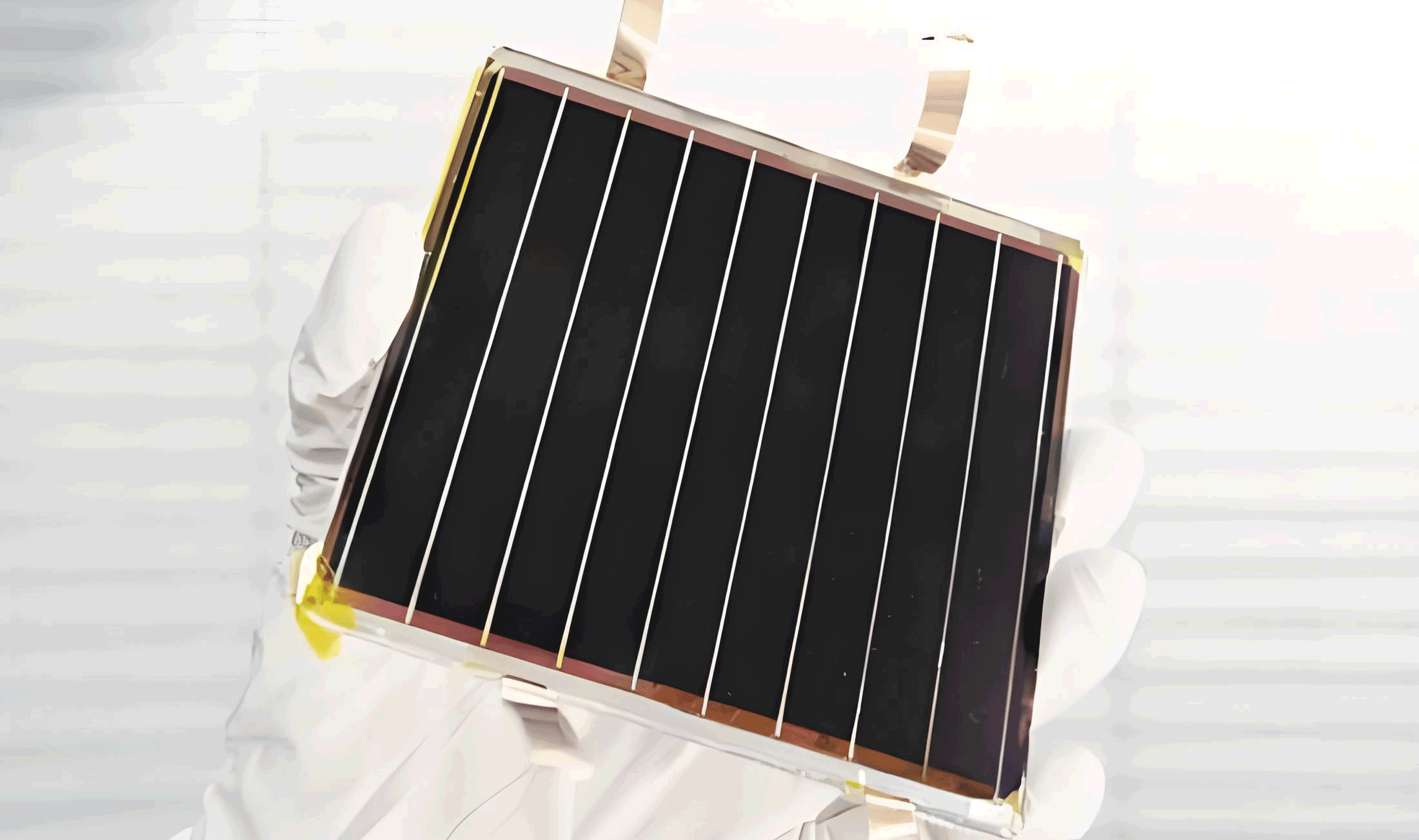
Characterization techniques play a crucial role in understanding and improving perovskite solar cells. Methods such as transient absorption spectroscopy, electrochemical impedance spectroscopy, and time-resolved photoluminescence provide insights into charge carrier dynamics and recombination mechanisms. For instance, the carrier lifetime $\tau$ can be extracted from photoluminescence decay data using:
$$ I(t) = I_0 \exp\left(-\frac{t}{\tau}\right) $$
where $I(t)$ is the intensity at time $t$, and $I_0$ is the initial intensity. These analyses help identify loss pathways and guide material optimization. Additionally, machine learning approaches are being employed to predict new perovskite compositions and accelerate the discovery of stable, high-efficiency materials.
From an industrial perspective, the commercialization of perovskite solar cells requires addressing manufacturing challenges like reproducibility, cost, and environmental impact. Lifecycle assessments indicate that perovskite solar cells have a lower carbon footprint compared to silicon-based cells, owing to their lower energy-intensive processing. The levelized cost of electricity (LCOE) for perovskite solar cells can be estimated as:
$$ \text{LCOE} = \frac{\text{Total Cost}}{\text{Total Energy Output}} = \frac{C_{\text{cap}} + \sum \frac{C_{\text{O&M}}}{(1+r)^t}}{\sum \frac{E_{\text{output}}}{(1+r)^t}} $$
where $C_{\text{cap}}$ is the capital cost, $C_{\text{O&M}}$ is the operation and maintenance cost, $E_{\text{output}}$ is the energy output, $r$ is the discount rate, and $t$ is time. With ongoing research, the LCOE for perovskite solar cells is projected to decrease significantly, making them competitive in the global energy market.
In conclusion, perovskite solar cells represent a pivotal advancement in photovoltaic technology, offering high efficiency, versatility, and low-cost potential. As I reflect on the progress made, it is clear that interdisciplinary efforts in materials science, engineering, and sustainability are essential to fully realize the benefits of perovskite solar cells. While stability and scalability remain key hurdles, innovative solutions continue to emerge, paving the way for a future dominated by clean, renewable energy. The continuous improvement in perovskite solar cell performance underscores their role as a cornerstone of the energy transition, and I am optimistic that they will soon become a mainstream technology in the fight against climate change.
To further elaborate, the role of perovskite solar cells in emerging applications such as agrivoltaics, floating solar farms, and space-based power systems cannot be overstated. Their ability to be fabricated on flexible substrates allows for integration into curved surfaces and mobile devices, expanding the horizons of solar energy utilization. As research progresses, I anticipate that perovskite solar cells will not only complement existing technologies but also enable entirely new paradigms in energy harvesting and storage. The journey of perovskite solar cells from lab-scale curiosities to industrial contenders is a testament to human ingenuity and the relentless pursuit of a sustainable future.