
In recent years, perovskite solar cells have emerged as a promising technology due to their high power conversion efficiencies and cost-effective fabrication processes. As a researcher in the field of materials science, I have focused on developing novel hole transport materials (HTMs) to address the limitations of conventional doped systems. Metal phthalocyanines (MPcs), particularly copper and nickel derivatives, offer excellent thermal stability, high hole mobility, and ease of synthesis, making them ideal candidates for dopant-free applications in perovskite solar cells. In this study, I synthesized α-tetra(4-tert-butylphenoxy)-substituted copper phthalocyanine (CuPc-TB) and nickel phthalocyanine (NiPc-TB) and evaluated their performance as HTMs in mesoporous perovskite solar cells. The incorporation of copper centers enhanced molecular H-aggregation, leading to superior hole transport properties compared to nickel-based analogues. This work demonstrates the potential of tailored metal phthalocyanines in advancing the efficiency and stability of perovskite solar cells.
The synthesis of CuPc-TB and NiPc-TB involved nucleophilic substitution and cyclization reactions under controlled conditions. For CuPc-TB, I employed a molybdenum-catalyzed method with nitrobenzene as the solvent, while NiPc-TB was synthesized using an organic base-catalyzed approach in N,N-dimethylethanolamine. Both compounds were purified via column chromatography and characterized using high-resolution mass spectrometry and elemental analysis, confirming their molecular structures. The thermal stability of these materials was assessed through thermogravimetric analysis (TGA), where CuPc-TB exhibited a decomposition temperature above 490°C, and NiPc-TB showed stability up to 273°C, as summarized in Table 1. These properties are crucial for ensuring the longevity of perovskite solar cells under operational conditions.
| Material | Decomposition Temperature (°C) | λmax in Solution (nm) | λmax in Film (nm) | Blue Shift (nm) |
|---|---|---|---|---|
| CuPc-TB | >490 | 694 | 644 | 50 |
| NiPc-TB | 273 | 681 | 639 | 42 |
UV-visible absorption spectroscopy revealed distinct Q-band and B-band transitions for both compounds in dichloromethane solutions and thin films. The Q-band absorption in films showed a significant blue shift due to H-aggregation, with CuPc-TB exhibiting a larger shift (50 nm) than NiPc-TB (42 nm), indicating stronger face-to-face molecular packing. This behavior enhances charge transport in perovskite solar cells by facilitating π-π interactions. The optical band gap (Eg) was calculated using the formula:
$$ E_g = \frac{1240}{\lambda_{\text{onset}}} $$
where λonset is the absorption onset wavelength. The HOMO and LUMO energy levels were determined from cyclic voltammetry data, using the equations:
$$ E_{\text{HOMO}} = -e(5.1 + \phi_{\text{ox}}) $$
$$ E_{\text{LUMO}} = E_{\text{HOMO}} – E_g $$
where φox is the onset oxidation potential relative to the ferrocene/ferrocenium couple. The results, presented in Table 2, show that both materials have HOMO levels aligned with the perovskite valence band and LUMO levels above the conduction band, enabling efficient hole extraction and electron blocking in perovskite solar cells.
| Material | φox (V vs. Fc/Fc+) | EHOMO (eV) | ELUMO (eV) | Eg (eV) | Hole Mobility (cm²·V⁻¹·s⁻¹) |
|---|---|---|---|---|---|
| CuPc-TB | 0.08 | -5.18 | -3.60 | 1.58 | 2.53 × 10⁻⁴ |
| NiPc-TB | 0.03 | -5.13 | -3.57 | 1.56 | 1.43 × 10⁻⁴ |
Hole mobility measurements using the space-charge-limited current (SCLC) method confirmed that CuPc-TB has a higher mobility (2.53 × 10⁻⁴ cm²·V⁻¹·s⁻¹) than NiPc-TB (1.43 × 10⁻⁴ cm²·V⁻¹·s⁻¹), which correlates with the stronger aggregation observed in UV-vis spectra. The SCLC model is described by the equation:
$$ J = \frac{9}{8} \epsilon_r \epsilon_0 \mu \frac{V^2}{L^3} $$
where J is the current density, εr is the relative permittivity, ε0 is the vacuum permittivity, μ is the hole mobility, V is the voltage, and L is the film thickness. This enhanced mobility is critical for reducing charge recombination in perovskite solar cells.
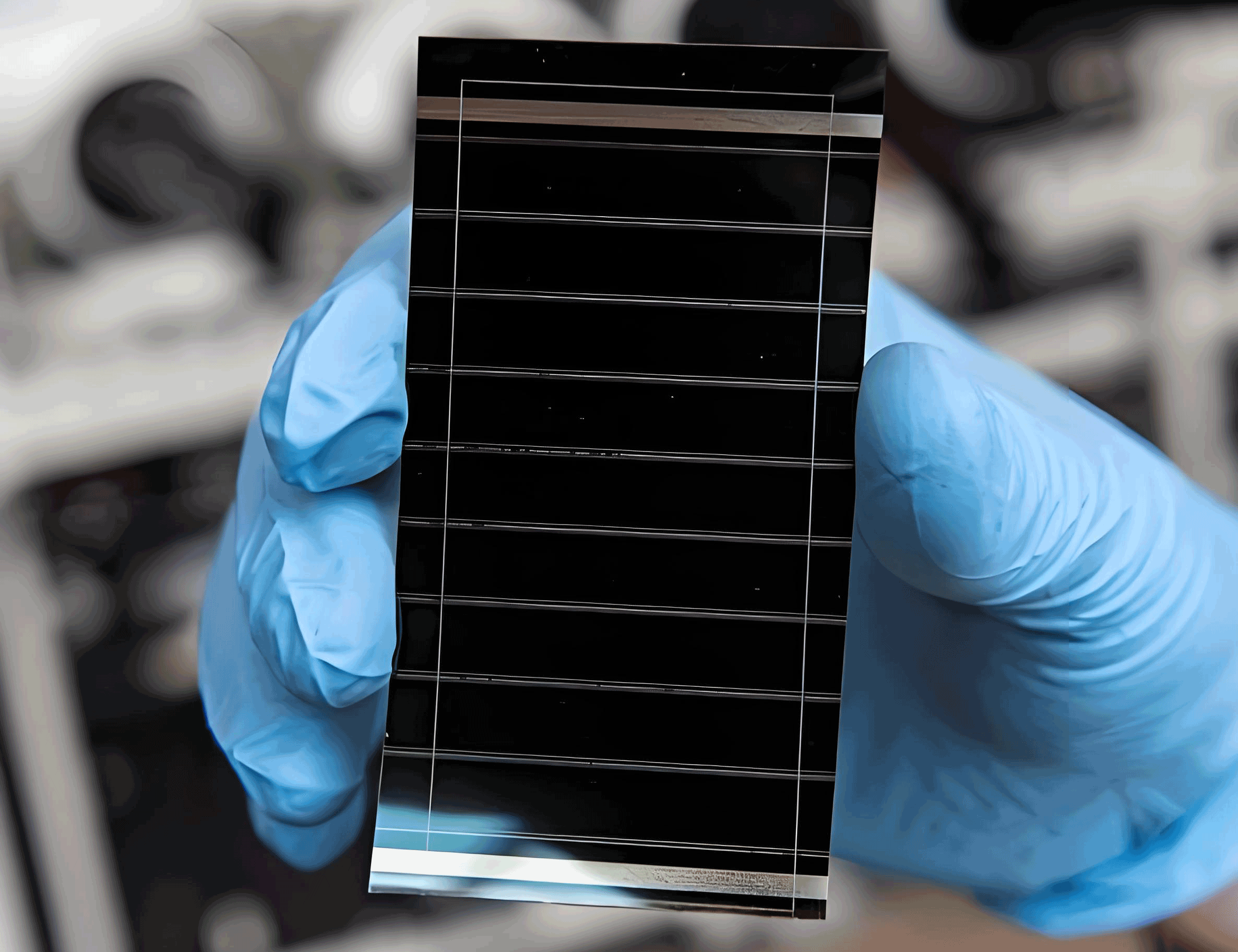
To evaluate the practical application of these materials, I fabricated perovskite solar cells with a structure consisting of FTO/TiO2 compact layer/TiO2 mesoporous layer/perovskite/HTM/Au. The perovskite layer was deposited using a two-step spin-coating method, and the HTM layers were applied via solution processing without any dopants. Current density-voltage (J-V) characteristics under standard AM 1.5G illumination revealed that devices with CuPc-TB achieved a peak power conversion efficiency (PCE) of 17.3%, with an open-circuit voltage (Voc) of 1.08 V, short-circuit current density (Jsc) of 216 A·m⁻², and fill factor (FF) of 0.74. In comparison, NiPc-TB-based devices showed a PCE of 16.5%, with Voc = 1.07 V, Jsc = 212 A·m⁻², and FF = 0.73. The external quantum efficiency (EQE) spectra further supported these results, with CuPc-TB devices exhibiting higher responses across the 350–800 nm range, as detailed in Table 3.
| HTM | Voc (V) | Jsc (A·m⁻²) | FF | PCE (%) | Integrated Jsc from EQE (A·m⁻²) |
|---|---|---|---|---|---|
| CuPc-TB | 1.08 | 216 | 0.74 | 17.3 | 210 |
| NiPc-TB | 1.07 | 212 | 0.73 | 16.5 | 202 |
Steady-state efficiency measurements at the maximum power point demonstrated that CuPc-TB-based perovskite solar cells maintained a PCE of 16.4% over 180 seconds, while NiPc-TB devices sustained 15.0%, indicating robust performance under continuous illumination. The stability of unencapsulated devices was tested under dark conditions at 20°C and 85% relative humidity. CuPc-TB-based perovskite solar cells retained 78% of their initial PCE after 7.5 days, outperforming doped Spiro-OMeTAD-based devices, which degraded to 40% efficiency. This enhanced stability is attributed to the hydrophobic nature of CuPc-TB, as evidenced by water contact angle measurements showing 97° for CuPc-TB films compared to 74° for doped Spiro-OMeTAD. The degradation kinetics can be modeled using the equation:
$$ \frac{PCE(t)}{PCE(0)} = e^{-kt} $$
where k is the degradation rate constant, and t is time. The lower k value for CuPc-TB confirms its superior environmental resilience in perovskite solar cells.
In conclusion, my findings highlight the significance of molecular engineering in metal phthalocyanines for developing efficient and stable dopant-free HTMs in perovskite solar cells. The choice of metal center influences molecular packing and hole mobility, with copper-based derivatives offering superior performance. Future work will focus on optimizing substituents and processing conditions to further enhance the efficiency and scalability of perovskite solar cells. The integration of metal phthalocyanines paves the way for sustainable and high-performance photovoltaic technologies.