
As a researcher deeply immersed in the fields of materials science and artificial intelligence, I have witnessed remarkable progress in technologies that promise to reshape our future. From soft robotics in aquatic environments to AI-driven scientific discovery, and from renewable energy solutions like perovskite solar cells to advanced computing architectures, these developments highlight a collective push toward sustainability and intelligence. In this article, I will delve into these advancements, emphasizing the transformative potential of perovskite solar cells, which have repeatedly demonstrated their value in clean energy applications. I will incorporate tables and equations to summarize key findings, ensuring a comprehensive exploration of each topic. The integration of these innovations not only addresses current global challenges but also paves the way for a more efficient and environmentally conscious world.
One of the most exciting areas of research I have explored involves soft robotics designed for underwater applications. Traditional robots often rely on motor-driven systems and tethered connections, limiting their mobility and efficiency in liquid environments. In contrast, soft robots utilize intelligent materials that enable programmable, cable-free movements. Recent work has focused on creating monolithically structured, light-responsive topological liquid crystal gel kirigami for underwater use. This approach integrates topological defects with soft materials, allowing for complex shape transformations and unique motions that mimic aquatic organisms. For instance, the deformation of these gels can be modeled using equations that describe their response to light stimuli. Consider the strain energy density \( U \) in such a system:
$$ U = \frac{1}{2} \int_V \sigma_{ij} \epsilon_{ij} dV $$
where \( \sigma_{ij} \) represents the stress tensor and \( \epsilon_{ij} \) the strain tensor. This formulation helps in predicting how the material adapts to environmental changes, facilitating applications in biomedical engineering and underwater micro-robotics. The ability to replicate natural behaviors while surpassing them in certain aspects opens up new avenues for innovation. Below is a table summarizing key parameters in soft robotic materials:
| Material Property | Value Range | Impact on Motion |
|---|---|---|
| Elastic Modulus | 0.1 – 10 MPa | Determines flexibility and deformation capacity |
| Response Time to Light | 10 – 100 ms | Affects speed of shape change |
| Energy Efficiency | Up to 80% | Influences sustainability in prolonged use |
Moving to artificial intelligence, I have been particularly intrigued by systems that emulate human scientific capabilities. An AI scientist system, for example, can operate independently, driving goal-oriented research and iterating on discoveries without human intervention. This represents a shift from AI as a mere assistant to a collaborative partner in scientific endeavors. The underlying algorithms often involve reinforcement learning and probabilistic modeling, which can be expressed mathematically. For instance, the expected reward \( R \) in such a system might be optimized using:
$$ R = \sum_{t=0}^{\infty} \gamma^t r_t $$
where \( \gamma \) is the discount factor and \( r_t \) the reward at time \( t \). This enables the AI to prioritize long-term scientific goals over immediate gains. The development of such systems has implications for accelerating research in fields like energy materials, including perovskite solar cells, by rapidly testing hypotheses and optimizing parameters. The table below outlines the capabilities of AI-driven research systems:
| Feature | Description | Benefit |
|---|---|---|
| Autonomous Experimentation | Self-directed data collection and analysis | Reduces human effort and time |
| Iterative Learning | Continuous improvement from feedback loops | Enhances accuracy and innovation |
| Cross-Domain Application | Applicable to multiple scientific fields | Broadens impact, e.g., in perovskite solar cell development |
In the realm of renewable energy, I have closely followed advancements in offshore wind power and its integration with green ammonia production. As offshore wind resources expand into deeper waters, challenges such as high transmission costs and grid integration difficulties arise. One proposed solution involves centralized offshore platforms for ammonia synthesis, using wind energy to produce green ammonia. This approach includes a comprehensive economic model for production, storage, and transportation. The cost-effectiveness can be evaluated using equations like the levelized cost of energy (LCOE):
$$ LCOE = \frac{\sum_{t=1}^{n} \frac{I_t + M_t + F_t}{(1+r)^t}}{\sum_{t=1}^{n} \frac{E_t}{(1+r)^t}} $$
where \( I_t \) is investment cost, \( M_t \) is maintenance cost, \( F_t \) is fuel cost, \( E_t \) is energy output, and \( r \) is the discount rate. This model helps in assessing the viability of such projects, which could complement other clean energy technologies like perovskite solar cells. The table below compares different renewable energy storage options:
| Storage Method | Efficiency (%) | Cost (USD/kWh) | Suitability for Offshore Use |
|---|---|---|---|
| Green Ammonia | 60-70 | 50-100 | High, due to ease of transport |
| Batteries | 85-95 | 150-300 | Moderate, limited by capacity |
| Hydrogen | 40-60 | 100-200 | High, but requires infrastructure |
Among the most promising developments I have encountered are perovskite solar cells, which offer a path to sustainable, high-efficiency photovoltaics. Recent breakthroughs in tin-based perovskite solar cells have achieved record-breaking photoconversion efficiencies while ensuring environmental friendliness throughout their lifecycle. These cells address critical issues in lead-free, green energy technology by focusing on defect control, interface optimization, and carrier extraction. The efficiency \( \eta \) of a perovskite solar cell can be calculated as:
$$ \eta = \frac{J_{sc} \times V_{oc} \times FF}{P_{in}} \times 100\% $$
where \( J_{sc} \) is the short-circuit current density, \( V_{oc} \) the open-circuit voltage, \( FF \) the fill factor, and \( P_{in} \) the incident light power. Innovations in material growth and bandgap engineering have enabled these cells to reach efficiencies of up to 17.7%, as verified by independent authorities. This progress underscores the potential of perovskite solar cells to dominate the solar energy landscape. The following table highlights key performance metrics of various perovskite solar cell types:
| Cell Type | Efficiency (%) | Stability (Hours) | Environmental Impact |
|---|---|---|---|
| Tin-Based Perovskite | 17.7 | 1000+ | Low, lead-free |
| Lead-Based Perovskite | 25.5 | 500-1000 | Moderate, contains lead |
| Silicon-Perovskite Tandem | 29.0 | 2000+ | Low, but complex manufacturing |
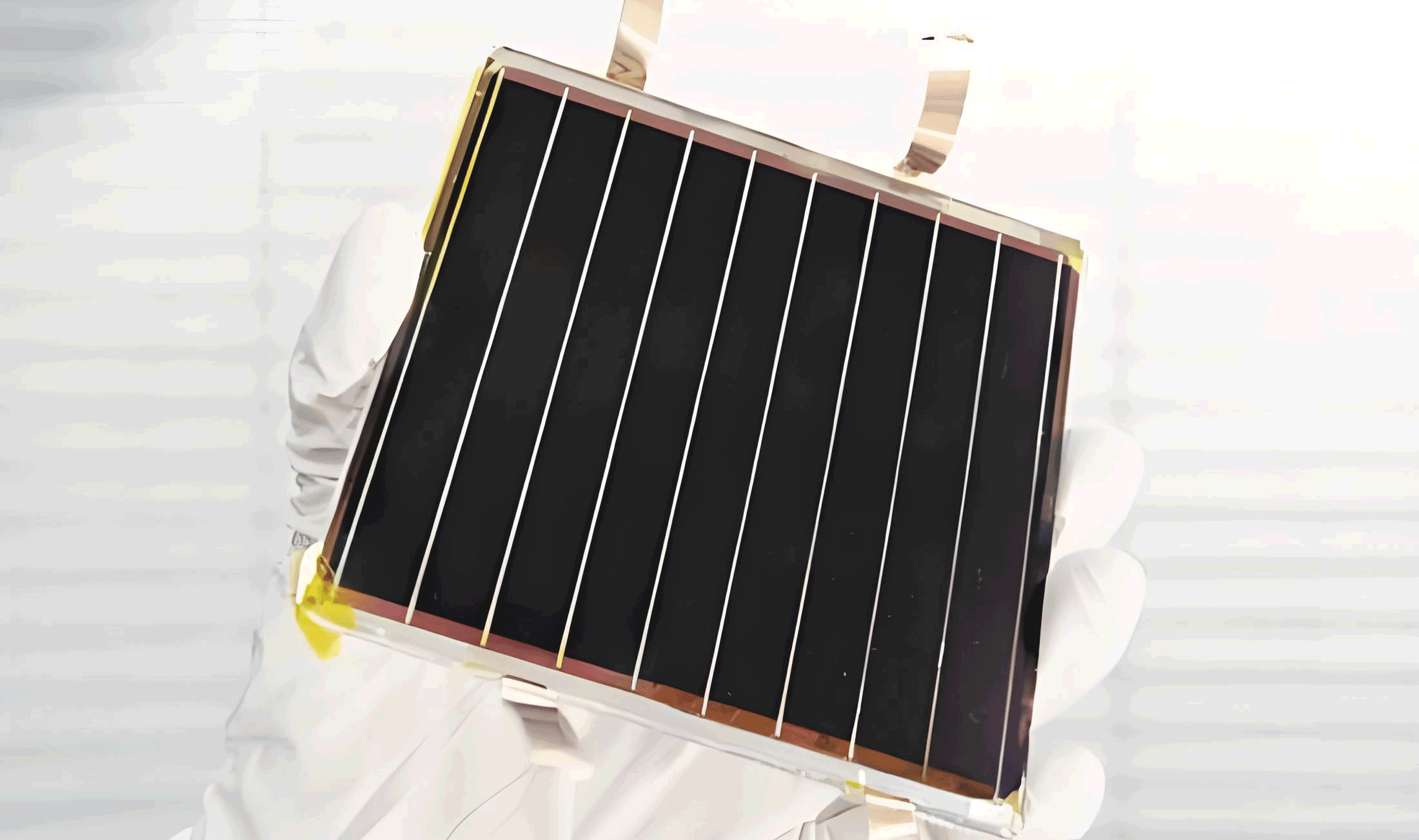
The image above illustrates the structure of a typical perovskite solar cell, highlighting its layered design that contributes to high efficiency. As I reflect on these advancements, it is clear that perovskite solar cells are not just a niche innovation but a cornerstone of future energy systems. Their ability to achieve high performance with minimal environmental footprint makes them ideal for widespread adoption. Moreover, the integration of AI and economic models can further optimize their development, reducing costs and accelerating deployment. For instance, machine learning algorithms can predict material properties for perovskite solar cells using equations like:
$$ P(x) = \frac{1}{1 + e^{-( \beta_0 + \beta_1 x_1 + \cdots + \beta_n x_n )}} $$
where \( P(x) \) is the probability of a desired property, and \( \beta_i \) and \( x_i \) are coefficients and input features, respectively. This synergistic approach exemplifies how interdisciplinary research can drive progress.
Another area I have investigated involves hybrid computing architectures, specifically two-dimensional-silicon-based flash memory chips. By combining ultrafast two-dimensional memory devices with mature silicon CMOS processes, researchers have created chips that overcome engineering challenges in information storage. This innovation shortens the application cycle for disruptive devices and supports the evolution of high-speed information technology. The performance of such chips can be modeled using charge retention equations:
$$ Q(t) = Q_0 e^{-t/\tau} $$
where \( Q(t) \) is the charge at time \( t \), \( Q_0 \) the initial charge, and \( \tau \) the retention time constant. This advancement, while distinct from energy technologies, shares a common thread with perovskite solar cells in its reliance on material science breakthroughs. Both fields benefit from precise control at the nanoscale, enabling higher efficiencies and faster processing. The table below compares different memory technologies:
| Memory Type | Speed (Access Time) | Density (Bits/cm²) | Power Consumption |
|---|---|---|---|
| 2D-Silicon Hybrid | 10 ns | 10^{12} | Low |
| Traditional Flash | 50 ns | 10^{10} | Moderate |
| DRAM | 5 ns | 10^{11} | High |
In conclusion, the convergence of soft robotics, AI, renewable energy, and advanced electronics represents a paradigm shift in scientific and technological development. As a researcher, I am particularly optimistic about the role of perovskite solar cells in this ecosystem, given their repeated demonstrations of high efficiency and sustainability. The equations and tables provided here offer a snapshot of the quantitative aspects driving these innovations. Looking ahead, I anticipate that continued interdisciplinary collaboration will unlock even greater potentials, from enhancing the stability of perovskite solar cells to scaling AI-driven discoveries for global benefit. The journey toward a smarter, greener future is well underway, and these advancements serve as critical milestones along the path.