
In recent years, perovskite solar cells have garnered unprecedented global attention due to their excellent stability and high theoretical power conversion efficiency. As a researcher in the field of renewable energy, I have observed how organic-inorganic halide perovskites, with their low cost, ease of film formation, narrow bandgap, and high charge carrier mobility, have become widely applied in solar cells and other semiconductor optoelectronic devices. However, the fabrication of polycrystalline perovskite films inevitably introduces numerous defects at surfaces and grain boundaries. These defects accelerate non-radiative recombination under high voltage loss, leading to reduced power conversion efficiency and diminished resistance to environmental stimuli. Reports indicate that the defect density at the interfaces of polycrystalline films is approximately one to two orders of magnitude higher than within the film bulk. Therefore, minimizing interfacial non-radiative recombination losses through interface engineering is a critical strategy for achieving high-performance and stable perovskite solar cells. The effective regulation of defects remains a key challenge. Based on this, I will review the research progress in perovskites, summarize and discuss existing problems, recall solutions, and provide an outlook on further strategies.
The 21st century presents humanity with significant challenges, including dwindling fossil fuel resources and escalating environmental pollution. Addressing these issues is paramount for sustainable global economic development. Currently, the exploitation and utilization of various green and renewable energy sources have become a focal point of research. Solar energy, which continuously radiates to Earth, is an abundant, clean, and sustainable resource, making it an ideal future energy source. Photovoltaic cells are semiconductor devices that convert solar radiation into electrical energy, primarily fabricated from semiconductor materials. These devices operate without the need for electrical, thermal, or mechanical inputs, enabling continuous power generation directly from sunlight. Since solar cells consume no energy during operation, they emit no harmful gases, do not pollute the environment, and pose no risks to human health. In regions with high solar irradiation, converting solar energy directly into electricity via photovoltaic cells can alleviate energy crises caused by resource scarcity and reduce grid load and power supply constraints, offering substantial social and economic benefits.
Introduction to Perovskite Solar Cells
Solar power generation represents a method of harnessing the sun’s energy, and given the widespread distribution of solar resources across the globe, utilizing solar energy as a primary source is crucial for mitigating the pressure from conventional energy shortages. Photovoltaic technology has emerged as one of the most important energy technologies worldwide, with continuous advancements in solar cell development.
Initially, silicon-based solar cells dominated the market, including monocrystalline silicon, polycrystalline silicon, and amorphous silicon solar cells. These cells are well-established and widely used in commercial and residential applications, accounting for approximately 90% of the global photovoltaic market. While they offer high efficiency, their complex manufacturing processes contribute to environmental pollution, and efficiency improvements have encountered bottlenecks, limiting their development and gradual replacement. The next phase involved multicompound thin-film solar cells, which boasted low production costs, high photoelectric conversion efficiency, and suitability for large-scale production. However, the inclusion of toxic metals in their fabrication materials led to significant environmental contamination, preventing them from becoming ideal substitutes for silicon-based cells. Current photovoltaic technologies include dye-sensitized solar cells and perovskite solar cells, which benefit from abundant raw materials and low costs, offering substantial development potential. Among these, perovskite solar cells, as a novel type of photovoltaic device, have a theoretical maximum photoelectric conversion efficiency exceeding 30%. Since their initial development in 2009, their efficiency has rapidly increased from 3.8% to over 25.8%, demonstrating immense commercial value. Nevertheless, the performance and stability of perovskite solar cells are severely affected by environmental factors such as light, moisture, and heat, necessitating effective strategies to address these issues.
The working principle of photovoltaic cells involves converting solar radiation into electrical energy. Solar cells consist of a series of metal-semiconductor structures. The fundamental mechanism is the photovoltaic effect in semiconductor junctions, where the distribution of charges within a material changes, generating an electromotive force and current. Photogenerated carriers are absorbed in the junction region of the semiconductor material, producing electron-hole pairs; electrons are excited from the valence band to the conduction band, while holes transition, becoming free electrons. Simultaneously, excited electrons generate excitation energy in the nearby conduction band. When illuminated, the photovoltaic cell material absorbs energy and produces a current.
Due to the characteristics of photogenerated carrier transport, when a photovoltaic cell is exposed to intense light, the carrier concentration increases, leading to a rise in current density; conversely, as light intensity decreases, current density gradually declines. Both short-circuit current and open-circuit voltage increase with light intensity, but the short-circuit current grows linearly, while the open-circuit voltage increases logarithmically. The maximum photovoltage is achieved when the p-n junction barrier disappears.
Crystal Structure of Perovskites
Perovskites typically exhibit a chemical structure of ABX3. Here, A represents a large-radius cation, often organic amine ions such as CH3(NH2)2+ (FA+) or CH3NH3+ (MA+), or inorganic cations like Cs+ or Rb+; B denotes a small-radius cation, typically metal cations such as Pb2+ or Sn2+; and X is a halide anion like I- or Br-. The A and B cations coordinate with X anions in twelve-fold and six-fold arrangements, respectively, forming cubic [AX12] octahedra and [BX6] octahedra, ultimately resulting in a well-defined cubic crystal structure. Based on whether the A-site is occupied by organic cations or inorganic metal cations, perovskites are classified as organic-inorganic hybrid perovskites or all-inorganic perovskites.
Typical all-inorganic perovskites, such as CsPbI3, have a bandgap of 1.73 eV, which is considered ideal for perovskites. However, at room temperature, CsPbI3 exhibits poor lattice stability and is prone to phase transitions under high humidity. Moreover, the wider bandgap leads to significant energy losses, and the high annealing temperatures required limit their application in flexible devices. Organic-inorganic hybrid perovskites allow bandgap tuning by altering halide ions or adjusting the ratios of metal ions and organic cations. For instance, mixed-cation perovskites like FA1-xMAxPbI3 enable bandgap modulation by varying the FA and MA ratios. By controlling crystallization and film formation processes, high-quality perovskite crystals can be achieved, enhancing efficiency and stability, and facilitating applications in flexible electronics.
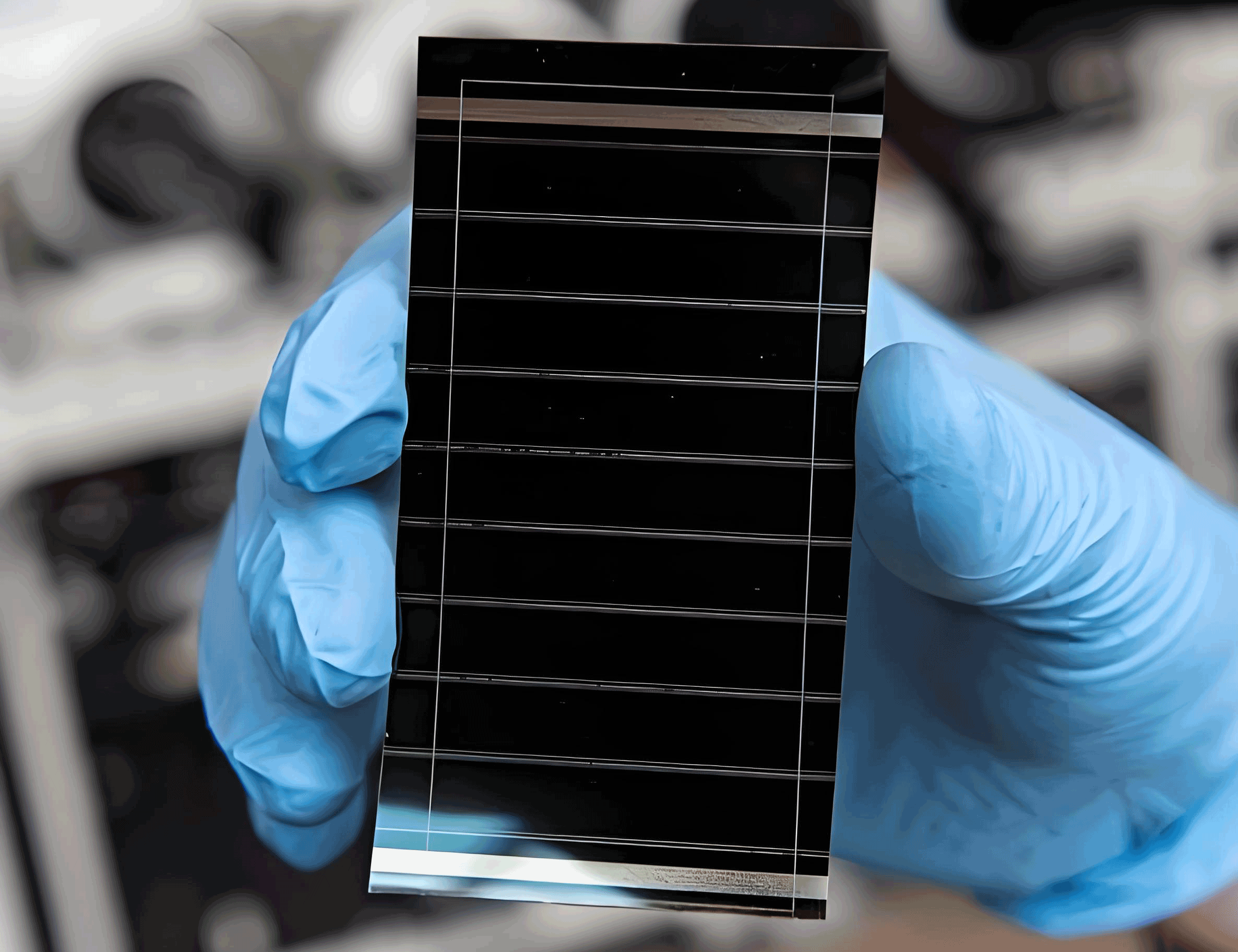
Device Architecture of Perovskite Solar Cells
The structure of perovskite solar cells is primarily categorized into two types based on the presence of a mesoporous layer: mesoporous and planar. Mesoporous structures differ in that the electron transport layer comprises a compact TiO2 layer and a mesoporous TiO2 layer. The mesoporous layer not only promotes perovskite film formation, suppresses defects, and enhances light absorption but also mitigates hysteresis and facilitates electron transport. However, the complex processing, high cost, and need for high-temperature calcination of mesoporous materials restrict their widespread use.
Planar structures are further divided into conventional and inverted configurations based on the direction of incident light. The conventional structure, also known as the n-i-p structure, involves sunlight passing sequentially through the transparent electrode, electron transport layer, perovskite layer, hole transport layer, and metal electrode. This configuration offers high efficiency and low cost but suffers from surface defects and significant hysteresis. The inverted structure, or p-i-n type, reverses this order, with the transparent electrode followed by the hole transport layer, perovskite layer, electron transport layer, and metal electrode. It benefits from suppressed hysteresis and improved stability.
The performance of perovskite solar cells can be summarized using key parameters, as shown in Table 1.
| Parameter | Typical Value | Description |
|---|---|---|
| Power Conversion Efficiency (PCE) | Up to 25.8% | Ratio of electrical output to solar input |
| Open-Circuit Voltage (V_oc) | ~1.1 V | Maximum voltage at zero current |
| Short-Circuit Current Density (J_sc) | ~25 mA/cm² | Current density under short-circuit conditions |
| Fill Factor (FF) | >80% | Measure of junction quality and series resistance |
The efficiency of a perovskite solar cell can be expressed by the formula:
$$PCE = \frac{J_{sc} \times V_{oc} \times FF}{P_{in}}$$
where \(P_{in}\) is the incident solar power density.
Fabrication Methods for Perovskite Solar Cells
Various methods exist for preparing perovskite films, and selecting an appropriate technique is crucial for achieving high-quality films and enhancing device performance. These methods can be broadly classified into one-step and two-step processes. One-step methods include one-step spin-coating, pulsed laser deposition, and gas-mediated extraction. One-step spin-coating is commonly used in laboratories, where a perovskite precursor solution is spin-coated onto a substrate and annealed to form the film. This approach is simple and cost-effective but is limited by substrate size and precursor solubility issues.
Two-step methods involve sequential vapor deposition and vapor-assisted solution processes. In a typical two-step solution deposition, PbI2 is first spin-coated onto the substrate, followed by the application of an amine salt solution, resulting in denser and more uniform perovskite films. Vapor-assisted deposition introduces MAI or FAI via vapor phase, allowing control over film morphology and grain size. However, the prolonged phase transition time limits its application.
While these methods are widely used in laboratories, scaling up for commercial production requires large-area fabrication techniques such as blade coating, spray coating, and slot-die coating. Spray coating, in particular, is well-suited for large areas and is extensively employed in industry.
The defect density in perovskite films can be modeled using the following equation:
$$N_t = N_0 \exp\left(-\frac{E_a}{kT}\right)$$
where \(N_t\) is the trap density, \(N_0\) is a constant, \(E_a\) is the activation energy, \(k\) is Boltzmann’s constant, and \(T\) is temperature.
Current Challenges and Solutions in Perovskite Solar Cells
For commercial application of photovoltaic technologies, several criteria must be met, including high efficiency, long-term stability, low cost, and low toxicity. The primary obstacle to the widespread adoption of perovskite solar cells is their operational stability. Early stability research focused on moisture resistance, with extensive discussions on water-induced decomposition mechanisms. Improvements in intrinsic and extrinsic moisture instability have been achieved through molecular engineering or the use of hydrophobic layers. While humidity stability can be addressed via encapsulation, issues related to light and thermal stability remain significant challenges, necessitating internal structural modifications to extend lifespan. Furthermore, light exposure can exacerbate perovskite layer decomposition, drawing researchers’ attention. Studies have shown that due to the low activation energy of organic-inorganic halide perovskites, ion migration occurs readily under bias, leading to ion redistribution and effective shielding of the external electric field. Consequently, mobile ions accumulated at perovskite interfaces can facilitate selective chemical reactions with adjacent interfaces, accelerated by light and heat.
Currently, the best-performing perovskite solar cells utilize organic-inorganic hybrid perovskites as the light-absorbing layer, but they face a range of stability issues under high temperature and light conditions. Light-induced lattice distortions cause iodine aggregation, which can diffuse throughout the perovskite layer, accelerating degradation. Additionally, degradation in the presence of humidity and oxygen poses significant challenges to commercialization, especially given the high cost of required encapsulation. Due to the organic components in OIHPs, water molecules in the environment tend to form hydrogen bonds, leading to phase changes or even compound degradation. Since defect density is higher at grain boundaries, moisture infiltration is more likely there, and prolonged exposure to humidity severely degrades photovoltaic performance. Therefore, appropriate调控 to increase grain size can reduce grain boundaries and enhance humidity stability.
Mixed-cation halide perovskites with suitable ratios exhibit considerable stability under ambient conditions, attributed to their appropriate ionic radii, which place the tolerance factor within an optimal range. Moreover, A-site organic cations almost entirely occupy the spaces between lead halide octahedra, forming strong covalent bonds that release lattice strain and reduce lattice formation energy.
Table 2 summarizes common defects in perovskite solar cells and their passivation strategies.
| Defect Type | Location | Passivation Method | Effect |
|---|---|---|---|
| Iodine vacancies | Surface/Grain boundaries | Excess iodides (e.g., KI, PbI2) | Reduces non-radiative recombination |
| Lead-related defects | Bulk | Lewis base additives (e.g., DMSO) | Improves crystal growth |
| Organic cation vacancies | Interfaces | Ammonium salts (e.g., PEAI) | Enhances interface stability |
| Halide vacancies | Grain boundaries | Halide substitution | Suppresses ion migration |
The non-radiative recombination rate due to defects can be described by the Shockley-Read-Hall model:
$$R_{nr} = \frac{\sigma v_{th} N_t n p}{n + p + 2 n_i \cosh\left(\frac{E_t – E_i}{kT}\right)}$$
where \(\sigma\) is the capture cross-section, \(v_{th}\) is the thermal velocity, \(N_t\) is the defect density, \(n\) and \(p\) are electron and hole concentrations, \(n_i\) is the intrinsic carrier concentration, and \(E_t\) is the defect energy level.
Performance Enhancement of Perovskite Solar Cells
In perovskite solar cells, the key component is the polycrystalline perovskite absorber layer, typically fabricated via low-temperature solution processing. Defects in perovskite materials govern various operational processes, including carrier generation, transport, extraction, and ion diffusion, all of which are closely linked to the efficiency and stability of solar cells. All crystalline defects and impurities in perovskite compounds can act as charge recombination centers, affecting carrier transfer processes in perovskite solar cells, leading to diminished photovoltaic performance and reduced efficiency. Moreover, these defects can interfere with ion diffusion processes or migrate within the perovskite, contributing to current-voltage hysteresis in solar cells and degradation due to exposure to humidity, oxygen, UV radiation, and temperature. Therefore, to further enhance the photovoltaic performance of perovskite solar cells toward the theoretical efficiency limit and achieve efficient and stable devices, researchers must not only passivate defects responsible for non-radiative charge recombination but also suppress ion migration by passivating both deep-level and shallow-level traps.
In recent years, scientists have developed various additives for defect passivation, size regulation, and interface modification to mitigate the adverse effects of defects and impurities in semiconductor perovskites, optimize crystallization, and improve the properties of perovskite film surfaces/interfaces, thereby enhancing the stability and efficiency of perovskite solar cells. Initially, excess iodides such as KI, PbI2, and MAI were shown to compensate for halide vacancies at grain boundaries, reducing non-radiative recombination pathways. For instance, solvent engineering strategies have yielded superior perovskite devices with efficiencies exceeding 16.2%, further improved to 22.1% by compensating for iodine loss. Similarly, phenethylammonium iodide (PEAI) has been used to fill iodine vacancies on perovskite crystal surfaces, boosting efficiency to 23.7%. Among the chemicals employed, organic compounds have attracted particular attention due to their diverse chemical structures and functionalities.
Currently, molecular additives with functional groups that interact with perovskite components have proven to be a viable method for preparing high-quality perovskite films and alleviating grain boundary issues. Based on Lewis acid-base theory, numerous volatile molecules such as water, dimethyl sulfoxide, N-methyl-2-pyrrolidone, and pyridine have been introduced to regulate crystal growth and reduce grain boundary density. Additionally, non-volatile small molecules or polymers with similar groups have been studied for passivating grain boundaries to achieve high-performance perovskite solar cells. To date, extensive research indicates that chemical molecules containing functional groups like amines, halide anion substitutes, nitrogen-based groups, hydroxyl, carboxyl, carbonyl, pyridine, and pyrrole groups can serve as defect passivators in perovskite crystals, thereby reducing non-radiative recombination. However, identifying or designing low-cost, high-performance molecules that effectively passivate various defects and impurities remains a significant challenge in perovskite solar cell passivation technology. The synergistic effects of multiple functional groups within a single molecule and their mechanisms have not been systematically investigated. Such studies would advance the development of low-cost, environmentally friendly, and efficient passivation molecules for perovskites.
The effectiveness of passivation can be quantified by the reduction in defect density, as shown in the formula for the passivation efficiency \(\eta_p\):
$$\eta_p = 1 – \frac{N_{t,passivated}}{N_{t,initial}}$$
where \(N_{t,initial}\) and \(N_{t,passivated}\) are the defect densities before and after passivation, respectively.
Prospects and Future Directions
From the initial reports to the present, the efficiency of perovskite solar cells has continuously climbed, bringing commercialization within reach. However, there remains a gap between the achieved efficiencies and the theoretical limit of 33%. Therefore, realizing high efficiency through the passivation of various defects in perovskites using suitable passivators is a major challenge that must be addressed before perovskite solar cells can enter the market. Passivators can bind to defects within or at the interfaces of perovskites via ionic bonds, covalent bonds, or other chemical interactions, and optimize interface contact through intermolecular forces. Furthermore, passivators refine the energy level alignment in perovskite solar cells, facilitating carrier transport processes. Appropriate interface layers can slow the degradation rate of perovskites under water, heat, and light, thereby enhancing the long-term stability of perovskite solar cells. The interactions between perovskites and additives are highly complex, making it essential to employ experimental techniques to evaluate and compare defect depths and densities. However, due to the multitude of processes involved in passivation and the difficulty in quantifying defect density, a comprehensive understanding of passivation mechanisms remains to be developed. The following three aspects may be focal points for future research: (1) optimizing the fabrication processes of perovskite films; (2) developing low-cost, highly efficient multifunctional passivation materials with strong charge coupling suitable for large-scale manufacturing; and (3) creating charge-selective layers with low defect density, high mobility, high stability, and low interface losses.
In conclusion, the advancement of perovskite solar cells hinges on addressing stability and efficiency through innovative materials and processes. The continuous improvement in passivation strategies and fabrication techniques will pave the way for the widespread adoption of this promising technology. As research progresses, I anticipate that perovskite solar cells will play a pivotal role in the global transition to sustainable energy.
The future development of perovskite solar cells can be guided by the following equation for the overall device performance metric \(\Phi\):
$$\Phi = \text{PCE} \times \text{Stability Factor} \times \text{Scalability}$$
where the Stability Factor accounts for longevity under operational conditions, and Scalability reflects the ease of large-scale production.
Table 3 outlines potential research directions for enhancing perovskite solar cells.
| Research Area | Objectives | Expected Outcomes |
|---|---|---|
| Film Fabrication | Develop low-temperature, scalable methods | Large-area, uniform films with reduced defects |
| Passivation Materials | Design multifunctional molecules | Enhanced efficiency and stability via defect control |
| Interface Engineering | Optimize charge transport layers | Minimized non-radiative losses and improved VOC |
| Toxicity Reduction | Replace lead with less toxic elements | Environmentally friendly perovskite solar cells |
Ultimately, the success of perovskite solar cells will depend on interdisciplinary efforts combining materials science, chemistry, and engineering to overcome existing barriers and unlock their full potential in the renewable energy landscape.