
In recent years, the growing global energy demand and the depletion of non-renewable resources have intensified the search for sustainable alternatives. Solar energy, as a clean and abundant source, has emerged as a key focus for research and development. Among various photovoltaic technologies, perovskite solar cells have garnered significant attention due to their exceptional properties, such as high efficiency, low cost, and tunable bandgaps. However, challenges like wide bandgaps, poor crystallinity, surface defects, and moisture instability in perovskite layers hinder their performance and commercialization. This article delves into the development, principles, applications, and advantages of perovskite solar cells, with a particular emphasis on thin-film technologies, to provide insights for future advancements in this field.
The journey of perovskite solar cells began in 2009 when researchers first applied halide perovskite compounds, such as methylammonium lead iodide (CH3NH3PbI3), as sensitizers in dye-sensitized solar cells. Early devices suffered from low efficiency and poor stability due to the use of liquid electrolytes. Over time, innovations like vapor deposition methods in 2013 led to the development of planar heterojunction structures, significantly improving efficiency. By 2017, optimizations in precursor compositions, such as adjusting lead iodide (PbI2) content, achieved efficiencies exceeding 20%. Recent breakthroughs in 2022, involving rubidium chloride (RbCl) doping, have stabilized perovskite phases and pushed certified power conversion efficiencies to over 25%, highlighting the rapid progress in perovskite solar cell technology.
Perovskite solar cells operate on the principle of the photovoltaic effect, where light absorption in the perovskite layer generates electron-hole pairs. These charge carriers are separated by an internal electric field and transported through electron and hole transport layers to produce an electric current. The general formula for the power conversion efficiency (PCE) of a solar cell is given by:
$$ \eta = \frac{J_{sc} \times V_{oc} \times FF}{P_{in}} $$
where \( \eta \) is the PCE, \( J_{sc} \) is the short-circuit current density, \( V_{oc} \) is the open-circuit voltage, \( FF \) is the fill factor, and \( P_{in} \) is the incident light power. For perovskite solar cells, the bandgap energy \( E_g \) plays a crucial role in light absorption, and it can be tuned by varying the composition of the perovskite material, as described by:
$$ E_g = \frac{hc}{\lambda} $$
where \( h \) is Planck’s constant, \( c \) is the speed of light, and \( \lambda \) is the wavelength. The flexibility in tuning \( E_g \) allows perovskite solar cells to better match the solar spectrum, enhancing their overall performance.
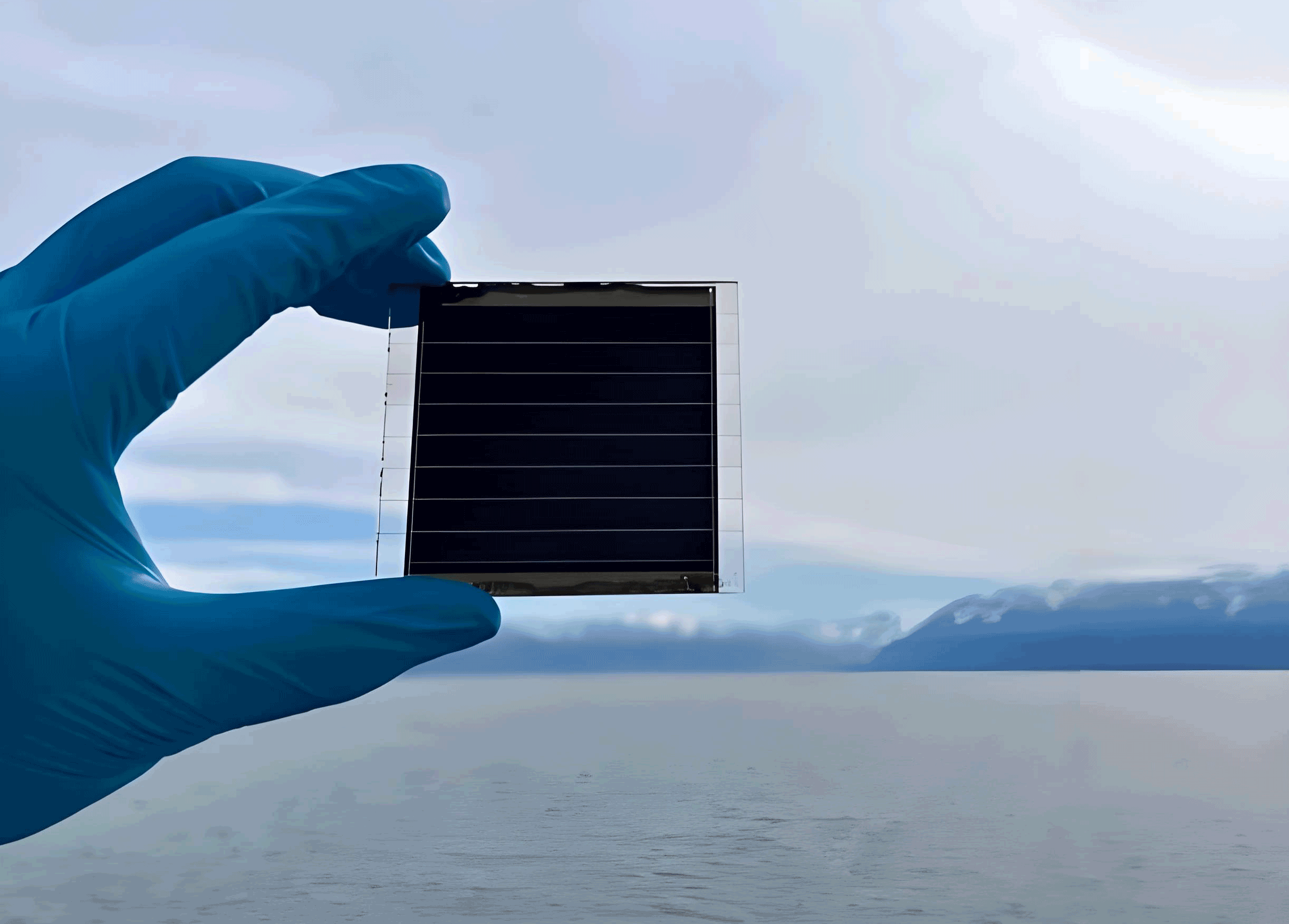
The fabrication of perovskite thin films is primarily divided into dry and wet methods. Dry methods, such as vacuum evaporation, involve depositing organic and inorganic materials under high vacuum conditions to form uniform films. This technique offers excellent control over film consistency but requires slower processing speeds and higher equipment costs. In contrast, wet methods, including solution-based approaches like spin-coating and slot-die coating, are cost-effective and allow for rapid film formation. However, they necessitate solvent recovery and environmental management, adding to the complexity of large-scale production. The following table summarizes the key aspects of these methods:
| Method | Process | Advantages | Disadvantages |
|---|---|---|---|
| Dry (Vacuum Evaporation) | High-vacuum deposition | High uniformity, controllable | Slow speed, high cost |
| Wet (Solution-Based) | Spin-coating, slot-die coating | Low cost, fast processing | Complex crystallization, solvent issues |
Perovskite solar cells exhibit remarkable advantages, particularly in high-efficiency photoelectric conversion. The optical properties of perovskite materials, such as high absorption coefficients, enable efficient light harvesting even in thin layers. The bandgap tunability allows for optimization across the solar spectrum, while low defect densities minimize charge recombination. The carrier mobility in perovskite films facilitates rapid charge transport, as expressed by the drift-diffusion equation:
$$ J = q \mu n E + q D \frac{dn}{dx} $$
where \( J \) is the current density, \( q \) is the electron charge, \( \mu \) is the mobility, \( n \) is the carrier concentration, \( E \) is the electric field, and \( D \) is the diffusion coefficient. Additionally, the flexibility in fabrication methods supports scalable production and integration into various devices, including flexible electronics.
The performance of perovskite solar cells heavily relies on the uniformity and density of the thin films. Uniform films ensure consistent photoelectric properties across the entire area, reducing local performance variations. Dense films minimize grain boundaries and pores, enhancing charge transport and stability against environmental factors. For instance, all-inorganic perovskite films like CsPbI3 and CsPbBr3 have shown efficiencies near 20% and high external quantum efficiencies in light-emitting diodes, making them suitable for applications in photodetectors, military, and aerospace fields. The relationship between film quality and device performance can be quantified using parameters like the defect density \( N_t \), which affects recombination rates:
$$ R = \frac{1}{\tau} = \sigma v_{th} N_t $$
where \( R \) is the recombination rate, \( \tau \) is the carrier lifetime, \( \sigma \) is the capture cross-section, and \( v_{th} \) is the thermal velocity.
Encapsulation technology is vital for enhancing the environmental stability of perovskite solar cells. It protects the films from moisture, oxygen, and UV radiation, thereby extending their lifespan. Environmental factors such as humidity and temperature can accelerate degradation, leading to reduced efficiency. For example, moisture ingress causes decomposition of perovskite materials, while thermal stress induces mechanical failures. The use of barrier layers and advanced encapsulation materials helps mitigate these effects, as summarized in the table below:
| Environmental Factor | Impact on Perovskite Films | Mitigation Strategies |
|---|---|---|
| Humidity | Decomposition, reduced stability | Moisture-resistant coatings |
| Oxygen | Oxidation, performance decay | Encapsulation with inert gases |
| Temperature | Thermal expansion, cracking | Thermal management materials |
| UV Radiation | Photo-degradation, efficiency loss | UV-filtering layers |
Looking ahead, the innovation in perovskite solar cell thin films is directed toward nanoscale engineering, smart functional materials, and sustainable production. Research focuses on improving stability through compositional engineering, such as mixed cation and halide perovskites, and developing lead-free alternatives to address environmental concerns. The integration of perovskite solar cells with other technologies, like silicon tandem cells, promises higher efficiencies beyond the Shockley-Queisser limit. The potential for large-scale deployment in building-integrated photovoltaics and portable electronics underscores the bright future of perovskite solar cells. The continuous optimization of fabrication processes and encapsulation techniques will be crucial for achieving commercial viability and widespread adoption.
In summary, perovskite solar cells represent a transformative technology in photovoltaics, with thin films playing a central role in their performance. The advancements in dry and wet fabrication methods, coupled with a deep understanding of material properties, have propelled efficiencies to remarkable levels. However, challenges in stability and scalability remain. Through ongoing research and development, perovskite solar cells are poised to become a cornerstone of renewable energy solutions, contributing to a sustainable and energy-secure future.