
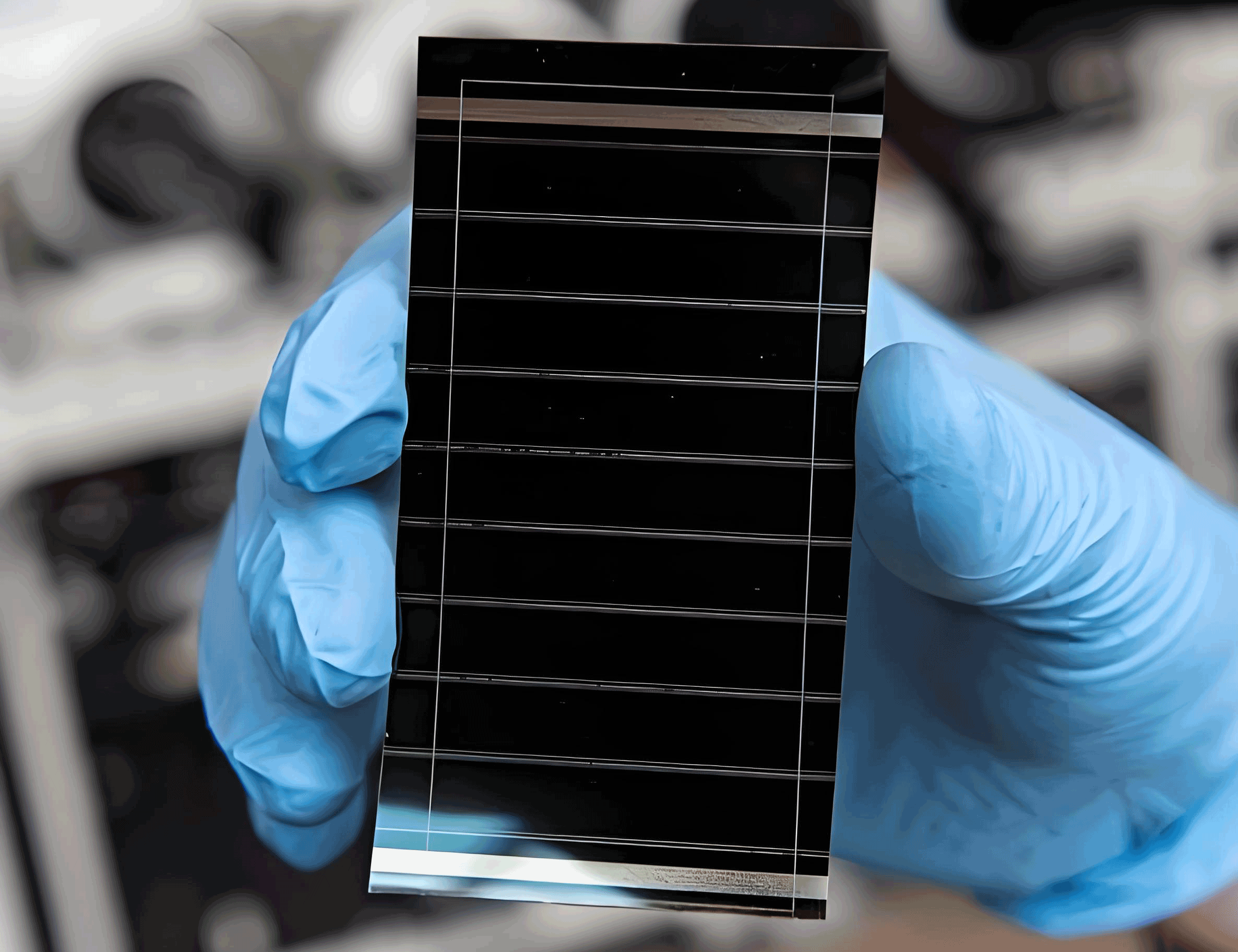
In recent years, perovskite solar cells have emerged as a transformative technology in the field of photovoltaics, attracting significant attention due to their high power conversion efficiency, flexibility, lightweight nature, low cost, and ease of fabrication. These devices, which utilize organic-inorganic hybrid metal halide perovskite materials, hold revolutionary potential for applications in solar power plants, portable electronics, and indoor photovoltaics. However, challenges such as long-term stability and device lifetime continue to impede their widespread industrialization. To systematically understand the evolution and current trends in this dynamic field, I employed CiteSpace, a scientific mapping tool, to analyze literature data from 2014 to 2023. This analysis aims to identify research hotspots, collaborative networks, and emerging frontiers, thereby guiding focused efforts on key technological hurdles and accelerating the development and commercialization of perovskite solar cells.
The data for this study were sourced from the Web of Science Core Collection, with a search conducted on October 28, 2024. The search query was designed to capture relevant articles and reviews published between 2014 and 2023, using terms such as “perovskite*photovol*”, “perovskite*solar cells*”, “CH3NH3PbI3 solar cell*”, “solar cell*CsSnI3*”, and “BaSnO3 solar cell*perovskite*”. This resulted in a dataset of 2,565 publications, which were subsequently analyzed using CiteSpace version 6.2.R6 to perform bibliometric and visual examinations. The methodology included co-authorship, co-occurrence, and burst detection analyses to map the intellectual structure and temporal shifts in perovskite solar cell research.
The annual publication trend reveals two distinct phases in the growth of perovskite solar cell research. From 2014 to 2019, the field experienced rapid expansion, with a total of 1,285 publications and an annual average of 214 papers. This period marked the initial surge in interest, driven by breakthroughs in efficiency and material synthesis. From 2020 to 2023, growth stabilized, with 1,280 publications and an average of 320 papers per year, accounting for 49.9% of the total literature. This trend underscores the sustained interest and maturation of the field, as researchers shift from foundational discoveries to optimization and application-oriented studies. The linear increase in output highlights the global recognition of perovskite solar cells as a pivotal technology for future energy solutions.
To assess the core author network, I applied Price’s Law, which defines core authors as those contributing significantly to the literature. The threshold is calculated using the formula: $$ M = 0.749 \times \sqrt{N_{\text{max}}} $$ where \( N_{\text{max}} \) is the highest number of publications by a single author. In this dataset, the maximum was 40 papers, yielding \( M \approx 4.74 \). Thus, authors with five or more publications are considered core contributors. A total of 114 core authors were identified, collectively producing 1,094 papers, which represents 42.65% of the total literature. However, the distribution indicates that a cohesive core author group has not yet formed, as no single cluster dominates the network. This suggests a diverse and decentralized research community, with opportunities for greater collaboration and knowledge integration.
| Number of Publications | Number of Authors | Percentage of Total Literature |
|---|---|---|
| ≥ 5 | 114 | 42.65% |
| < 5 | Numerous | 57.35% |
Institutional and national collaboration patterns were examined to understand the global landscape of perovskite solar cell research. A total of 372 institutions participated, generating 1,885 collaboration links with a density of 0.0273. The top three institutions by publication count were leading research academies in Asia and Europe, but inter-institutional collaborations were predominantly domestic, with limited cross-border ties. For instance, while institutions within the same country exhibited strong collaboration strengths (e.g., up to 0.90), international linkages were weaker, often below 0.30. This insularity may hinder the exchange of innovative ideas and resources, potentially slowing progress in addressing global challenges such as stability and scalability.
| Country | Number of Publications | Centrality |
|---|---|---|
| China | 1,204 | 0.27 |
| United States | 382 | 0.18 |
| Republic of Korea | 219 | 0.15 |
| Japan | 193 | 0.12 |
| India | 153 | 0.10 |
At the national level, 85 countries contributed to the perovskite solar cell literature, with 609 collaboration links and a density of 0.1706. China led in both publication volume (1,204 papers) and centrality (0.27), indicating its pivotal role in international networks. The top five countries—China, the United States, Republic of Korea, Japan, and India—collectively accounted for 83.86% of the total output. Despite this concentration, collaboration strengths among these nations ranged from 0 to 0.27, reflecting modest levels of international cooperation. Enhancing these ties could foster multidisciplinary approaches, essential for overcoming the complex barriers in perovskite solar cell development.
Keyword co-occurrence analysis revealed the core research themes in perovskite solar cell studies. A network of 389 keywords and 1,676 links was generated, with a density of 0.0222. The most frequent terms included “performance” (556 occurrences), “efficient” (534), “stability” (392), “films” (285), and “lengths” (264). These keywords can be categorized into material-related aspects (e.g., “crystallization”, “growth”, “recombination”), fundamental theory (e.g., “hysteresis”), and fabrication processes (e.g., “deposition”, “layer”, “transport”). The prevalence of these terms underscores a multidisciplinary focus on achieving high efficiency and stability through advancements in materials science, device physics, and surface engineering. For example, the optimization of perovskite films often involves controlling crystallization dynamics, which can be modeled using equations like the Avrami equation: $$ X(t) = 1 – \exp(-kt^n) $$ where \( X(t) \) is the fraction of crystallized material at time \( t \), \( k \) is the rate constant, and \( n \) is the Avrami exponent. Such theoretical frameworks guide experimental efforts in enhancing film quality for perovskite solar cells.
Clustering analysis of keywords further delineated the research domains, yielding eight clusters with a modularity Q value of 0.3883 and an average silhouette S value of 0.7003, indicating robust and reliable groupings. The clusters were labeled as #0 tin, #1 deposition, #2 perovskite solar cell, #3 quantum dots, #4 efficiency, #5 perovskite photovoltaics, #6 methylammonium lead iodide, and #7 lead iodide. These can be synthesized into four overarching themes: materials development, performance enhancement, fabrication techniques, and novel structures. In materials research, clusters #0, #6, and #7 highlight the focus on lead-based and tin-based perovskites. Lead-based formulations, such as methylammonium lead iodide (CH3NH3PbI3), offer high efficiency but raise environmental concerns due to lead toxicity. Tin-based alternatives are being explored to address this, though they often face issues with stability and oxidation. The power conversion efficiency of a perovskite solar cell can be expressed as: $$ \eta = \frac{J_{\text{sc}} \times V_{\text{oc}} \times \text{FF}}{P_{\text{in}}} \times 100\% $$ where \( J_{\text{sc}} \) is the short-circuit current density, \( V_{\text{oc}} \) is the open-circuit voltage, FF is the fill factor, and \( P_{\text{in}} \) is the incident light power. Recent studies have pushed \( \eta \) beyond 26% for single-junction cells and over 30% for tandem configurations, underscoring the rapid progress in this area.
Fabrication processes, represented by cluster #1 deposition, emphasize techniques like atomic layer deposition (ALD) and chemical vapor deposition (CVD). These methods enable precise control over film morphology and interface engineering, critical for improving device performance and stability. For instance, ALD can deposit uniform charge transport layers and passivation films, reducing defect densities and enhancing carrier lifetime. The defect density \( N_t \) in a perovskite layer can be correlated with recombination losses through the Shockley-Read-Hall model: $$ U = \frac{\sigma v_{\text{th}} N_t n p}{n + p + 2n_i \cosh\left(\frac{E_t – E_i}{kT}\right)} $$ where \( U \) is the recombination rate, \( \sigma \) is the capture cross-section, \( v_{\text{th}} \) is the thermal velocity, \( n \) and \( p \) are electron and hole concentrations, \( n_i \) is the intrinsic carrier concentration, \( E_t \) is the trap energy level, \( E_i \) is the intrinsic Fermi level, \( k \) is Boltzmann’s constant, and \( T \) is temperature. Reducing \( N_t \) via advanced deposition methods is a key strategy for achieving high-efficiency perovskite solar cells.
Cluster #3 quantum dots points to the growing interest in perovskite quantum dot (PQD) solar cells. PQDs exhibit tunable bandgaps and high photoluminescence quantum yields, making them suitable for applications in light-emitting diodes and photovoltaics. In perovskite solar cells, PQDs can be integrated into the active layer, electron transport layer (ETL), or hole transport layer (HTL) to improve charge extraction and reduce non-radiative recombination. The efficiency of a PQD-based device often depends on the quantum dot size and surface chemistry, which influence the bandgap \( E_g \) according to the Brus equation: $$ E_g(\text{QD}) = E_g(\text{bulk}) + \frac{\hbar^2 \pi^2}{2R^2} \left( \frac{1}{m_e^*} + \frac{1}{m_h^*} \right) $$ where \( R \) is the quantum dot radius, and \( m_e^* \) and \( m_h^* \) are the effective masses of electrons and holes, respectively. Optimizing these parameters is essential for enhancing the performance of perovskite solar cells incorporating quantum dots.
Keyword burst detection identified emerging trends, with the top fifteen bursts including “lengths” (strength 41.47), “deposition” (25.58), “transport” (21.61), “low cost” (18.89), and “electron” (14.35). The prolonged burst of “transport” reflects ongoing efforts to improve charge carrier mobility and reduce recombination in perovskite solar cells. More recently, “defect passivation” (strength 10.63) and “indoor photovoltaics” (7.42) have emerged as frontiers, indicating a shift toward solving stability issues and expanding application scenarios. Defect passivation techniques, such as incorporating organic salts or 2D composites, aim to suppress trap states at grain boundaries and interfaces. The effectiveness of passivation can be quantified by the reduction in interface recombination velocity \( S \), which impacts the open-circuit voltage: $$ V_{\text{oc}} = \frac{n k T}{q} \ln\left( \frac{J_{\text{sc}}}{J_0} \right) $$ where \( n \) is the ideality factor, \( q \) is the electron charge, and \( J_0 \) is the reverse saturation current, which is proportional to \( S \). For indoor photovoltaics, research focuses on tailoring the bandgap to match artificial light spectra, achieving efficiencies over 30% under LED illumination. This application leverages the high low-light performance of perovskite solar cells to power Internet of Things (IoT) devices, with lifetime projections exceeding 40 years in some studies.
| Keyword | Burst Strength | Duration |
|---|---|---|
| lengths | 41.47 | 2014-2017 |
| deposition | 25.58 | 2015-2019 |
| transport | 21.61 | 2014-2020 |
| low cost | 18.89 | 2016-2018 |
| electron | 14.35 | 2015-2019 |
| defect passivation | 10.63 | 2021-2023 |
| indoor photovoltaics | 7.42 | 2022-2023 |
In conclusion, the analysis of perovskite solar cell research from 2014 to 2023 reveals a field in vigorous growth, with increasing publication output and evolving focus areas. The absence of a well-defined core author group suggests a fragmented community that could benefit from strengthened collaborations. Internationally, while certain countries lead in output, cross-border partnerships remain limited, potentially constraining innovation. Research hotspots center on enhancing the efficiency, stability, and environmental sustainability of perovskite solar cells, through advances in materials like tin-based perovskites, deposition techniques such as ALD and CVD, and novel architectures including quantum dot integrations. Emerging trends in defect passivation and indoor photovoltaics highlight the ongoing transition from lab-scale achievements to practical applications. To address these findings, I recommend fostering international cooperation through joint projects and shared platforms, intensifying research on lead-free materials, refining deposition processes for scalable production, and deepening investigations into defect engineering and indoor applications. By concentrating resources on these priorities, the scientific community can overcome existing barriers and accelerate the industrialization of perovskite solar cells, paving the way for their broad adoption in global energy systems.