
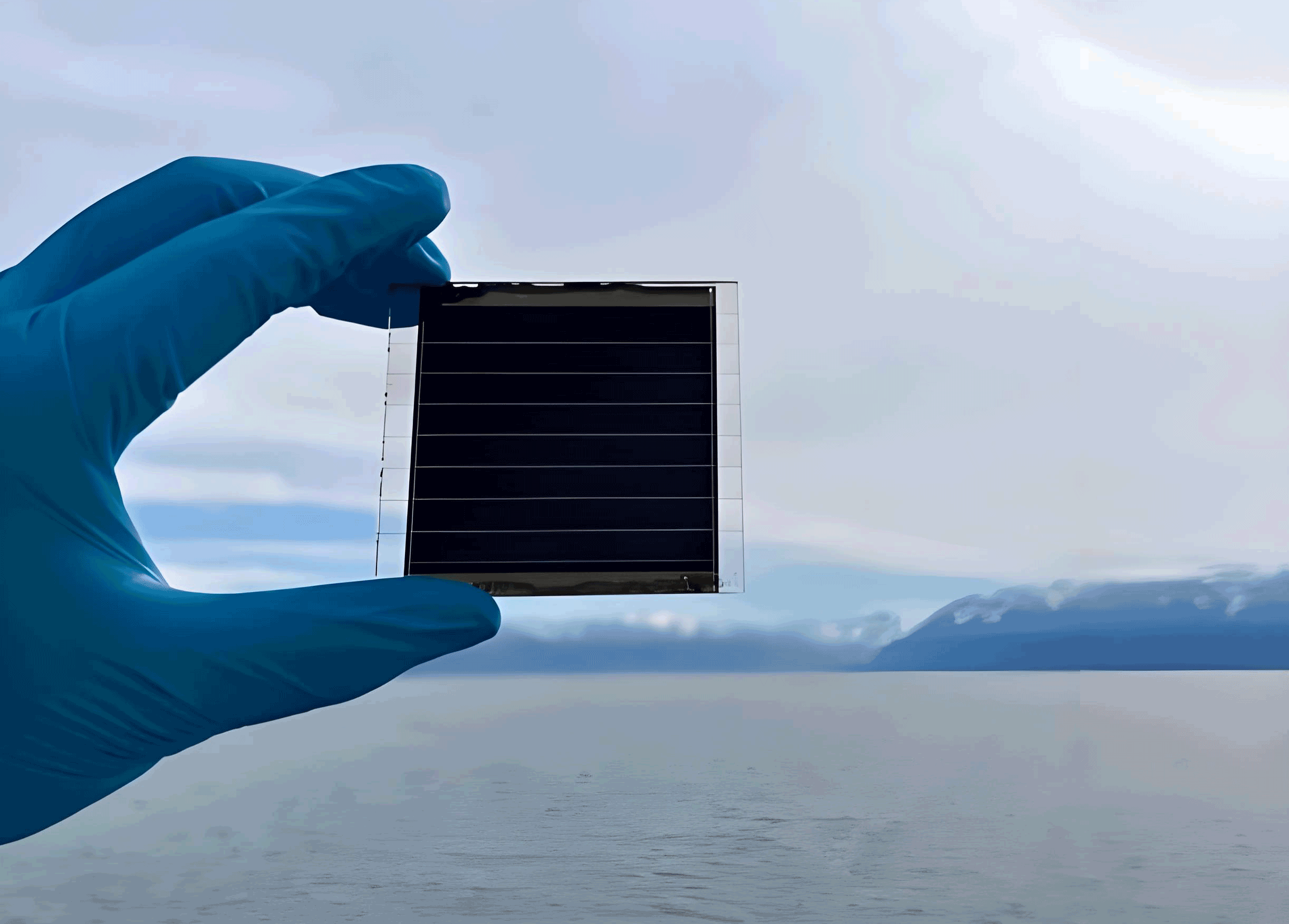
Perovskite solar cells have garnered significant attention due to their low cost, high efficiency, and flexibility. Over the past decade, the power conversion efficiency (PCE) of lab-scale perovskite solar cells has surged from 3.8% to 26.7%, rivaling traditional silicon-based solar cells. However, transitioning from small-area devices to large-area perovskite solar modules (PSMs) remains a critical challenge for commercialization. The primary obstacle lies in fabricating high-quality, uniform large-area perovskite films. While spin-coating is effective for small-scale devices, it suffers from non-uniformity and material waste when applied to larger areas. This has spurred the development of alternative techniques such as blade coating, slot-die coating, inkjet printing, and vapor deposition. This article comprehensively reviews the progress in large-area perovskite thin-film fabrication, discusses the role of additives and solvents in optimizing device performance, and explores future directions for industrial scalability.
The crystallization process of perovskite films involves three stages: saturation, nucleation, and growth. Initially, the precursor solution reaches supersaturation ($C_s$) upon solvent evaporation, triggering nucleation. The Gibbs free energy change ($\Delta G$) for nucleation is given by:
$$\Delta G = \frac{4}{3}\pi R^3 \Delta G_v + 4\pi R^2 \gamma,$$
where $R$ is the nucleus radius, $\Delta G_v$ is the volumetric free energy change, and $\gamma$ is the surface energy. The critical radius ($R_c$) for stable nucleation occurs when $\frac{d\Delta G}{dR} = 0$. Rapid solvent removal methods, such as anti-solvent quenching or vacuum annealing, are employed to achieve homogeneous nucleation and growth. Controlling these dynamics is essential for producing large-area films with minimal defects and high crystallinity.
Spin-coating is widely used for lab-scale perovskite solar cell fabrication due to its simplicity and low equipment cost. The process involves depositing a precursor solution onto a substrate, which is then rotated at high speeds to form a thin film. Parameters like spin speed, solution concentration, and annealing temperature influence film quality. However, for areas exceeding 1 cm², spin-coating leads to radial inhomogeneity and significant material waste. Innovations like multi-tip pipettes for anti-solvent dispensing have improved uniformity on 5 cm × 5 cm substrates. For instance, incorporating additives like methylammonium chloride (MACl) and imidazolium-based ions has enhanced PCEs to 23.30% in modules with an aperture area of 27.22 cm². Despite these advances, spin-coating remains impractical for industrial-scale production of perovskite solar cells.
Blade coating, also known as doctor blading, involves spreading a precursor solution using a blade that moves relative to the substrate. This method offers high material utilization and compatibility with roll-to-roll (R2R) processes. The film thickness is controlled by the gap between the blade and substrate, solution viscosity, and coating speed. Challenges include slow solvent evaporation, which can cause pinholes and non-uniform crystallization. Techniques like substrate heating, gas quenching, and vacuum flash evaporation have been developed to accelerate drying and improve film quality. For example, using mixed solvents (e.g., NMP) with MACl additives extended the processing window to 8 minutes, achieving a PCE of 17.33% on 1.2 cm² devices and 13.3% on 12.6 cm² modules. Blade-coated perovskite solar cells with formamidinium-cesium (FA-Cs) compositions have demonstrated stabilized PCEs of 18.6% on 30 cm² modules, maintaining 98% initial efficiency after 1,000 hours under damp-heat tests (85°C, 85% RH).
Slot-die coating is a scalable technique suitable for continuous R2R manufacturing. It employs a closed reservoir system to dispense precursor solution through a slit onto the substrate, forming a capillary coating bead. Parameters such as solution flow rate, coating speed, and gap width are optimized to achieve uniform films. Nitrogen gas knife-assisted drying and solvent additives (e.g., DMSO) have been used to enhance crystallization and device performance. For instance, slot-die-coated FAPbI₃ films with ACN-based additives achieved a certified PCE of 22.3% on small areas and 17.1% on 12.7 cm² modules. Fully R2R-printed perovskite solar cells using slot-die coating have reached PCEs of 16.7% on flexible substrates, highlighting its potential for commercial perovskite solar cell production.
Spray coating techniques, including ultrasonic and electrospray deposition, enable non-contact, high-speed film formation. These methods atomize the precursor solution into fine droplets, which are deposited onto the substrate. Key parameters include droplet size, nozzle-substrate distance, and substrate temperature. Ultrasonic spray coating with concurrent pumping of precursors has achieved PCEs of 11.7% on 3.8 cm² modules. Rapid spray plasma processing (RSPP) combines atmospheric plasma with ultrasonic spraying to deposit perovskite films at rates up to 4 cm/s, yielding PCEs of 15.7% on 930 cm² substrates without post-treatment. Recent advances include ZnO-SnO₂ cascade electron transport layers, enabling PCEs of 17.8% on 6 cm × 6 cm modules. Spray-coated perovskite solar cells benefit from high material efficiency and adaptability to curved surfaces, though nozzle clogging and durability issues need addressing for large-scale applications.
Vapor deposition methods, such as physical vapor deposition (PVD) and chemical vapor deposition (CVD), offer solvent-free, high-precision film growth. In PVD, precursors like PbCl₂ and MAI are co-evaporated under vacuum to form uniform, pinhole-free films. Early work demonstrated PCEs of 15.4% with excellent reproducibility. Hybrid approaches combining vapor deposition and solution processing have achieved PCEs of 20.0% on 16 cm² modules. Recrystallization-assisted vapor deposition using solvent annealing improved film quality, resulting in PCEs of 19.9% on 10 cm² devices. Vapor-deposited perovskite solar cells exhibit superior stability and minimal hysteresis, making them suitable for tandem applications. For example, perovskite-silicon tandem cells fabricated via sequential evaporation reached certified PCEs of 31.2%. Despite high equipment costs, vapor deposition remains promising for industrial perovskite solar cell manufacturing due to its scalability and environmental benefits.
Additives and solvent engineering play a crucial role in optimizing perovskite solar cell performance. Additives like MACl, Cs⁺, and Rb⁺ enhance crystallinity and reduce defect density. Solvent mixtures (e.g., 2-ME with DMSO) improve ink stability and processing windows. The use of ionic liquids, such as [Bcmim]Cl, passivates interfaces and suppresses ion migration. These strategies have enabled PCEs exceeding 23% in modules and improved operational stability under thermal and light stress.
The following table summarizes the advantages and disadvantages of large-area perovskite film fabrication techniques:
| Fabrication Method | Advantages | Disadvantages |
|---|---|---|
| Spin-coating | Simple process, low equipment cost | High material waste, non-uniformity on large areas |
| Blade coating | High material utilization, compatible with R2R | Slow solvent evaporation, pinhole formation |
| Slot-die coating | Continuous production, high reproducibility | High precision required for equipment |
| Spray coating | Non-contact, adaptable to complex shapes | Nozzle clogging, low production efficiency |
| Vapor deposition | Solvent-free, high film quality | High cost, low material utilization |
Recent advancements in perovskite solar cell technologies are compared in the table below:
| Technique | Active Layer | Active Area (cm²) | PCE (%) | Year |
|---|---|---|---|---|
| Spin-coating | Cs₀.₀₅MA₀.₀₅FA₀.₉₀Pb(I₁₋ₓClₓ)₃ | 27.22 | 23.30 | 2024 |
| Blade coating | FAPbI₃ | 100.0 | 15.94 | 2024 |
| Slot-die coating | FA₀.₈₅Cs₀.₁₅PbI₂.₈₇Br₀.₁₃ | 58.5 | 19.28 | 2023 |
| Spray coating | CsPbI₃₋ₓBrₓ | 112.0 | 13.82 | 2021 |
| Vapor deposition | Cs₀.₀₅FA₀.₉₅PbI₃ | 16.0 | 20.02 | 2023 |
The performance of perovskite solar cells is often modeled using the diode equation:
$$ J = J_{ph} – J_0 \left( \exp\left(\frac{q(V + J R_s)}{n k T}\right) – 1 \right) – \frac{V + J R_s}{R_{sh}}, $$
where $J$ is the current density, $J_{ph}$ is the photocurrent, $J_0$ is the reverse saturation current, $R_s$ is the series resistance, $R_{sh}$ is the shunt resistance, $n$ is the ideality factor, $q$ is the electron charge, $k$ is Boltzmann’s constant, and $T$ is the temperature. Minimizing $R_s$ and maximizing $R_{sh}$ are critical for achieving high fill factors and PCEs in large-area perovskite solar cells.
In conclusion, the development of large-area perovskite solar cells hinges on advancing fabrication techniques to ensure uniformity, scalability, and stability. Methods like blade coating, slot-die coating, and vapor deposition have demonstrated promising results for module production. Additive and solvent engineering further enhance film quality and device performance. Future research should focus on optimizing these processes for industrial-scale manufacturing, improving long-term stability, and reducing costs. With continuous innovation, perovskite solar cells are poised to become a mainstream photovoltaic technology, contributing to sustainable energy solutions globally.