
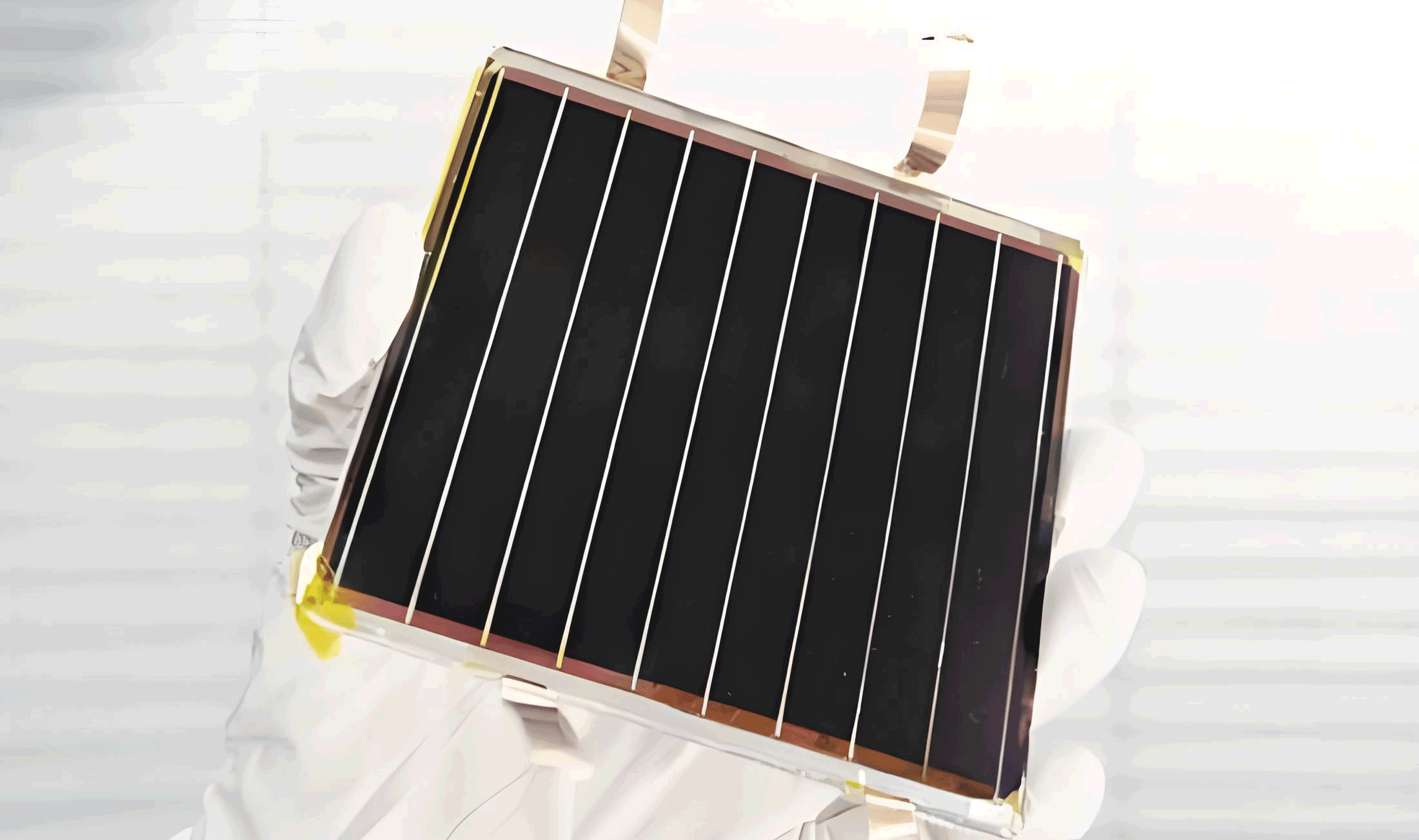
In recent years, perovskite solar cells have emerged as a promising photovoltaic technology due to their excellent optoelectronic properties and processability. However, the performance of these devices is often limited by defects at the interfaces, particularly between the electron transport layer (ETL) and the perovskite layer. These defects lead to non-radiative recombination and reduced open-circuit voltage (VOC). In this study, we introduce 1-adamantanamine hydrochloride (ADA) as an interfacial modifier between tin dioxide (SnO2) and the perovskite layer to form an electron reflux barrier. This layer passivates interface defects, blocks electron backflow, and suppresses non-radiative recombination, thereby enhancing the overall performance of perovskite solar cells.
The device fabrication involved spin-coating a diluted SnO2 colloidal dispersion onto ITO substrates, followed by annealing. ADA solutions in isopropanol at various concentrations (0.1, 0.3, and 0.5 mg/mL) were then spin-coated onto the SnO2 films and annealed. The perovskite layer was deposited using a two-step method, involving lead iodide (PbI2) and a mixed amine salt solution. Finally, a hole transport layer (Spiro-OMeTAD) and silver electrodes were added to complete the perovskite solar cells. Characterization included current density-voltage (J-V) measurements, scanning electron microscopy (SEM), atomic force microscopy (AFM), X-ray diffraction (XRD), photoluminescence (PL), time-resolved photoluminescence (TRPL), X-ray photoelectron spectroscopy (XPS), ultraviolet photoelectron spectroscopy (UPS), electrochemical impedance spectroscopy (EIS), and Mott-Schottky analysis.
The introduction of ADA significantly improved the photovoltaic parameters. The optimized perovskite solar cell with ADA modification achieved a power conversion efficiency (PCE) of 23.07%, with a VOC of 1.13 V, short-circuit current density (JSC) of 24.67 mA·cm⁻², and fill factor (FF) of 82.59%. In contrast, the control device without ADA had a PCE of 20.22%. The enhanced performance is attributed to reduced defect density and suppressed charge recombination. Additionally, the modified devices exhibited excellent stability, retaining over 85% of their initial PCE after 1000 hours in ambient air.
Morphological analysis revealed that the ADA-modified SnO2 layer promoted the growth of a denser and more uniform perovskite film with fewer pinholes. AFM showed similar roughness for both modified and unmodified SnO2 layers, indicating that ADA did not alter the overall topography. XRD patterns demonstrated improved crystallinity and reduced PbI2 residues in the ADA-modified perovskite films, suggesting effective passivation of lead-related defects. PL and TRPL measurements indicated enhanced charge extraction and shorter carrier lifetimes in the modified devices, confirming reduced non-radiative recombination.
XPS analysis revealed shifts in binding energies for O 1s, Sn 3d, and Pb 4f peaks, indicating strong interactions between ADA and both SnO2 and perovskite layers. The presence of Cl 2p peaks in ADA-modified samples suggested chloride incorporation, which further passivated oxygen vacancies. UPS and Tauc plot analyses showed that the ADA layer formed a tunnel barrier that facilitated electron transport while blocking backflow, leading to a higher built-in potential and improved VOC. EIS and Mott-Schottky measurements supported these findings, showing increased recombination resistance and built-in potential in ADA-modified perovskite solar cells.
The performance of perovskite solar cells is influenced by various factors, including defect density, charge carrier dynamics, and energy level alignment. The carrier lifetime (τ) can be described by a bi-exponential decay model: $$I(t) = A_1 \exp(-t/\tau_1) + A_2 \exp(-t/\tau_2)$$ where I(t) is the PL intensity at time t, A₁ and A₂ are amplitudes, and τ₁ and τ₂ are decay time constants for fast and slow components, respectively. The average carrier lifetime (τ_avg) is calculated as: $$\tau_{\text{avg}} = \frac{A_1 \tau_1^2 + A_2 \tau_2^2}{A_1 \tau_1 + A_2 \tau_2}$$ For the ADA-modified perovskite solar cells, τ_avg was significantly reduced, indicating efficient charge extraction.
The Mott-Schottky analysis provides insights into the built-in potential (V_bi) and carrier density (N_D). The capacitance-voltage relationship is given by: $$\frac{1}{C^2} = \frac{2}{A^2 \epsilon \epsilon_0 q N_D} (V_{\text{bi}} – V)$$ where C is the capacitance, A is the device area, ε is the relative permittivity, ε₀ is the vacuum permittivity, q is the elementary charge, and V is the applied bias. The ADA modification increased V_bi, enhancing the charge separation and reducing recombination.
The ideal factor (n) from the VOC-light intensity (E_e) relationship indicates the recombination mechanism. The slope of ln(J_SC) vs. ln(E_e) is related to n by: $$V_{\text{OC}} = \frac{n k_B T}{q} \ln\left(\frac{J_{\text{SC}}}{J_0}\right)$$ where k_B is Boltzmann’s constant, T is temperature, and J_0 is the reverse saturation current. A lower n value for ADA-modified devices suggests suppressed trap-assisted recombination.
Tables below summarize key parameters. Table 1 compares photovoltaic performance, Table 2 shows a comparison with other cage-like molecular modifiers, and Table 3 lists TRPL parameters.
| Sample | VOC (V) | JSC (mA·cm⁻²) | FF (%) | PCE (%) |
|---|---|---|---|---|
| Control SnO2 | 1.06 | 24.52 | 78.16 | 20.22 |
| SnO2-AD | 1.11 | 24.57 | 82.41 | 22.35 |
| SnO2-ADA | 1.13 | 24.67 | 82.59 | 23.07 |
| Year | Device Structure | VOC (V) | FF (%) | PCE (%) | Reference |
|---|---|---|---|---|---|
| 2025 | ITO/SnO2/ADA/PVK/HTL/Ag | 1.13 | 82.59 | 23.07 | This work |
| 2023 | ITO/SnO2/DABCO/PVK/HTL/Ag | 1.17 | 81.60 | 23.60 | Literature |
| 2023 | ITO/NiOX/AAD/PVK/PC61BM/Ag | 1.13 | 83.72 | 22.21 | Literature |
| 2024 | FTO/TiO2/PVK/PHMG/HTL/Au | 1.16 | 83.53 | 25.42 | Literature |
| 2025 | ITO/SnO2/PVK/ADAI/HTL/Au | 1.19 | 83.79 | 25.13 | Literature |
| Sample | τ₁ (ns) | τ₂ (ns) | A₁ (%) | A₂ (%) | τ_avg (ns) |
|---|---|---|---|---|---|
| Control PVK | 19.25 | 114.29 | 53.85 | 46.15 | 98.60 |
| SnO2-AD PVK | 15.08 | 102.06 | 60.80 | 39.20 | 85.85 |
| SnO2-ADA PVK | 8.42 | 85.45 | 74.67 | 25.33 | 68.12 |
The electron reflux barrier mechanism can be modeled using energy band theory. The conduction band offset (ΔE_C) between SnO2 and perovskite influences electron transport. The ADA layer creates a thin tunneling barrier that allows forward electron transport while blocking reverse flow. The tunneling probability (T) can be estimated using the Wentzel-Kramers-Brillouin approximation: $$T \approx \exp\left(-2 \int \sqrt{\frac{2m^*}{\hbar^2} (V(x) – E)} dx\right)$$ where m* is the effective mass, ħ is the reduced Planck’s constant, V(x) is the potential barrier, and E is the electron energy. For ADA, the thin layer ensures high T for forward transport but low for reflux, reducing recombination.
The defect passivation effect of ADA can be quantified by the reduction in trap density (N_t). The trap-assisted recombination rate (U) is given by: $$U = \frac{\sigma v_{\text{th}} N_t n p}{n + p + 2n_i \cosh\left(\frac{E_t – E_i}{k_B T}\right)}$$ where σ is capture cross-section, v_th is thermal velocity, n and p are electron and hole densities, n_i is intrinsic carrier density, and E_t is trap energy level. ADA passivation lowers N_t, decreasing U and improving VOC.
Stability testing showed that the ADA-modified perovskite solar cells maintained over 85% of initial PCE after 1000 hours, attributed to improved interfacial adhesion and reduced ion migration. The water contact angle increased from 50.85° to 59.83°, indicating enhanced hydrophobicity. This correlates with longer device lifetime, as moisture-induced degradation is mitigated.
In conclusion, the introduction of ADA as an interfacial modifier in perovskite solar cells effectively passivates defects, blocks electron reflux, and enhances charge extraction. This results in higher efficiency and stability, making it a promising strategy for advancing perovskite solar cell technology. Future work could explore other diamondoid derivatives for further optimization.
The performance of perovskite solar cells is critically dependent on interface quality. The ADA modification not only improves electronic properties but also contributes to morphological stability. The combination of Lewis base coordination from amine groups and chloride ion passivation addresses both oxygen vacancies and Pb²⁺ vacancies, creating a comprehensive defect passivation strategy. The electron reflux barrier function is particularly important for minimizing voltage losses and maximizing fill factor in perovskite solar cells.
Further analysis of the charge transport dynamics can be described by the drift-diffusion model. The current density (J) in the device is given by: $$J = q \mu n E + q D \frac{dn}{dx}$$ where μ is mobility, n is carrier density, E is electric field, and D is diffusion coefficient. The ADA layer optimizes E and D by aligning energy levels and reducing traps, leading to higher JSC and FF.
The series resistance (R_s) and shunt resistance (R_sh) are key parameters extracted from J-V curves. The modified devices showed lower R_s and higher R_sh, indicating better charge collection and reduced leakage currents. The fill factor can be expressed as: $$\text{FF} = \frac{V_{\text{mp}} J_{\text{mp}}}{V_{\text{OC}} J_{\text{SC}}}$$ where V_mp and J_mp are voltage and current at maximum power point. The ADA modification increased FF by reducing resistive losses.
In summary, the ADA-based electron reflux barrier layer significantly enhances the performance of perovskite solar cells through multiple mechanisms, including defect passivation, improved charge transport, and suppressed recombination. This approach offers a viable path toward high-efficiency and stable perovskite solar cells for commercial applications.