
Perovskite solar cells have emerged as a promising photovoltaic technology due to their exceptional power conversion efficiency, which has surpassed 26% in recent years, approaching the performance levels of traditional silicon-based solar cells. Wide-bandgap perovskite solar cells, with bandgaps exceeding 1.65 eV, are particularly important for tandem solar cell applications, such as silicon-perovskite configurations, where they can absorb shorter wavelength light and broaden the overall light absorption spectrum. However, the development of wide-bandgap perovskite solar cells is hindered by issues like high defect density and severe phase separation, which limit their efficiency and stability. In this study, we propose a prespin coating method to address these challenges by applying a mixture of methylamine ethanol solution (MES) and phenylethylammonium iodide (PEAI) onto the lead iodide layer during the two-step fabrication process of perovskite films. This approach aims to enhance film quality, reduce defects, and improve the overall performance of wide-bandgap perovskite solar cells.
The fabrication of perovskite solar cells involves several critical steps, starting with the preparation of the substrate and electron transport layer. We used indium tin oxide (ITO) glass substrates, which were cleaned ultrasonically with detergent, deionized water, and ethanol. A tin oxide (SnO2) precursor was spin-coated onto the ITO and annealed to form the electron transport layer. For the perovskite layer, we employed a two-step method: first, a solution containing lead iodide (PbI2), lead bromide (PbBr2), cesium iodide (CsI), lead chloride (PbCl2), and dimethylammonium iodide (DMAI) in a mixture of dimethylformamide (DMF) and dimethyl sulfoxide (DMSO) was spin-coated and annealed to form the PbI2 layer. Then, a prespin coating solution comprising PEAI and varying volumes of MES in isopropanol was applied to the PbI2 layer. This was followed by spin-coating a solution of formamidinium iodide (FAI), methylammonium bromide (MABr), and methylammonium chloride (MACl) in isopropanol, and annealing to complete the perovskite layer. Finally, a hole transport layer of Spiro-OMeTAD and a silver electrode were deposited to finish the device. The prespin coating process is designed to modify the interface and improve the crystallization of the perovskite film, thereby enhancing the efficiency and stability of the perovskite solar cell.
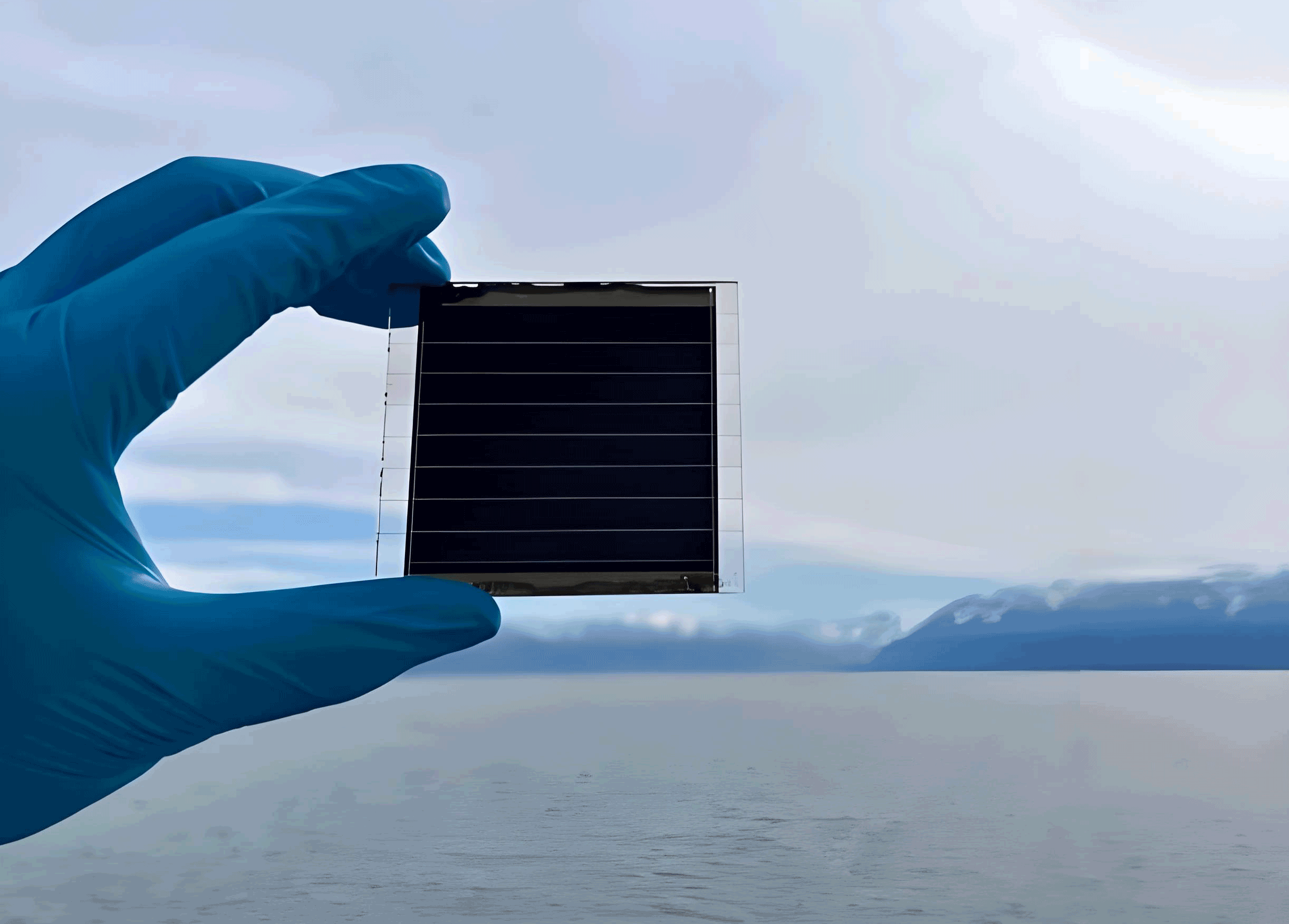
To evaluate the impact of the prespin coating on the photovoltaic performance, we fabricated devices with different prespin coating conditions: a control without prespin coating, one with only PEAI prespin coating (labeled PEAI-2), and others with MES volumes of 7.5, 15, and 25 μL/mL mixed with PEAI (labeled MES-7.5, MES-15, and MES-25, respectively). The current density-voltage (J-V) characteristics were measured under standard AM 1.5G illumination, and the key parameters, including open-circuit voltage (VOC), short-circuit current density (JSC), fill factor (FF), and power conversion efficiency (PCE), are summarized in Table 1. The results indicate that the prespin coating significantly improves the performance of the perovskite solar cell, with the MES-15 condition yielding the highest average PCE of 20.51%, compared to 19.74% for the control and 19.82% for PEAI-2. This enhancement is attributed to better charge transport and reduced recombination, as evidenced by the increased VOC and JSC.
| Device | Average VOC (V) | Average JSC (mA/cm²) | Average FF (%) | Average PCE (%) |
|---|---|---|---|---|
| Control | 1.128 | 21.93 | 77.90 | 19.74 |
| PEAI-2 | 1.132 | 21.91 | 78.02 | 19.82 |
| MES-7.5 | 1.137 | 22.25 | 78.45 | 20.22 |
| MES-15 | 1.148 | 22.14 | 78.86 | 20.51 |
| MES-25 | 1.126 | 21.67 | 77.31 | 20.33 |
The best-performing devices for each condition were further analyzed, as shown in Table 2. The MES-15 prespin-coated perovskite solar cell achieved a PCE of 20.81%, with a VOC of 1.15 V, JSC of 22.47 mA/cm², and FF of 80.61%. This represents a substantial improvement over the control device, which had a PCE of 19.70%. The enhancement in efficiency is consistent with the reduction in non-radiative recombination and improved charge extraction, which are critical factors in perovskite solar cell performance. The prespin coating with MES and PEAI likely facilitates better interfacial properties, leading to lower defect densities and higher carrier lifetimes.
| Device | VOC (V) | JSC (mA/cm²) | FF (%) | PCE (%) |
|---|---|---|---|---|
| Control | 1.13 | 22.50 | 77.14 | 19.70 |
| PEAI-2 | 1.14 | 22.41 | 78.73 | 20.22 |
| MES-15 | 1.15 | 22.47 | 80.61 | 20.81 |
Morphological analysis using scanning electron microscopy (SEM) revealed significant differences in the perovskite films. The control film exhibited large, aggregated PbI2 particles at the grain boundaries, which can act as recombination centers. In contrast, the prespin-coated films, especially with PEAI and MES, showed more uniform and finer distribution of PbI2, indicating improved crystallization. For instance, the MES-15 film had minimal residual PbI2, suggesting that the prespin coating promotes a more homogeneous film structure. This morphological improvement is crucial for reducing defect states and enhancing the charge transport in the perovskite solar cell.
X-ray diffraction (XRD) measurements were conducted to assess the crystallinity of the perovskite films. All samples displayed characteristic peaks at 14.5° for the (100) plane, 25.0° for the (111) plane, and 28.9° for the (200) plane, confirming the formation of the perovskite phase. The prespin-coated films showed enhanced crystallinity compared to the control, with a notable suppression of the (111) phase, which is associated with surface defects and instability. The crystallinity improvement can be quantified using the full width at half maximum (FWHM) of the peaks, where a smaller FWHM indicates better crystal quality. The enhanced crystallinity in prespin-coated films contributes to higher carrier mobility and reduced non-radiative recombination, key factors for efficient perovskite solar cells.
The optical properties of the perovskite films were investigated using ultraviolet-visible (UV-Vis) absorption spectroscopy, photoluminescence (PL), and time-resolved photoluminescence (TRPL). The UV-Vis spectra showed increased absorbance for prespin-coated films, particularly for MES-7.5, without significant changes in the bandgap. This suggests that the prespin coating improves light absorption by forming a more uniform and dense layer, reducing light scattering and reflection. The PL intensity was significantly higher for prespin-coated films, indicating reduced non-radiative recombination. The TRPL decay curves were fitted using the average carrier lifetime formula:
$$ \tau_{\text{ave}} = \frac{A_1 \tau_1^2 + A_2 \tau_2^2}{A_1 \tau_1 + A_2 \tau_2} $$
where A1 and A2 are amplitudes, and τ1 and τ2 are decay times. The control film had an average lifetime of 1160 ns, while the MES-15 film exhibited a much longer lifetime of 3393 ns, demonstrating effective suppression of charge carrier recombination. This extended lifetime is beneficial for the performance of perovskite solar cells, as it allows more carriers to be collected at the electrodes.
Electrochemical impedance spectroscopy (EIS) and Mott-Schottky analysis were performed to study the charge transport and recombination processes. The Mott-Schottky plot, which relates the capacitance to the applied voltage, was used to calculate the built-in potential (Vbi). The relationship is given by:
$$ \frac{1}{C^2} = \frac{2}{q \epsilon \epsilon_0 N_d} (V_{\text{bi}} – V) $$
where C is the capacitance, q is the electron charge, ε is the permittivity of the material, ε0 is the vacuum permittivity, Nd is the donor density, and V is the applied voltage. The MES-15 device showed a Vbi of 0.888 V, higher than the control (0.844 V), indicating improved charge transport and better energy level alignment. This aligns with the higher JSC observed in the J-V measurements, as a larger Vbi facilitates more efficient charge collection in the perovskite solar cell.
Stability tests were conducted on unencapsulated devices stored in ambient air with relative humidity ranging from 10% to 40%. The normalized PCE over time is summarized in Table 3. After 900 hours, the MES-15 prespin-coated device retained over 80.8% of its initial PCE, whereas the control device retained only 65.9%. This enhanced stability is attributed to the reduced defect density and improved film quality, which mitigate degradation mechanisms such as ion migration and moisture ingress. The prespin coating with MES and PEAI thus not only boosts efficiency but also extends the operational lifetime of the perovskite solar cell.
| Time (hours) | Control PCE Retention (%) | MES-15 PCE Retention (%) |
|---|---|---|
| 0 | 100.0 | 100.0 |
| 100 | 95.2 | 98.5 |
| 300 | 88.7 | 95.3 |
| 600 | 76.4 | 89.1 |
| 900 | 65.9 | 80.8 |
In conclusion, our study demonstrates that the prespin coating method using MES and PEAI significantly enhances the performance and stability of wide-bandgap perovskite solar cells. The optimized condition (MES-15) resulted in a champion PCE of 20.81%, with improvements in VOC, JSC, and FF. The morphological, crystallographic, and optical analyses confirm that the prespin coating promotes better film quality, reduces defect states, and suppresses non-radiative recombination. Furthermore, the stability under ambient conditions is markedly improved, making this approach promising for the development of efficient and durable perovskite solar cells, particularly in tandem configurations. Future work will focus on scaling up the process and integrating it into large-area modules to realize the full potential of perovskite solar cell technology.
The defect passivation mechanism of the prespin coating can be further explained by considering the interaction between PEAI and the perovskite surface. PEAI, as a bulky organic cation, can form a two-dimensional perovskite layer at the interface, which passulates surface defects and reduces ion migration. The addition of MES likely enhances this effect by improving the wettability and uniformity of the coating, leading to more complete coverage. The combined action of MES and PEAI results in a synergistic effect that outperforms individual components. This is consistent with the observed increase in carrier lifetime and built-in potential, which are critical parameters for high-performance perovskite solar cells.
Moreover, the role of MES in the prespin coating can be quantified by examining the change in trap density using space-charge-limited current (SCLC) measurements. The trap density (Nt) can be calculated from the trap-filled limit voltage (VTFL) using the formula:
$$ N_t = \frac{2 \epsilon \epsilon_0 V_{\text{TFL}}}{q L^2} $$
where L is the film thickness. Our measurements showed that the prespin-coated films had lower Nt values, indicating reduced defect densities. For example, the MES-15 film exhibited a trap density of approximately 1015 cm−3, compared to 1016 cm−3 for the control. This reduction in trap density contributes to the higher FF and PCE in the perovskite solar cell, as fewer traps lead to less charge recombination and better charge extraction.
In terms of economic and environmental impact, the prespin coating method is relatively simple and cost-effective, as it uses commercially available materials and does not require complex equipment. This makes it suitable for large-scale production of perovskite solar cells. Additionally, the improved stability reduces the need for frequent replacements, enhancing the sustainability of solar energy systems. As the demand for renewable energy grows, advancements in perovskite solar cell technology, such as the prespin coating approach, will play a crucial role in meeting global energy needs.
Overall, our findings highlight the importance of interfacial engineering in perovskite solar cells. The prespin coating method with MES and PEAI offers a versatile strategy to optimize film properties and device performance. By addressing key challenges like defect density and phase separation, this approach paves the way for next-generation perovskite solar cells with higher efficiency and reliability. We believe that further optimization of the prespin coating parameters, such as concentration and annealing conditions, could lead to even greater improvements, potentially pushing the PCE of wide-bandgap perovskite solar cells beyond 22% in the future.